
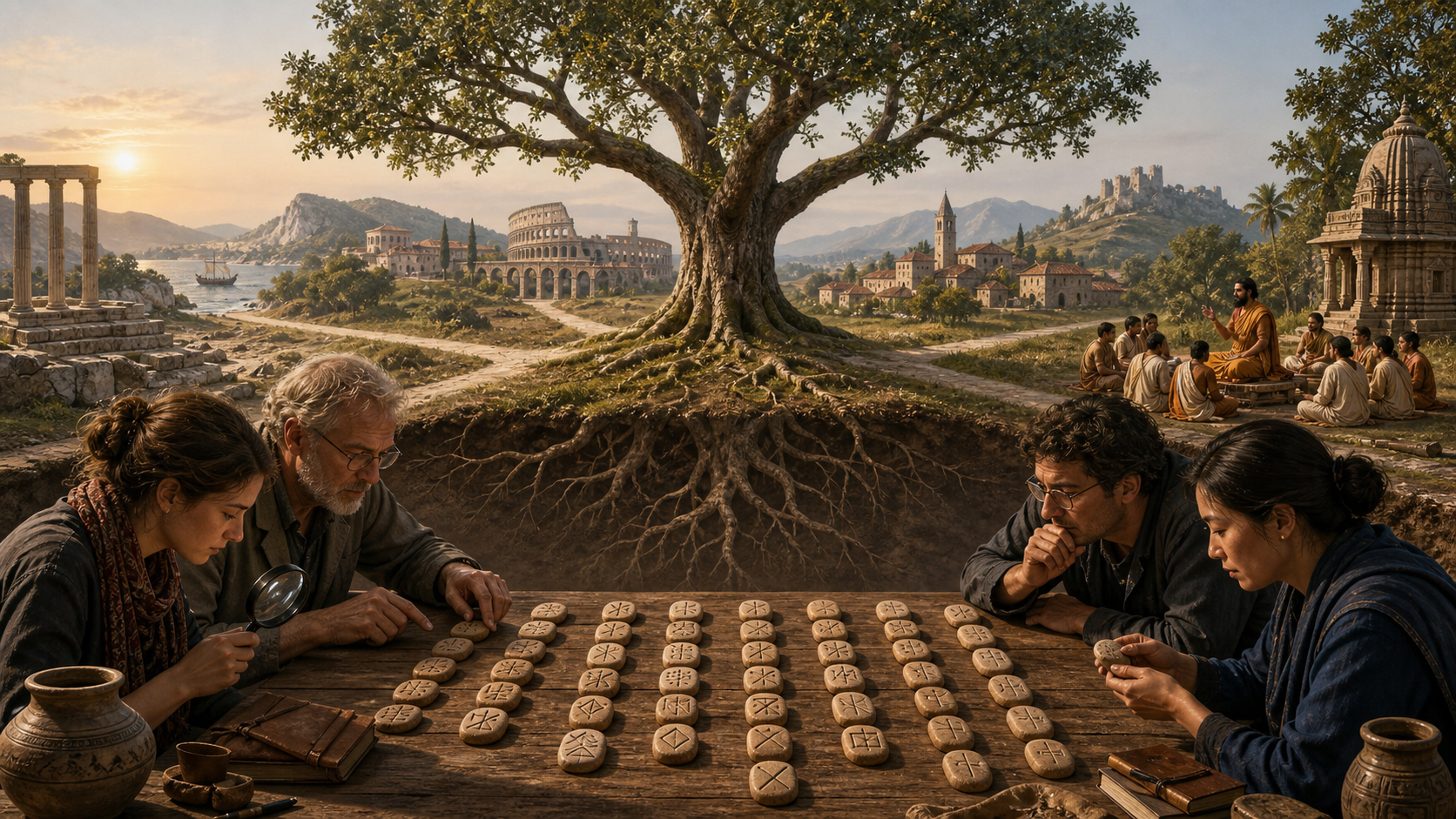
You may have arrived after hearing one of two confident claims: Sanskrit is the mother of Greek, Latin and most European languages, or Proto-Indo-European was invented to displace Sanskrit. Neither claim gives you a reliable way to judge the evidence.
You do not have to choose between reverence for Sanskrit and disciplined historical linguistics. Once you know what reconstruction can establish, you can inspect a proposed cognate, recognize a serious argument and separate linguistic evidence from political conclusions that the evidence cannot carry.
Begin with the right family-tree claim

Sanskrit, Greek and Latin are not normally placed in a chain in which one becomes the next. Their extensive correspondences in vocabulary and grammar identify them as sister languages descended from an earlier common ancestor reconstructed as Proto-Indo-European, usually abbreviated PIE.
The distinction between an attested language and a reconstructed language matters. Vedic Sanskrit is known through the Ṛgveda and related material. Greek, Latin, Hittite and other early Indo-European languages also survive in texts or inscriptions. PIE does not. It is a model inferred from the agreements and disagreements among its descendants.
That is why a reconstructed form carries an asterisk. A form such as *bher- is not a word copied from a PIE manuscript. The asterisk tells you that linguists have inferred the form by working backward from attested evidence. A reconstruction can be strongly supported without being a recording of an ancient speaker, just as an ancestral relationship can be well established even when every detail of the ancestor remains uncertain.
Vedic Sanskrit preserves many archaic features, but archaic does not mean identical to PIE. Sanskrit underwent its own sound changes and grammatical developments after separating from the common ancestor. Calling it a particularly valuable witness is justified. Calling it PIE itself erases the changes that comparative analysis is meant to explain.
- Check the direction of descent. Sanskrit, Greek and Latin should normally point back toward a shared ancestor, not sideways toward one another.
- Check the status of the form. An asterisk marks a reconstruction; an attested Sanskrit, Greek or Latin form should not be silently substituted for it.
- Check the kind of conclusion being drawn. Linguistic kinship does not rank civilizations, determine the sanctity of scripture or decide which tradition possesses greater spiritual authority.
- Check whether script has been confused with language. Devanāgarī is a writing system, not an alternative name for Sanskrit, and a change of script does not create a new linguistic ancestry.
Reconstruction depends on patterns, not impressive-looking words
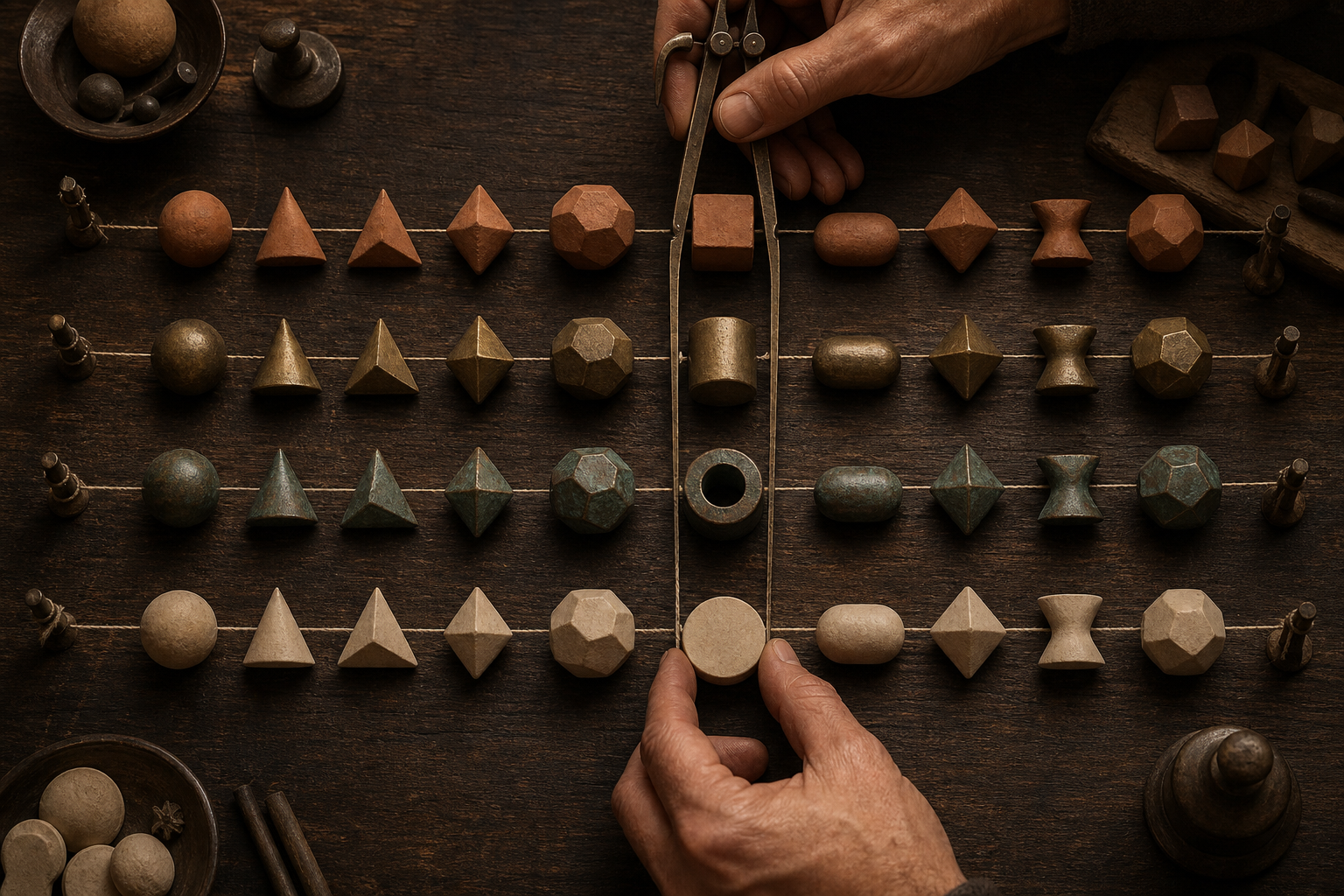
A few similar words can arise through borrowing, coincidence or common human tendencies. The comparative method becomes persuasive when the same sound relationships recur across many words, when the meanings make historical sense and when inflectional endings and grammatical structures support the same family tree.
| Meaning | Sanskrit | Greek | Latin | English |
|---|---|---|---|---|
| father | pitṛ | patēr | pater | father |
| mother | mātṛ | mētēr | mater | mother |
| three | trayas | treis | trēs | three |
| name | nāma | onoma | nōmen | name |
The table is a starting point, not a proof by itself. Its force comes from recurrence. English father begins with f where Sanskrit, Greek and Latin have p. That is not an inconvenient exception to be explained away. It participates in the wider Germanic shift described by Grimm’s Law, including the regular development of PIE *p into Germanic *f. Verner’s Law accounts for further conditioned outcomes within the Germanic pattern.
This is the practical difference between resemblance and correspondence. Resemblance asks whether two words look alike. Correspondence asks whether a sound in one language repeatedly matches a particular sound in another language under identifiable conditions. Two words may look nearly identical because one was borrowed. Genuine cognates can look quite different after centuries of regular change.
The reconstructed word for horse, *h₁éḱwos, illustrates the second point. Its descendants include Sanskrit aśva, Latin equus and Greek híppos. The Greek form does not win a visual-similarity contest with the Sanskrit form. It belongs in the comparison because broader sound patterns explain the different outcomes.
If you want to assess a proposed reconstruction rather than merely admire it, work through five checks:
- Verify the meaning. Start with comparable senses in attested contexts. A vague thematic association is much weaker than a stable basic meaning such as a kinship term, numeral or body part.
- Collect a set, not a pair. One Sanskrit word beside one European word proves little. Look for evidence from several branches and for additional words showing the same sound relationship.
- Demand regular correspondences. A proposed sound change should recur in an identifiable environment. If every difficult example needs a separate exception, the reconstruction is doing no predictive work.
- Inspect morphology. Shared case endings, number distinctions, verbal formations and other structured paradigms are more probative than a loose list of nouns because core inflection is generally more resistant to borrowing.
- Test the result against unused evidence. A reconstruction becomes more credible when it explains additional forms, irregular-looking alternations or evidence from another branch without being redesigned for every example.
This procedure also tells you when to stop. If a claim rests on a single word, ignores known borrowing or changes its proposed sound rules from example to example, you do not yet have a reconstruction. You have a possibility that still needs comparative evidence.
Why Vedic Sanskrit carries unusual comparative weight

Sanskrit matters to PIE reconstruction for more than its age or cultural prestige. Vedic Sanskrit preserves a dense, highly organized body of phonological and grammatical evidence. Its cases, singular-dual-plural distinctions, gender system, verbal agreement and tense-aspect-mood formations allow comparison across whole paradigms rather than isolated dictionary entries.
PIE itself is commonly reconstructed with eight cases: nominative, accusative, genitive, dative, ablative, locative, instrumental and vocative. It also had singular, dual and plural numbers, as well as masculine, feminine and neuter genders. Vedic Sanskrit retains many features of this richly inflected architecture. Greek and Latin provide independent agreements, while also preserving or changing different parts of the inherited system.
That independence is essential. Sanskrit is powerful evidence precisely because its forms can be checked against evidence that did not pass through Sanskrit. If every reconstruction merely restated a Sanskrit form, the method could not distinguish inheritance from an assumption that Sanskrit must always preserve the original state.
Three features show how much more is happening than word matching.
Ablaut explains patterned vowel changes
Ablaut is an inherited system of vowel alternation associated with grammar and word formation. Linguists conventionally describe e-grade, o-grade and zero-grade patterns. The PIE root *bher-, meaning to carry, lies behind Sanskrit bharāmi, Greek pherō, Latin ferō and English bear.
The forms are not expected to preserve one unchanged vowel-and-consonant sequence. Their variation becomes evidence when regular branch-specific sound changes, inherited vowel grades and morphological formations account for it. When two proposed cognates differ, therefore, ask whether the difference recurs within a paradigm or elsewhere in the family before treating it as a refutation.
Grassmann’s Law turns a mismatch into a rule
Sanskrit and Greek independently show a dissimilation affecting aspirated stops, described by Grassmann’s Law. Sanskrit dadhāti and Greek tithēmi, both meaning to put, are a standard illustration. Their surface consonants differ, but the differences participate in a systematic process rather than a collection of arbitrary substitutions.
The lesson is methodological: an altered form may preserve information about the ancestor through the rule that altered it. You should not judge ancestry by asking which descendant looks most original in a single example. You should ask which reconstruction explains the complete set of changes with the fewest independent assumptions.
Laryngeals show why Sanskrit cannot stand alone
The laryngeal theory reconstructs consonants conventionally written *h₁, *h₂ and *h₃. These sounds affected neighboring vowels and help explain patterns that Sanskrit and Greek alone leave puzzling. Hittite preserves visible traces written with signs transliterated as ḫ, giving the theory an important independent anchor.
This is exactly what a strong model should do: connect several problems through one coherent explanation and fit evidence from another branch. It also places a limit on Sanskrit-first reasoning. Vedic Sanskrit preserves extraordinary evidence, but Hittite, Greek, Latin and other branches sometimes retain distinctions that Sanskrit merged, transformed or lost.
Not every detail of the reconstructed sound system is closed. The traditional analysis includes voiceless, voiced and voiced aspirated stops, while the glottalic theory reinterprets parts of that system, partly in response to typological concerns and the unusual rarity of plain *b. Such disagreement concerns the best analysis of the stop series. It does not dissolve the much broader network of sound and grammatical correspondences linking the family.
Keep reconstruction separate from homeland verdicts
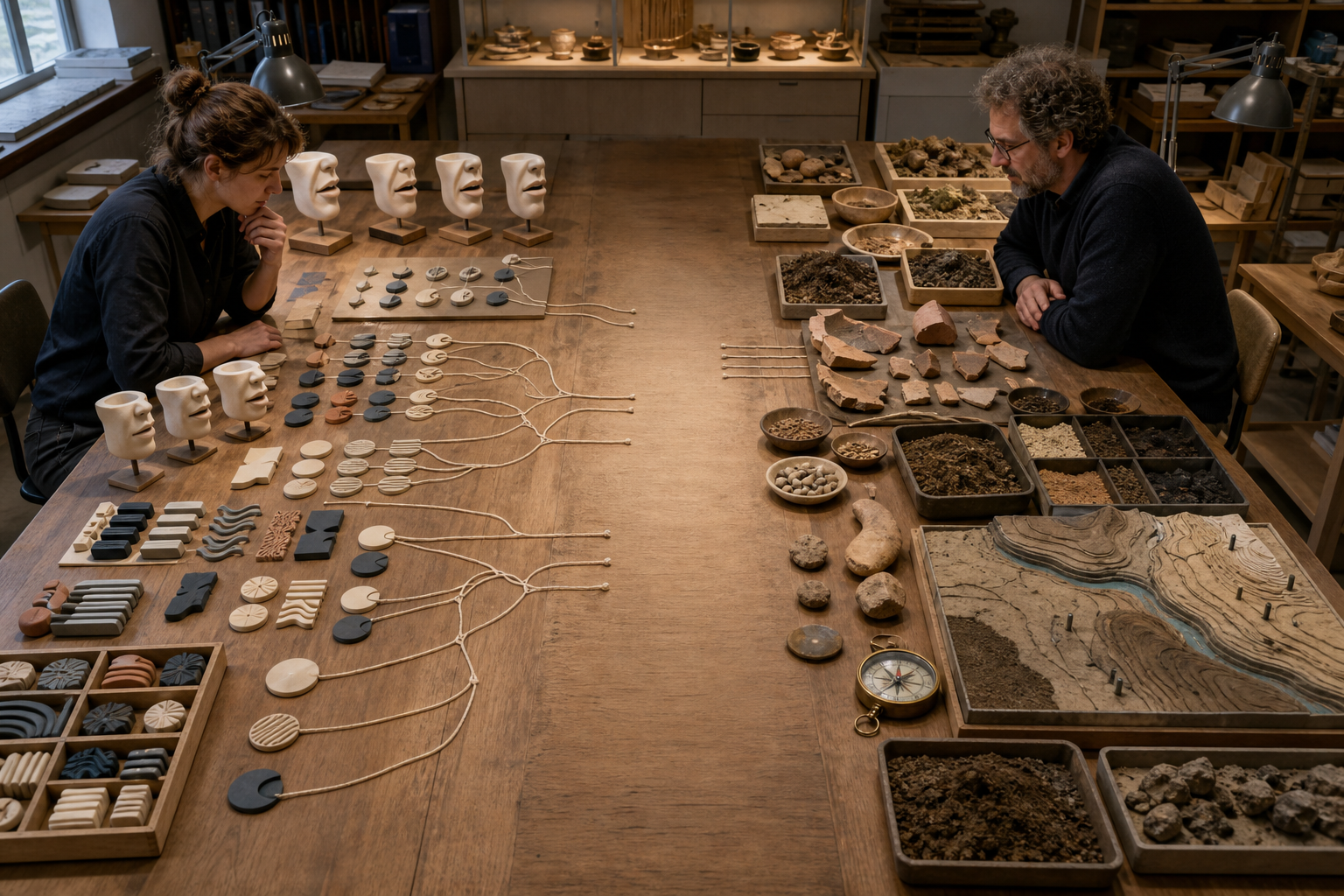
This separation is especially important when Sanskrit enters a debate about Bharat. The comparative method can establish historical relationships without, by itself, locating the PIE homeland or describing every movement through which Indo-European languages spread.
Three geographic frameworks commonly enter the discussion. The Steppe or Kurgan hypothesis places the homeland in the Pontic-Caspian steppe and relates dispersal to Bronze Age pastoralism and wheeled transport. The Anatolian hypothesis associates an earlier expansion with Neolithic farming. Out of India models propose that Indo-European lineages radiated from the Indian subcontinent. These proposals combine linguistic, archaeological and, increasingly, genetic arguments; no single class of evidence is interchangeable with the others.
Reconstructed vocabulary can contribute clues. PIE *kʷékʷlos, associated with the wheel, is compared with Sanskrit cakra and Greek kyklos. The horse term *h₁éḱwos supplies another clue to a shared cultural vocabulary. Such reconstructions can help test whether a proposed chronology or archaeological setting is plausible. They are not a latitude-and-longitude pin for a homeland.
Ancient DNA adds evidence about population movement and admixture, including steppe-related ancestry signals in parts of Eurasia and South Asia. DNA does not record what language an individual spoke. A language can spread through migration, but it can also spread through elite power, trade, education or religious prestige without a matching mass replacement of population. Moving from a genetic component directly to a language label skips the historical mechanism that must be demonstrated.
Use a four-column mental ledger whenever an origin argument appears:
| Question | Relevant evidence | What it can support | What it cannot establish alone |
|---|---|---|---|
| Are the languages related? | Regular sound correspondences and shared morphology | A common linguistic ancestor | The exact homeland |
| Where and when did dispersal occur? | Linguistics, archaeology and chronology | Compatibility of a proposed route and setting | A complete migration history from one word |
| Did populations move or mix? | Ancient DNA | Genetic ancestry and admixture | The language or religious identity of each population |
| How was a language written? | Inscriptions, manuscripts and script history | The use and transmission of writing systems | The deeper ancestry of the spoken language |
Script deserves particular care. Indo-Aryan languages have been written in Brahmi-derived systems including Devanāgarī, Śāradā and Gurmukhi, while Greek and Latin followed different script histories. Shared linguistic descent does not imply a shared script. Conversely, adopting a script does not make the languages written in it close genetic relatives.
The same discipline protects the dharmic significance of Sanskrit from a false dilemma. Comparative classification asks how languages developed. It cannot adjudicate the authority of śruti, the meaning of a mantra or the spiritual standing of a tradition. Sanskrit can be an Indo-European language and remain the distinctive language of an immense sacred, philosophical and literary inheritance. Those statements answer different questions.
Key takeaways
- PIE is an unattested but testable reconstruction, not another name for Sanskrit and not a language found in an inscription.
- Sanskrit, Greek and Latin are sister languages within Indo-European; none is normally treated as the direct parent of the other two.
- A serious cognate argument requires recurring sound correspondences, compatible meanings and support from grammar, not one striking pair of words.
- Vedic Sanskrit is exceptionally valuable because it preserves archaic sounds, inflections and complete paradigms, but evidence from other branches remains indispensable.
- An asterisk marks a hypothetical reconstructed form. Confidence in the family relationship can be high even while the exact pronunciation of a proto-form remains revisable.
- Linguistic ancestry, archaeological culture, genetic ancestry, script history and sacred authority are distinct questions. Evidence for one must not be presented as an automatic verdict on the others.
The next time you meet a sweeping claim about Sanskrit and PIE, write down the exact forms, their meanings, the proposed sound correspondence and the kind of conclusion being drawn. Then ask for parallel examples. If the argument jumps from one similar word to a national, genetic or theological verdict, the missing steps are the real issue. If the pattern survives comparison across vocabulary, morphology and independent branches, it deserves serious attention. That exacting standard does not diminish Sanskrit; it lets you appreciate more precisely what this remarkable language preserves.