
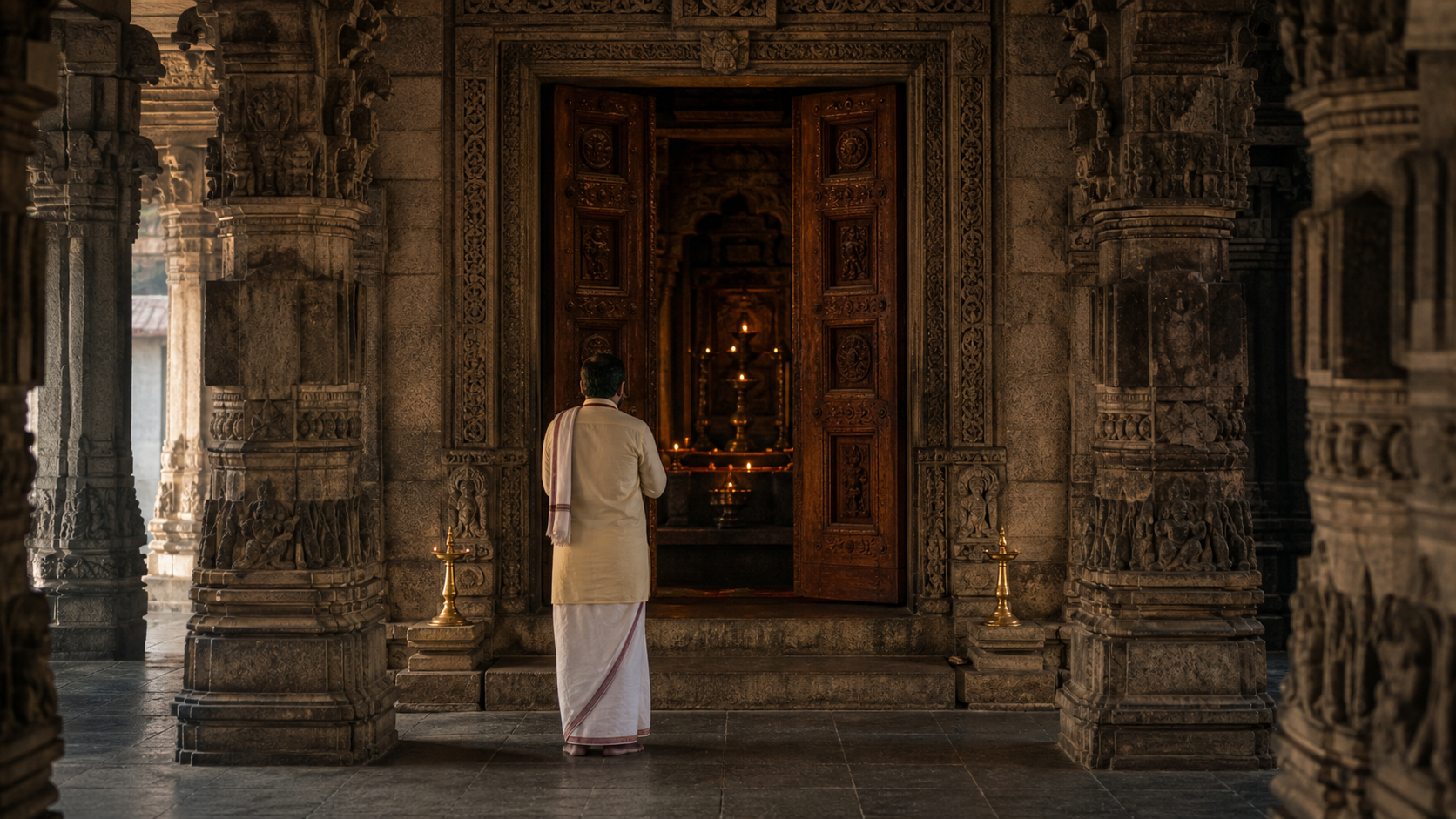
You have reached the garbhagriha after a long journey, only to find its doors closed. It can feel as though darshan is being withheld just when you are ready for it. Yet a closed sanctum usually marks a change in ritual time, not a denial of the deity’s presence.
Once you learn to read the doorway, the wait becomes intelligible. Its opening and closing tell you when worship is public, its carvings tell you how to approach, and its architecture gathers your attention toward darshan. The door is not an obstacle accidentally placed between you and the divine. It is one of the means by which the encounter is prepared.
A closed sanctum does not mean an absent deity
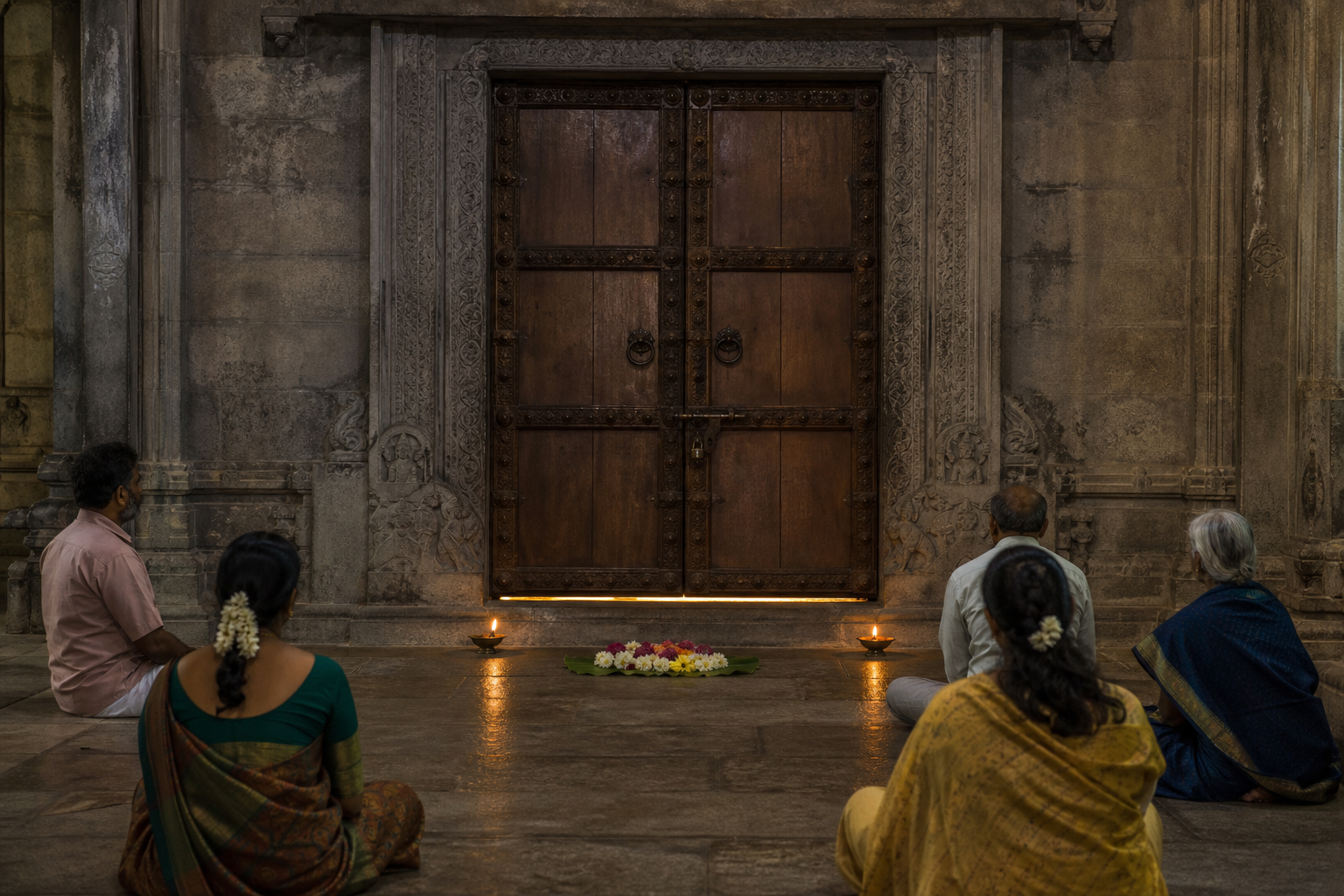
The first mistake is to ask why a deity needs a door, a lock, or privacy. The deity is not being protected from devotees as a vulnerable person would be. The door regulates human conduct around a consecrated presence and gives the temple’s daily worship an ordered form.
In Agamic practice, a temple is a living liturgical system rather than a hall that remains continuously open for viewing. Prana-pratishtha establishes the murti as a focus of sacred presence, and the daily cycle of opening, service, offering, revelation, and rest determines when devotees enter or behold the sanctum.
The cycle may begin with pre-dawn Suprabhata and Nirmalya Darshan. It then moves through acts such as abhisheka, the ritual bathing of the murti; alankara, adornment with garments, flowers, and ornaments; naivedya, the offering of food; and arati, the offering of light. Evening observances may culminate in sayana or rest. A temple’s precise sequence and public access will depend on its own tradition, so these terms are a map of the ritual logic, not a universal timetable.
Closing the doors during an inner service does three things at once. It gives attendants the quiet and space required for the rite. It prevents sacred service from becoming casual spectacle. It also creates a definite moment of unveiling, so that darshan is received with attention rather than caught as an incidental glance. Some temples reinforce this meaning with dvara-bandhana and dvara-uddghatana mantras when the doors are closed and opened.
If you encounter a closed sanctum, do not immediately conclude that you have missed darshan or that access is arbitrary. Look for the local schedule, listen for an announcement, or ask a temple attendant when the next opening will occur. If alankara or another service is underway, the most fitting response is usually to wait quietly or return at the stated time. Patience here is not dead time. It is part of learning that worship has a rhythm not set solely by your arrival.
Architecture turns an entrance into a path of attention
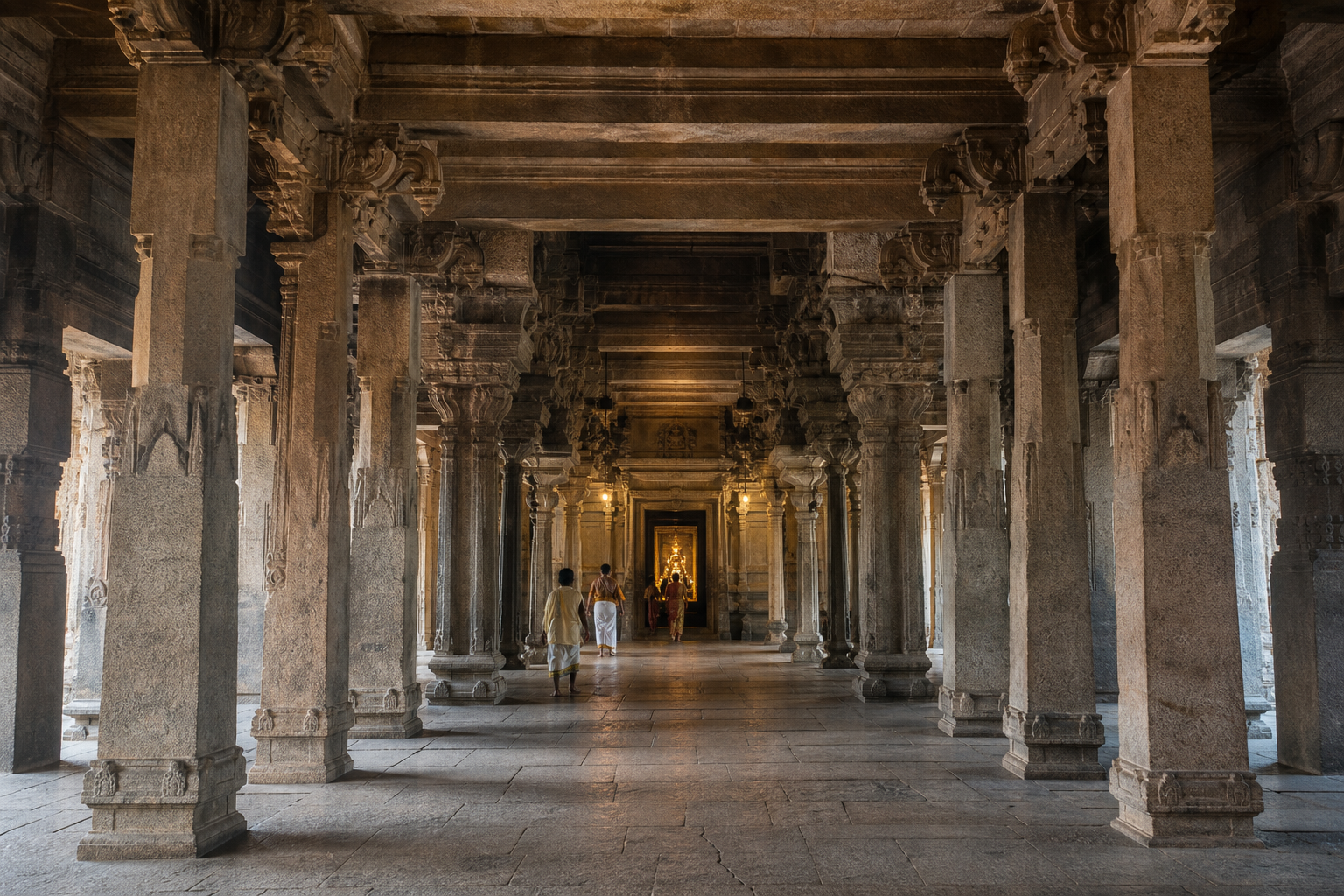
A temple doorway is more than an opening cut into a wall. Its location, proportion, frame, and relationship to the rest of the building organize how you approach the sanctum. Classical temple planning commonly establishes an axial line from the main entrance through the mandapa, the gathering hall, and the antarala, the transitional chamber, toward the garbhagriha.
That alignment creates a darshan corridor. The bali-pitha and dhvaja-stambha, where present, participate in the same sacred plan, while pradakshina routes organize movement around the sanctum. Many temples face east and receive the first light, although eastward orientation should not be treated as a rule for every shrine. Door-frame proportions and threshold placement belong to a larger geometry associated with the Vastu-Purusha Mandala and the prescriptions of the shilpa-shastras.
You can read this architecture without knowing every technical rule. Before entering the inner space, stop where you can see the main axis. Notice whether the successive doorways reveal the murti directly, frame only part of the sanctum, or defer the view until you move closer. Then observe how your attention narrows as the everyday surroundings fall behind you. The sequence of spaces is doing devotional work: it is changing you from a passer-by into someone approaching darshan.
The door also controls the senses. A partly open sanctum can focus the eye upon the murti while softening distractions around it. A closed panel can preserve silence during an intricate rite. When the doors open, lamplight, incense, chanting, bells, and the image of the adorned deity may arrive together. The intensity is not accidental. The threshold measures what is disclosed and when.
Deep vestibules and substantial doors have equally practical effects. They buffer sound and reduce the movement of dust, outside air, and harsh light into the sanctum. Traditional doors made from seasoned woods such as teak or sal, sometimes strengthened with metal bindings and bosses, unite craft, durability, security, and sacred imagery. Form serves worship because the physical conditions of worship matter.
The doorway tells you what kind of entry is being asked of you
Do not hurry past a temple door as though all meaning begins on the other side. The threshold itself often teaches you how to enter. Dvarapalakas stand as guardians of sacred order; in Vaishnava temples they may be identified as Jaya and Vijaya. Their presence does not imply that a sincere devotee is unwelcome. It warns that entry carries a change of conduct.
Look next at the lintel and jambs. A form such as Dvara-Lakshmi may confer auspiciousness at the point of passage. Narrative carvings can recall Puranic episodes, while geometric designs or yantras connect the doorway to the temple’s wider mandala. The jambs may function almost like a compact visual scripture, teaching pilgrims who pause long enough to see them.
A useful way to examine an unfamiliar doorway is to look in a fixed order: first at the guardians on either side, then upward to the lintel, and finally along the carved registers of the jambs. Ask what each element does. Does it guard, bless, narrate, orient, or mark a transition? You do not need to identify every figure to recognize that the frame is preparing your mind. Look without touching or leaning on old carvings; reverence for the image includes care for its material survival.
The larger dharmic family uses thresholds in related but distinct ways. The toranas at Sanchi demarcate a Buddhist sacred precinct while narrating Dharma. Jain derasars use ornate entrances and manastambhas to encourage purity and contemplative approach. The four cardinal doors of the Harimandar Sahib express Sikh openness, while daily opening, closing, and maryada preserve order within that openness. The shared lesson is not that every tradition assigns the same theology to a door. It is that sacred access can be welcoming without becoming careless.
When visiting a shrine outside the practice you know best, resist translating every feature into the vocabulary of a Hindu garbhagriha. Watch how the community uses the threshold, follow its maryada, and ask what that particular tradition is marking. Respect begins with allowing a sacred space to explain itself through its own forms.
A practical threshold practice for your next temple visit
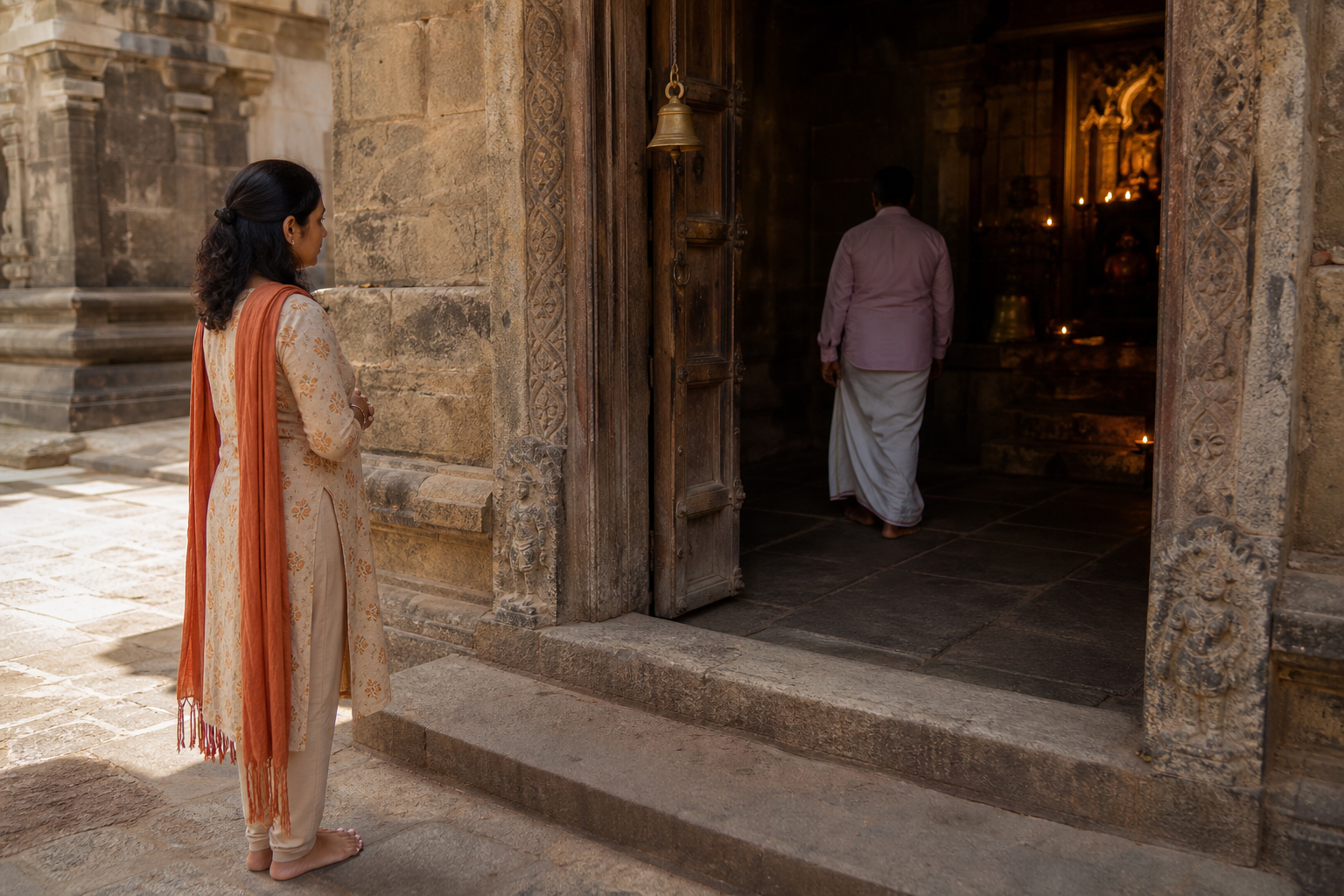
You do not need to reproduce an elaborate ritual at every doorway. A brief, deliberate sequence is enough to keep your visit from becoming hurried or mechanical. Local instructions always take priority over a generic checklist.
- Learn the darshan rhythm before joining the queue. Check the temple’s opening periods and ask specifically about temporary closures for abhisheka, alankara, naivedya, or evening service. Knowing the next opening time prevents frustration and lets you arrive for the form of darshan you seek.
- Complete the outer preparations. Remove footwear where directed. Secure bags, cameras, and prohibited items before approaching the sanctum. If ringing a bell is part of the local custom, do so there; do not assume that every temple asks for the same gesture.
- Pause before the inner threshold. Lower your voice, steady your breath, and allow the line ahead of you to move. This short pause separates ordinary conversation and distraction from the attention required for darshan.
- Read the doorway while you wait. Notice the dvarapalakas, lintel image, jamb carvings, material, and relation of the opening to the murti. Waiting becomes observation rather than impatience.
- Treat a closure as a ritual interval. If the doors close, follow the attendant’s directions and avoid pressing forward for a partial view. Listen to the chanting or remain silent. The opening will have greater force because your attention has been gathered rather than scattered.
- Receive darshan without turning proximity into competition. The doorway is already framing a visual connection, sometimes from a considerable distance. Do not assume that pushing closer necessarily makes the encounter deeper. Make space for the devotees behind you once you have had the allotted moment.
- Leave by the indicated route. Follow the prescribed circulation or pradakshina path where it is permitted. Do not stop in a doorway, because a threshold must continue to serve the whole community.
If a raised sill, narrow passage, or crowded queue creates an accessibility problem, ask temple staff about a safer route or viewing arrangement. A physical threshold is not a test of devotion. Contemporary access can be incorporated thoughtfully alongside inherited ritual patterns, and you should not risk a fall or injury to imitate another person’s manner of crossing.
The same door must protect heritage and welcome a community
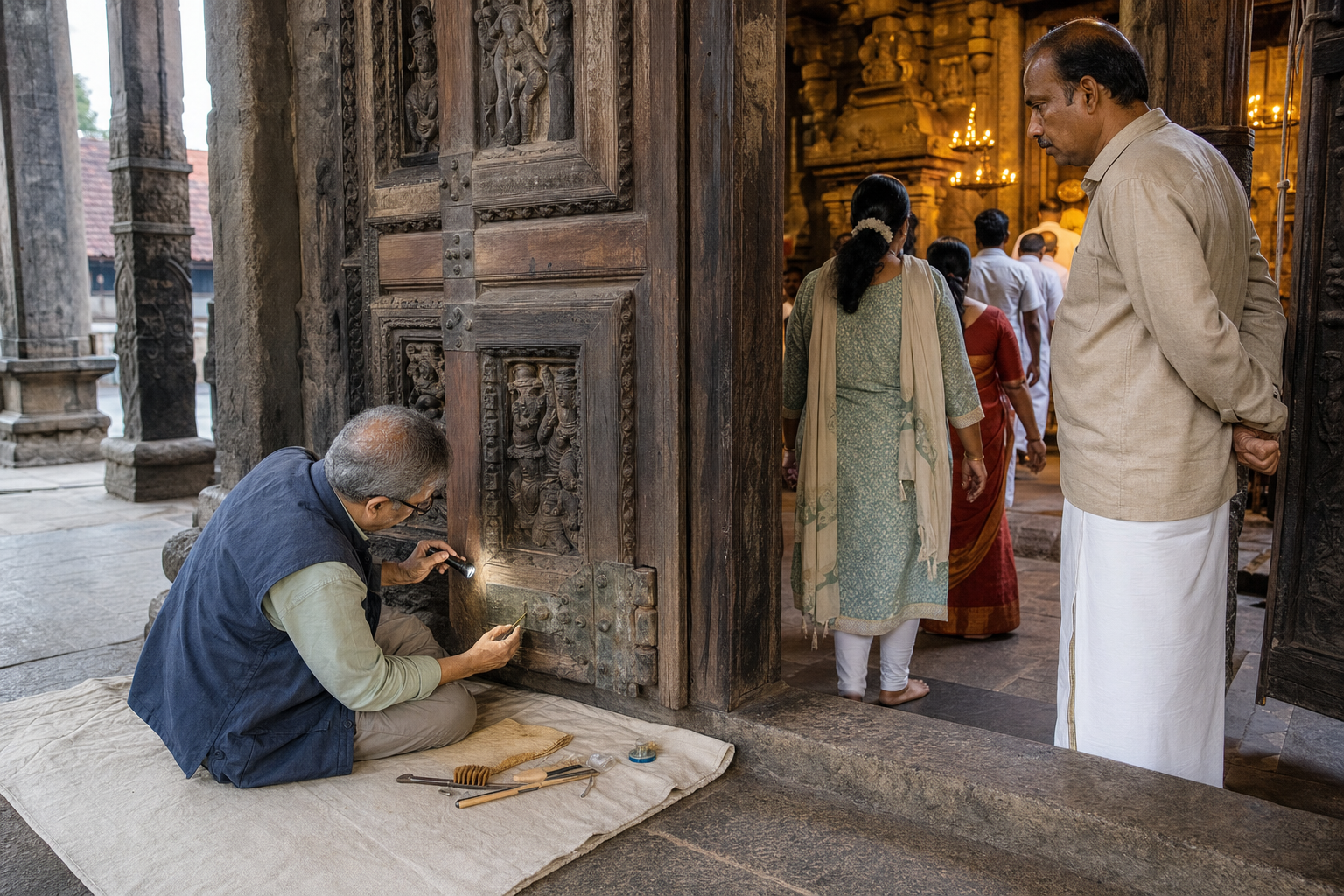
Ritual meaning does not cancel practical responsibility. Sanctums may contain murtis, paintings, wooden ceilings, textiles, jewels, ceremonial vessels, manuscripts, and metal utsava-murtis entrusted to the temple over generations. The deity does not need a lock, but human custodians do have a dharmic duty to safeguard these objects.
Doors help control dust, humidity, salt-laden air, ultraviolet light, temperature changes, and excessive airflow. These conditions can damage vulnerable materials, especially where lamps, flowers, and incense are used intensively. Heavy doors and deep transitional spaces can stabilize the sanctum’s microclimate while also buffering noise. What looks like an old-fashioned barrier may therefore be part of a working conservation system.
They also help manage people. At heavily visited temples, the phased opening of outer and inner doors, queue corridors, and designated viewing points can distribute access more fairly and reduce unsafe crowding. A brief darshan framed clearly by the sanctum entrance may offer a stronger visual encounter than an uncontrolled press of bodies close to the murti. Order is not the opposite of welcome; it is often what makes shared access possible.
Contemporary stewardship must balance ritual integrity with fire egress, emergency lighting, secure storage, conservation, and inclusive access. These needs should be integrated into the temple’s established movement rather than treated as reasons to erase it. A good intervention preserves both the meaning of the threshold and the safety of the people who cross it.
Festival cycles show that temple doors are not simply instruments of restriction. At Puri, the movement from Snana Yatra through Anavasara to Nabajouban Darshan uses concealment and renewed revelation as part of the sacred calendar. At Tirumala, the dawn opening of the Bangaru Vakili gathers attention toward the first darshan, while Ekanta Seva marks evening withdrawal. During a rath yatra or other procession, the doors open outward and the deity enters the town. The same threshold that limits access at one moment becomes a bridge between sanctum and community at another.
Key takeaways
- A closed sanctum usually marks ritual service, rest, conservation, security, or crowd regulation; it does not imply divine absence.
- The doorway belongs to the architecture of darshan. It aligns movement, frames sight, and controls the arrival of light, sound, and scent.
- Dvarapalakas, lintel images, and jamb carvings prepare and teach the devotee before entry.
- Local maryada outranks a universal checklist. Check timings, follow attendants, lower your voice, and do not force proximity.
- Protection and openness are complementary when doors preserve sacred objects, maintain safe movement, and give each devotee a meaningful view.
On your next visit, give the doorway one full moment before trying to pass through it. Notice what is being guarded, what is being revealed, and what must change in your own conduct. Then cross when the temple invites you to cross. That small act can turn waiting for darshan into preparation for it.