
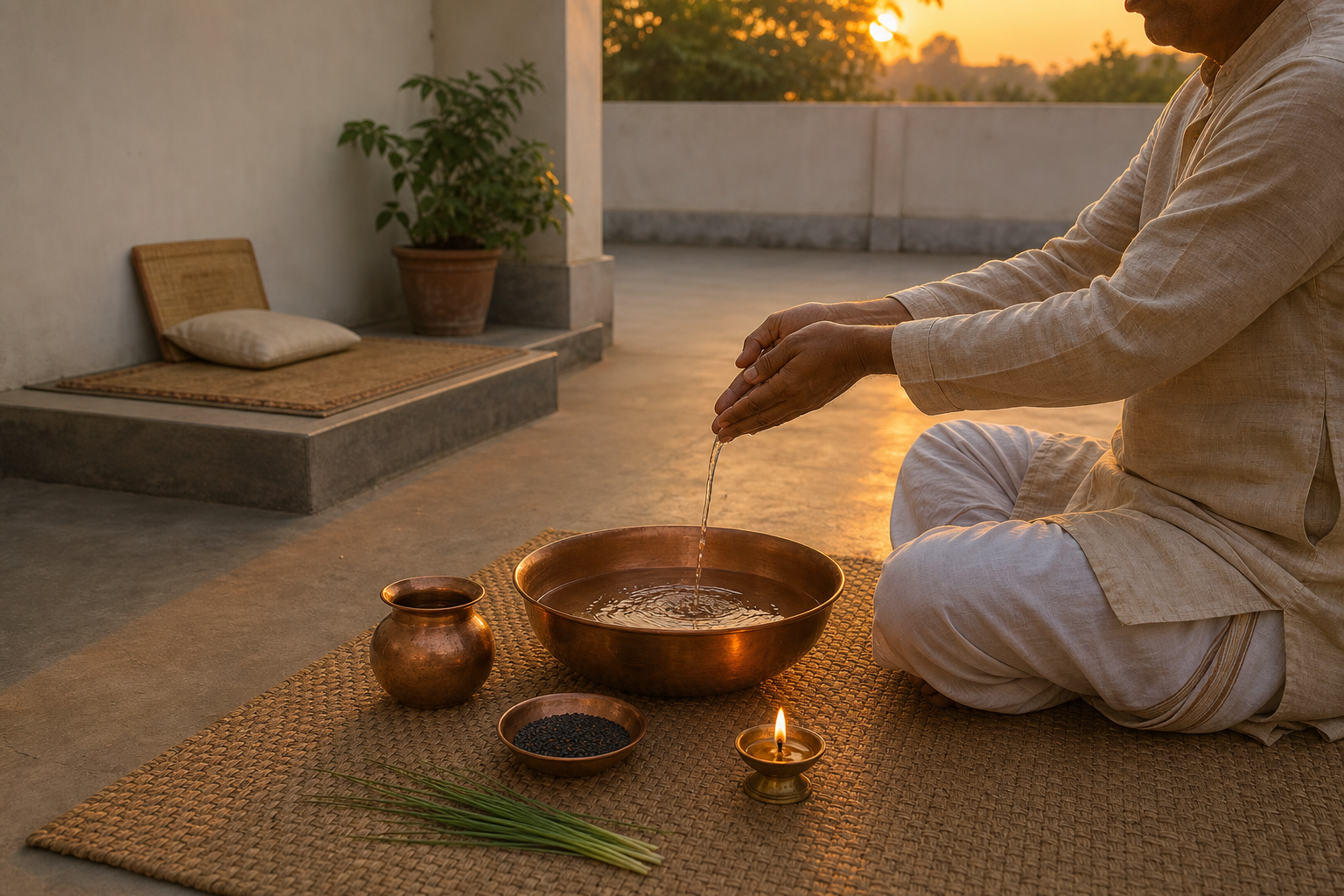
Perhaps an Amāvasyā is approaching, your family no longer has an elder who remembers the procedure, or you live far from the river and temple where Tarpan was once performed. You want to honor your ancestors properly, but you don’t want to turn a sacred rite into guesswork.
You can resolve much of that uncertainty by separating the common structure of Pitṛ Tarpan from the details that belong to your kula, region, and Vedic tradition. The water, intention, direction, and recipient form the core. The exact mantras, number of libations, names, sacred-thread procedure, and eligibility may require family guidance.
First identify the ancestral rite you actually need
Tarpan is a water libation offered with śraddhā to Devas, Ṛṣis, and Pitṛs. The name is connected to the Sanskrit root trip, carrying the sense of satisfying or gladdening. In ancestral Tarpan, you offer water in remembrance of those from whom your life and family continuity came.
Tarpan and Śrāddha are related, but they are not interchangeable. Tarpan is the offering of water; when sesame is added, it is commonly called tilodaka or Tilatarpaṇa. Śrāddha is a broader ancestral rite that may include cooked food, piṇḍas, Brāhmaṇa hospitality, and Tarpan within its sequence. If your family obligation is an annual Śrāddha, performing only a water offering does not automatically complete the larger rite.
Use the situation in front of you to decide what kind of help you need:
- If you want a recurring act of ancestral remembrance on Amāvasyā or during Pitṛ Pakṣa, ask about your family’s ordinary Pitṛ Tarpan procedure.
- If you are observing a parent’s or another ancestor’s death tithi, first confirm whether your family performs Tarpan alone or a complete tithi-Śrāddha.
- If the death was recent and sapīṇḍīkaraṇa has not occurred, do not apply a general Amāvasyā procedure. Ekoddiṣṭa Tarpan addresses a particular departed person during a transitional period and should follow the family’s post-antyeṣṭi instructions.
- If you already perform Sandhyāvandanam, use the Deva, Ṛṣi, and Pitṛ Tarpan sequence taught in your own recension rather than attaching a second procedure assembled from unrelated customs.
- If you are visiting Gayā, Prayagraj, Haridwar, Kashi, or another tīrtha for ancestral rites, arrange the local procedure before the day of worship. Tīrtha Tarpan and piṇḍadāna can involve obligations beyond a simple household libation.
This distinction prevents two common errors. The first is treating every ancestral observance as the same ritual. The second is assuming that a more elaborate performance must be more sincere. Śraddhā means the offering is made with earnest attention; expense and display cannot replace it.
Choose the time, place, and materials deliberately
Amāvasyā is a common recurring occasion for Pitṛ Tarpan. Pitṛ Pakṣa gives ancestral rites special prominence and culminates in Mahālaya Amāvasyā. A family’s annual death tithi may carry a more specific obligation. Some traditions also prescribe Tarpan at eclipses, Saṅkrānti, or other significant times.
Do not assume that every day named in a general calendar applies in the same way to your household. Establish the relevant tithi using the calendar and convention followed by your family or temple. If you are performing on an ordinary Amāvasyā, say so accurately in the saṅkalpa; if you are not, do not recite an Amāvasyā formula merely because it appeared in a remembered procedure.
For a home observance, prepare the setting before you sit down:
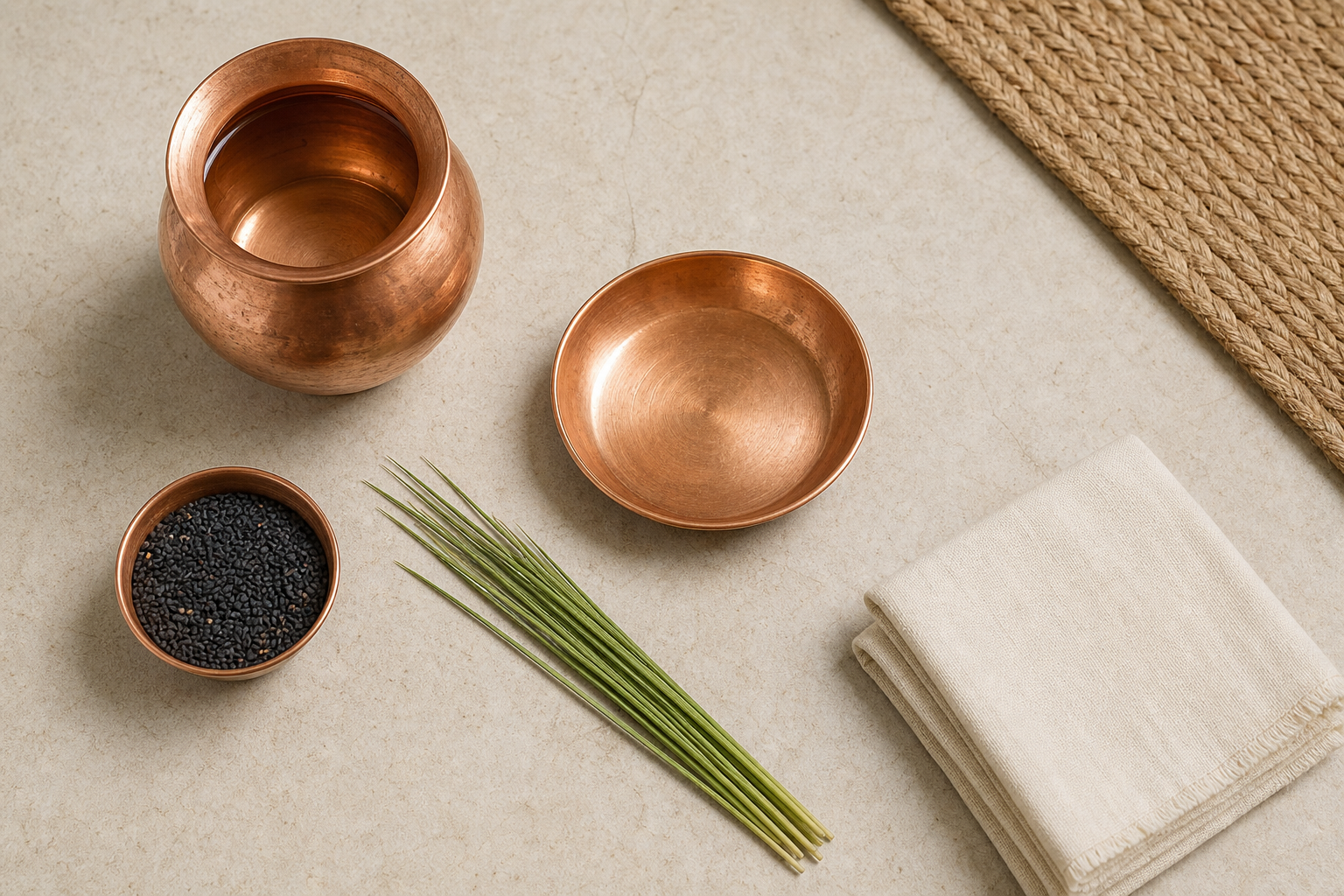
- Clean water in a clean vessel. Copper or earthen vessels are traditional choices, but a dedicated clean vessel is preferable to delaying remembrance because you cannot obtain a particular material.
- A clean place where the libation can fall, or a separate receiving vessel when pouring directly onto the ground is impractical.
- Black sesame for Pitṛ tilodaka when it belongs to your custom. Barley and clean darbha tips are also used in traditional preparations.
- A clean seat, ideally kuśa when available and prescribed, and clean clothing after bathing or washing.
- A written list of the ancestral names and gotras that your family actually recites. Verify the list rather than reconstructing it during the rite.
- A darbha pavitra for the right ring finger and the yajñopavīta, but only if these are already part of the procedure for which you are eligible.
The absence of a sacred river does not make remembrance impossible. Householders, including those in the diaspora, can use a clean bowl and a modest quantity of water at home. What matters is that the adaptation remains clean, composed, and recognizable as an offering rather than becoming an improvised display.
Ecological restraint belongs inside the ritual, not outside it. Use only as much water as the libation requires. Keep plastic, synthetic decoration, food packaging, and other non-biodegradable material out of rivers and lakes. If local rules or environmental conditions make outdoor pouring inappropriate, use a receiving vessel and follow a respectful, environmentally responsible disposal practice accepted in your tradition.
A careful sequence for Pitṛ Tarpan at home
The following sequence gives you the common architecture of an ordinary ancestral water offering. It is not a substitute for the fuller paddhati of your śākhā or kula. Where your inherited procedure differs, the inherited procedure takes priority.
- Confirm the scope. Decide whether this is ordinary Pitṛ Tarpan, an annual Śrāddha, or a rite connected with a recent death. Stop and seek guidance if the family is still within the post-antyeṣṭi sequence.
- Clean yourself and the place. Bathe where practical, wear clean garments, wash the vessels, and set aside distractions. Śauca here is both physical cleanliness and deliberate separation from ordinary activity.
- Arrange the seat and direction. For Pitṛ Tarpan, sit so that you face south. Place the water and receiving vessel where you can pour steadily without repeatedly turning or reaching across the ritual space.
- Perform the preliminary purification you were taught. A formal procedure commonly begins with a brief ācamanam. If you have never learned its mantras and actions, do not combine fragments from different traditions. Begin with clean hands and a clear statement of intention, then obtain instruction before adopting the complete formal sequence.
- State the saṅkalpa. Name the occasion, place, and purpose as your tradition requires. On Amāvasyā, a concise form is “asminn amāvasyāyām pitṛ-tarpaṇam kariṣye,” meaning that on this Amāvasyā you undertake Pitṛ Tarpan. Use it only when the stated occasion is true.
- Adopt the ritual markers that apply to you. A person who wears the yajñopavīta moves it to prācīnāvīta for Pitṛ rites, from the right shoulder toward the left hip. A darbha pavitra may be worn on the right ring finger. Do not treat either item as a costume; follow the rules under which you received and use it.
- Prepare the offering water. Add black sesame when performing the Tilatarpaṇa observed by your family. Barley and darbha tips may also be included where prescribed. Avoid replacing a missing traditional substance with a look-alike material of unknown ritual status.
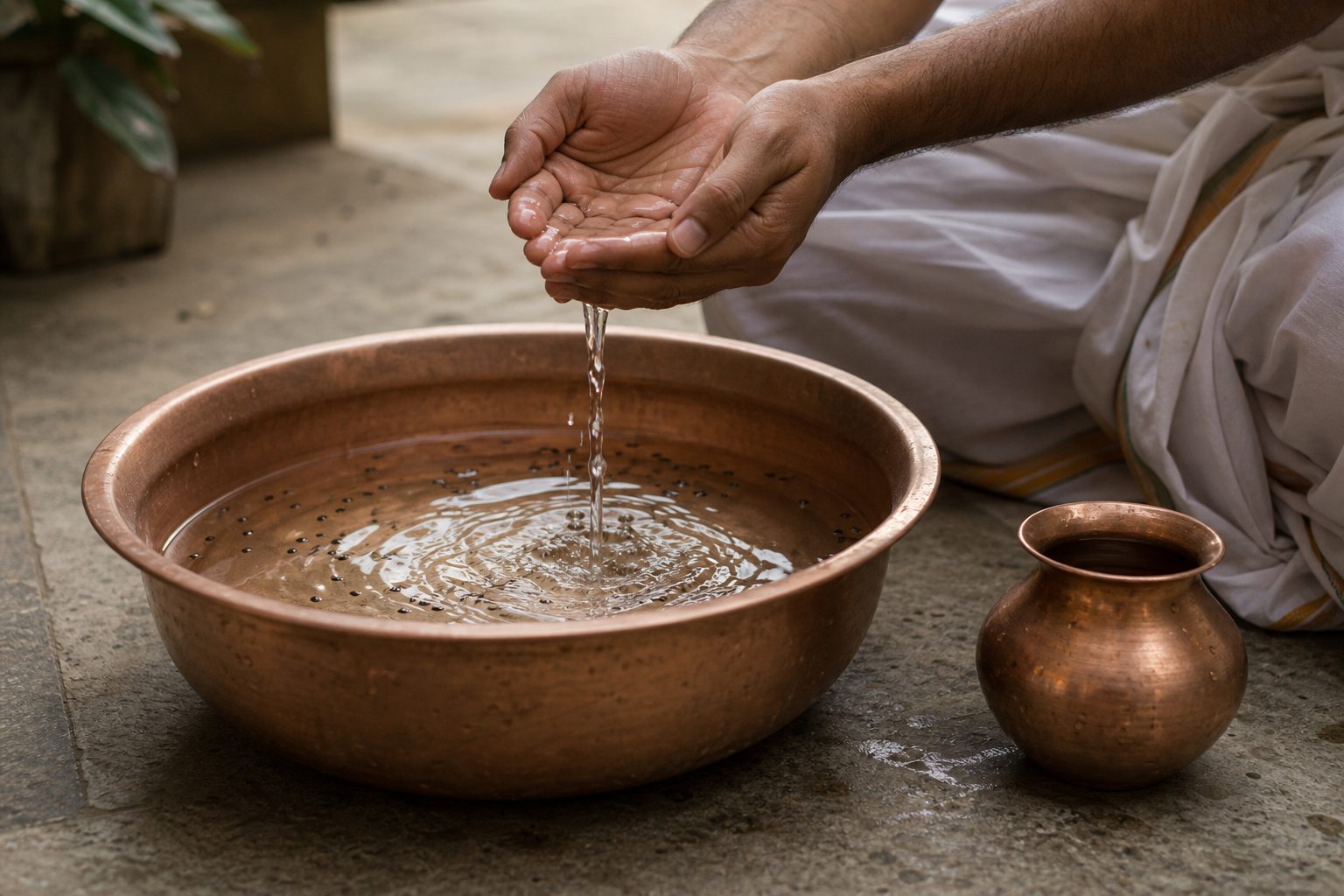
- Offer through the Pitṛ-tīrtha. Hold the water in the right hand and let it flow from the region near the base of the little finger. A common general invocation is “Om pitṛbhyo svadhā namaḥ tarpayāmi.” Pour gently onto clean ground or into the vessel prepared for that purpose.
- Name ancestors only as your custom permits. Some families recite names and gotras from paternal and maternal lines. A living direct ancestor’s name is generally omitted. When the proper names are unknown, or when a named list is not appropriate, traditions may use a universal offering such as “sarva-pitṛbhyaḥ.” Confirm the wording rather than inventing names, relationships, or gotras.
- Repeat only the prescribed number of times. Daily sequences often employ three libations for each recipient group, but counts vary by recension and occasion. Do not turn that common pattern into a universal rule for every Pitṛ rite.
- Close without bargaining. Remember teachers, elders, and the wider ancestral line as your custom directs. Conclude with a prayer for the welfare of beings and family harmony. If you have a particular wish, frame it within dharma, ahiṃsā, and the good of others rather than treating the offering as a transaction.
If you make a small verbal mistake, maintain composure. Correct it if you know the correction and continue according to your family method. A mistake is not repaired by adding unverified mantras. When you discover afterward that an important procedural element was wrong, record the question and ask a competent family priest before the next observance.
Know which technical details must remain lineage-specific
The three recipient classes are distinguished through direction, the tīrtha or water-route of the right palm, and the position of the sacred thread. These details coordinate body, speech, and intention; they are not merely ornamental gestures.
| Recipient | Usual direction | Right-hand tīrtha | Yajñopavīta position, when applicable | Common general formula |
|---|---|---|---|---|
| Devas | East | Fingertips, Deva-tīrtha | Upavīta: left shoulder to right hip | Om devatābhyo namaḥ tarpayāmi |
| Ṛṣis | East in the common daily sequence | Center of the palm, Ṛṣi-tīrtha | Nivīta: around the neck | Om ṛṣibhyo namaḥ tarpayāmi |
| Pitṛs | South | Near the base of the little finger, Pitṛ-tīrtha | Prācīnāvīta: right shoulder to left hip | Om pitṛbhyo svadhā namaḥ tarpayāmi |
If you are performing only a simplified ancestral remembrance, this table should not tempt you to construct a full Deva-Ṛṣi-Pitṛ sequence without instruction. Formal Nitya Tarpan may enumerate deities, Saptarṣis, other sages, and several ancestral classes. The lists and transitions are precisely where recensions diverge.
The same care applies to names and gotras. Some procedures identify father, grandfather, and great-grandfather, along with corresponding women and maternal ancestors. Others arrange the recitation differently. Do not exclude the maternal lineage merely because you remember only a paternal formula, and do not insert a living relative into a list intended for departed ancestors.
Eligibility also varies. Several traditions permit a daughter, wife, or another close relative to perform Tarpan when a male heir is unavailable. That does not create one rule for every sampradāya, nor does a restrictive rule in one family settle the question for all Hindus. Ask who is authorized within the actual tradition of the departed person, especially when the family includes more than one regional or sectarian custom.
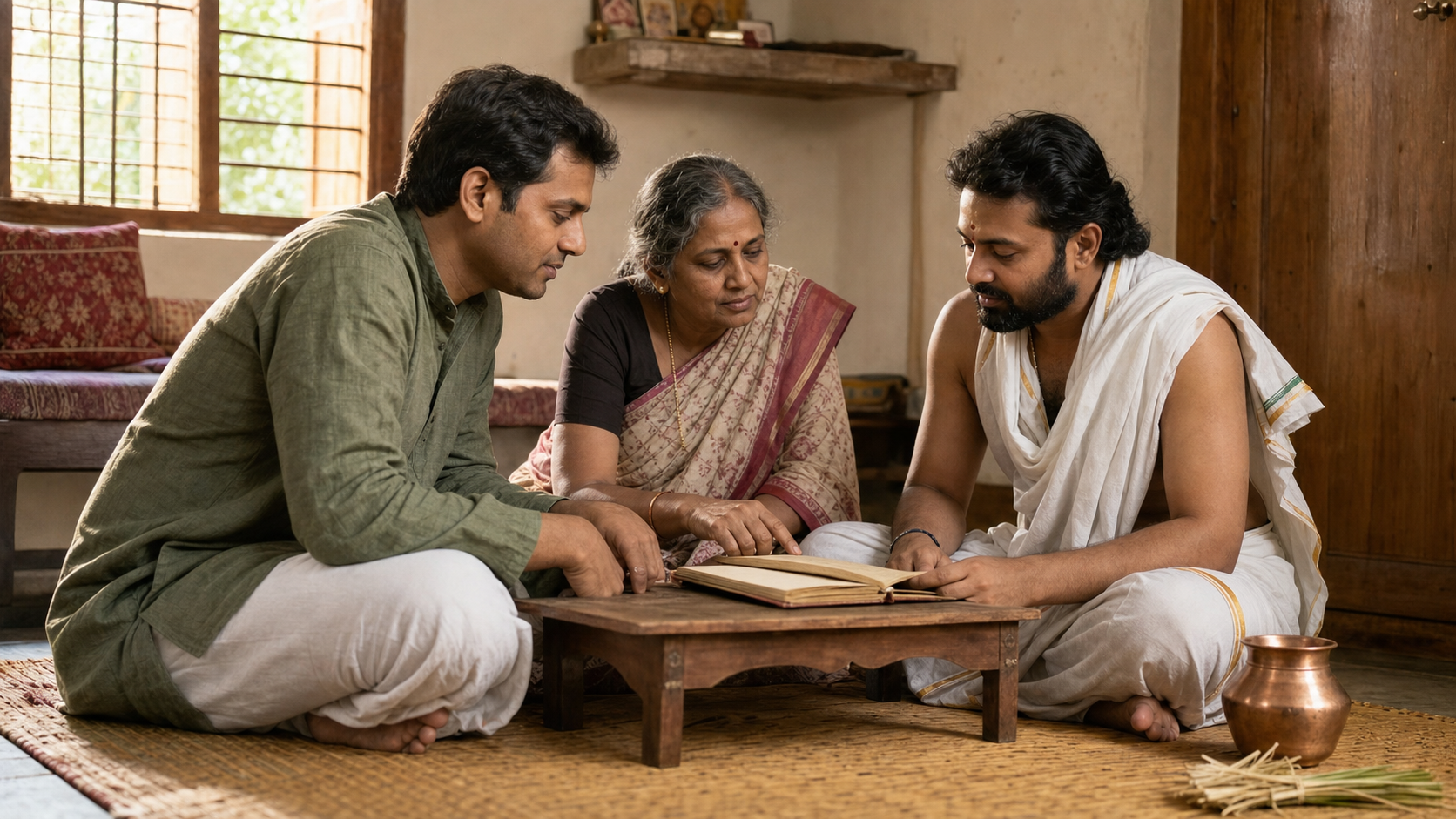
A useful conversation with a family elder or priest is specific. Instead of asking only, “How do I do Tarpan?”, take these questions:
- Which observances are required in our family: monthly Amāvasyā, Pitṛ Pakṣa, the annual death tithi, or a combination?
- Is this Tarpan independent, or is it one part of Śrāddha?
- Who may perform it in our family, and what changes when the customary performer is unavailable?
- Which names, relationships, and gotras are recited, and which living ancestors must be omitted?
- What is the exact number and order of libations?
- Which mantra form, yajñopavīta position, darbha use, and concluding prayers belong to our procedure?
- How should the offered water be handled when the rite is performed inside an apartment or outside Bharat?
Write down the answers in one place, including the regional calendar convention and the priest or elder who confirmed them. That record is more valuable to the next generation than a collection of disconnected ritual clips.
Key takeaways for a respectful ancestral offering
- Tarpan is a water libation; Śrāddha is a broader ancestral rite that may include Tarpan, piṇḍas, food offerings, and hospitality.
- For ordinary Pitṛ Tarpan, the common markers are southward orientation, the Pitṛ-tīrtha near the base of the right little finger, and the prācīnāvīta thread position for an eligible yajñopavīta wearer.
- Black sesame is especially associated with Pitṛ tilodaka. Barley and darbha are also used, but the exact preparation should follow your tradition.
- Amāvasyā, Pitṛ Pakṣa, Mahālaya Amāvasyā, and the family death tithi are significant occasions; they do not all carry identical procedures.
- A recent death calls for specific post-antyeṣṭi guidance. Do not substitute a general household Tarpan for Ekoddiṣṭa or other transitional rites.
- Names, gotras, mantra variants, repetitions, performer eligibility, and sacred-thread details are lineage-sensitive. Verify them rather than combining procedures.
- A clean bowl at home can support a modest diaspora adaptation. Sacred remembrance never requires polluting a river or leaving non-biodegradable offerings behind.
- Śraddhā is expressed through sincere, attentive performance. It does not excuse carelessness, but neither is it measured by expense or spectacle.
Your best next step is not to buy a larger ritual kit. Before the next Amāvasyā, call the relative or priest who knows your kula practice, verify the names and sequence, and write them down. Then prepare a small, clean place and offer the water without haste. That is how ancestral gratitude becomes a living family discipline rather than a custom remembered only when someone dies.