
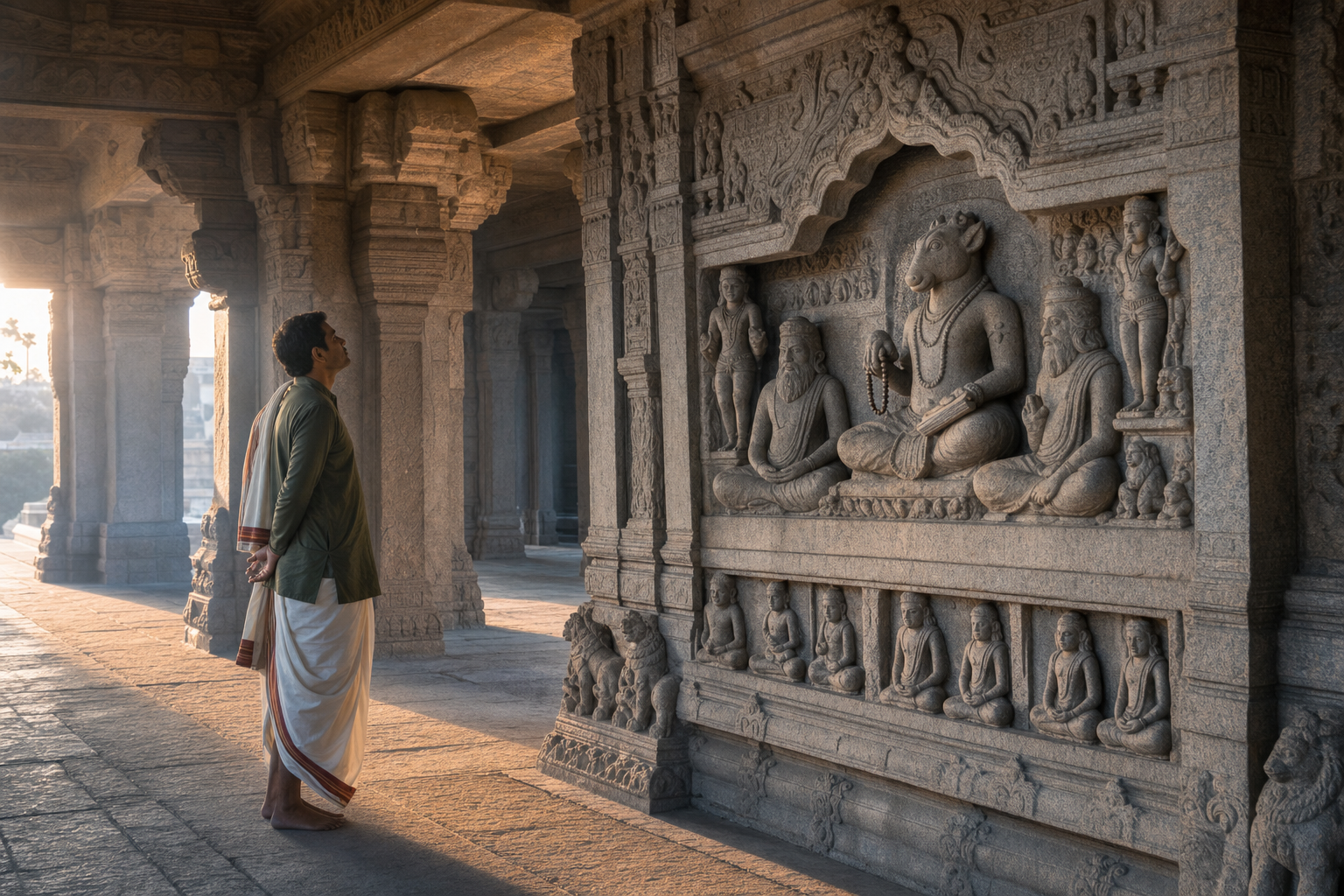
You notice an animal-faced sage on a temple wall. The figure holds a rosary or manuscript, sits among other teachers, and looks too deliberate to be a decorative curiosity. Before you call it a deity, dismiss it as grotesque, or repeat the first identification you hear, you need a reliable way to read what the sculptural program is doing.
The safest method is to examine the figure in context: where it stands, how the animal form is used, what the hands carry, who appears beside it, and how the temple remembers it. That approach is especially important when considering the rare donkey-faced personification of the Rig Veda.
A personified Veda is not a portrait of a book
Begin with the right category. A Veda mūrti is not meant to portray a manuscript that somehow became human. Within Hindu sacred thought, the Vedas are śruti: revelation received through disciplined hearing, preserved through exact recitation, and regarded as apauruṣeya rather than the work of a historical author. A human or partly animal form makes that living authority of sacred sound visible.
This personification has several layers. The Vedas act, praise, approach, and petition in sacred narratives. Upaniṣadic reflection brings their voices inward through breath and awareness. The idea of Veda-puruṣa presents Veda as an integral person whose limbs are the six Vedāṅgas and whose heart is Vāc, sacred speech. When this theology enters temple sculpture, knowledge can appear as a teacher to be approached, a guardian of the precinct, or a power participating in worship.
That distinction changes the question you ask. Do not begin with, “Which story does this strange creature illustrate?” Ask, “What relationship with sacred knowledge is this figure establishing?” Its posture may invite learning. Its position at a threshold may suggest guardianship. Its implements may point toward recitation, restraint, purity, or instruction.
The wider Dharmic world makes this relational understanding easier to recognize. Mahāyāna traditions revere Prajñāpāramitā as the mother of wisdom; Tibetan monasteries ceremonially enthrone scriptures; Jain communities venerate Śruta-devī as an embodiment of learning; and Sikh practice receives the Guru Granth Sahib as the living Guru. These traditions are not interchangeable, but they share an important civilizational intuition: sacred knowledge is not inert information. You enter into a disciplined relationship with it.
Read the sculpture in four passes
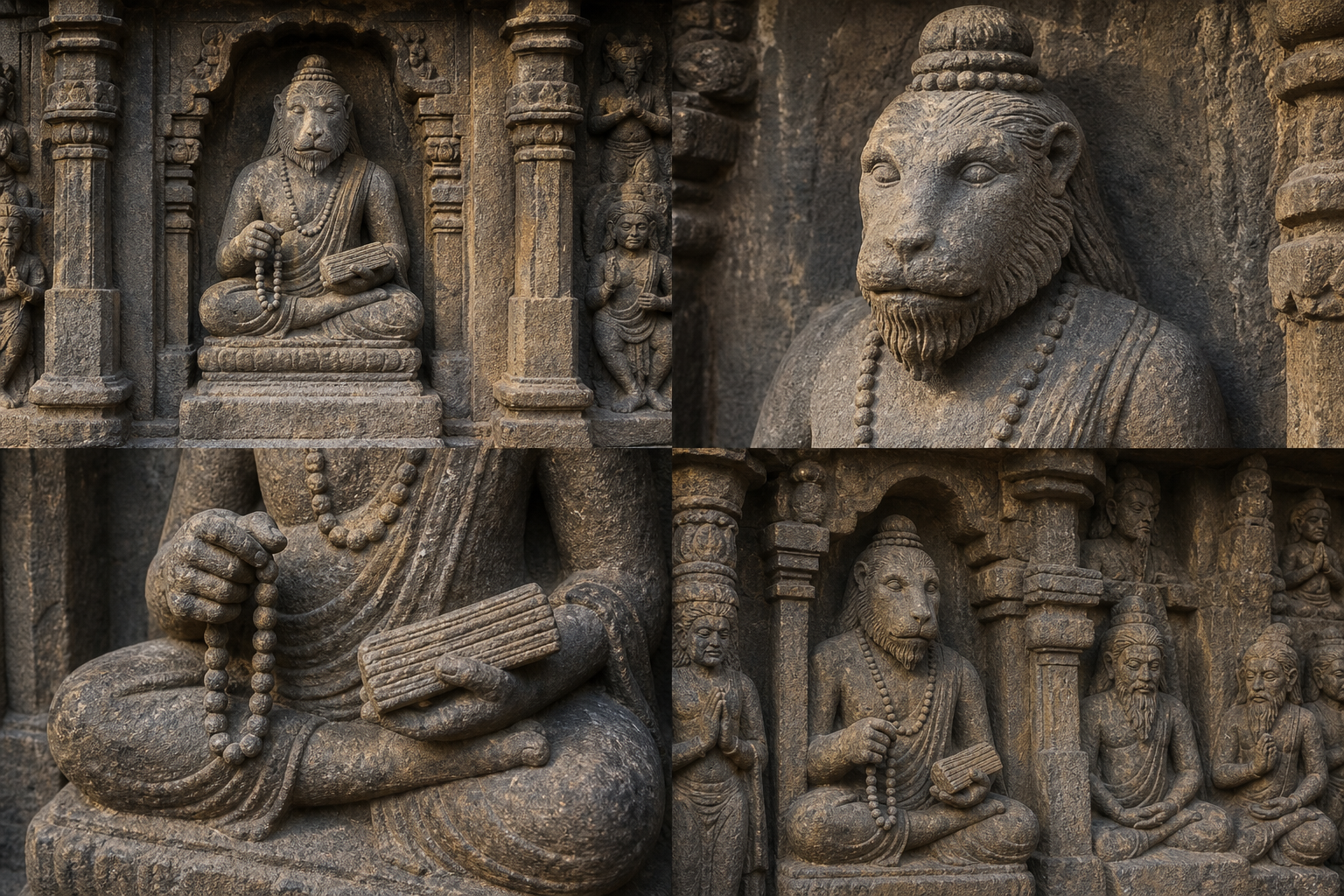
An isolated close-up rarely gives enough evidence for a responsible identification. Agamic and allied Śilpaśāstra traditions organize posture, gesture, attributes, and placement into a visual grammar. Read that grammar from the outside inward.
- Establish the location. Record whether the figure is on a gopura tier, beside a gateway, along a prākāra, on a mandapa pillar, or in a shrine niche. A threshold can emphasize guardianship; a teaching or recitation space can strengthen an association with sacred learning. Location is evidence, but it is not proof by itself.
- Separate face, vehicle, companion, and emblem. An animal head joined to a sage-like body communicates something different from an animal standing beside a deity or serving as a vāhana. Look closely at the mouth, ears, bearing, and seated or standing posture. An enlarged mouth can direct attention toward utterance. Prominent ears can direct attention toward hearing. A steady ascetic posture can shift the meaning from animality toward discipline.
- Read the hands and implements. A pustaka marks living teaching rather than mere possession of information. An akṣamālā can indicate rhythmic repetition and sustained study. A kamaṇḍalu suggests purity and restraint. Abhaya or varada mudrā presents the knowledge-bearing figure as a source of assurance or blessing. No single object settles the identity, so look for a cluster of compatible signs.
- Reconstruct the ensemble. Step back and inspect the figures on both sides. Four related teachers may suggest the four Vedas. A larger company of ṛṣis, siddhas, and personified śāstras may identify the panel as an assembly of knowledge. Repeated postures with deliberately varied heads or objects are often more informative than the most unusual face in the group.
After those four passes, seek the temple’s own memory. Ask how priests, guides, reciters, or a local sthala-purāṇa name the figure. Note the wording carefully. “Locally identified as the Rig Veda” is a sound conclusion when a regional tradition supplies the name but no universal iconographic rule does. An attribution becomes stronger when form, placement, ensemble, attributes, and liturgical memory converge.
How to handle the donkey-faced Rig Veda
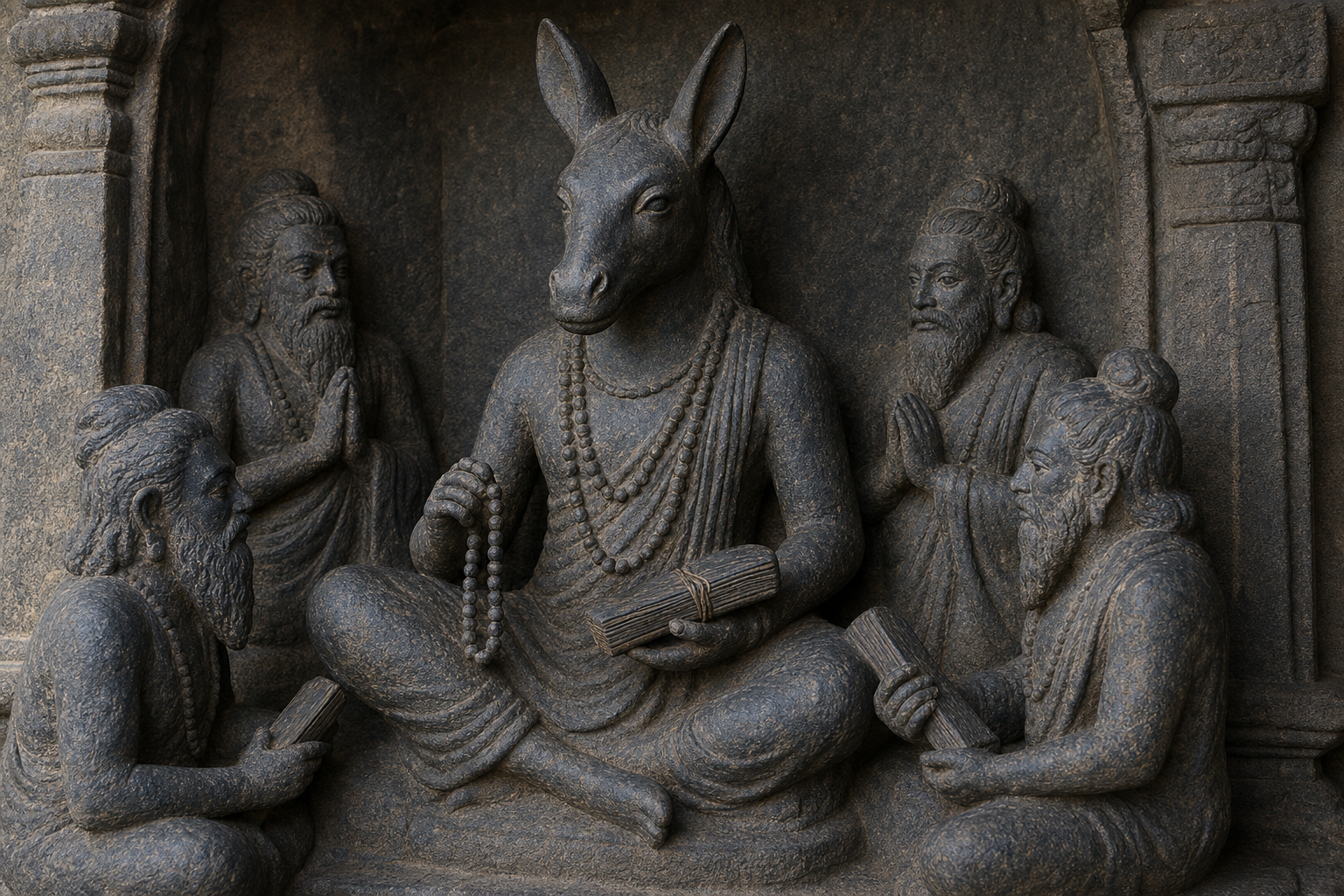
The donkey-faced Rig Veda must be handled with calibrated confidence. It is an uncommon, regionally bounded motif, not a standard form that can be projected onto every temple. Some sculptural arrays in Tamil Nadu and Karnataka contain animal-faced teachers identified locally as Veda mūrtis, yet documentation of the donkey-faced Rig Veda remains specialized. A donkey head alone therefore cannot establish the identity.
Once the surrounding evidence supports the identification, three interpretive layers become useful.
The face makes sound visible
The Rig Veda is a collection of ṛc whose transmission depends on sounded syllables, meter, phonetics, and disciplined memory. The donkey’s bray is raw, forceful, and unmistakable. A sculptor who emphasizes the muzzle and jaw can turn the mouth into the visual center of the figure. The point is not that Vedic recitation resembles uncontrolled braying. The contrast teaches that untrained phonation must be shaped into measured sacred utterance.
Notice what this reading requires from you. Do not treat the icon as a puzzle solved by recognizing an animal. Attend to the relation between mouth and ear, speaking and hearing, sound and restraint. In a tradition grounded in śruti, the worthy hearer matters as much as the voice.
The animal carries the weight of discipline
The donkey’s association with bearing loads gives the form an ascetic force. Vedic learning is sustained by brahmacarya, daily svādhyāya, careful repetition, and ritual exactitude over years. The image can therefore honor endurance that receives little public glamour: returning to the syllable, breath, and cadence until memory becomes stable.
This is more than praise for hard work. It identifies the kind of labor sacred learning demands. Inspiration may bring you to a text, but repetition carries it into the body. If you receive the figure as a teacher, the practical response is a steadier discipline, not admiration for its novelty.
The unglamorous face tests humility
A donkey can be useful and overlooked at the same time. Giving such a face to the personified Rig Veda reverses ordinary expectations of beauty, rank, and prestige. Sacred authority does not depend on a polished appearance. It can confront the viewer through an earthy form associated with service and persistence.
This does not turn every negative association with the donkey into doctrine. It identifies a plausible theological use of the paradox: the viewer who laughs at the exterior may expose an inability to recognize knowledge without social ornament. The icon asks whether you value truth only when it arrives in a form you already esteem.
Sound, endurance, and humility are interpretive layers, not three independent identification tests. Establish the figure’s identity from the whole sculptural and ritual context first. Then use these layers to understand why that form may have been chosen.
A short FAQ for responsible identification
Is every animal-headed sage a personified Veda?
No. Temple iconography contains many animal-linked deities, sages, guardians, and knowledge forms. Hayagrīva, for example, is a horse-headed embodiment of salvific knowledge in Vaiṣṇava traditions. Similarity at the broad level of “animal head plus sacred figure” does not make two images equivalent. Compare the face, body, implements, companions, placement, and local name.
Does “Agamic” mean every temple follows one design?
No. Śaiva Siddhānta, Pāñcarātra, and allied sculptural traditions provide disciplined iconographic frameworks, but regional and sectarian programs do not produce a single universal catalogue of Veda images. Treat a rare identification as rare. Do not turn one local form into a rule for Bharat as a whole.
Is the donkey face an insult to the Rig Veda?
That conclusion ignores how theriomorphic features work within a sacred ensemble. A pronounced jaw can amplify speech, large ears can amplify listening, and an unprestigious animal can teach endurance and humility. The decisive issue is the form’s function within the temple, not a modern ranking of attractive and unattractive animals.
What should you record when documenting the image?
Take a wide view of the complete panel before taking a close-up. Record the exact structure and side of the temple, the figure’s level or tier, its orientation, every visible object, adjacent figures, and the local identification. If the name comes from a priest or guide, preserve it as a local attribution rather than silently upgrading it into a pan-Indian certainty. This small discipline prevents a striking photograph from becoming a misleading claim.
Let the icon change how you enter the temple
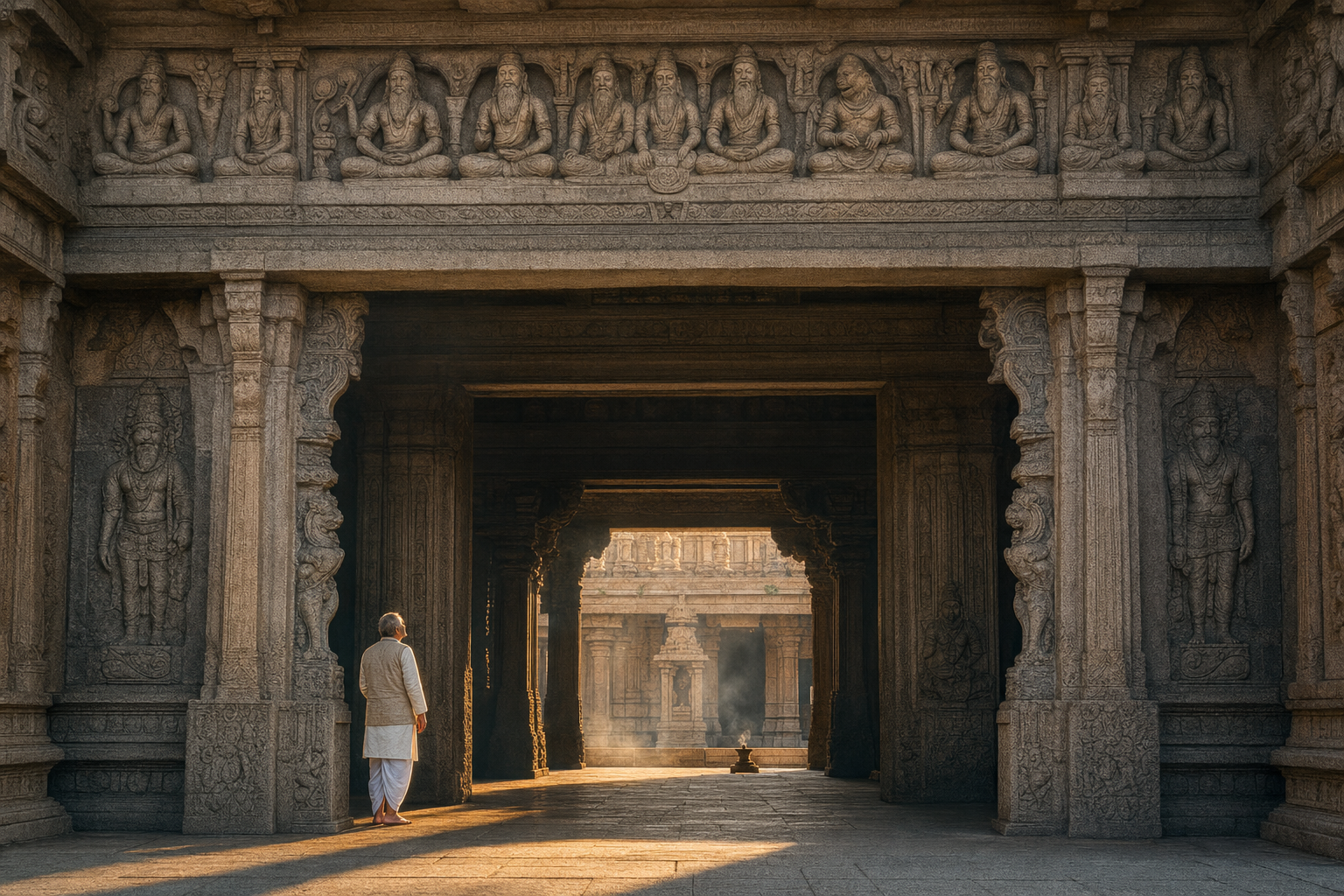
Agamic personification is performative theology. The image belongs to a precinct shaped by Veda-pārāyaṇa, homa, festival recitation, conches, cymbals, measured svara, and human breath. Near a place of chanting, a Veda mūrti reinforces that acoustic order. It does not merely label knowledge; it teaches the bodily conditions through which knowledge is received and carried.
This is why the icon loses something when treated only as an unusual museum object. Its open mouth belongs with recitation. Its ears belong with attentive hearing. Its rosary belongs with repetition. Its water vessel belongs with restraint. Its position in a larger ensemble belongs with an ordered sacred world.
On your next temple visit, resist naming the figure from the face alone. First see the complete sculptural band. Then examine posture, hands, and implements. Listen to the precinct before asking how the local lineage identifies the image. If the evidence remains partial, keep your language partial.
Once the identification is secure, let it become instruction. Recite carefully, listen before interpreting, return to study without demanding novelty, and carry what you learn into conduct. That is how a personified Veda stops being an iconographic curiosity and resumes its proper place as a living teacher.