
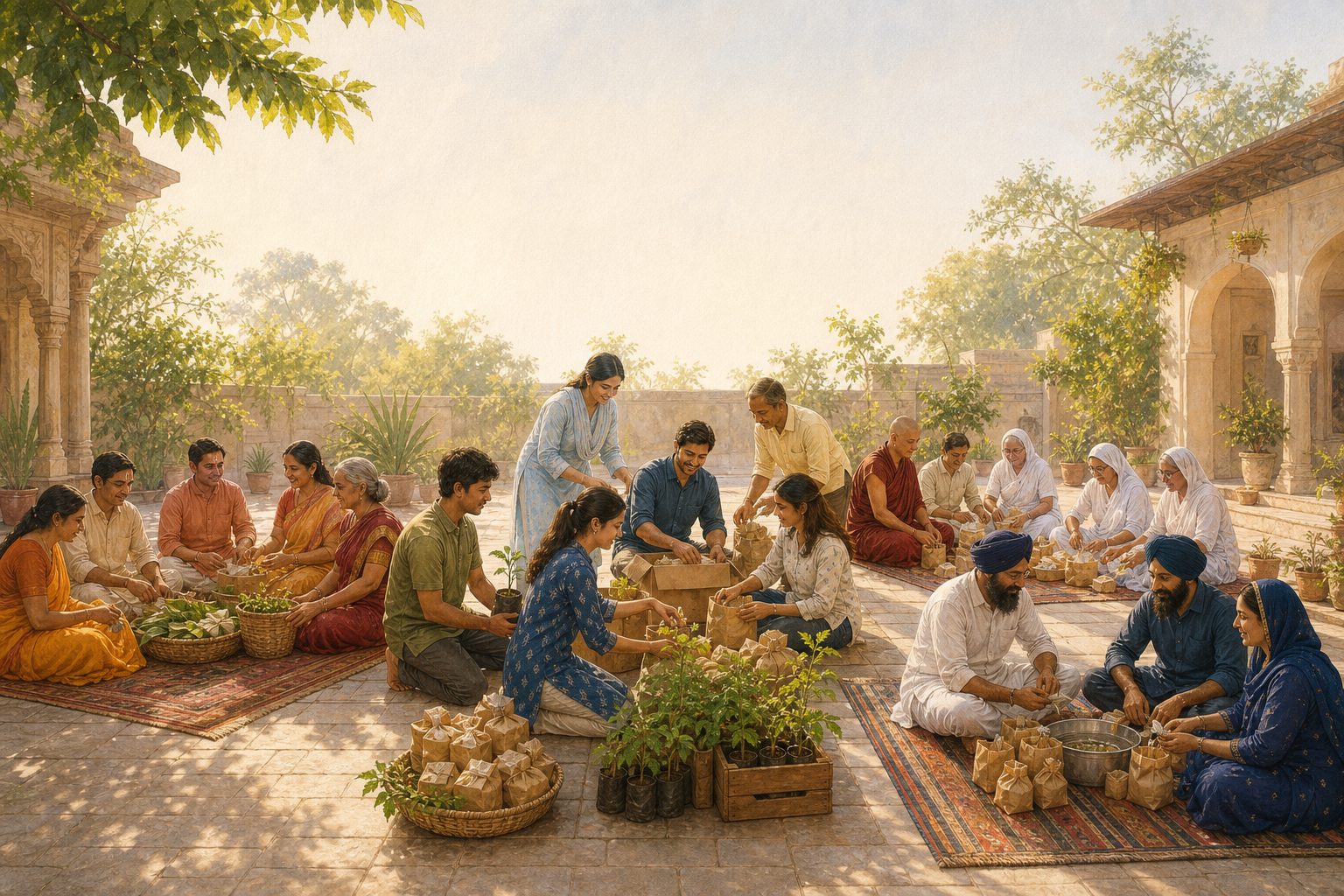
You want Hindus, Buddhists, Jains, and Sikhs to stand together, but the conversation can go wrong in two opposite ways. One side turns unity into a demand that every tradition accept the same identity. The other becomes so cautious that nothing remains except polite distance.
There is a better approach. Build cooperation around shared ethical work, let every community describe itself, and treat theological difference as a boundary to respect rather than a problem to hide. That makes Dharmic unity strong enough for real life.
Name the kind of unity you are asking for
Many Hindus use Sanatan Dharma to describe an enduring spiritual and ethical order: dharma that must be discerned, practised, and renewed in changing circumstances. It is not merely a membership label. It asks how a person should live, what responsibilities hold a community together, and how human conduct should relate to the wider living world.
That Hindu self-understanding can support generous relations with other traditions. It should not, however, become a shortcut for assigning an identity to Buddhists, Jains, or Sikhs without their consent. Dharmic unity is most credible when it means civilizational kinship, ethical cooperation, and mutual protection of spiritual freedom. It does not require a merged theology.
Before making a unity claim, identify its level. Agreement at one level does not automatically establish agreement at the others.
| Level | What you can reasonably seek | What to avoid |
|---|---|---|
| Ethical | Cooperation around honest conduct, restraint from harm, compassion, service, and self-discipline | Claiming that the reasons behind those disciplines are identical |
| Civilizational | Recognition of related histories, shared cultural space, and responsibilities toward Bharat’s heritage | Reducing every community to a branch of one modern identity |
| Theological | Respectful inquiry into teachings, practices, and genuine disagreements | Announcing consensus that the participating traditions have not affirmed |
This distinction also matters when you use the word Hindutva. Some people intend it as the cultural expression of a Hindu way of life; others hear a narrower political claim. Do not assume the word carries the same meaning for everyone in the room. Define your use through conduct: responsibility, heritage stewardship, ethical education, service, and openness to examination and reform. If a term produces more heat than clarity, state the duties you mean instead of arguing over the label.
Build common ground from disciplines, not slogans
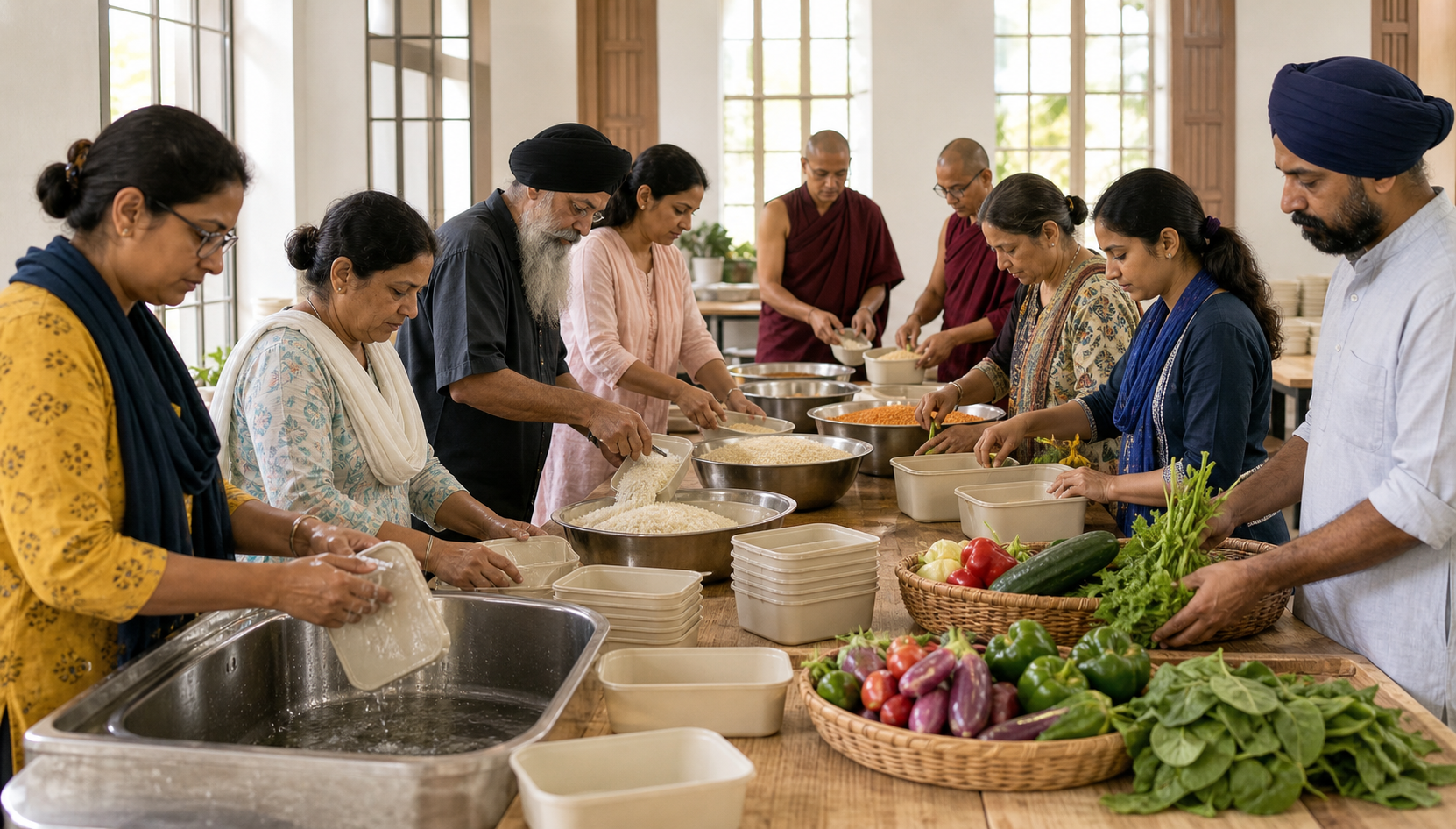
The most workable meeting point is a family of ethical disciplines: restraint from harm, truthfulness, compassion, service, and inner formation. These principles appear across Hindu, Buddhist, Jain, and Sikh life, though their philosophical foundations, scope, and methods are not interchangeable.
Use that common ground by turning each value into a question about conduct:
- Dharma: What responsibility belongs to us in this situation, rather than merely what outcome do we prefer?
- Ahimsa: Can we oppose harm without humiliating a community, denying a fact, or treating anger as evidence?
- Satya: Have we described every tradition in language its own adherents would recognize?
- Karuna: Who will bear the burden of our decision, especially if that person has little influence over it?
- Seva: What useful work will follow our declaration of unity?
- Inner discipline: Are we asking others to show a restraint, honesty, or humility that we have excused ourselves from practising?
This method keeps unity from becoming decorative. A stage full of representatives may produce an attractive photograph, but it does not prove trust. A stronger sign is that the same people can name a local need, divide responsibility fairly, complete the work, and address disagreement without questioning one another’s right to belong.
Ahimsa is especially easy to turn into a vague appeal for quiet. It should not be used to suppress a principled objection or to demand passivity in the presence of injustice. In a unity effort, ahimsa governs the means: do not lie about an opponent, make an entire community answer for one person, or use degradation as a substitute for argument. You can defend a boundary firmly while refusing needless harm.
Protect difference as part of the relationship

Within Hindu life, the acceptance of diverse Ishta has helped sustain spiritual freedom: people may orient worship toward different forms of the divine without requiring one chosen form to erase the others. That plural habit offers a valuable ethic of hospitality. It is not permission to redescribe non-Hindu traditions as though their differences were merely variations in Hindu worship.
When you convene a Dharmic gathering, put four safeguards in place:
- Self-definition: Let each participating community name its tradition, commitments, and internal diversity in its own words.
- Ritual consent: Distinguish being present from joining a ritual. No guest should have to recite, bow, receive a religious mark, or affirm a doctrine as the price of cooperation.
- Accurate attribution: Do not treat satsang, meditation, langar, and anna-dana as interchangeable decorations. Use their proper names, explain the setting, and allow practitioners to present their meaning.
- Honest disagreement: If traditions differ about ultimate reality, liberation, authority, ritual, or social duty, say that respectful cooperation does not settle those questions.
These boundaries do not weaken unity. They make participation safer because people know they will not be absorbed, displayed, or misrepresented. Trust grows when a Hindu can speak as a Hindu, a Buddhist as a Buddhist, a Jain as a Jain, and a Sikh as a Sikh while all remain responsible for how they treat one another.
The same rule applies inside Hindu society. Sanatan Dharma includes many sampradayas, philosophies, gurus, regional customs, and forms of worship. Do not praise pluralism across religions while demanding artificial uniformity among Hindus. Ask whether your language leaves room for different Ishta, modes of practice, and reasoned interpretation without turning every disagreement into disloyalty.
Turn unity into a project people can evaluate
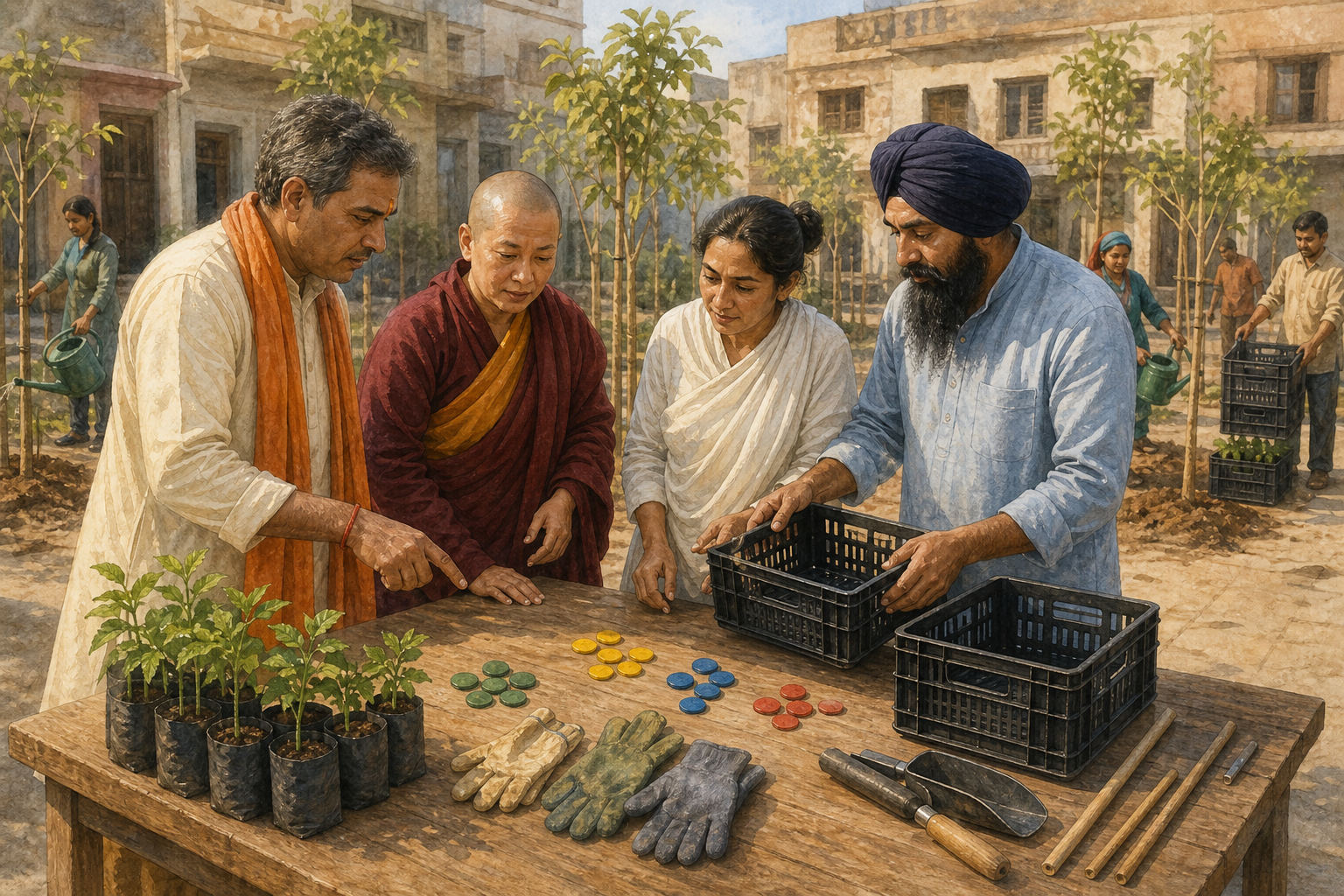
For a dialogue, festival, or cultural gathering
Begin with a narrow purpose. A usable statement is: Hindu, Buddhist, Jain, and Sikh neighbours will cooperate on a named community need while each tradition explains its own motivation in its own voice. Participation expresses goodwill and shared responsibility, not theological agreement.
- Invite representatives to help design the gathering before its title, programme, and publicity have been fixed.
- Separate tradition-specific observances from the common civic or service activity. Tell participants which parts are optional.
- Give each community equal authority to correct how it is introduced. Do not rely on one speaker to define everyone else.
- Explain the host tradition’s customs before guests encounter them, including what respectful observation looks like.
- End with a named responsibility, an owner, and a follow-up point. Without that handoff, goodwill usually remains ceremonial.
Festivals can become cultural meeting points that transmit values, but shared celebration does not mean pretending every festival belongs to every tradition in the same way. Let the host explain its meaning. Let guests decide how to participate. Add a common act of hospitality or service that does not depend on accepting the host’s theology.
For a seva initiative
Choose a need that is concrete enough to verify. Health, education, and environmental care offer natural fields for cooperation because the benefit can extend beyond the participating communities.
- For a community meal, agree on dietary requirements, preparation responsibilities, serving customs, accessibility, and the destination of unused food. Preserve the proper meaning of langar or anna-dana instead of inventing a generic ritual around them.
- For education, let practitioners present their own teachings on truth, service, or self-discipline. Pair scriptural reflection with questions, critical inquiry, and a practical assignment rather than requiring passive agreement.
- For environmental care, select a visible local responsibility such as caring for a shared site or reducing waste at community events. Explain each tradition’s motivation separately, then perform the work together.
Define success before the activity begins. Useful indicators are whether the promised work was completed, beneficiaries were treated with dignity, responsibilities were shared rather than shifted to one community, participants were represented accurately, and the group is willing to cooperate again. Attendance and publicity may matter, but neither tells you whether unity survived contact with responsibility.
A decision test for difficult moments
When disagreement appears, ask these questions before answering publicly:
- Is this an ethical, civilizational, or theological disagreement?
- Have we allowed the affected community to define its own position?
- Does our proposed solution require anyone to accept an identity or doctrine they have not chosen?
- Can we preserve cooperation while stating the disagreement plainly?
- What action would demonstrate satya, ahimsa, karuna, and seva here?
If you cannot answer the first question, pause the argument. Many conflicts become needlessly severe because one person makes an ethical appeal while another hears a theological demand. Name the level first; then decide whether the moment requires correction, consent, dialogue, or shared work.
Key takeaways
- Dharmic unity should mean principled relationship and cooperation, not compulsory sameness.
- Start with shared disciplines such as truthfulness, restraint from harm, compassion, service, and inner responsibility.
- Let Hindu, Buddhist, Jain, and Sikh communities describe their own beliefs and boundaries.
- Separate common civic action from optional, tradition-specific worship.
- Judge unity by completed responsibilities, accurate representation, and durable trust rather than slogans or photographs.
Begin with the next event already on your calendar

Take the next satsang, festival, youth programme, meal, or service activity you are helping to organize. Rewrite its purpose in one sentence. Name the common responsibility, state that every tradition retains its own voice, identify who will co-design the activity, and make participation boundaries clear before invitations go out.
If you cannot name the work, the consent, and the people sharing authority, the plan is not ready to carry the language of unity. Fix those elements first. You do not preserve Sanatan Dharma by making another tradition disappear. You preserve it by practising dharma with enough clarity and confidence to cooperate without coercion.
References
