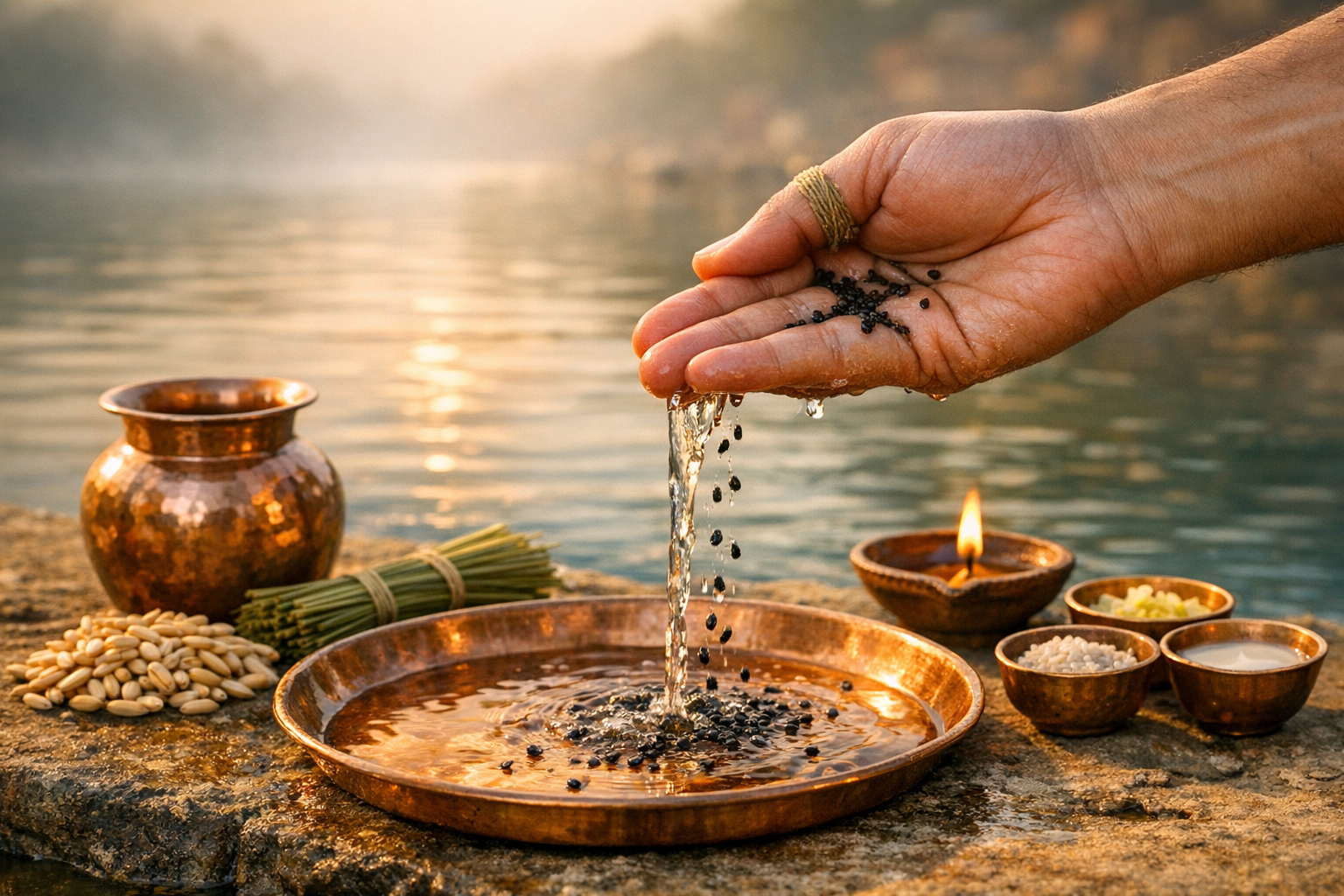
Tarpan in Hinduism is a sacred water oblation offered with devotion (shraddhā) to Devas, Ṛṣis, and Pitṛs (ancestors). The term derives from the Sanskrit root “trip,” meaning to satisfy or gladden, and the ritual’s goal is precisely thatsatisfying those who nurture and precede. In practice, Tarpan uses clean water infused with sesame (tila), barley (yava), and darbha (kuśa grass), accompanied by mantras and precise hand gestures. It stands at the heart of Hindu rituals associated with gratitude, remembrance, and continuity across generations.
Scriptural groundings for Tarpan are found widely across Gṛhya Sūtras (such as Āpastamba, Baudhāyana, and Kātyāyana), Dharmasūtras and Dharmashāstras, and Puranic texts (notably sections of Garuḍa Purāṇa and Viṣṇu Purāṇa). While details vary by lineage (kula) and region, the ritual architecture remains consistent: purity, intention, correct orientation and hand position (tīrthas of the palm), appropriate offerings, and recitation of mantras. This consistency creates a recognizable Vedic pattern that is both deeply traditional and broadly adaptable.
It is helpful to distinguish Tarpan from Śrāddha. Śrāddha is a broader rite of honoring Pitṛs with cooked rice-balls (piṇḍa), food offerings, and hospitality to Brāhmaṇas; Tarpan is the libation of water (tilodaka when sesame is added). Many Śrāddha procedures incorporate Tarpan, and during Pitṛ Pakṣa (the fortnight dedicated to ancestors), Tilatarpaṇa gains special prominence, culminating on Mahālaya Amāvasyā.
Across dharmic traditions, the ethical and emotional core of Tarpangratitude to forebears and compassion for all beingsfinds resonances. Buddhist communities observe Ullambana (a remembrance of departed beings) in some regions; Jain communities uphold deep reverence for family lineage and ethical remembrance; Sikh teachings center profound respect for parents, elders, and community memory. These parallels underscore a shared civilizational value: honoring those who made present life possible, fostering unity in diversity among Hindu, Buddhist, Jain, and Sikh traditions.
Core principles of Tarpan include five elements: shraddhā (sincere intention), śauca (personal and environmental purity), deśa-kāla (place and time selection), nyāsa and āsana (proper seating and orientation), and mantra-mudrā (correct recitation and hand use). Technically, practitioners recognize distinct tīrthas of the right palm for each offering: Deva-tīrtha at the fingertips, Ṛṣi-tīrtha at the center of the palm, and Pitṛ-tīrtha near the base of the little finger. Allowing the water to flow from the correct palm-zone integrates body, speech, and intention with scriptural method.
Time selection varies by type. Deva and Ṛṣi Tarpan are commonly integrated within daily Sandhyā rituals around sunrise and sunset, facing east. Pitṛ Tarpan is traditionally performed facing south, especially on Amāvasyā, eclipses (grahaṇa), and during Pitṛ Pakṣa. Regional calendars may advise additional days such as Saṅkrānti (solar ingress) and specific tithis linked to family śrāddha. The ecological spirit of Hindu dharma encourages mindful use of clean water and biodegradable materials even when performed at sacred rivers.
Preparations typically include bathing, wearing clean garments, and sitting on a kuśa or clean seat. A darbha ring (pavitra) is placed on the right ring finger; the sacred thread (yajñopavīta) position shifts by recipient category: upavīta (left shoulder to right hip) for Devas, nivīta (around the neck) for Ṛṣis, and prācīnāvīta (right shoulder to left hip) for Pitṛs. Tilodaka is prepared by adding black sesame (preferred for Pitṛ rites), barley, and clean darbha tips to water in a copper or earthen vessel.
A general procedure unfolds as follows. A brief ācamanam (sipping water for ritual purity) is performed, followed by a concise saṅkalpa declaring time, place, and intentionfor example: “asminn amāvasyāyām pitṛ-tarpaṇam kariṣye.” The practitioner orients in the appropriate direction, takes water in the right hand forming the correct palm-tīrtha, recites the relevant invocation, and lets the water flow gently onto clean ground or a designated vessel. Offerings are repeated as prescribed, concluding with prayers for universal welfare (sarva-bhūta-hita) and remembrance of teachers and elders.
Nitya Tarpan (daily) integrates Deva, Ṛṣi, and Pitṛ offerings into Sandhyā. It usually involves three libations for each group, though recensions vary. The aim is steady remembrancesustaining a daily rhythm of gratitude that complements formal śrāddha.
Naimittika Tarpan (occasional) is performed on special temporal junctures: Amāvasyā, eclipses, Saṅkrānti, death anniversaries (tithi-śrāddha days), and sometimes on birthdays or auspicious milestones. Scriptures regard these liminal times as ritually potent for purification and blessing (śuddhi and śreyas).
Deva Tarpan pays homage to presiding deities and guardian powers. Performed facing east, it uses the Deva-tīrtha (fingertips) with the upavīta position. A simple invocation commonly used is: “Om devatābhyo namaḥ tarpayāmi.” Many lineages further enumerate guardian deities, lokapālas, and Viśvedevas according to their traditional lists.
Ṛṣi Tarpan recognizes knowledge lineagesSaptarṣis and other sages who preserved Vedic revelation and dharma. It is offered using the palm-center (Ṛṣi-tīrtha) with the nivīta thread position. An often-heard formula is: “Om ṛṣibhyo namaḥ tarpayāmi,” expanded by some schools to name Kashyapa, Atri, Bharadvāja, Viśvāmitra, Gautama, Jamadagni, and Vasiṣṭha, along with devarṣis and rājarṣis.
Pitṛ Tarpan is the heart of ancestral veneration. Performed facing south with the prācīnāvīta thread position, it uses the Pitṛ-tīrtha (base of the little finger). A common formula is: “Om pitṛbhyo svadhā namaḥ tarpayāmi.” When permitted by family custom, names and gotras of father, grandfather, great-grandfather (and the corresponding maternal lineagemother, grandmother, great-grandmother) may be recited. Where a direct ancestor is living, traditions usually omit that specific name, instead offering to “sarva-pitṛbhyaḥ.”
Tilatarpaṇawater sanctified with sesameis particularly praised for Pitṛ rites. Classical texts extol tila as purifying and pacifying (śāntikara) for unsettled ancestral obligations (ṛṇa). During Pitṛ Pakṣa and on eclipses, Tilatarpaṇa becomes a central practice for many households.
Ekoddiṣṭa Tarpan focuses on a single, recently departed ancestor prior to the sapīndīkaraṇa rite. It supports the transitional phase (antyeṣṭi aftermath), often accompanied by specific mantras taught within a family tradition. Given the sensitivity of bereavement, lineages advise strict adherence to one’s kula-achāra and the guidance of a competent priest.
Tīrtha Tarpan is performed at sacred rivers and lakesGaṅgā, Yamunā, Godāvarī, Narmadā, Kṛṣṇā, and Kaveri among otherswhere the sanctity of place is believed to amplify the merit (puṇya) of the offering. Gaya Tarpan and Piṇḍadāna are especially renowned; many families also visit Prayagraj, Haridwar, and Kashi for Tarpan during major observances.
Vr̥ddhi-Śrāddha with Tarpan appears in certain regions during auspicious family occasions (such as the birth of a child), seeking Pitṛ blessings for expansion and wellbeing. Though celebratory, it retains the composure and sobriety of offering, acknowledging that all prosperity flows from the grace of Devas, Ṛṣis, and Pitṛs.
Kamya Tarpan is undertaken for specific intentionshealth, clarity, family harmony, or communal welfare. Classical dharma literature emphasizes that such wishes be framed within dharmic bounds, including ecological care, non-harm (ahiṃsā), and inclusive social wellbeing (lokasaṅgraha).
Regional expressions add rich cultural texture. In Bengal, Mahālaya at the close of Pitṛ Pakṣa is widely observed; Tarpan on riverbanks at dawn precedes the advent of Śāradīya Durga Puja, interweaving remembrance with the welcoming of the Goddess. In South India, Nitya Tarpan is often embedded in Sandhyāvandanam, with clear procedures for thread positions, palm-tīrthas, and mantra recitation. Elsewhere, householders may perform simplified Tarpan at home with careful Sankalpa and clean water.
Family customs also address inclusion and responsibility. When a male heir is unavailable, several traditions allow a daughter, wife, or other close relative to perform Tarpan with appropriate Sankalpa. Diaspora communities often adapt by using clean bowls at home, ensuring ecological mindfulness and fidelity to intention. The overarching principle remains shraddhā: it is sincere remembrance, not ostentation, that sanctifies offering.
Mantra usage varies, but common templates help. For Devas: “Om devatābhyo namaḥ tarpayāmi.” For Ṛṣis: “Om ṛṣibhyo namaḥ tarpayāmi.” For Pitṛs: “Om pitṛbhyo svadhā namaḥ tarpayāmi.” For a specific ancestor: “Om [amuka gotrasya] [nāmnā] pitṛyai svadhā namaḥ tarpayāmi.” Where lineages insist on exact recensions, the family priest’s guidance takes precedence.
Technical considerations improve accuracy. Counting of libations may be three for Deva-Ṛṣi-Pitṛ in Nitya Tarpan, while Pitṛ Pakṣa Tarpan can follow a śoḍaśa (sixteen-fold) model or other enumerations. Black sesame is often preferred for Pitṛs; white sesame or akṣata (uncooked rice) may be used in Deva offerings by some schools. The right-hand palm should be used, with water released smoothly and respectfullynever splashed or spilled carelessly.
Ethical and psychological dimensions of Tarpan are significant. Ritual remembrance can aid families in grief processing, fostering acceptance, continuity, and intergenerational healing. The environmental ethic is intrinsic: use only needed quantities of water; prefer copper or clay vessels; and respect local ecosystems when performing Tarpan at open water bodies. Such practices align dharmic duties (dharma) with modern sustainability goals.
Common points of caution are worth noting. Observances during a period of household impurity (sūtaka/āśauca) may be postponed according to lineage rules. One should avoid naming a living ancestor in Pitṛ Tarpan. Cleanliness and correct thread position must be maintained, and the recitation should be steady and heartfelt rather than hurried.
For those seeking a succinct checklist: prepare clean space and tilodaka; don the darbha ring; adopt correct thread position (upavīta/nivīta/prācīnāvīta) as per recipient; face the proper direction; perform ācamanam; state a clear saṅkalpa; use the correct palm-tīrtha; recite the appropriate formulas; release the water mindfully; and conclude with prayers for the welfare of all beings. This sequence harmonizes the technical and the devotional.
In its essence, Tarpan braids metaphysics, ethics, and emotion. It acknowledges a chain of givingfrom cosmic powers to sages to forebearsflowing into the present and onward to future generations. By honoring this chain through water, sesame, darbha, and mantra, families cultivate gratitude, cultural memory, and spiritual steadinessvalues that resonate across Hinduism and sister dharmic traditions seeking harmony, remembrance, and collective uplift.
Inspired by this post on Hindu Blog.