
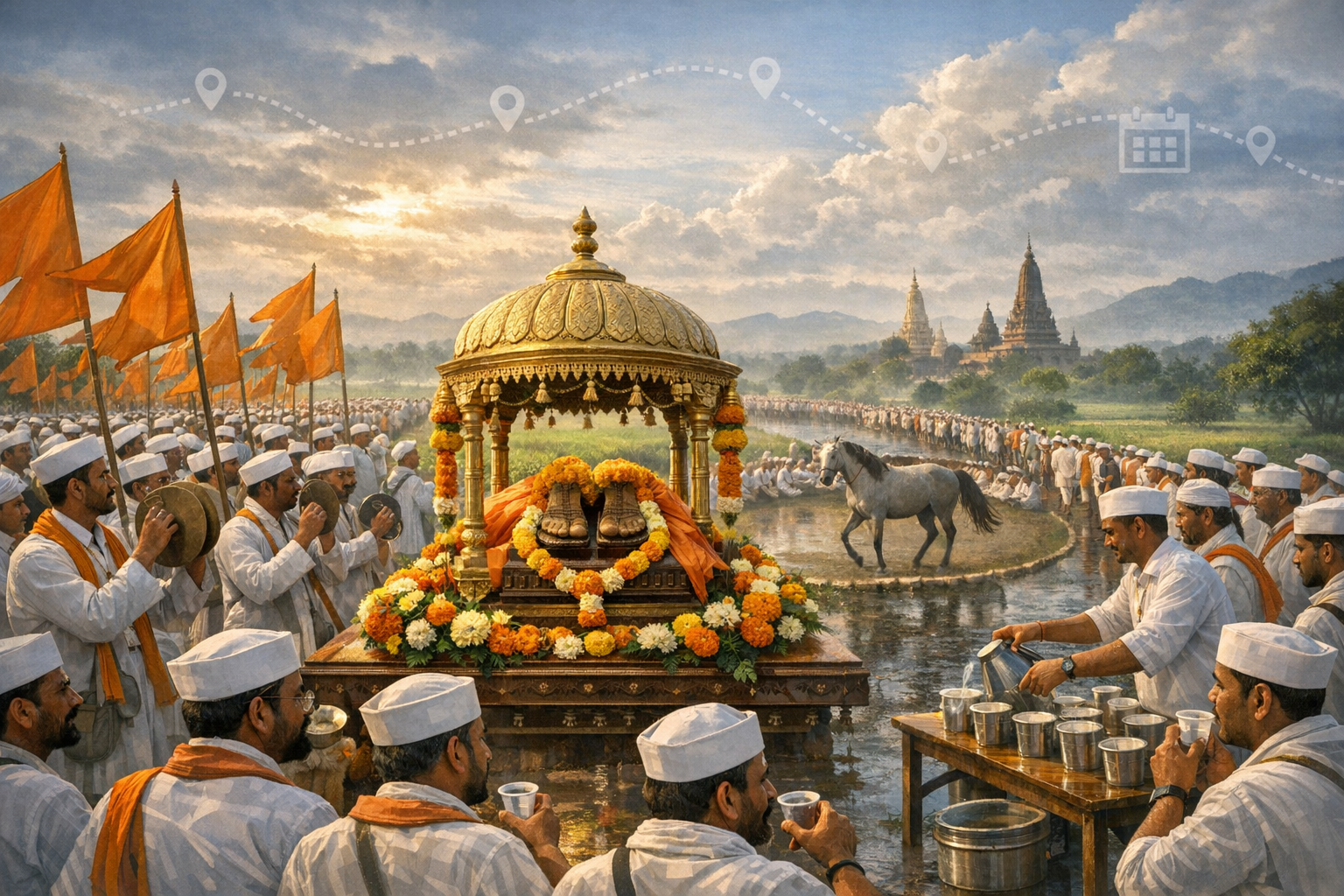
Sant Dnyaneshwar Maharaj Palkhi 2026 forms the beating heart of the Pandharpur Waari Yatra 2026 (Ashadi/Ashadhi Ekadashi Yatra), uniting lakhs of Varkari devotees in an annual tirtha-yatra that is at once devotional, cultural, and meticulously organized. For 2026, the Sant Dnyaneshwar Palkhi departs from Alandi on 8 July 2026 and reaches Pandharpur on 25 July 2026, aligning with the auspicious Ashadha season and culminating around the sacred observances associated with Ashadhi Ekadashi at the Shri Vitthal Rukmini Mandir.
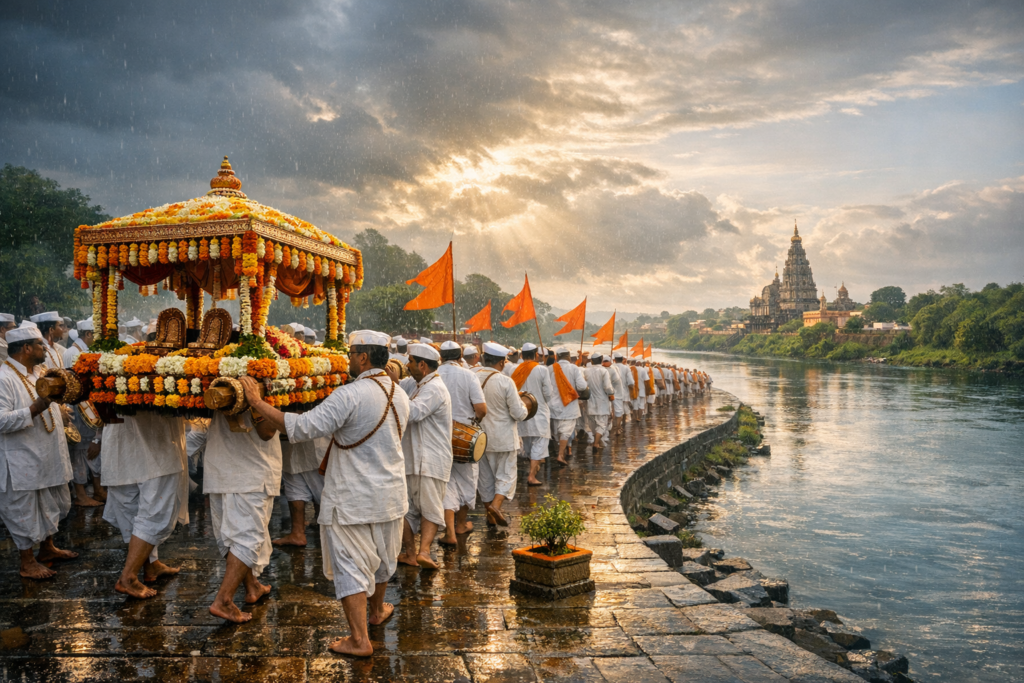
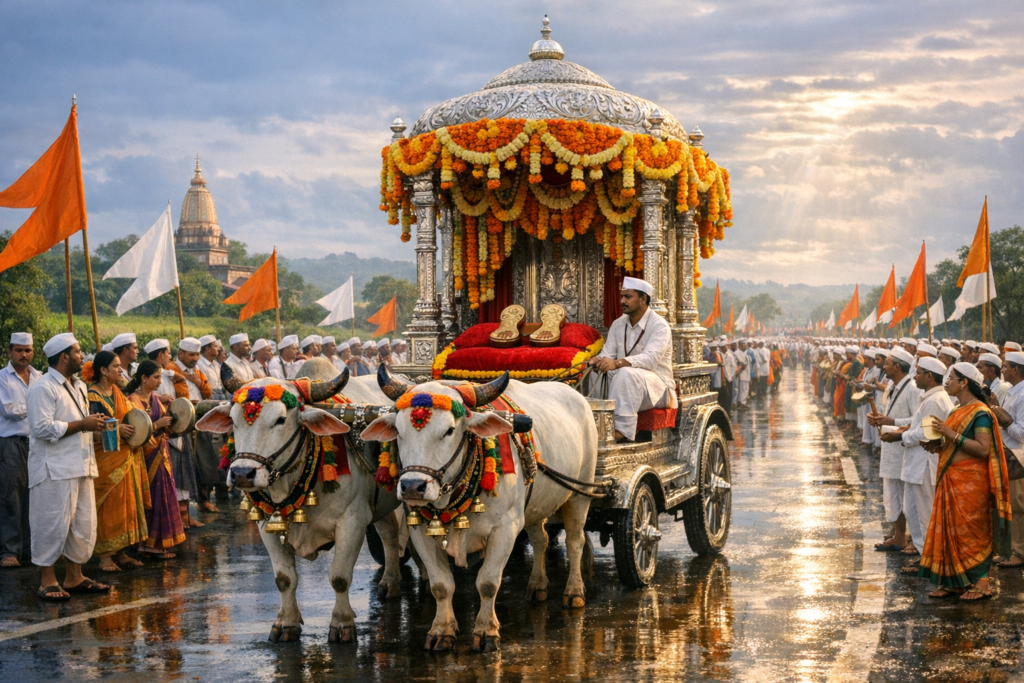
In the Varkari sampradaya, a “Palkhi” carries the paduka (sacred sandals) of a Sant, transforming a long-distance foot journey into a moving temple. The Dnyaneshwar Palkhi from Alandi and the Tukaram Palkhi from Dehu together anchor Maharashtra’s most deeply loved Waari, a tradition whose inclusive bhakti ethos resonates broadly across dharmic communities. The experience extends beyond sectarian lines, emphasizing kirtan, seva, and ethical living—principles that also find kinship in the contemplative and service traditions of Hinduism, Buddhism, Jainism, and Sikhism.
Historically, the Waari’s Palkhi-format was consolidated in the early nineteenth century under visionary organizers who synchronized multiple dindis (pilgrim troupes) into a coherent, safe, and repeatable route. Over time, civil administrations along the corridor—from Alandi and Pune through the plateau towns to Pandharpur—have developed a robust logistical framework that accommodates foot pilgrims, service volunteers, and local communities hosting the procession.
The 2026 schedule confirms two non-negotiable anchors for planning: the start from Alandi on 8 July 2026 and the arrival at Pandharpur on 25 July 2026. Official micro-schedules for each day’s start time, morning halt, lunch break, evening aarti, and night stay are typically announced by the Palkhi Sohala Samiti in coordination with district administrations along the route. As in previous years, daily stages generally range between roughly 12 and 20 kilometers, paced to balance collective movement, ritual obligations, and rest.
The route traditionally follows an Alandi–Pune–Saswad–Jejuri–Lonand–Natepute–Malshiras–Wakhari–Pandharpur corridor, with variations as determined by road conditions, crowd management, and host-community capacity. Within major towns, the Palkhi’s entry and exit sequences are planned to facilitate public darshan while preserving the procession’s momentum and safety. Specific halting points—especially for the morning halt and lunch break—are selected based on water access, sanitation, medical stations, and space for dindis to regroup.
The daily rhythm of the Dnyaneshwar Palkhi is distinctive. Pre-dawn preparations and mangal aarti set the tone before the Palkhi steps off in the early hours. A planned morning halt allows pilgrims to regroup, hydrate, and attend short kirtan or pravachan sessions. A midday lunch break—often supported by community-led anna-daan—provides sustained rest during the day’s peak humidity, before the Palkhi resumes a measured march toward the designated evening halt. Night halts are marked by collective bhajans, abhangas, and seva, maintaining the devotional cadence that defines the Waari.
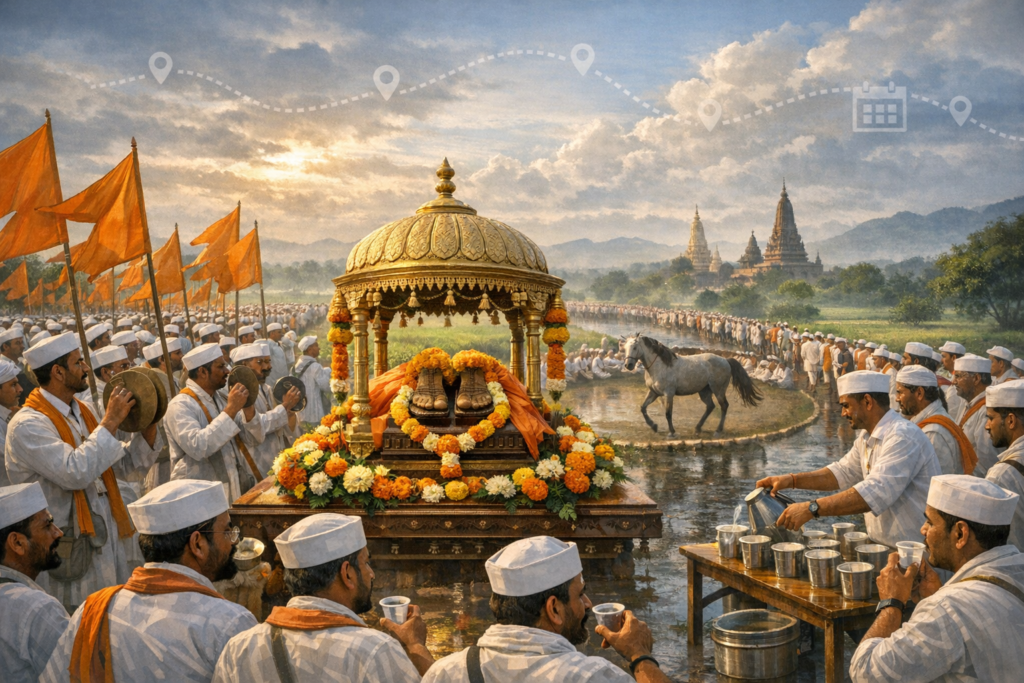
Ritual highlights include the darshan of the paduka, continuous abhang-gayan, and the famed ringan, where the Palkhi’s sacred horses circle a path marked in the soil, symbolically blessing those present with the merit of the journey. These practices, deeply rooted in the Varkari imagination, are also pedagogical: they model simplicity, equality, nonviolence, and service—values shared widely across dharmic traditions.
Participation remains open and community-driven. Dindis typically coordinate internally for discipline, rest, food, and cleanliness, while pilgrims joining independently often align with host committees en route. The inclusive nature of the Waari encourages seva by local volunteers, social organizations, and medical teams, who staff first-aid points, mobile clinics, and hydration counters—particularly crucial in Ashadha’s monsoon conditions.
For those planning to commence from Alandi, access via Pune offers the most practical gateway. Alandi, revered as the samadhi-sthal of Sant Dnyaneshwar Maharaj, becomes the spiritual launch pad for the 2026 Palkhi on 8 July 2026. For the conclusion at Pandharpur on 25 July 2026, travelers should anticipate high footfall around Wakhari and the town’s approach roads, along with queue management systems near the Shri Vitthal Rukmini Mandir for darshan during the Ashadi (Ashadhi) Ekadashi period.
Accommodation during the Waari spans community tents, school or community halls allocated temporarily, dharmashalas, and limited private stays. Pilgrims benefit from carrying light, quick-dry clothing, reliable rain protection, a compact medical kit (including blister care), reusable water bottles, and identification. Footwear suited to long, wet walks—sturdy yet breathable—helps mitigate fatigue and foot injuries in slushy monsoon stretches.
Food and water are largely provided through anna-daan and local kitchens that honor the Waari’s ethic of shared sustenance. Nevertheless, maintaining a personal hydration routine and carrying simple dry snacks is advisable. Many host points arrange filtered water; pilgrims should use designated refill stations to reduce plastic waste and support the Waari’s growing sustainability commitments.
Public health and safety are central to the Waari’s organization. District health departments, police, and disaster management units collaborate to maintain medical posts at halts and along intermediate stretches. Crowd flows are channeled through barricaded lanes in dense areas, while traffic diversions and temporary parking zones protect pedestrian priority on procession days. Pilgrims are best served by following marshal instructions, honoring quiet hours at night halts, and refraining from obstructing the Palkhi’s core path.
Accessibility considerations have improved steadily. Families, seniors, and differently abled devotees often rely on short-stage participation, strategic joining points, and assistance from volunteer teams trained to help with seating, shade, and steady access to water. The spirit of mutual care—seva—ensures that the Waari’s devotional goals remain aligned with public welfare and dignity.
The Waari’s dharmic inclusivity is increasingly recognized as a living model of unity in diversity. While rooted in the Varkari bhakti of “Vithoba–Rukmini” devotion, it welcomes seekers from varied spiritual paths who resonate with its ethical and contemplative spirit. The shared practices of kirtan, meditation, self-discipline, and service echo through Hindu, Buddhist, Jain, and Sikh traditions, underscoring a civilizational ethic that honors many paths to the same ultimate truth.
Environmental stewardship has become a conscious pillar of recent Waari editions. Efforts to minimize single-use plastics, manage wastewater, and maintain cleanliness at halts are supported by volunteers and local authorities. Pilgrims can contribute by carrying reusable bottles and utensils, disposing waste responsibly, and joining cleanliness drives at the conclusion of each halt.
Arrival at Pandharpur is both climactic and contemplative. As the Palkhi reaches Wakhari and proceeds toward the temple town on 25 July 2026, the devotional energy intensifies with continuous abhangas and darshan preparations. Queue systems near Shri Vitthal Rukmini Mandir accommodate high-volume devotees; patient adherence to timings and instructions preserves the sanctity and safety of darshan for all.
To summarize the 2026 framework for planning: the Sant Dnyaneshwar Palkhi begins from Alandi on 8 July 2026 and arrives in Pandharpur on 25 July 2026. The official day-by-day micro-schedule—covering step-off times, morning halts, lunch breaks, evening aartis, night halts, and any route refinements—will be issued closer to the start by the Palkhi organizers with the support of district administrations. Pilgrims are encouraged to align their personal itineraries with these announcements to ensure a seamless, safe, and spiritually fulfilling Waari.
Participating in the Pandharpur Waari Yatra 2026 is an opportunity to experience the living continuity of the Varkari tradition: walking, singing, and serving together on a path sanctified by centuries of devotion to Sant Dnyaneshwar Maharaj and the grace of Vithoba. With thoughtful preparation, respect for local guidance, and a spirit of seva, the 2026 journey can be both personally transformative and a celebration of the broader dharmic commitment to compassion, harmony, and shared uplift.
Inspired by this post on Hindu Pad.








Leave a Reply
You must be logged in to post a comment.