Author: Ami Ganatra

  • Manasa Devi Puja 2026: Essential Dates, Rituals and Monsoon Wisdom Explained

    Manasa Devi Puja 2026: Essential Dates, Rituals and Monsoon Wisdom Explained

    Manasa Devi Puja 2026 honours eastern India’s serpent goddess through monsoon worship, household ritual and regional storytelling. The principal dates are 17 August for Nag Panchami-linked observances and 16 September for Ranna Puja, although several communities also worship on selected dates in July, August and early September. This guide explains why calendars differ and why…

  • Essential Tirumala VIP Break Darshan Cancellation Dates: July-September 2026

    Essential Tirumala VIP Break Darshan Cancellation Dates: July-September 2026

    This guide explains the Tirumala VIP Break Darshan cancellation dates for July, August, and September 2026 in a clear pilgrimage-planning format. It highlights July 14 for Koil Alwar Tirumanjanam and July 17 for Anivara Asthanam, while also explaining why August and September festival observances can affect VIP Break Darshan access. The article places these cancellations…

  • Narali Purnima 2026: Powerful Coastal Rituals, Meaning, Date and Traditions

    Narali Purnima 2026: Powerful Coastal Rituals, Meaning, Date and Traditions

    Narali Purnima 2026 falls on Friday, August 28, 2026, and is observed on Shravan Purnima. The festival is especially important in coastal Maharashtra, where fishing communities offer coconuts to the sea and pray to Varuna for safety, calm waters, and prosperity. It marks a ritual renewal of maritime life after the monsoon and reflects a…

  • Aadi Amavasai 2026: Powerful Date, Timings, Rituals, and Ancestral Meaning

    Aadi Amavasai 2026: Powerful Date, Timings, Rituals, and Ancestral Meaning

    Aadi Amavasai 2026 falls on Wednesday, August 12, 2026, for India and Tamil Nadu observance. The Amavasya Tithi is active from about 1:52 AM to 11:06 PM IST according to standard panchang calculations for New Delhi, with local variations possible. This important Tamil calendar observance is dedicated to forefathers, departed ancestors, and the sacred duty…

  • Bhagavad Gita 2.12 Reveals the Powerful Truth of God, Self, and Eternal Identity

    Bhagavad Gita 2.12 Reveals the Powerful Truth of God, Self, and Eternal Identity

    Bhagavad Gita 2.12 presents one of Krishna’s most profound teachings on the eternal nature of the self and the Supreme. This reflection explains why denying God also weakens the philosophical basis of personal identity, moral responsibility, and spiritual purpose. The article explores the verse in its Kurukṣetra context, showing how Krishna addresses Arjuna’s grief through…

  • Sant Muktabai Palkhi Sohala 2026: Powerful Wari Guide to Faith and Unity

    Sant Muktabai Palkhi Sohala 2026: Powerful Wari Guide to Faith and Unity

    Sant Muktabai Palkhi Sohala 2026 is a major Varkari pilgrimage connected with the Ashadhi Wari and the sacred journey from Muktainagar to Pandharpur. The procession carries the padukas of Sant Muktabai, honoring her legacy as a saint-poet, spiritual guide, and revered figure in Maharashtra’s bhakti tradition. This article explains the religious meaning of the palkhi,…

  • Ishana Shiva Iconography: Sacred Upward Gaze, Panchabrahma Power and Grace

    Ishana Shiva Iconography: Sacred Upward Gaze, Panchabrahma Power and Grace

    Ishana Shiva in murti form represents the upward-facing, liberating dimension of Lord Shiva within the Panchabrahma tradition. This article explains how Ishana relates to panchakritya, the fivefold cosmic activity of creation, preservation, dissolution, concealment, and grace. It explores the symbolism of the upward gaze, the role of sacred sound, and the connection between iconography, temple…

  • Maha Sadashiva: Awe-Inspiring 25-Faced Shiva Form and Its Cosmic Meaning

    Maha Sadashiva: Awe-Inspiring 25-Faced Shiva Form and Its Cosmic Meaning

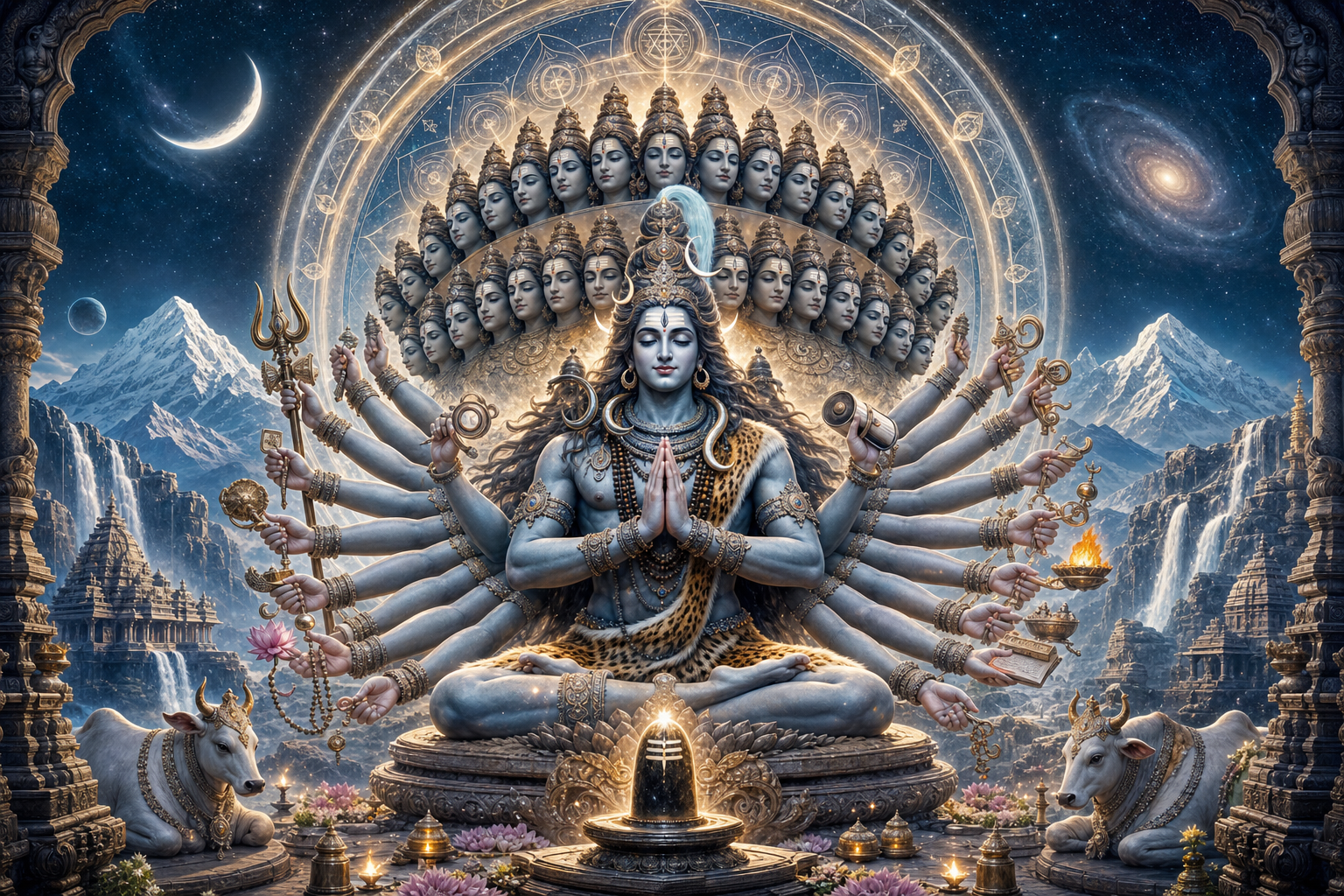
    Maha Sadashiva, the twenty-five-faced and fifty-handed form of Lord Shiva, represents one of the most profound achievements of Shaiva iconography. This form expresses the paradox of Shiva as both nirguna, beyond all attributes, and saguna, accessible through sacred form, ritual, mantra, and devotion. The twenty-five faces symbolize expanded consciousness, cosmic awareness, and the layered principles…

  • The Powerful Freedom of Letting Go: How Mindfulness Ends Self-Judgment

    The Powerful Freedom of Letting Go: How Mindfulness Ends Self-Judgment

    This reflective essay examines how mindfulness can become distorted when it turns into another form of self-control. Using the example of a rainy vacation day, it explains how suffering often increases when people judge their own disappointment, irritation, or anxiety. The piece connects emotional resistance with dharmic insights from Yoga, Buddhism, Jainism, and Sikh spirituality,…

  • Srimad Bhagavatam 3.26.47-49: Powerful Sankhya Wisdom on Senses and Earth

    Srimad Bhagavatam 3.26.47-49: Powerful Sankhya Wisdom on Senses and Earth

    Srimad Bhagavatam 3.26.47-49 offers a precise Sāṅkhya analysis of the senses, their objects, and the five gross elements. The passage explains hearing through sound, touch through air, sight through form, taste through water, and smell through earth. It also teaches that the effect carries the qualities of its cause, which is why earth is described…

  • Why Hinduism Offers Many Powerful Spiritual Paths for Every Kind of Seeker

    Why Hinduism Offers Many Powerful Spiritual Paths for Every Kind of Seeker

    Hinduism recognizes that spiritual growth cannot be identical for every person because human beings differ in temperament, capacity, duty, and life situation. This article explains how concepts such as adhikara, svadharma, the three gunas, Ishta Devata, Karma Yoga, Bhakti Yoga, Jnana Yoga, and Raja Yoga support a plural yet disciplined spiritual vision. It shows that…

  • Ardhanarishvara Shiva: Powerful Symbol of Divine Balance and Shakti Unity

    Ardhanarishvara Shiva: Powerful Symbol of Divine Balance and Shakti Unity

    Ardhanarishvara Shiva is the sacred half-male and half-female form of Lord Shiva and Parvati Mata, expressing the inseparable unity of Shiva and Shakti. This form teaches that consciousness and energy, stillness and activity, ascetic discipline and creative abundance are not opposing forces but complementary aspects of one divine reality. The Puranas preserve several narratives explaining…

  • Scotland Unveils Sushruta Statue: Honouring India’s Father of Surgery and Global Medical Legacy

    Scotland Unveils Sushruta Statue: Honouring India’s Father of Surgery and Global Medical Legacy

    A bronze statue of Maharishi Sushruta at the Royal College of Surgeons of Edinburgh honours India’s ancient medical heritage and affirms the global, polycentric roots of surgery. The Sushruta Samhitatraditionally dated to around 600 BCE and refined over centuriescodifies operative techniques, instruments, cadaveric dissection, and ethical practice with remarkable precision. Reconstructive breakthroughs such as rhinoplasty…

  • Bhakti Beyond Ritual: Renunciation and Absorption in the Gopalapurvatapani Upanishad

    Bhakti Beyond Ritual: Renunciation and Absorption in the Gopalapurvatapani Upanishad

    The Gopalapurvatapani Upanishad defines bhakti with striking precision as two inseparable movements: renunciation of both this world and the next, and unwavering absorption in the Supreme Self. This account goes beyond ritual and emotion, aligning devotion with the Upanishadic quest for liberation while integrating knowledge, meditation, and ethical clarity. By rejecting reward-seekingworldly or heavenlyit grounds…

  • Unlocking the Treasure Within: Chandogya Upanishad and a Dharmic Map to Self-Realization

    Unlocking the Treasure Within: Chandogya Upanishad and a Dharmic Map to Self-Realization

    A classic image from the Chandogya Upanishada person seated on a hidden treasure yet beggingcaptures a pervasive human error: mistaking instruments for essence. Vedanta clarifies this through pañca-kośa, three-body, and Mandūkya analyses, pointing to the Self as Sat–Cit–Ānanda and the core of Tat tvam asi. Related insights appear across Buddhism’s luminous mind, Jainism’s jīva purified…

  • Kamadeva Unveiled: Reclaiming Hinduism’s Sacred Science of LoveNot Lust

    Kamadeva Unveiled: Reclaiming Hinduism’s Sacred Science of LoveNot Lust

    Kamadeva in Hindu thought is not a Cupid-like figure of conquest but the ethically governed power of love and creative desire. Vedic and Atharvavedic sources locate kama at the heart of cosmogenesis, while Purāṇic narratives refine it through the Ananga episode and Pradyumna motif. Framed within the purusharthas, kama is pursued under dharma, distinguishing love’s…

  • Defying Caste, Riding the Tiger: Dombi Yogini’s Mahamudra that Awakened India’s Conscience

    Defying Caste, Riding the Tiger: Dombi Yogini’s Mahamudra that Awakened India’s Conscience

    Dombi Yogini’s legendan outcaste woman riding a tiger through the skyembodies the Tantric insight of Mahamudra while exposing the illusory basis of caste hierarchy. Grounded in the mahasiddha milieu of medieval India, the tale converges with Hindu Shakta yogini traditions and Buddhist Vajrayana narratives to affirm unity in spiritual diversity. The technical contours of Mahamudraluminous…

  • Awaken the Primordial Pulse: Tantric Science of Sabda Brahman, Mantra, and Living Sound

    Awaken the Primordial Pulse: Tantric Science of Sabda Brahman, Mantra, and Living Sound

    This in-depth exploration presents Sabda Brahman as the primordial vibration at the heart of Tantric science, explaining how sound unfolds through the four stages of speech from para to vaikhari. Readers gain a clear map of matrika and bija mantras, an understanding of how chakras like anahata and visuddha translate vibration into transformation, and practical…

  • Himayatnagar Venkateswara Brahmotsavams 2026: Dates, Rituals, and a Devotee’s Essential Guide

    Himayatnagar Venkateswara Brahmotsavams 2026: Dates, Rituals, and a Devotee’s Essential Guide

    The Himayatnagar Sri Venkateswara Swamy Temple Brahmotsavams will be observed under TTD guidance from 19–24 June 2026 in Hyderabad. The festival opens with Ankurarpanam and, in line with tradition, Dhwajarohanam, followed by Vahana Sevas, Sri Vari Shanti Kalyanam, Rathotsavam, and Snapana Tirumanjanam. It culminates on 24 June with Chakrasnanam, Pushpayagam, and Dhwajavarohanam. This comprehensive guide…

  • Purusottama Month 2026 in Mayapur: Sacred Timekeeping, Austerity Vows, and Dharmic Unity

    Purusottama Month 2026 in Mayapur: Sacred Timekeeping, Austerity Vows, and Dharmic Unity

    The June 2026 ISKCON TV Video Diary spotlights Purusottama Month (Adhik Māsa), a rare intercalary period dedicated to Lord Vishnu and praised in the Padma Purāṇa. Readers gain a clear, technical explanation of the Vedic lunisolar calendar, including why Adhik Māsa appears about once every 2½ to 3 years and how sankranti governs its insertion.…