
This article was originally posted on the Dharma Dispatch Substack.
Preface
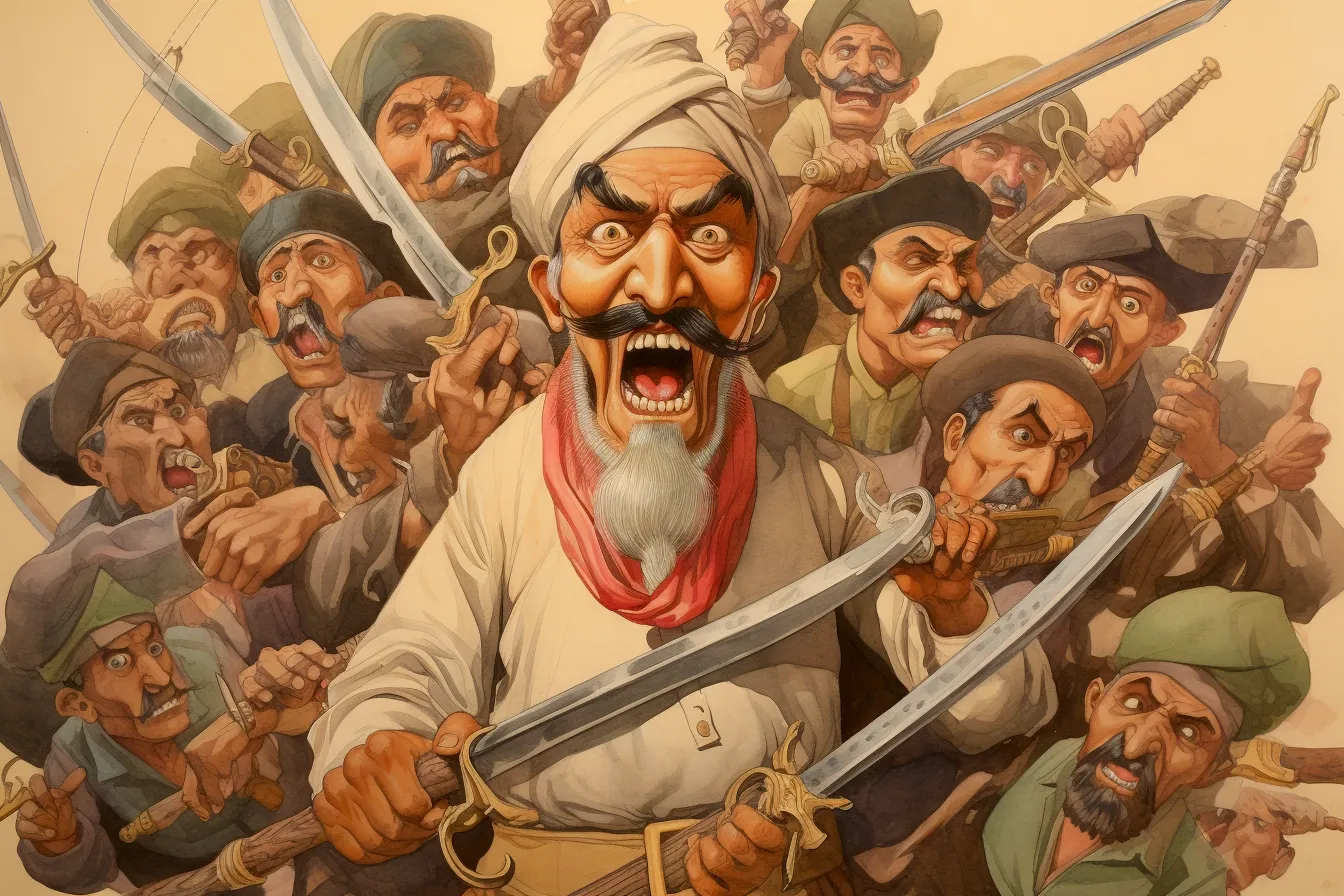
THE TEASER OF THE upcoming Telugu movie, Razakar is on expected lines. In less than two minutes, it showcases graphic clips of the Razakar atrocities against the Hindus in the dominions of the Nizam of Hyderabad. It closes with a shot of Sardar Patel’s back, a clear cue that the movie is themed on the liberation of Hyderabad.
Razakar is a really welcome addition to the corpus of Indian cinema based on historical themes. It is coming about half a century too late but better late than never. I would rate the movie highly if it succeeds in capturing the complex and protracted phenomena that necessitated its liberation in the first place. It would be an underwhelming experience if Razakar merely captures the widespread anti-Hindu terror that the Nizam’s fanatical squad unleashed this sort of cinematic treatment will place it just a step higher than a documentary. The converse is also true: a truly well-made documentary on historical events is one which is imbued with literary and dramatic elements.
A Historical Phenomenon
On the broadest plane, the story of the liberation of Hyderabad illustrates a familiar historical phenomenon which is rooted in a psyche which travelled to Bharatavarsha with Muhammad Bin Qasim’s raid, congealed during the Mughal rule and created Pakistan in the 20th century. Pakistan is the only Islamic state which was won not through traditional warfare but through street violence and… Mohandas Gandhi. Indeed, by the Nizam’s own tacit admission, it was the conceding of Pakistan that gave him the confidence to get a private Pakistan for himself in the Dakkhan.
The other facet of this historical phenomenon tells us that among all the Muslim-ruled Princely States, only Hyderabad, the last remnant of the Mughal Empire, was fully dissolved on November 1, 1956!
K.M. Munshi, who officially presided over the liquidation of the Nizam’s decrepit “empire” phrases this memorably: “From a long term point of view, the collapse of Hyderabad was a significant event in the history of India, for the Nizam’s rule was the last and the most outworn relic of the Mughal Empire.”
Maratha Shortsightedness
But the story dates back to a much earlier period. The untrammelled supremacy of the successive Nizams of Hyderabad substantially owes to the civilisational myopia of the Maratha Power which was at its peak well beyond the mid 18th century. At that peak, any Maratha ruler could have swatted out the current Nizam and annexed his territory to the engorged Maratha dominion. Sadly, the Marathas fell for the Nizams’ booty, flattery and guile and allowed them to continue their tyrannical regime. The East India Company and later, the imperial British crown, used the Nizam for its own subversive purposes.
We turn to Munshi again:
The Nizams would have been thrown on the scrap-heap of history by the Marathas long before the end of the 18th century… After 1857, the British Crown kept them… in power as a potential reservoir of strength in the event of a country-wide anti-British outburst. Later, the Nizams were the most glittering pendants to the Imperial Crown, as also counter-weights against militant nationalism. The Nizam’s Hyderabad had, therefore, lived because the British rulers were interested in maintaining them, though the people of the State had to pay a heavy price for it.
Oppressing the Hindu Majority
For all practical purposes, the Nizam dynasty was a British puppet but a deadly puppet that was free to inflict its will. And so, here was an alleged “kingdom” ruled by a tiny Muslim minority which had full despotic sway over its Hindu majority populace. It had a standing army, a police force, a quasi-independent economy… in short, the entire administrative machinery at its disposal. Almost all Nizams used this machinery to terrorize their Hindu subjects in a multi-pronged fashion.
The case of Kashmir where a Hindu King Maharaja Hari Singh ruled over a Muslim majority populace presents a stark contrast with the Nizam of Hyderabad.
Please consider supporting Dharma Dispatch on Substack and following their twitter account.