-
When the Lord Performs Śrāddha: Puri Jagannath’s Living Legacy of Ancestral Offerings

Set in the sacred coastal landscape of Puri, this long-form exploration explains how ancestral offerings (śrāddha, pindadāna, tarpaṇa) integrate with the living temple tradition of Śrī Jagannath. It traces the historical and theological basis for performing śrāddha around Puriespecially at Swargadvāra and sacred water bodiesand clarifies why devotees say the Lord “perfects” the rite by…
-
Hemkund Sahib: Faith, Sacrifice, and a High‑Altitude Pilgrimage of Unity in the Himalaya

Gurdwara Hemkund Sahib, a star-like sanctuary beside a glacial lake at 4,329 meters in Uttarakhand, unites Faith, History, Sacrifice, Pilgrimage, and Unity in a single high-altitude experience. Rooted in Guru Gobind Singh’s Bachitra Natak and shaped by 20th‑century exploration and sewa, the yatra blends disciplined devotion with rigorous mountain travel. The route via Govindghat and…
-
Nearly 300,000 Spiritual Literatures Shared: WSN March 2026 Sankirtan Highlights and Temple Rankings

The March 2026 World Sankirtan Newsletter records a near-300,000 distribution of spiritual literatures worldwide, highlighting the enduring outreach of ISKCON temples. Mumbai-Juhu, Vrindavan, and Silicon Valley (ISV) lead the large category, while London-Soho, Bengaluru-South, and San Diego top the medium segment. Small centers such as Atlanta Krishna Life, Surat, and Swansea, and maha-small leaders Baltimore,…
-
Krodha Bhairava Unveiled: Iconography of the Fourth Circle of the Sixty-Four Bhairavas

Krodha Bhairava, a fierce and protective manifestation of Shiva, presides over the fourth circle of the Sixty-Four Bhairavas, uniting wrathful compassion with precise Hindu sculptural grammar. Drawing on Agamas, Shilpa Shastras, and Puranic echoes, this in-depth overview explains his stance, weapons, ornaments, vāhana, and cremation-ground motifs. Readers learn how to visually “read” the iconstarting from…
-
Nilathingal Thundam Perumal at Ekambaranathar, Kanchipuram: Moonlit Healing at a 108 Divya Desam

Kanchipuram’s Nilathingal Thundam Perumal is a rare 108 Divya Desam enshrined within the great Shaiva Ekambaranathar Temple, embodying a living harmony between Vaishnava and Shaiva traditions. Local legendcaptured in the name “moon-fragment sanctuary”celebrates Shiva cooling and healing Vishnu with the moon’s radiance, making the site a poetic locus of grace and reconciliation. Architecturally, the compact…
-
Canda Bhairava Iconography Decoded: A Definitive Guide to the Fiercest Form of Shiva

This in-depth guide decodes the iconography of Canda Bhairava, the fierce third leader within the Sixty-Four Bhairavas, as understood in Shaiva Tantra and Agamic Hinduism. Readers learn how to recognize core featuressuch as trident, drum, skull-bowl, serpent ornaments, and cremation-ground motifsand how these elements teach fearlessness and ethical clarity. The article explains why Canda’s fierce…
-
June 2026 at Tiruchanur: Soulful Guide to Sri Padmavathi Ammavari Festivals & Planning

June 2026 at Sri Padmavathi Ammavari Temple, Tiruchanur, unfolds under a precise TTD calendar aligned to Jyeshtha and Ashadha. This guide explains how Panchang-driven scheduling works, the core Lakshmi-centric sevas commonly seen in June, and how to plan Darshan and Seva bookings smoothly. Devotees can anticipate kumkumarchana, sahasranamarchana, and designated snapana tirumanjanam, with tithi observances…
-
Shri Padmanabhaswamy alert: alleged missing gold, security lapses, and a rigorous audit blueprint

Intelligence inputs have reportedly flagged possible discrepancies in valuables, security gaps, and record‑keeping irregularities at Kerala’s Shri Padmanabhaswamy Temple, prompting calls for a calm, evidence‑led response. This analysis explains how to separate allegations from adjudicated fact and outlines a practical, temple‑compatible audit roadmap. It details inventory identity protocols, chain‑of‑custody discipline during rituals, tamper‑evident digital record‑keeping,…
-
Shiva as the Tiger‑Slayer: Sardula Samhara Murti, Darukavana Myth and the Fall of Ritual Ego

Sardula Samhara Murti portrays Shiva as the Tiger‑Slayer of Darukavana, an image that dissolves ego and ritual pride rather than celebrating brute force. The narrative anchors a subtle theology: saṁhāra is the removal of inner obstructions, not annihilation of life. By reading the icon’s visual grammartiger skin, serpents, ḍamaru, and agnireaders gain a practical key…
-
Devotion and Public Service: Suvendu Adhikari leads Aarti at ISKCON Mayapur, West Bengal

Suvendu Adhikari, Leader of the Opposition in West Bengal, visited ISKCON Mayapur in Nadia district to perform aarti and pay respects to Srila Prabhupada, drawing an enthusiastic response from devotees. The report explains why Mayapur is central to Gaudiya Vaishnavism and the global Hare Krishna movement, highlighting the Sri Mayapur Chandrodaya Mandir and the Temple…
-
Snan Darpan at Puri: The Sacred Mirror Bath Preserving Jagannath and Revealing Living Dharma

At Puri’s Jagannath Temple, Snan Darpan“bathing by the sacred mirror”unites Agamic ritual theory with careful conservation of the daru-brahma murtis. A consecrated mirror receives the ablutionary mantras and offerings, transmitting the bath to Mahaprabhu Jagannath by reflection rather than direct immersion. This practice preserves delicate wooden images while remaining fully orthodox within temple paddhatis. The…
-
Kamakhya’s 16-Day Navratri 2026: Definitive Guide to Assam’s Unique Shakta Puja and Darshan

Kamakhya Temple in Guwahati, Assam, hosts a rare sixteen-day observance of Durga Puja and Navratri in 2026, rooted in Shakta-tantric tradition and the temple’s aniconic yoni-pitha. Unlike the mainstream nine-night format, Kamakhya’s Shodasha-dinātmak Navaratri integrates Shodasha Upachara, daily Chandi Path, Kumari Puja, Sandhi Puja, and homa, culminating in Vijayadashami. The complex’s Daśa Mahāvidyā shrines and…
-
Ruru Bhairava Iconography Unveiled: The Gentle Guru Among the 64 Fierce Protectors

Ruru Bhairava is revered as the teacher among the sixty-four manifestations of Bhairava, presiding over the second group within the Ashtashta Bhairavas. Iconography emphasizes a serene, pedagogical presenceoften with a vīṇā, book, or rosaryset within Bhairava’s standard emblems such as jaṭā, serpent ornaments, and the crescent moon. Regional traditions vary in vāhana and hand-attributes, but…
-
Decoding the Ten Siddhi Devis: Guardians of Mahameru’s Sri Chakra First Avarana

The Mahameru Sri Chakra’s first avaranaTrailokya-mohana, the bhupurahouses the Ten Siddhi Devis who guard the sacred threshold from Anima to Sarvakama. This long-form, research-driven essay decodes their technical meanings, ritual functions in Sri Vidya navavarana puja, and practical correlates in attention, ethics, and resilience. It clarifies variant lineage lists while preserving accuracy, situating siddhi within…
-
Temple Lands at Risk? Why Maharashtra’s 2026 Devasthan Inams Draft Act Alarms Dharmic Bodies

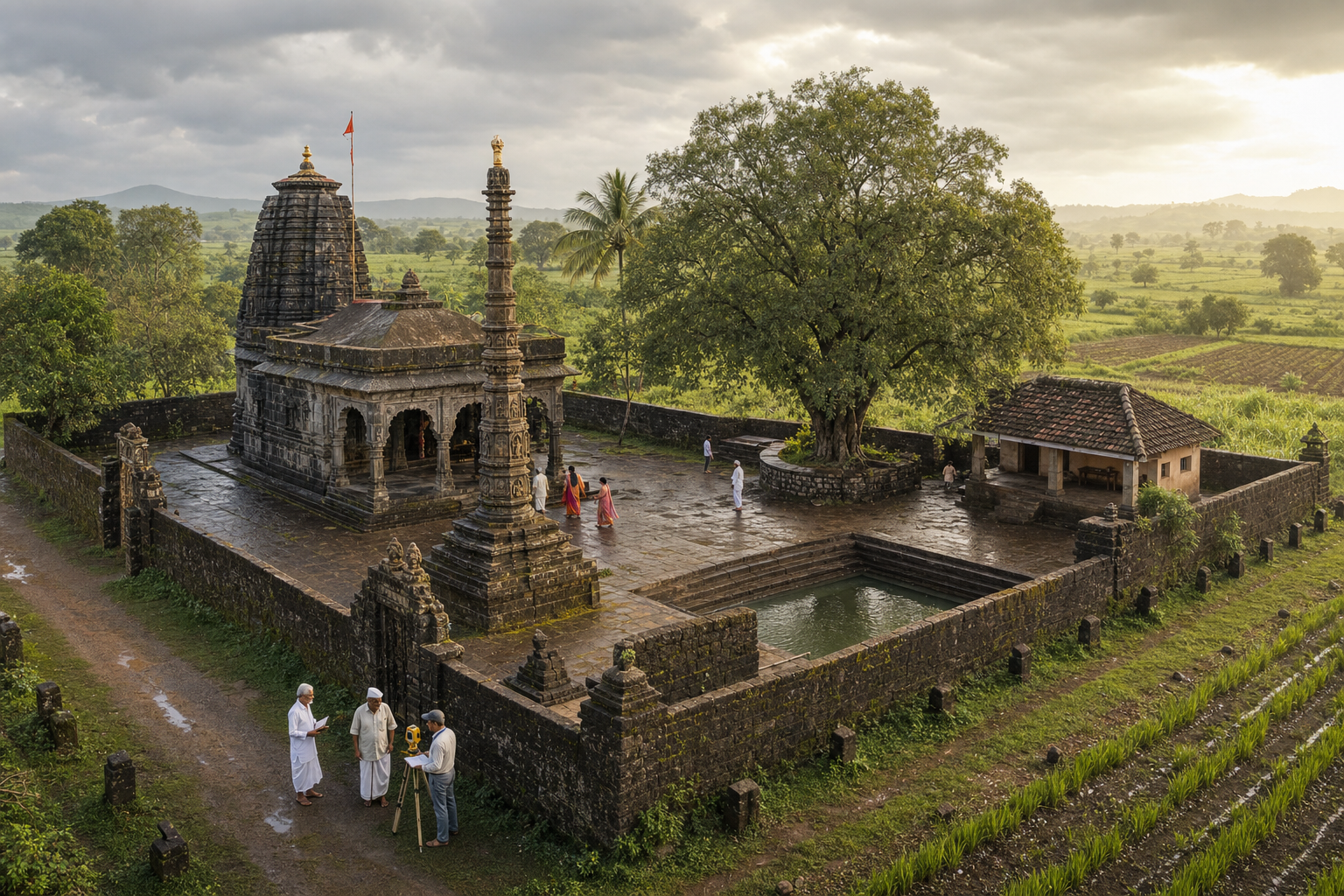
Maharashtra’s proposed Devasthan Inams Abolition Draft Act, 2026 has raised alarms among temple trusts and dharmic institutions that rely on endowment-backed revenues for worship, welfare, and heritage conservation. This analysis clarifies what devasthan inams are, why they matter to community life across Hindu, Buddhist, Jain, and Sikh traditions, and how constitutional safeguards under Articles 25,…
-
Unveiling Goddess Kaveri in Hindu Sculpture: Iconography, Ritual Power, and Sacred Geography

Goddess Kaveri, revered as a living river and divine mother, is rendered in Hindu sculpture through a precise visual grammar that blends Shilpa Shastra canons with the lived rhythms of sacred geography. This essay explains how to recognize her iconography, from kumbha and lotus attributes to makara-toranas and gentle mudras, and shows where she commonly…
-
Asitanga Bhairava Unveiled: Iconography, Mantras, and the Sacred Power of the Golden Lord

Asitanga Bhairava, the Golden Lord of the First Octet, embodies a luminous, eastward guardianship that unites protection with awakening. This long-form exploration decodes his iconographygolden hue, trident, drum, skull-bowl, and threshold placementso readers can recognize and interpret the form in temples and texts. It clarifies how attributes map to disciplined practice, turning weapons into inner…
-
Padma in Hindu Sculptures: The Lotus as Cosmic Throne, Purity Symbol, and Living Geometry

This in-depth guide decodes how the lotus (padma) functions in Hindu sculptures as attribute, throne, halo, and yogic sign, translating sacred meaning into readable form. Readers learn to distinguish bud, half-bloom, and full bloom, recognize color symbolism, and spot double-lotus pedestals with confidence in temples and museums. Clear references to Shilpa Shastra canons show how…
-
Adhi Kandhanatha Swamy of Erakaram: Murugan’s Abhaya Grace, History, Architecture, Rituals

Adhi Kandhanatha Swamy Temple, Erakaram, presents a distinct Murugan shrine aligned behind a Shiva temple, highlighting Tamil Saiva-Agamic Temple Architecture and the Somaskanda ideal. The standing murti with abhaya hastam communicates protection and spiritual assurance, drawing devotees seeking courage, clarity, and peace. The shrine’s association with Arunagirinathar’s Thirupukazh embeds a rich musical-liturgical tradition that educates…
-
Kalaram Mandir, Nashik: Sacred Origins, Peshwa-Era Grandeur, and the Legacy of Panchavati

Kalaram Mandir in Panchavati, Nashik, is a landmark of Rama-bhakti and Peshwa-era craftsmanship renowned for its black stone murti of Bhagavan Sri Rama with Mata Sita and Lakshmana. Local tradition venerates the deity as swayambhu, with the temple’s late-18th-century construction attributed to Sardar Rangarao Odhekar. Set within the Ramayana-rich landscape of Ramkund, Sita Gufa, and…