
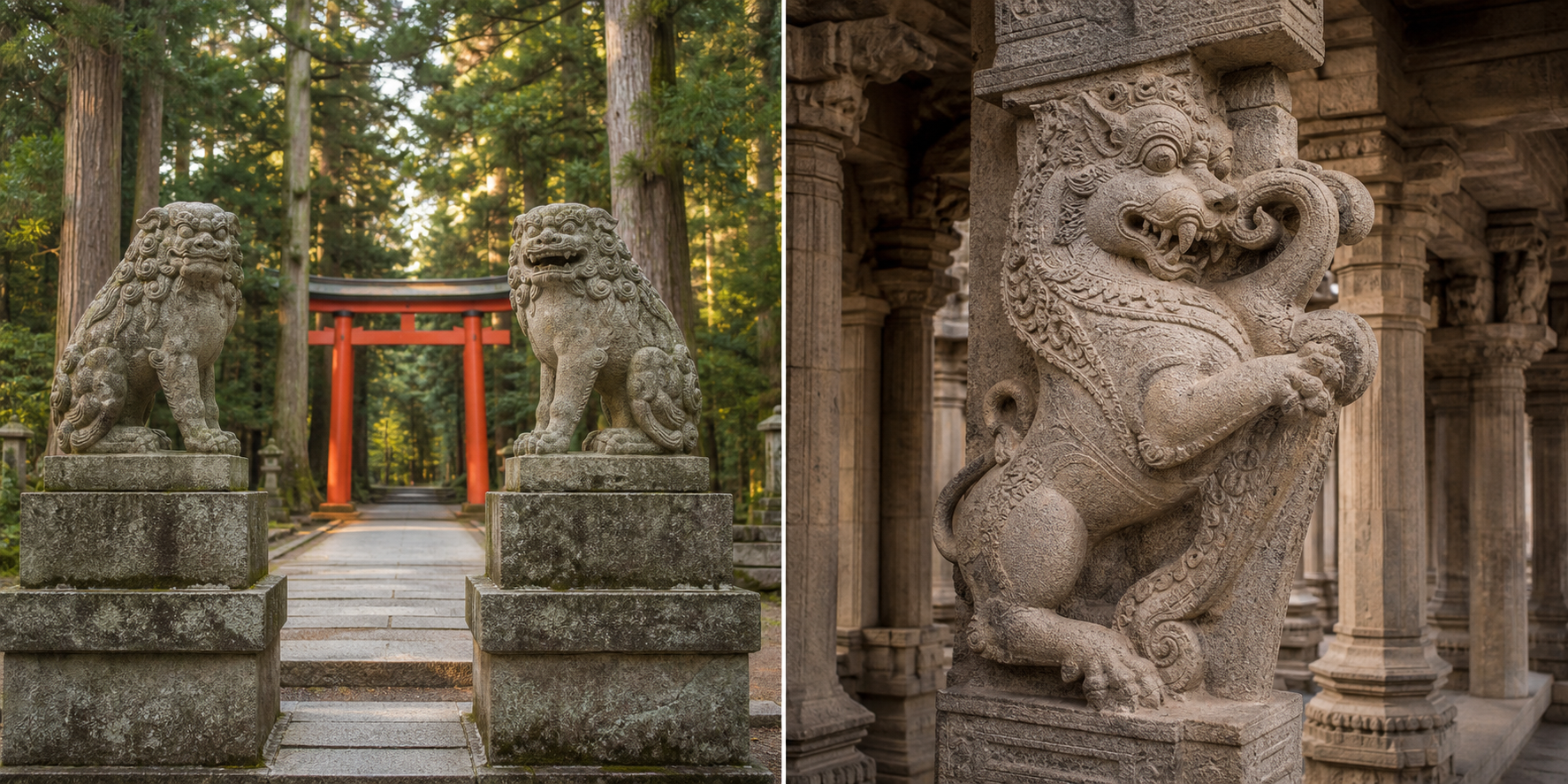
You have probably seen the resemblance in photographs: a fierce, lion-like guardian in Japan and another powerful leonine form in a Hindu temple. The natural question is whether Komainu and Yali are versions of the same sacred figure, or evidence of a historical connection between India and Japan.
The honest answer begins with a distinction. They can be compared meaningfully as guardians of sacred space, but they should not be collapsed into one icon. Their placement, anatomy, and religious settings tell you what is genuinely shared, what remains different, and where a visual comparison must stop.
Start with placement, not resemblance
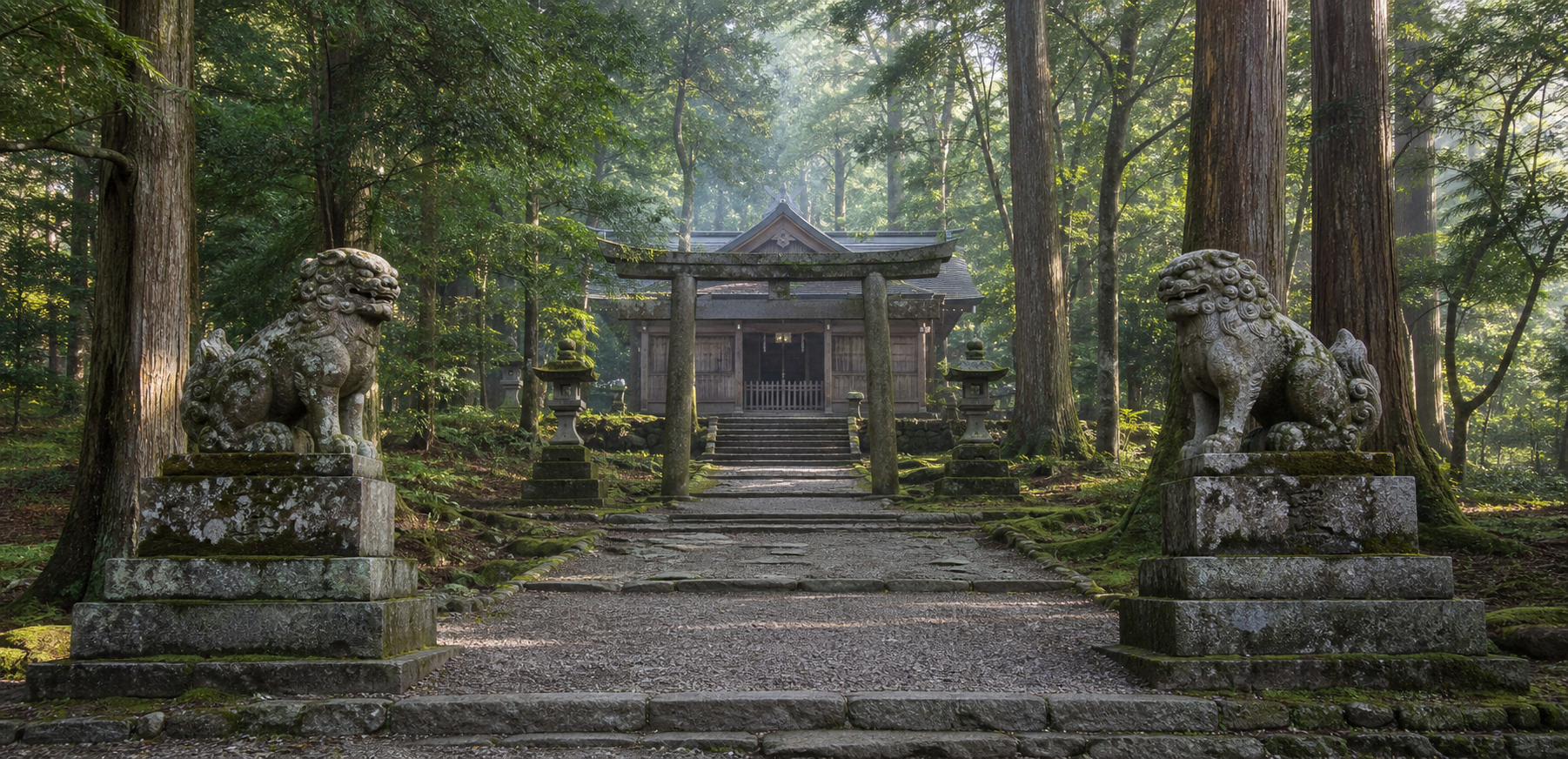
When you are trying to identify a guardian figure, look at the building before studying the face. The architectural setting is usually more informative than the general resemblance to a lion.
At a Shinto shrine in Japan, the A-gyo Komainu is an open-mouthed guardian positioned at the gateway. It confronts you as you approach and marks the passage into sacred ground. Its relationship to the entrance is central to the way you encounter it.
In a Hindu temple, the Yali, also called Vyala, is commonly encountered on a pillar. Its lion head is joined to the body of another creature, making the guardian part of the temple’s architectural fabric. You do not merely pass beside it at an outer threshold; you may meet it as your eyes follow the pillars and structural rhythms of the sacred building.
| What to inspect | A-gyo Komainu | Yali or Vyala |
|---|---|---|
| Religious setting | Shinto shrine in Japan | Hindu temple in India |
| Architectural clue | Shrine gateway | Temple pillar |
| Fast visual clue | Open mouth and lion-like face | Lion head joined to a composite body |
| Safest first identification | A gateway guardian within a Shinto setting | A pillar-borne guardian within Hindu temple architecture |
This gives you a practical rule: context outranks silhouette. If a photograph has been cropped so tightly that you cannot see the gateway, pillar, or surrounding architecture, treat any identification as provisional. Ask for an uncropped view before assigning a name.
Read the mouth and body as different visual languages
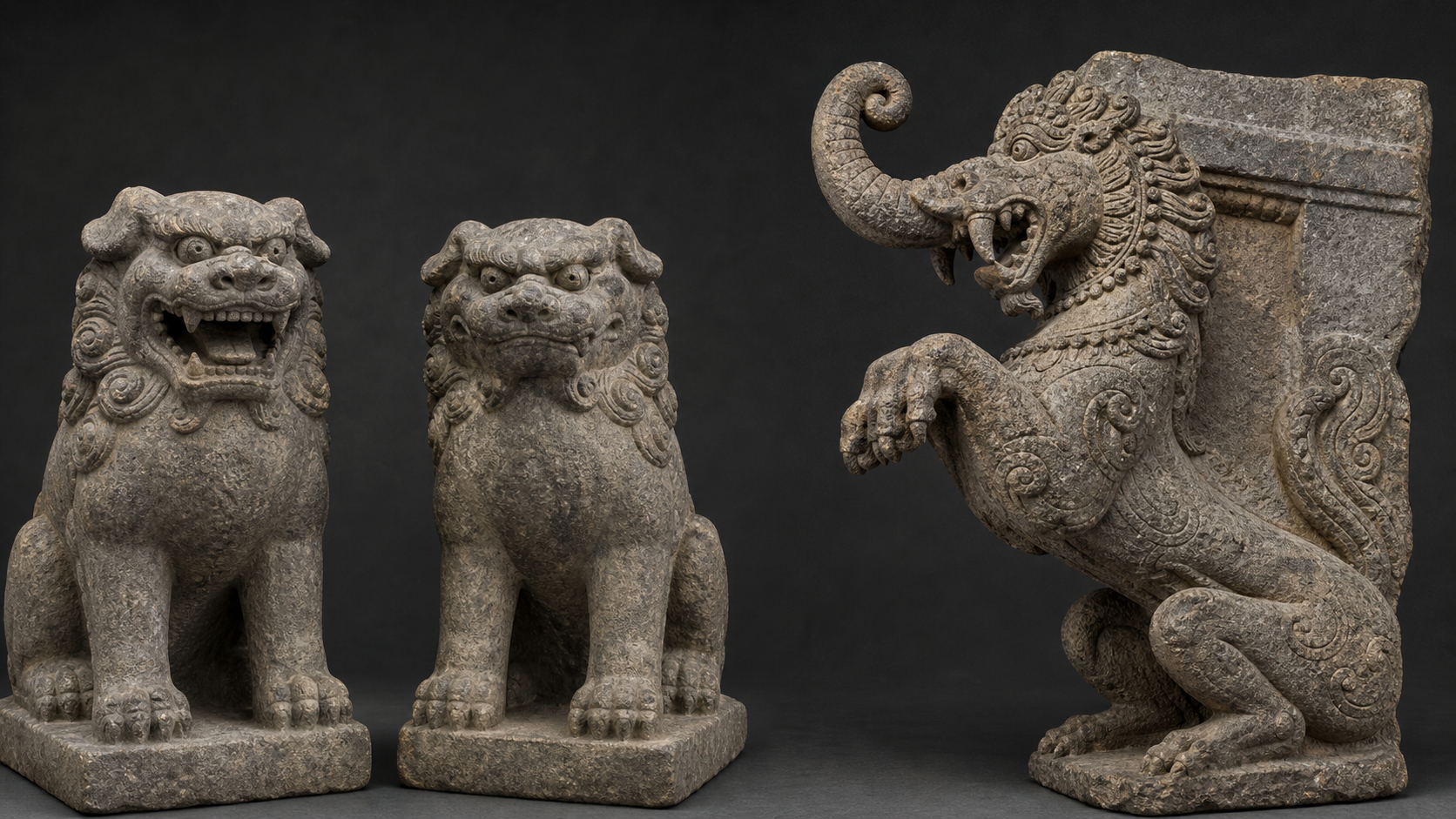
The Komainu directs attention through its face
The open mouth is the quickest clue for identifying the A-gyo form. Visually, it makes the guardian appear active and alert at the point of entry. The face meets the arriving visitor before the visitor crosses farther into the shrine grounds.
That clue should not be asked to carry more meaning than it can support. An open mouth helps you distinguish the form, but it does not by itself prove a particular doctrine about roaring, speech, breath, or sacred sound. Those interpretations require evidence from the tradition and the specific site. Begin with what you can actually see: an open-mouthed guardian at a Shinto gateway.
The Yali directs attention through hybridity
With the Yali, the lion head is only the beginning of the identification. The rest of the body matters because the figure deliberately joins leonine features to another creature’s form. If you look only at the face, you miss the composite character that distinguishes the Yali from an ordinary carved lion.
When examining a Yali, record the visible parts before trying to interpret them. Note the head, mouth, limbs, posture, and connection to the pillar. Do not force the figure into the category of a natural animal when its power lies precisely in exceeding such a category. The practical question is not, “Which zoo animal is this?” but, “How has the sculptor assembled a being fit to inhabit sacred architecture?”
In both cases, fierceness is serving guardianship. Teeth, an open mouth, or an impossible body should not automatically be read as signs of evil. Look instead at orientation and placement. A formidable figure stationed around sacred space can use visual danger in the service of protection.
Compare their sacred work without making them interchangeable
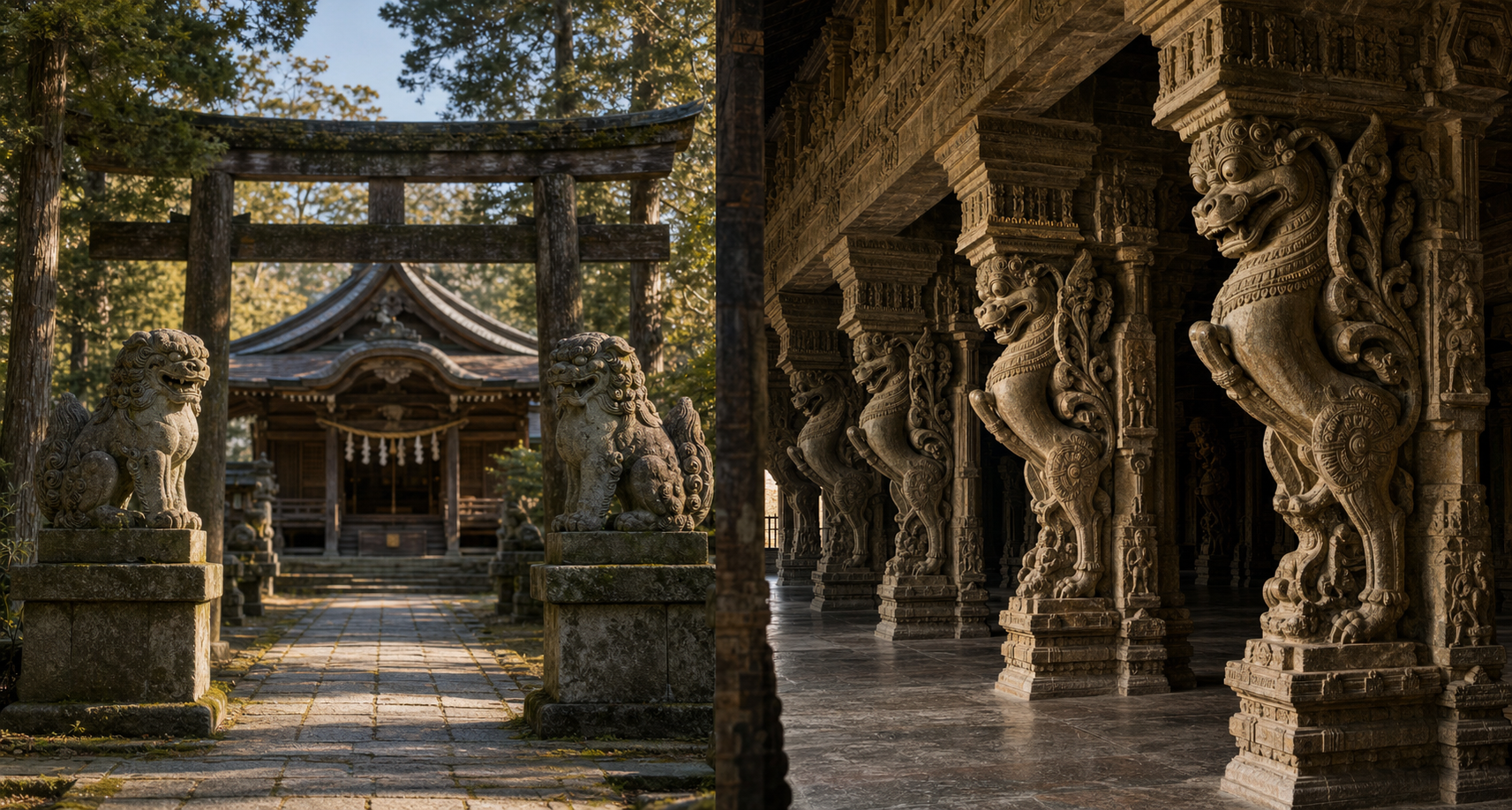
The strongest comparison concerns function. Both figures turn leonine force into a protective presence. They prepare the visitor to recognize that sacred space is not merely another piece of ordinary ground or architecture.
They accomplish that work differently. The A-gyo Komainu concentrates attention at a shrine gateway through an open mouth and frontal presence. The Yali brings a lion-headed composite into the pillars of a Hindu temple. One emphasizes the moment of approach; the other makes the guardian inseparable from the visual order of the building.
This difference protects you from two common mistakes. The first is to call every Asian lion-like guardian a Komainu. The second is to call any fierce temple creature a Yali. A family resemblance can begin an inquiry, but cultural setting and architecture must complete the identification.
The comparison also improves how you behave at a sacred site. At a Shinto shrine, retain the Japanese name and respect the shrine’s own customs. At a Hindu temple, understand the Yali within Hindu sacred architecture rather than treating it as a foreign version of something else. Similar protective roles do not make rites, deities, or theological meanings interchangeable.
A visual resemblance is not proof of a shared origin
If your deeper question concerns Bharat’s influence on Japan, these guardians offer an intriguing comparison but not a complete historical argument. A lion-like face is evidence of resemblance. It is not a date, a route of transmission, a textual record, or a documented chain connecting one sculptural convention to another.
Similar forms can be inherited, adapted, transmitted through cultural contact, or developed independently in response to similar religious needs. The appearance of two objects cannot decide among those possibilities on its own. A serious claim of descent would require securely dated examples, a plausible geographic sequence, and evidence linking the relevant communities or artistic conventions.
This distinction matters especially when discussing the global influence of Bharat. A pro-Dharmic history becomes stronger when it distinguishes an evocative parallel from a demonstrated line of transmission. There is no need to weaken a valuable comparison by making it prove more than the available evidence can bear.
Use four levels of confidence when you describe what you see:
- Observation: The mouth is open, the face is lion-like, the body is composite, or the figure is attached to a pillar.
- Identification: The form and setting support the name A-gyo Komainu or Yali/Vyala.
- Functional interpretation: The figure acts as a guardian associated with sacred space.
- Historical claim: One tradition influenced, inherited, or transformed the other.
The first three levels can often be reached through careful observation and reliable contextual information. The fourth needs historical evidence beyond resemblance. If that evidence is absent, say that the figures are comparable rather than claiming that one descends from the other.
Use this field method at a shrine, temple, or museum
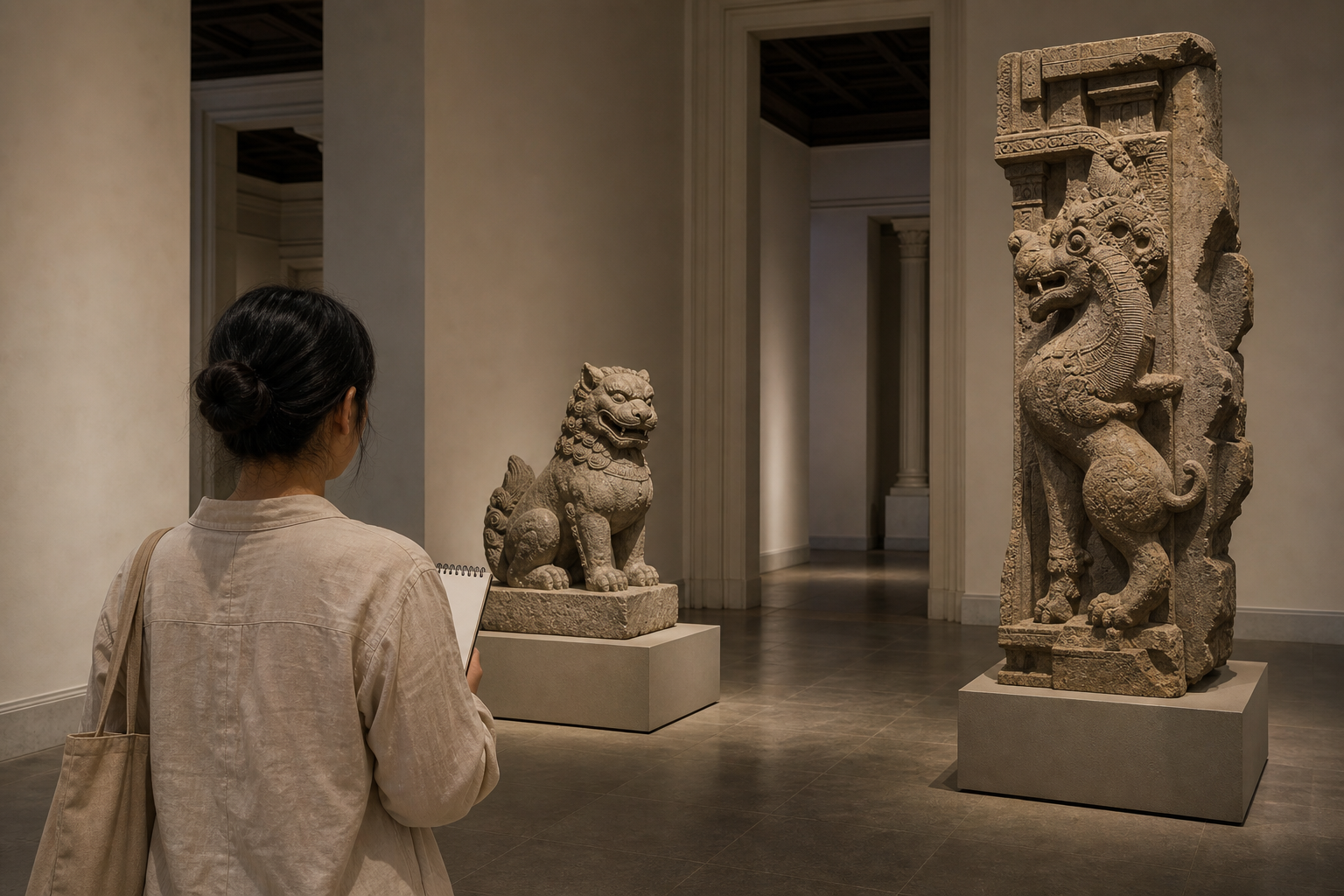
You can turn the comparison into a disciplined way of looking. Use the following sequence when you encounter either guardian in person or in an image.
- Establish the setting. Determine whether you are looking at a Shinto shrine, a Hindu temple, a museum object, or an unlabelled photograph. Do not identify a decontextualized image with complete confidence.
- Locate the figure architecturally. Record whether it stands at a gateway, emerges from a pillar, or appears somewhere else. Include the surrounding structure in a photograph when photography is permitted.
- Describe before interpreting. Write down observable features such as an open mouth, lion-like head, composite body, posture, and relation to the structure. Keep symbolic claims out of this first description.
- Use the tradition’s own name. Identify the open-mouthed Japanese shrine guardian as A-gyo Komainu when the context supports it. Identify the lion-headed Hindu pillar guardian as Yali or Vyala when its form and setting support that name.
- Separate comparison from genealogy. You may compare protective function, leonine imagery, and architectural placement. Leave historical descent open unless independent chronological and cultural evidence establishes it.
At an active sacred site, local practice outranks your comparative theory. Follow posted instructions, respect areas where photography is not allowed, and do not touch the carvings. Recognizing a parallel between traditions should make your attention more precise, not make the traditions seem interchangeable.
There is also a contemplative use for this method. Before moving past a guardian, pause long enough to notice the transition it marks. Ask what kind of conduct belongs beyond that point: less distraction, greater restraint, or more attentive presence. You need not invent a universal theology to let sacred architecture change the quality of your approach.
Key takeaways
- Begin with architecture: the A-gyo Komainu belongs at a Shinto shrine gateway, while the Yali or Vyala is associated with Hindu temple pillars.
- The Komainu’s open mouth is a primary identifying clue; the Yali’s lion head and composite body must be read together.
- Both figures use fierce, lion-like imagery for guardianship, but they remain distinct forms within distinct religious settings.
- A visual parallel supports comparison, not an automatic claim that one tradition borrowed from the other.
- In a photograph or museum display, withhold certainty when the original location, architecture, or cultural label is missing.
The next time you meet one of these guardians, keep the gateway or pillar in view and write down what you observe before deciding what it means. That small discipline will give you a richer comparison, preserve the integrity of both traditions, and help you recognize how sacred architecture prepares a visitor to cross a meaningful boundary.
References
