
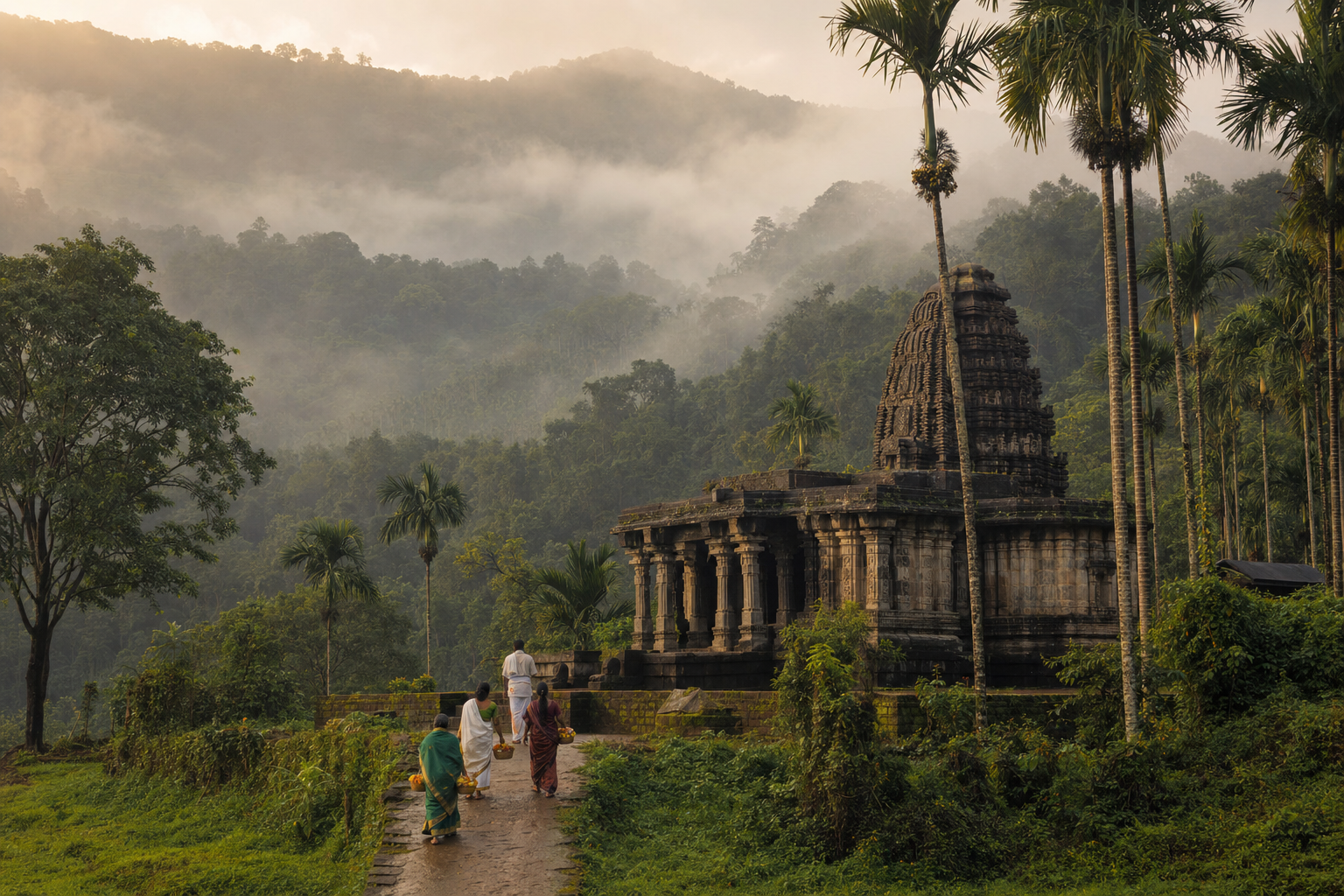
If your Chikkamagaluru plan consists of a coffee estate, Mullayanagiri and a waterfall, you will see a beautiful district but miss much of what gives it meaning. The hills are part of a sacred landscape, and the temples near the town preserve a civilizational record that is older than the region’s celebrated coffee culture.
You don’t need to choose between nature, history and darshana. You need to visit them in the right relationship: read the landscape first, enter the temples as living places of worship, and keep documented history distinct from local tradition without dismissing either.
Key takeaways
- Treat the Western Ghats as the setting of Chikkamagaluru’s Hindu heritage, not as scenery between monuments.
- Reserve a separate part of your visit for the temple cluster near the town; don’t squeeze a shrine into the final minutes of a sightseeing circuit.
- At a Hoysala temple, make three passes: receive darshana, study the building, and notice the evidence of continuing worship.
- Repeat legends as legends. The traditions surrounding the town’s name and the arrival of coffee are valuable forms of local memory, but they are not the same as dated dynastic history.
- Before setting out, confirm current road access, temple opening times, worship schedules and photography rules locally.
Read the hills before you read the stone
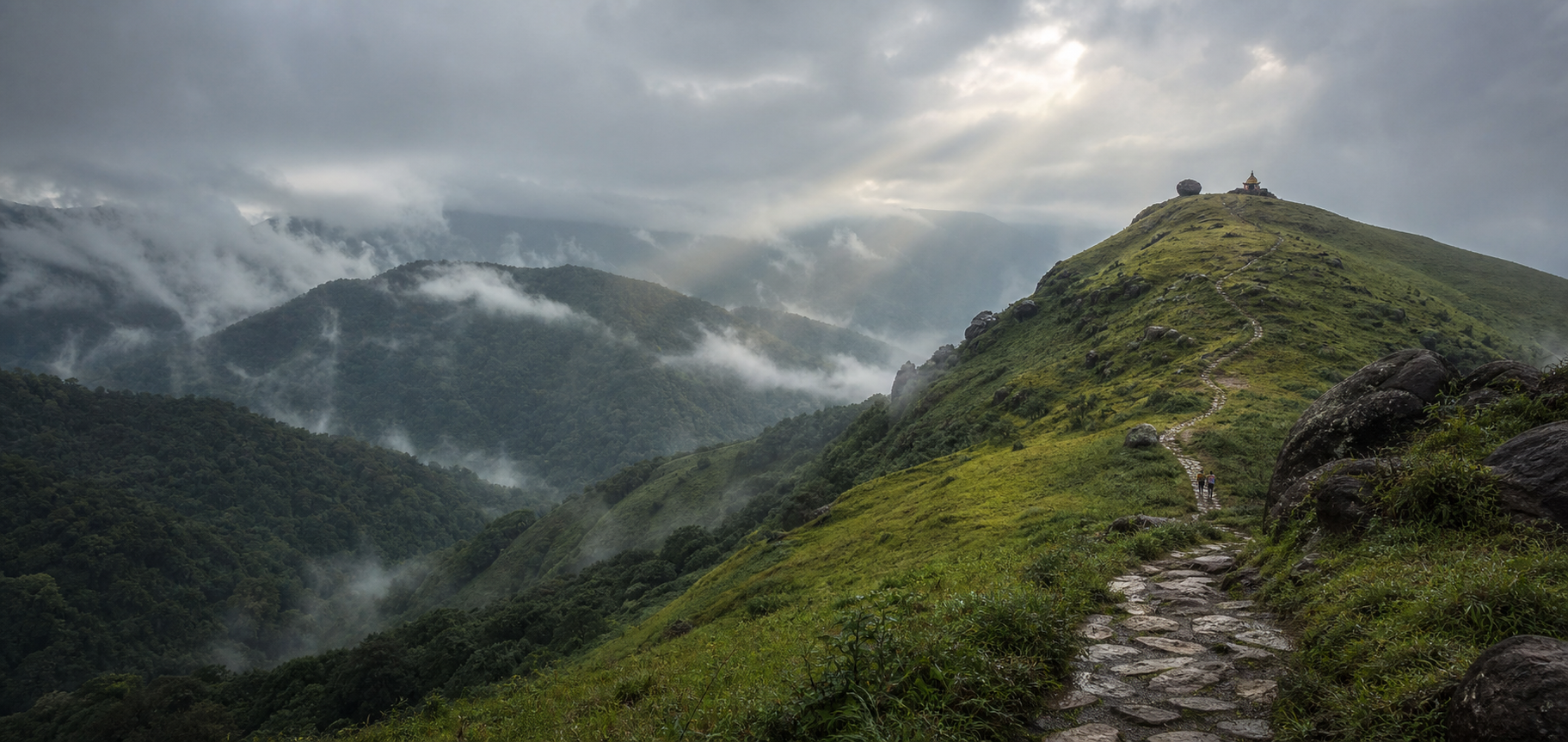
Chikkamagaluru stands at an elevation of about 1,000 metres in the Malnad region of the Western Ghats. Above it rises Mullayanagiri, Karnataka’s highest peak at 1,930 metres. Coffee plantations, tropical forests, grass-covered heights, lakes and seasonal waterfalls form the physical setting in which the district’s sacred places developed. The elevation, forests and landmarks are not incidental details; they explain why the experience of the region begins before you reach a temple door.
Begin your heritage visit with a highland block rather than treating the mountains as a closing photo stop. On the ascent toward Mullayanagiri, notice how settlements and plantations yield to forest and open slopes. From a high point, look for the relationship between ridges, valleys, water and routes of movement. Sacred geography becomes easier to understand when you see the land as a connected whole rather than a collection of pins on a map.
The nearby range commonly associated with Baba Budangiri also carries the older name Chandradrona Hills. That layered naming matters. Popular memory connects the slopes with the seventeenth-century tradition that Baba Budan brought seven coffee beans from Arabia and planted them there. Yet the Hindu cultural landscape predates that coffee narrative. Holding both facts in view keeps you from reducing a much older region to a single origin story.
Choose one additional natural landmark rather than racing through every famous name. Hebbe Falls, Jhari Falls, Hirekolale Lake, Ayyanakere Lake and Kemmangundi belong to the district’s larger landscape, but a packed checklist leaves little time to observe anything. During the monsoon, clouds descend and waterfalls become more prominent; whatever the season, verify access and conditions before committing to a mountain route.
Carry one question through this part of the journey: how did elevation, forest, water and travel routes shape the way people understood and inhabited this land? You may not obtain a complete answer in a day, but the question will change what you notice when you later encounter a shrine, a settlement or a local place-name.
Enter the temples as a devotee and a careful observer
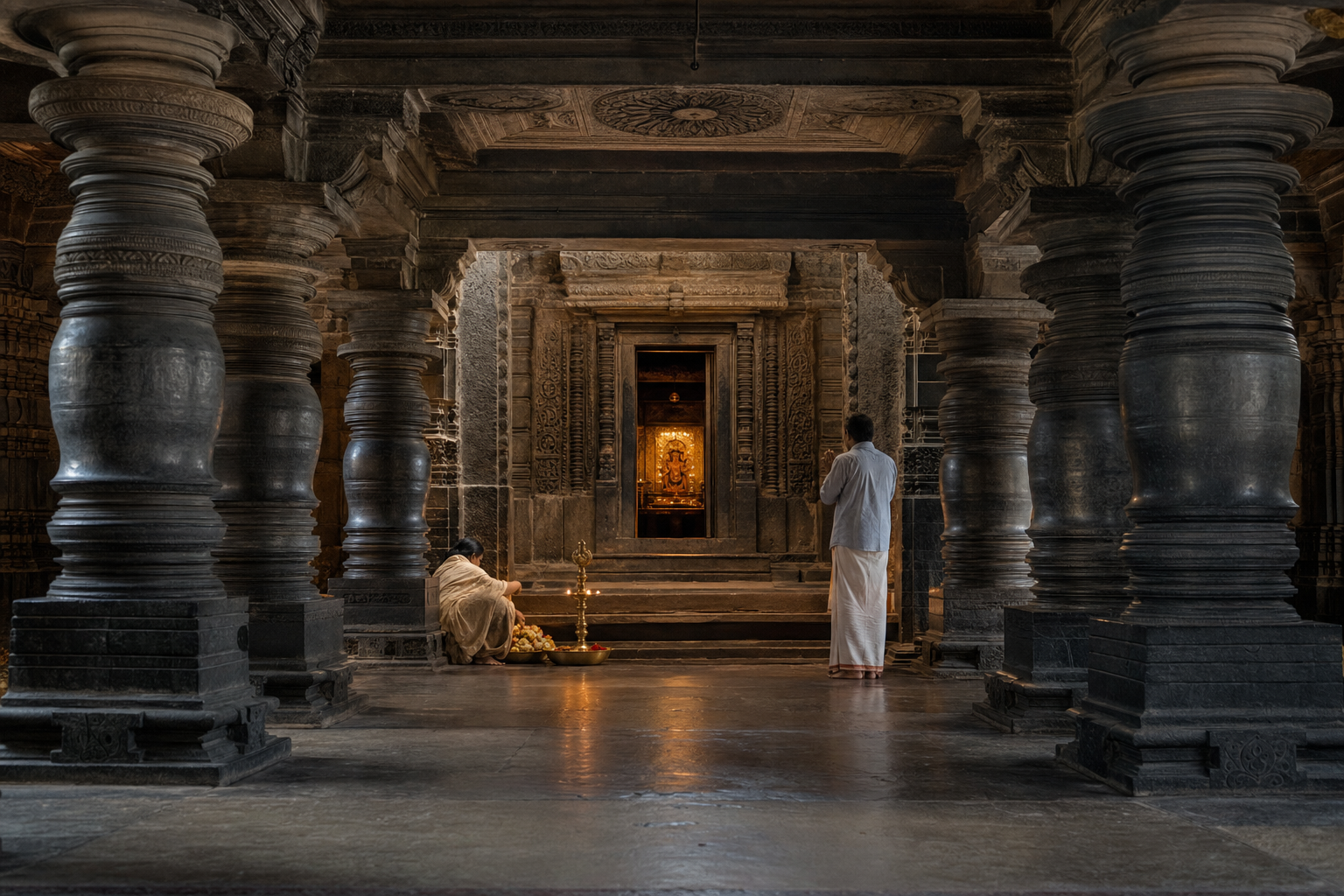
A short drive from Chikkamagaluru brings you into a field of temples whose history reaches back nearly a millennium. Some belong to the Hoysala architectural inheritance; others preserve traditions understood to be older. Together they record craftsmanship, royal patronage and continuing Hindu worship. The wrong way to approach them is as decorative ruins that happen to provide good photographs. Even an architecturally important shrine may remain, first of all, a sacred home of the deity.
Use a three-pass method at each temple:
- Receive darshana. Remove footwear where required, silence your phone, follow the local queue and allow the worship taking place to set the pace. If a ritual is underway, don’t step in front of devotees for a better view.
- Read the structure. After worship, move slowly around the permitted areas. Notice how the entrance directs you toward the sanctum, how subsidiary images relate to the principal deity, and where the building shifts from structural stonework to ornament and sacred narrative.
- Look for continuity. Lamps, flowers, ritual vessels, sounds, repaired surfaces and the movement of devotees show how the site functions now. Do not infer the age of a temple from weathering alone; maintenance can make an old shrine appear new, while neglect can make a later feature appear ancient.
Hoysala craftsmanship rewards close attention, but looking closely does not require touching. Study the treatment of pillars, ceilings, doorways, exterior walls and repeated motifs. Look for differences in depth, scale and finish. Ask whether the sculptural program guides your movement or marks a hierarchy between spaces. If an information board identifies a dynasty, patron, inscription or restoration, photograph or transcribe the wording rather than relying on memory.
Photography is a privilege, not an automatic right. Ask before photographing the sanctum, a murti, a priest or an active ritual. A sign that permits photography in the outer structure does not necessarily permit it everywhere. Keep bags and equipment out of circulation paths, and never climb onto a plinth or architectural member to frame an image.
This approach prevents two common mistakes. The first is performing a hurried pranam and leaving without seeing the historical achievement around you. The second is studying every carved surface while behaving as though worship were an inconvenience. Chikkamagaluru’s Hindu heritage is most legible when devotion, art and continuity remain together.
Keep legend, chronology and living memory in their proper places
The name Chikkamagaluru itself opens a door into local memory. In Kannada, chikka means younger, magala means daughter and ooru means town. A local tradition holds that Rukmangada, a ruler of Sakrepatna, gave the region to his younger daughter as dowry, while the elder daughter received neighbouring Kadur. The story gives the place a memorable identity, but it should be introduced as tradition rather than converted into a dated political event without further evidence.
The coffee story requires the same care. Local tradition places Baba Budan’s return from Arabia in the seventeenth century and says that he carried seven coffee beans, which were planted on the Chandradrona slopes. That tradition helps explain why Chikkamagaluru is regarded as the cradle of Indian coffee cultivation. It does not establish the beginning of Chikkamagaluru’s history, and it should not displace the older temple and sacred-geographical layers.
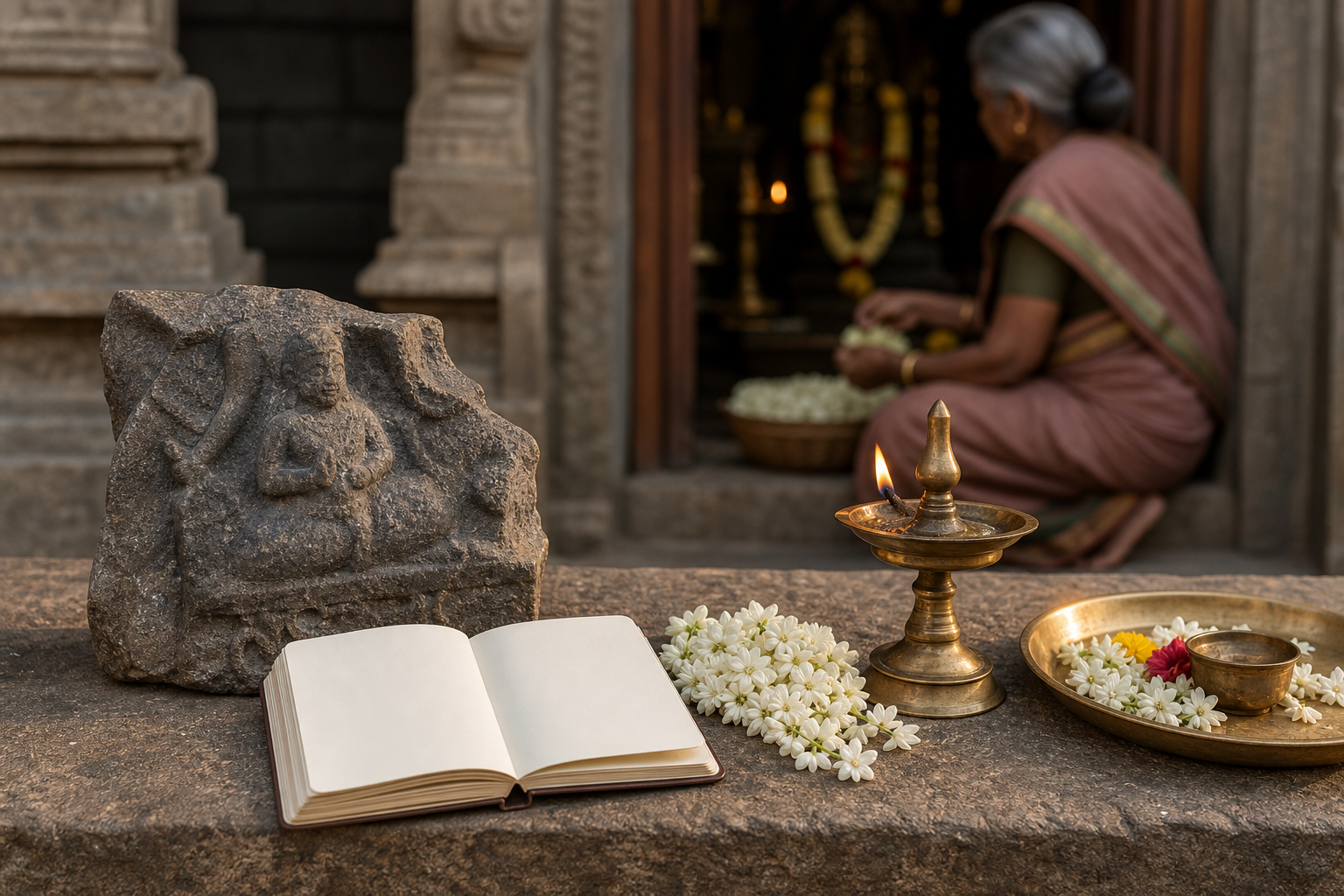
You can keep a clean record by labelling what you learn:
- Observed: what you can directly see, such as the temple plan, images, present worship or the site’s relationship to a hill or settlement.
- Attributed: a date, dynasty, patron or identification given by an inscription, official notice or other named authority. Record who makes the attribution.
- Remembered: a local narrative transmitted by a priest, resident or customary account. Note the teller and preserve words such as “tradition,” “legend” or “believed.”
- Inferred: your own interpretation of how the pieces relate. Keep it separate from what was observed or explicitly stated.
This is not a choice between belief and scepticism. It is a disciplined way to respect different kinds of knowledge. A sacred narrative can express a community’s relationship with a place even when it is not a substitute for an inscription. A dynastic date can locate a building in time without exhausting its religious meaning. Living worship may carry a temple’s significance across political changes that architecture alone cannot explain.
Build a two-day heritage plan that leaves room to notice
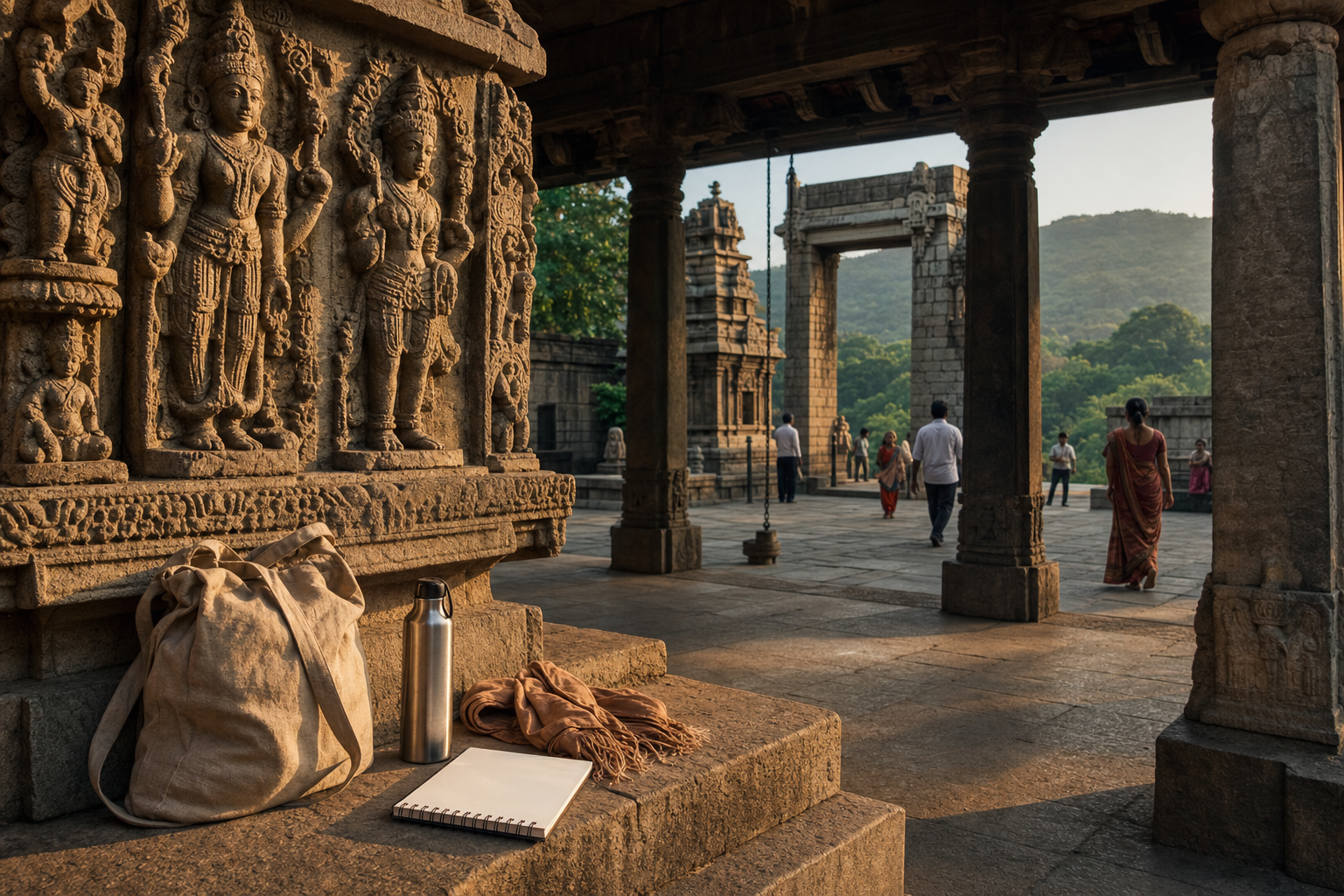
Two days allow you to connect landscape and temple without turning either into a rushed stop. The sequence matters more than the number of attractions.
- Before the first outing, confirm practical details. Ask locally about current road access, weather, temple opening times, puja schedules and photography restrictions. Online lists can help with orientation, but operating conditions and ritual schedules require local confirmation.
- Use the first day for the highland setting. Centre the day on Mullayanagiri and the surrounding mountain landscape. Pair it with no more than one lake, waterfall or garden destination. Pay attention to the transitions among town, plantation, forest, grassland and summit rather than counting stops.
- Use the second day for temples. Identify at least one Hoysala shrine and one site associated with an earlier or distinct local tradition. Select temples in the same directional cluster when possible so that driving does not consume the day. Give each place enough space for worship, architectural observation and conversation.
- Record five details at every shrine. Write down the locally used name and spelling, the principal deity, the attributed period or dynasty, one architectural feature you can describe precisely, and one account of the site’s living tradition. Mark each note as observed, attributed, remembered or inferred.
- End in the town, not on the road. Compare your notes while the distinctions are still clear. If two accounts conflict, retain both with their attributions instead of silently choosing the more dramatic version.
If you have only one day, remove a scenic stop before removing the temple visit. A sensible compressed plan combines one highland viewpoint with a small, locally confirmed temple circuit. The purpose is not to claim that you have “covered” Chikkamagaluru. It is to understand one relationship well: how the land, sacred architecture and continuing worship illuminate one another.
For your next visit, make one simple change to the usual itinerary: give the temples the same deliberate attention you would give the coffee estates or the summit. Begin with the hills, enter the shrines with humility, and leave with notes precise enough to distinguish what you saw from what you were told. That is how Chikkamagaluru becomes more than a hill-station break and begins to reveal its place in Bharat’s living sacred geography.
References
