-
Seven Kandas of the Ramayana: Powerful Symbols for a Transformative Dharmic Journey

The Ramayana’s Seven Kandas form a symbolic map of spiritual transformation—from the birth of dharma-consciousness to ethical leadership and serene release. Each Kanda models a stage of inner growth: intention, renunciation, purification, community, devotion, righteous action, and detachment. Read in this way, the epic becomes a practical guide to yama–niyama, tapas, seva, and courageous compassion.…
-
Pratyahara in Hinduism: Mastering Sensory Withdrawal for Profound Calm and Clarity

Pratyahara, the fifth limb of Patanjali’s Ashtanga Yoga, is the disciplined art of sensory withdrawal that bridges outer practices with meditation. Rather than suppressing experience, it redirects attention inward, stabilizing the mind-body connection and preparing the ground for dharana and dhyana. The principle resonates across dharmic traditions—Buddhism, Jainism, and Sikhism—affirming a shared commitment to clarity…
-
Elinati Shani (Sade Sati, Ezharai Sani): Navigate Saturn’s 7 ½-Year Transit

Elinati Shani (Sade Sati, Ezharai Sani) is the 7 ½-year Saturn transit across the 12th, 1st, and 2nd houses from the Moon sign. Rather than a blanket period of difficulty, it functions as a structured lesson in patience, responsibility, and ethical living. The onset cultivates simplification, the peak refines identity and health, and the completion…
-
November 29, 2025 Panchang: Shukla Navami to Dashami Timing, Significance & Auspicious Tips

Saturday, November 29, 2025 observes Shukla Paksha Navami until 5:39 PM in most regions, after which Shukla Paksha Dashami begins. The Panchang notes this transition as part of the Moon–Sun angular rhythm, explaining why tithi changes can occur at precise, non-standard times. Navami supports steady sadhana, thoughtful vrata, and quiet daana, while Dashami favors completion,…
-
Chitrakanya in Tantra: The Sacred Feminine on Shiva’s Lap and the Power of Unity

Chitrakanya, described in Tantric Hindu traditions as the “Beautiful Maiden,” embodies the sacred feminine seated on Lord Shiva’s lap, symbolizing the non-dual union of Shakti and Shiva. This portrayal affirms that purity and passion, stillness and dynamism, are complementary forces within spiritual life. The iconography functions as both metaphysical teaching and practical psychology, supporting emotional…
-
King Prthu’s Radiant Ascent to Vaikuntha: Timeless Lessons for Devotional Elevation

This article examines the Srimad-Bhagavatam account of King Prthu and Queen Arci ascending to Vaikuntha, highlighting how virtuous leadership and devotion culminate in spiritual perfection. It explains the text’s explicit assurance that narrating Prthu’s qualities with faith carries profound soteriological benefits. Readers gain clear, academically grounded insight into how hearing and describing saintly lives function…
-
Severed Head of Daksha: Powerful Symbolism of Ego, Humility, and Sacred Reconciliation

This analysis examines the Daksha Yajna narrative to explain why the severed head of Daksha endures as a powerful Hindu symbol of ego-transformation and humility. It clarifies how the head signifies pride cut away and how the goat’s head marks renewed, service-oriented understanding. The discussion connects ritual and devotion, showing that intention and reverence outweigh…
-
Unveiling the Real Source of Energy: Matter, Consciousness, and the Dharmic View

This essay explores the real source of energy through a dharmic lens, clarifying why matter alone lacks creative power without the organizing presence of consciousness and prana. It synthesizes insights from Hinduism, Buddhism, Jainism, and Sikhism to show a shared recognition of an enlivening principle beyond mere material aggregation. Practical analogies—like electricity requiring both a…
-
Five Faces of Goddess Siddhilakshmi: Tantric Symbolism, Shakti, and Fulfillment
Goddess Siddhilakshmi, revered in Shakta and Kaula Tantra, embodies Lakshmi’s auspicious abundance fused with transformative Shakti. The five-faced (Panchamukhi) symbolism presents an inner mandala of divine energies: Iccha (intention), Jnana (wisdom), Kriya (action), Aishvarya (prosperity), and Raksha–Anugraha (protection and grace). Interpreted through Hindu frameworks such as pancha-kosha and pancha-mahabhuta, this schema guides seekers from purpose…
-
Unlock Ishtadevta through Lagna: पंचमेश सूत्र, सरल उपासना, आंतरिक शांति और धर्मिक एकता

A concise, Lagna-based guideline from Jyotisha offers a practical way to contemplate one’s Ishtadevta by focusing on the fifth-house lord (Panchamesh). The maxim—“आपकी लग्न कुंडली मैं पंचम भाव का स्वामी गृह (पंचमेश ) आपके इष्ट देव है !”—frames a simple, accessible starting point that aligns devotion with the chart’s bhakti-oriented house. Even when doshas create…
-
Radiant Kankali Kali and the Chakras: A Transformative Guide to Sacred Energy Centers

This article explores Kankali Kali as a radiant symbol of transformative strength within Hindu spirituality, illuminating how her fierce compassion supports the harmonization of the chakras. It outlines each sacred energy center—from mulādhāra to sahasrāra—and explains how ethical clarity, steady breath, and mindful practice guide balanced awakening. Readers gain a practical, non-dogmatic framework for working…
-
Unlock House Strength in Vedic Astrology: Kendra, Tricona, Dhushta, Upachaya Explained

Vedic astrology evaluates House strength through four key groups—Kendra, Tricona, Dhushta, and Upachaya—each illuminating stability, purpose, challenge, and growth. Kendra Houses (1, 4, 7, 10) anchor life’s foundations, while Tricona Houses (1, 5, 9) highlight insight and good fortune. Dhushta Sthana (6, 8, 12) point to transformative challenges that cultivate resilience and compassion. Upachaya Houses…
-
Nine Radiant Forms of Goddess Kali in the Tantra Purana: Protection, Wisdom, and Grace

The Tantra Purana presents nine evocative forms of Goddess Kali that illuminate protection, wisdom, and compassionate strength. This overview explains a commonly transmitted Navakali sequence while noting regional and textual variations. Each form—such as Mahakali, Dakshina Kali, Smashana Kali, and Bhadrakali—offers a distinct lens on impermanence, courage, and ethical living. Readers gain clear, accessible symbolism…
-
Six-Armed Dhanalakshmi Decoded: Powerful Symbols of Fearlessness, Prosperity, and Dharma

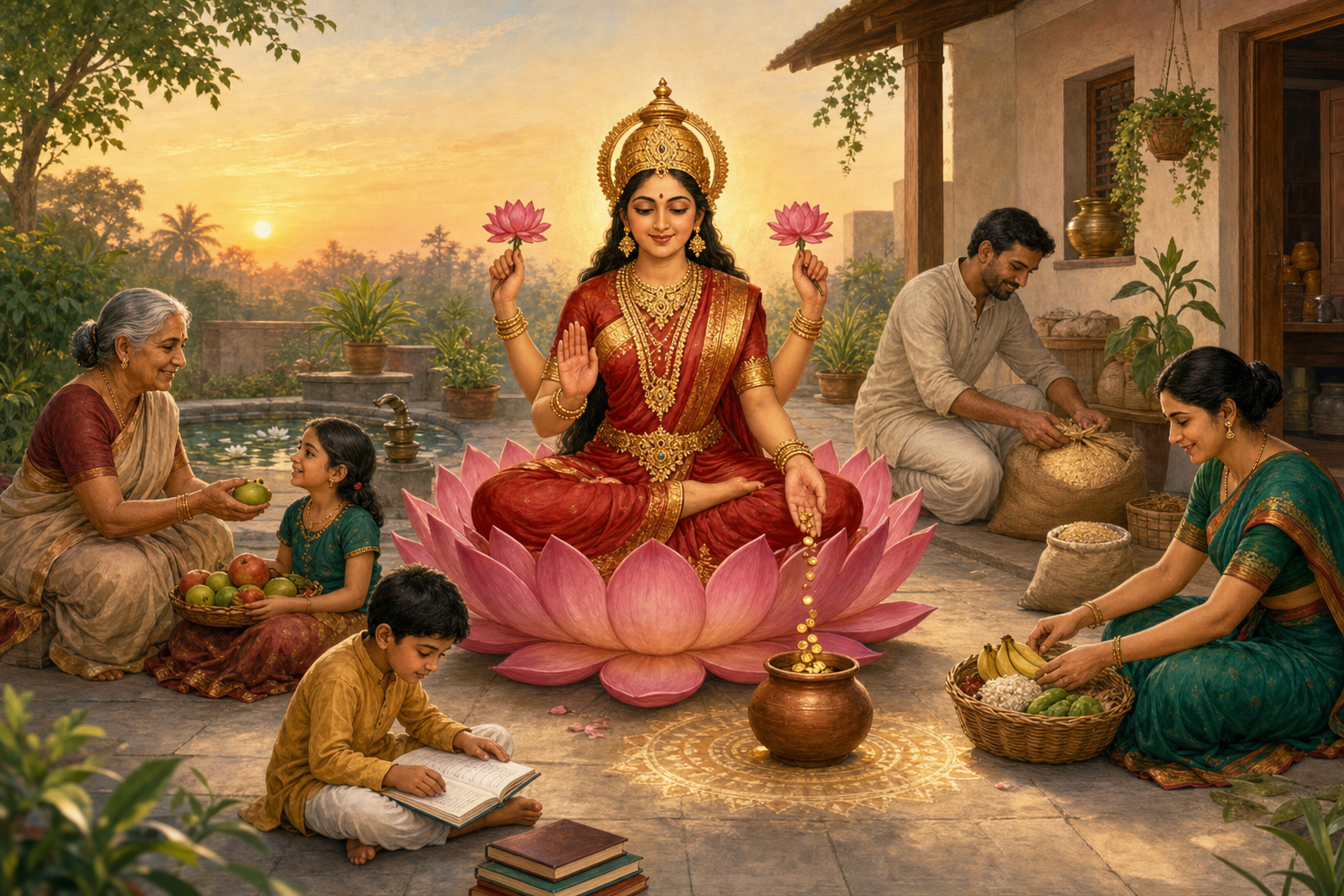
This article clarifies the two principal iconographic forms of Dhanalakshmi—four-armed and six-armed—and decodes the meaning of each sacred attribute. Readers learn how the chakra, padma, shankha, kalasha, bow and arrow, and abhaya mudra together convey prosperity grounded in dharma. The discussion highlights practical applications: ethical earning, mindful use of resources, and generosity. It also connects…
-
Hinduism’s Expansive Spectrum: How Flexibility and Pluralism Empower Inner Freedom

Hinduism’s strength lies in flexibility: a civilizational habit of accommodating diverse ideas, practices, and philosophies under shared ethical principles. This pluralism is mirrored across Dharmic traditions—Buddhism, Jainism, and Sikhism—creating unity in spiritual plurality without erasing distinct identities. The concept of Ishta exemplifies personal spiritual freedom coupled with respect for others’ paths. Historically, Hinduism has evolved…
-
Beyond Money: Dharmic Wisdom for Inner Riches, Community Bonds, and Lasting Fulfillment

This essay explores how Hinduism, in harmony with Buddhism, Jainism, and Sikhism, reframes wealth as inner stability, ethical character, and community bonds. It explains artha’s role within the puruṣārthas, showing how money serves dharma and mokṣa rather than replacing them. Readers gain practical steps—seva, mindful consumption, dāna, right livelihood, and Karma Yoga—to cultivate spiritual wealth…
-
Kali Yantra Unveiled: Sacred Geometry, Bindu Power, and the Living Symbolism of Shakti

The Kali Yantra presents a precise map of sacred geometry—square, circles, lotus petals, triangles, and a central bindu—guiding attention from multiplicity to unity. The bindu functions as a powerful focal point that many practitioners experience as a gateway to calm, clarity, and compassion. Each geometric form carries layered symbolism: the bhupura stabilizes, circles harmonize, lotus…
-
Santan Gopal Stotra (संतान गोपाल स्तोत्र): Hope, Santan Prapti, and Prosperity Through Japa Vidhi

Santan Gopal Stotra (संतान गोपाल स्तोत्र) is revered for its association with santan prapti and holistic well-being through Santan Gopal Stotra Japa Vidhi. The practice centers on devotion to Shri Krishna as Gopāla, guided by faith, discipline, and a clear sankalpa. Many devotees report renewed hope, calm, and strengthened family harmony through sustained chanting. Traditions…
-
Angaraka Loka Unveiled: Mangala’s Sacred Realm and the Red Planet in Hindu Cosmology

Angaraka, also known as Mangala and identified with the Red Planet Mars, is honored in Hindu cosmology as a graha of disciplined courage and ethical action. Legends connect him with Lord Varaha and Ma Bhudevi, or with Bhudevi through Shiva’s grace, highlighting strength anchored in compassion. Angaraka Loka is approached through Navagraha worship and vivid…