
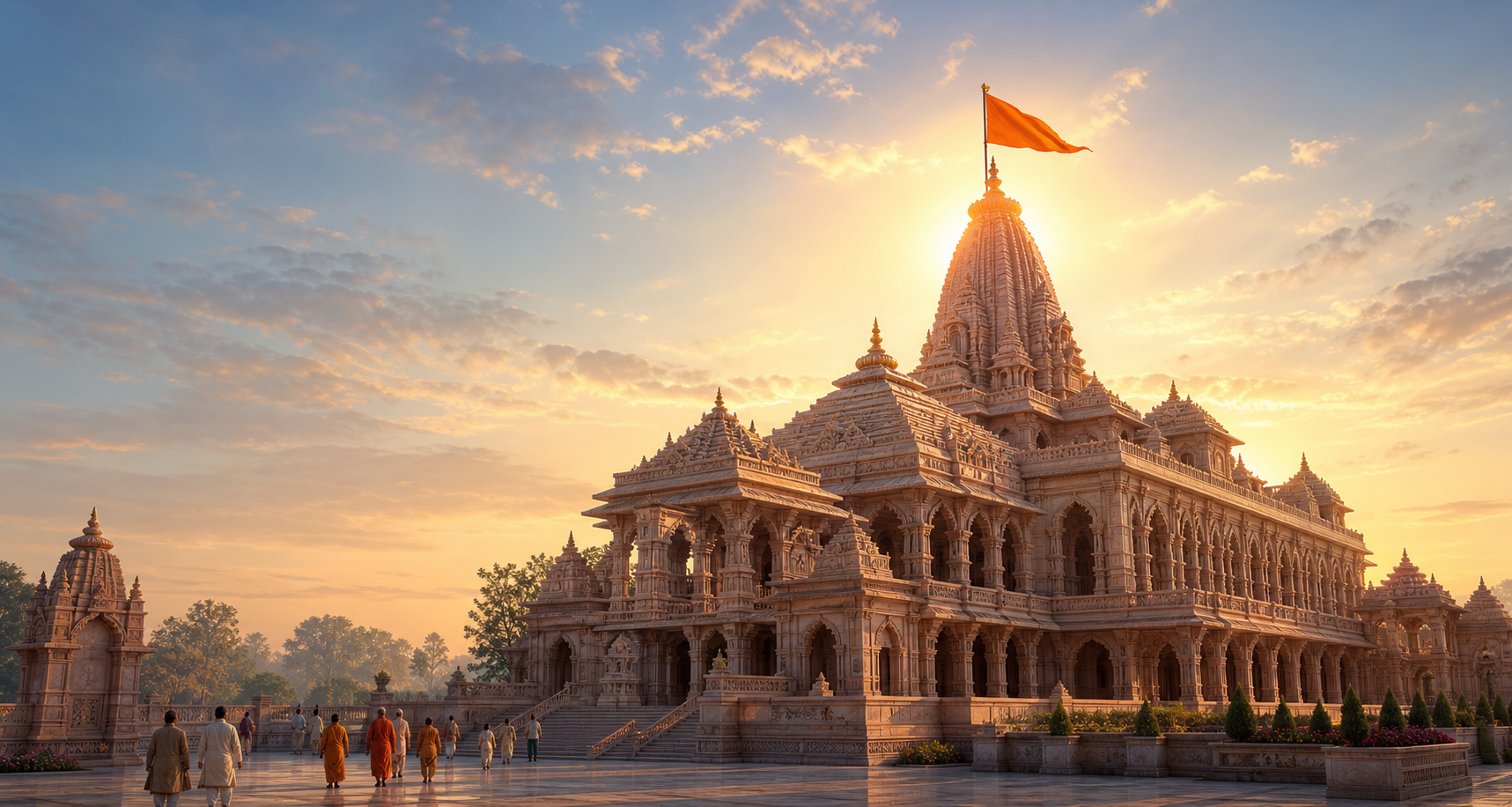
If you watched the saffron flag rise above the Ram Mandir and wondered what lay beyond the spectacle, begin with one distinction: Dhwajarohan is not merely the installation of a temple ornament. It announces a sacred centre and asks the people gathered around it to live by the dharma represented there.
That makes the ceremony more demanding than a victory celebration. The flag carries the memory of Shri Ram’s lineage, the discipline associated with saffron, and an ecological obligation expressed through the Kovidar tree. You can understand its meaning by asking not only what the symbols represent, but what conduct they now require.
Why raising the flag changes the meaning of the temple
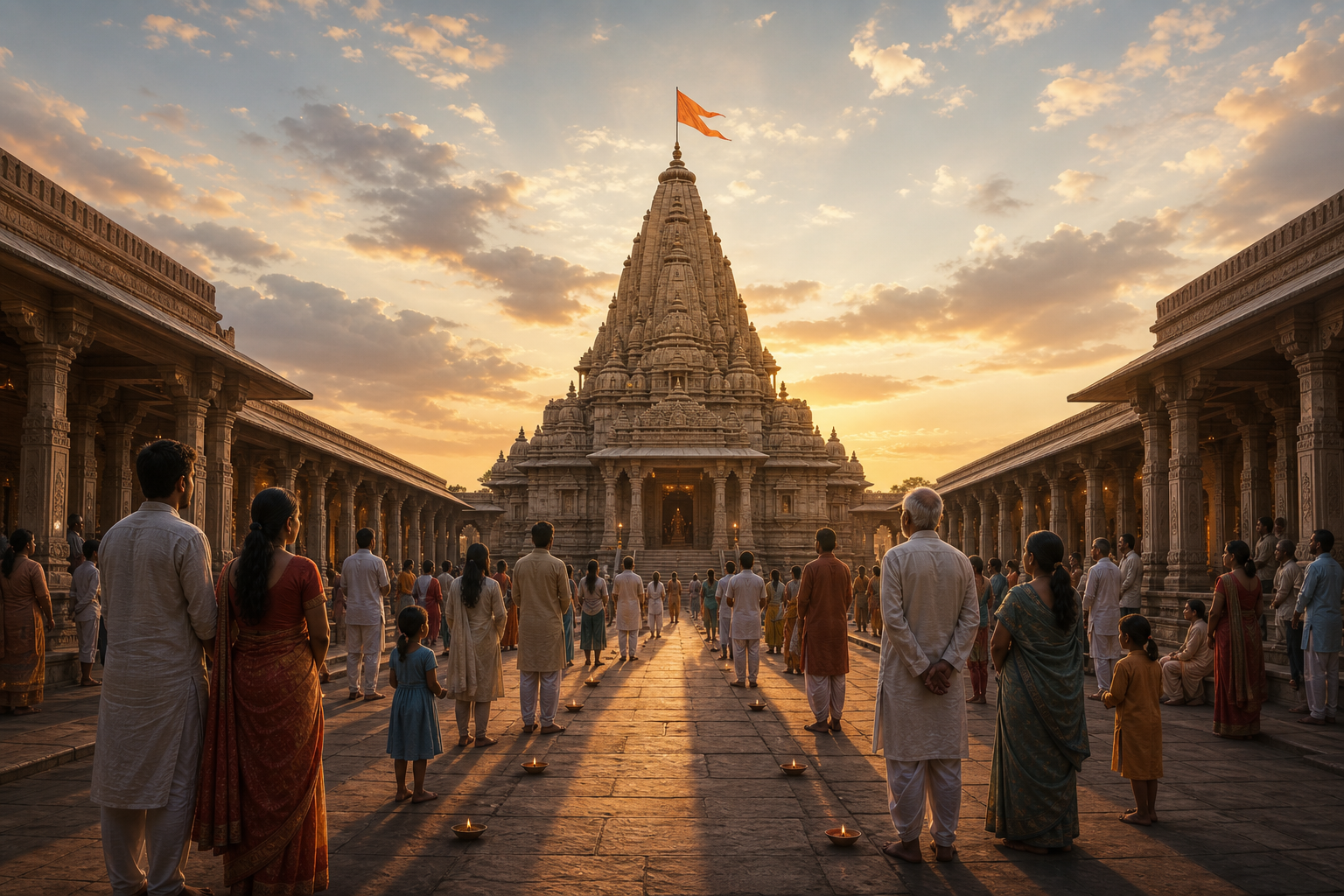
Dhwajarohan means the raising of a dhwaja, or sacred standard. In Ayodhya, Prime Minister Narendra Modi raised the saffron Dharma Dhwaja on the temple’s Shikhar in the presence of Uttar Pradesh Chief Minister Yogi Adityanath and spiritual and civic leaders.
The position matters. A flag above the Shikhar can be seen from outside the immediate ritual enclosure. It extends the temple’s presence into the public horizon. The sanctum remains the devotional heart, but the standard tells the surrounding community what kind of sacred abode stands there and which ideals it represents.
Traditional ritual interpretation describes this moment as the temple’s transition into a fully sovereign divine abode. Here, sovereignty is sacred rather than constitutional. It does not mean that the temple becomes a political state. It means that the deity, not a government official, party or institution, is the ultimate centre of the sacred space. Public authorities enter that space as participants in the rite, not as owners of the divine presence.
This distinction helps you avoid two shallow readings. The first reduces Dhwajarohan to pageantry. The second reduces it to the political identity of whoever performed the ceremony. Political context cannot be erased, especially when a prime minister takes a prominent ritual role, but neither can it exhaust the meaning of a rite rooted in a much older sacred vocabulary. Judge the ceremony first by its ritual centre: Shri Ram and the dharma associated with him.
When you encounter a photograph or short video of the event, therefore, notice the vertical order before debating the personalities: the temple below, the Shikhar rising above it, and the dhwaja at its summit. The visual statement is that public life should orient itself toward a moral standard higher than temporary office.
The saffron, Sun and Kovidar form one moral vocabulary

The standard should not be read as a collection of unrelated decorations. Its colour and emblems work together. Saffron points to disciplined self-mastery, the Sun locates Shri Ram within the Suryavanshi inheritance, and the Kovidar tree carries an ecological message. One concerns the self, one concerns public duty, and one concerns the living world.
Saffron makes belonging answerable to restraint
Saffron is widely associated in Hindu life with renunciation, tapas, courage and disciplined commitment. On a temple flag, it should not be mistaken for a licence to display anger in the name of identity. Its deeper demand runs in the other direction: sacrifice ego, restrain appetite and place duty before convenience.
This gives you a practical test for any public use of the colour. Does it encourage seva, courage and self-command, or does it merely excite hostility? A symbol of renunciation is being misread when it becomes an excuse for vanity or cruelty. The stronger your claim to represent saffron, the stronger the expectation that your conduct will show restraint.
The Sun joins ancestry to accountable action
The solar emblem recalls Shri Ram’s Suryavanshi heritage and the Ikshvaku line remembered through Raghukul. It therefore does more than identify a royal genealogy. The Sun evokes illumination, constancy and action performed in the open. It turns lineage into an ethical question: are those who invoke Ram willing to make their conduct visible to the standard they praise?
Heritage becomes useful when it disciplines the present. If Raghukul is invoked only to produce pride, half the symbol has been lost. Its harder implication is that position carries obligation. A leader, parent, teacher, temple trustee or ordinary devotee should be judged by truthfulness, courage, restraint and fidelity to duty, not merely by the identity claimed.
The Kovidar makes ecology part of devotion
Within the symbolism presented for the ceremony, the Kovidar tree represents love for the environment, while the Sun recalls Ram’s Suryavanshi lineage. Placing a tree on the standard prevents the meaning of dharma from being confined to ritual performed indoors. The natural world is not scenery around sacred life; reverence must shape how human beings inhabit it.
That ecological message is easy to admire and easy to evade. Apply it where your devotional life meets material practice: the waste produced at a celebration, the treatment of water around a pilgrimage site, the protection of trees, and the cleanliness of the path leading to a temple. A Kovidar emblem becomes empty if sacred enthusiasm leaves plastic, polluted water or damaged vegetation behind it.
A dharma flag is a standard to live under, not a trophy
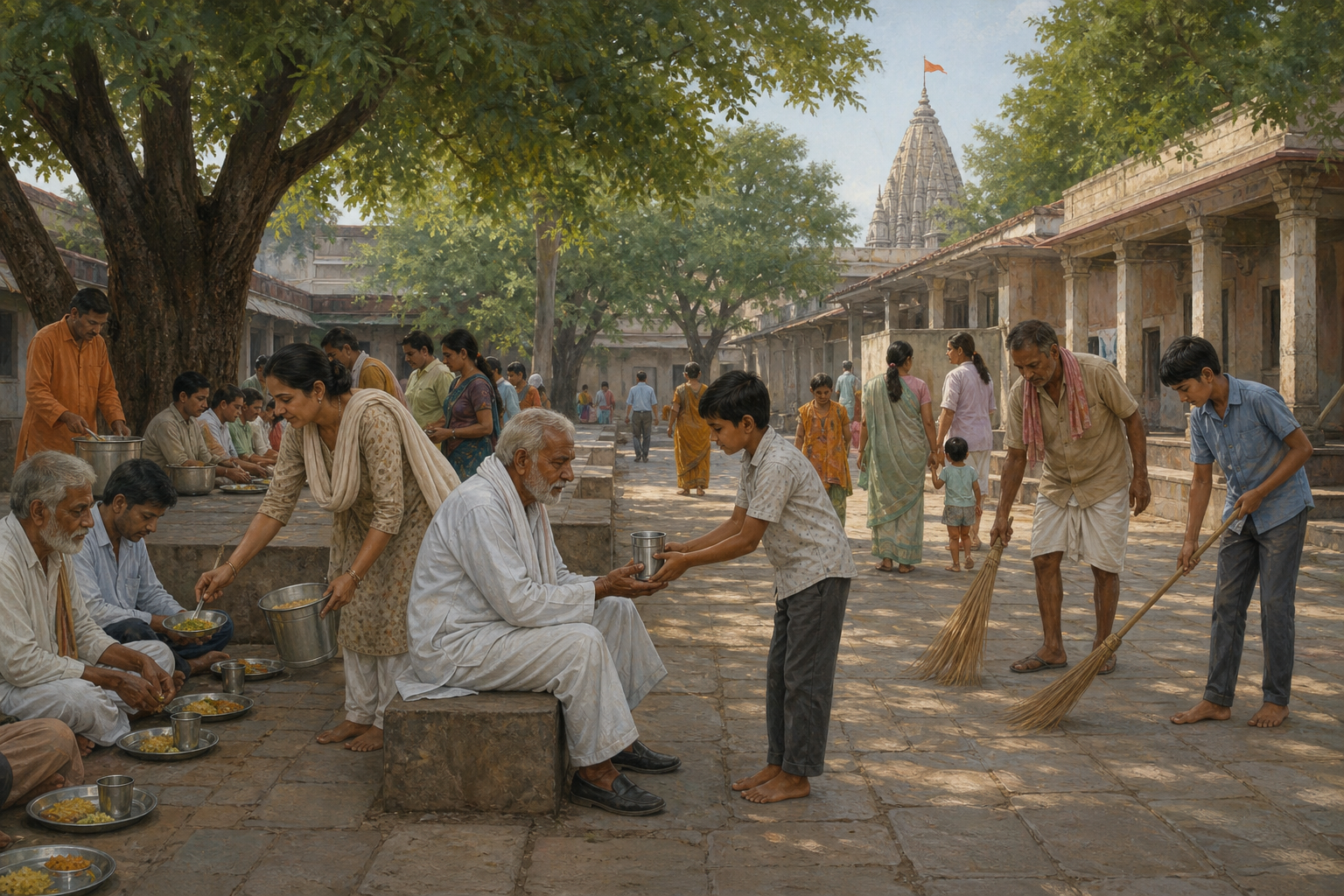
A trophy closes a contest: it says that someone has won. A dhwaja opens an obligation: it establishes the standard under which the next action must occur. This is the most useful way to understand the Ayodhya ceremony. Its civilizational significance does not remove the need for daily dharmic conduct; it increases that need.
The three principal features of the standard can become a simple examination of conduct:
- Saffron: What comfort, ego or impulse are you prepared to restrain for the sake of dharma?
- Sun: Would you defend this action if it were brought fully into the light?
- Kovidar: What effect will the action have on the land, water, animals and people around you?
Use all three questions together. Restraint without courage can become passivity. Courage without restraint can become aggression. Both become incomplete when they ignore the natural and social world in which duty must be performed.
This also clarifies what civilizational continuity should mean. Continuity is not the mechanical preservation of an image. It occurs when a community receives an inherited symbol, understands its discipline and carries that discipline into new conditions. The flag above Ayodhya connects remembered lineage with present responsibility only when devotees make that connection in their own choices.
When public discussion turns the Dhwajarohan into an argument about who is entitled to celebrate, return to a stricter question: what does celebration produce? If it produces seva, protection of sacred places, truthful speech and greater self-command, the symbol is active. If it produces only slogans, factional vanity or contempt, identity has displaced dharma.
Key takeaways
- Dhwajarohan announces the temple as a complete sacred abode centred on the deity; it does not confer political sovereignty.
- The flag’s saffron colour calls for sacrifice, discipline and courage rather than unrestrained anger.
- The solar emblem connects Shri Ram with the Suryavanshi and Ikshvaku inheritance while making lineage answerable to public duty.
- The Kovidar tree turns ecological care into a test of devotional sincerity.
- The ceremony is best treated as the beginning of an obligation, not the end of a civilizational struggle.
- Future celebrations can strengthen unity by placing shared dharmic virtues above partisan ownership.
How to carry the Dhwajarohan beyond the ceremony
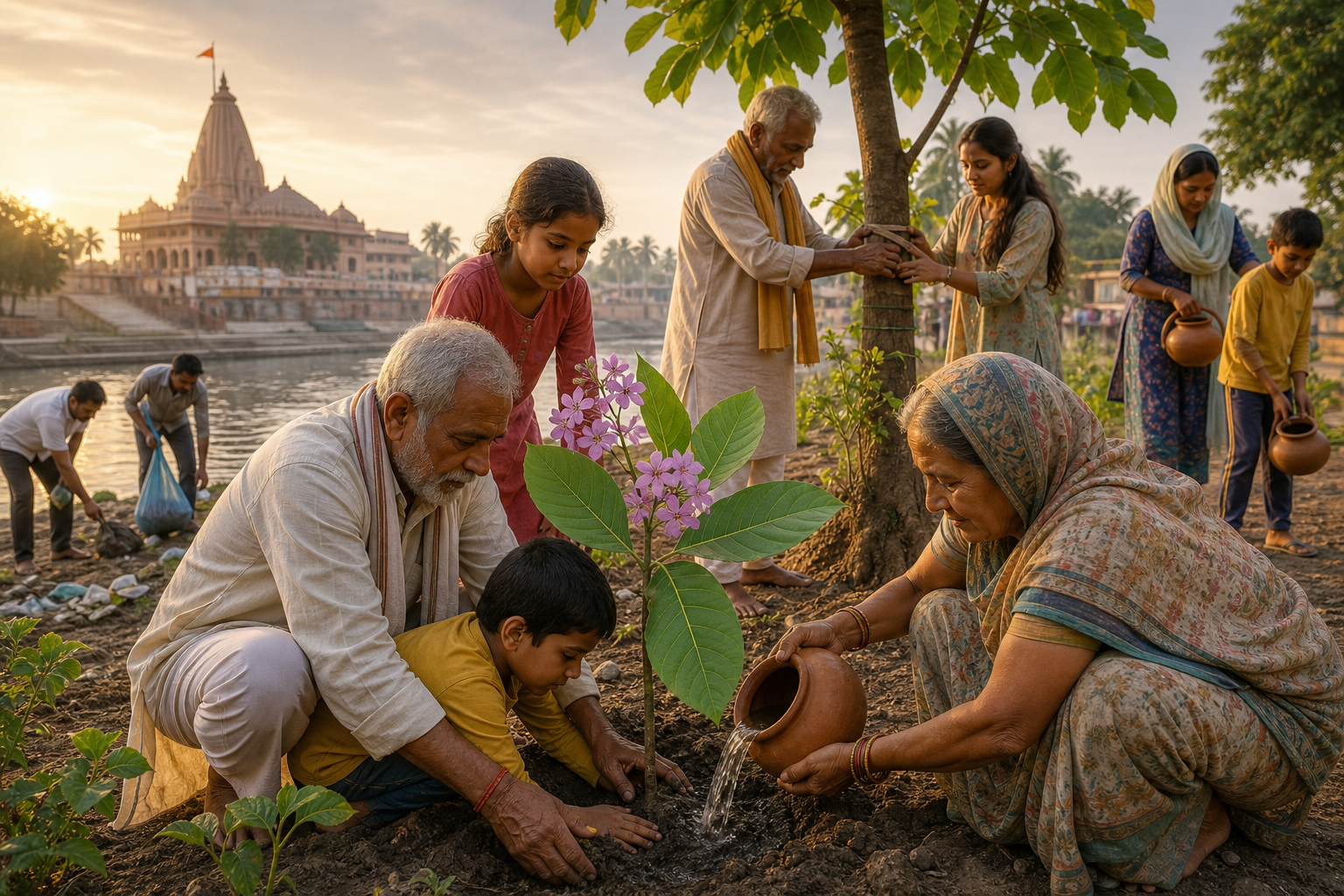
You do not need to reproduce a grand public ritual to respond meaningfully. Choose actions that preserve the relationship among restraint, duty and ecological care.
Make one sankalpa before sharing the imagery
Before forwarding a clip or image, pause long enough to name one commitment it will represent for you. Keep it concrete: refrain from one recurring form of harsh speech, offer a defined act of seva, or take responsibility for waste at the next religious gathering you attend. The point is not to advertise the vow. It is to prevent the symbol from travelling farther than its ethics.
Teach the emblems as duties, not trivia
If you explain the flag to a child or someone unfamiliar with the ceremony, use one sentence for each element: saffron asks us to govern ourselves; the Sun asks us to act truthfully and fulfil duty; the Kovidar asks us to care for the living world. This is more useful than testing whether someone can recall names without understanding their implications.
Evaluate celebrations by what they include and leave behind
A celebration worthy of the standard should leave the site cleaner, strengthen service and give disciplined cultural achievement a visible place. Athletes and classical artists can embody perseverance and sadhana. Spiritual leaders from Hindu, Buddhist, Jain and Sikh traditions can illuminate shared commitments such as seva, compassion, restraint and truth without pretending that all traditions are identical.
Future Ram Mandir observances can also build respectful bridges with indigenous and nature-honouring communities beyond Bharat, including Native American, Druid and Hellenic traditions. The responsible basis for such engagement is shared care for nature and civilizational dignity, not a claim that distinct theologies are interchangeable. Genuine inclusion identifies common ethical ground while allowing differences to remain visible.
Use the next image of the Ayodhya dhwaja as a prompt, not a possession. Name the restraint you will practise, the duty you will perform in the light, and the part of the living world you will protect. That is how a flag raised above a temple begins to shape the life lived below it.
References
