

You may have reached Ishtasiddhi after learning the formula that Atman is Brahman, only to find something closer to a philosophical courtroom than a meditation manual. That difficulty is the point. Vimuktatman does not merely give you a non-dual conclusion; he trains you to see what would count as knowledge of non-duality and how that knowledge survives serious objections.
If you read only to discover what Vimuktatman believes, you will collect doctrines without seeing how they work. Read with three sharper questions: What error is being removed? Which warrant is doing the work? At what level is the claim true? Those questions turn a demanding Sanskrit treatise into a usable map of Advaita epistemology.
The central puzzle: how can knowledge disclose non-duality?
Composed in Sanskrit in the 9th-10th century CE and situated in the Advaita lineage associated with Adi Shankaracharya, Ishtasiddhi belongs to the period in which non-dual Vedanta was sharpening its dialectical method. Its subject is Brahman, Atman, consciousness, maya, knowledge and moksha, but its deeper concern is the relation among them: how can a person who presently experiences difference know that reality is non-dual?
Epistemology asks what valid knowledge is, how it arises and where its authority ends. Advaita faces an unusual problem. An ordinary act of knowing appears to involve a knower, something known and a cognition connecting the two. Yet the non-dual conclusion denies that this division is ultimate. If ordinary knowledge is simply rejected, Advaita loses the means by which it argues or teaches. If the knower-known division is treated as final, non-duality can never be established.
The way through this problem is to distinguish empirical validity from ultimate reality. Pramanas, or means of valid knowledge, function within ordinary experience. They let you navigate a world in which distinctions have practical force. The Upanishadic teaching then addresses a more fundamental error: the assumption that the separate knower, the known world and consciousness are independently established realities.
This distinction prevents two opposite misreadings. The first says that because Brahman alone is ultimately real, evidence, reasoning, duty and suffering can be dismissed. That is not a defensible use of non-duality; empirical consequences remain consequential within empirical life. The second says that because the world works consistently, its apparent divisions must be ultimate. Consistency establishes practical order, not metaphysical independence.
Read maya within that distinction. It should not become the slogan “nothing exists.” The empirical world is experienced, discussed and acted within, but its mode of appearance does not establish it as a second, self-sufficient reality beside Brahman. When a passage discusses the world, ask whether it is denying experience or denying the ultimacy you have assigned to experience. In Advaita, those are not the same move.
The practical test is simple. Beside every important proposition, write either “empirical” or “ultimate.” If the sentence becomes contradictory, check whether two levels have been mixed. Many apparent paradoxes in Advaita are not solved by inventing a third doctrine; they clear when each claim is returned to the level at which it operates.
Keep scripture, reasoning and experience in their proper roles

Ishtasiddhi works through the Advaitic relationship among shruti, yukti and anubhava: scriptural disclosure, disciplined reasoning and direct recognition. Treating them as three interchangeable proofs will obscure the method. They cooperate, but they do not perform identical jobs.
| Lens | Question to write in the margin | Misreading it prevents |
|---|---|---|
| Shruti | Which Upanishadic disclosure anchors this claim? | Treating Brahman as a conclusion reached only by ordinary inference |
| Yukti | Which contradiction, assumption or rival account is being tested? | Reducing Advaita to an assertion protected from criticism |
| Anubhava | What about present awareness can be examined directly? | Confusing verbal mastery with recognition |
Shruti matters because Brahman is not introduced as one more object waiting to be found among other objects. If the ultimate self were an object, it would stand before a separate knower and the original duality would remain. The mahavakyas therefore have a corrective function: they challenge the identity you have assigned to the knower rather than adding a new item to the knower’s inventory.
Yukti keeps that teaching intelligible. Reason tests whether an interpretation is coherent, exposes hidden assumptions and answers objections. It does not need to manufacture Brahman as the result of a syllogism in order to be indispensable. Its immediate work is often eliminative: it shows why a mistaken account of the self, consciousness or reality cannot bear the weight placed upon it.
Anubhava must be handled just as carefully. Do not reduce it to emotion, intuition or an impressive altered state. A private feeling can be intense and still be misunderstood. The relevant inquiry concerns the immediacy of awareness: every perception, thought, doubt and denial is present as something known. You are not asked to believe that fact because someone reports a special experience. You are asked to notice what any experience already presupposes.
Use two margin codes while reading: S, Y or A for shruti, yukti or anubhava; and E or U for empirical or ultimate. A single passage may involve more than one code, but making yourself choose will reveal its architecture. When the reasoning feels obscure, the problem is often not the conclusion. It is uncertainty about which warrant is being used or which level is under discussion.
There is also a useful diagnostic here. If you appeal to scripture but cannot state the objection being answered, you may be repeating authority without understanding it. If you prize reasoning but treat Brahman as an inferred object, you have changed the claim. If you appeal to experience but cannot distinguish awareness from a passing mental condition, you have made anubhava depend on precisely what comes and goes.
Follow each debate as a five-move argument
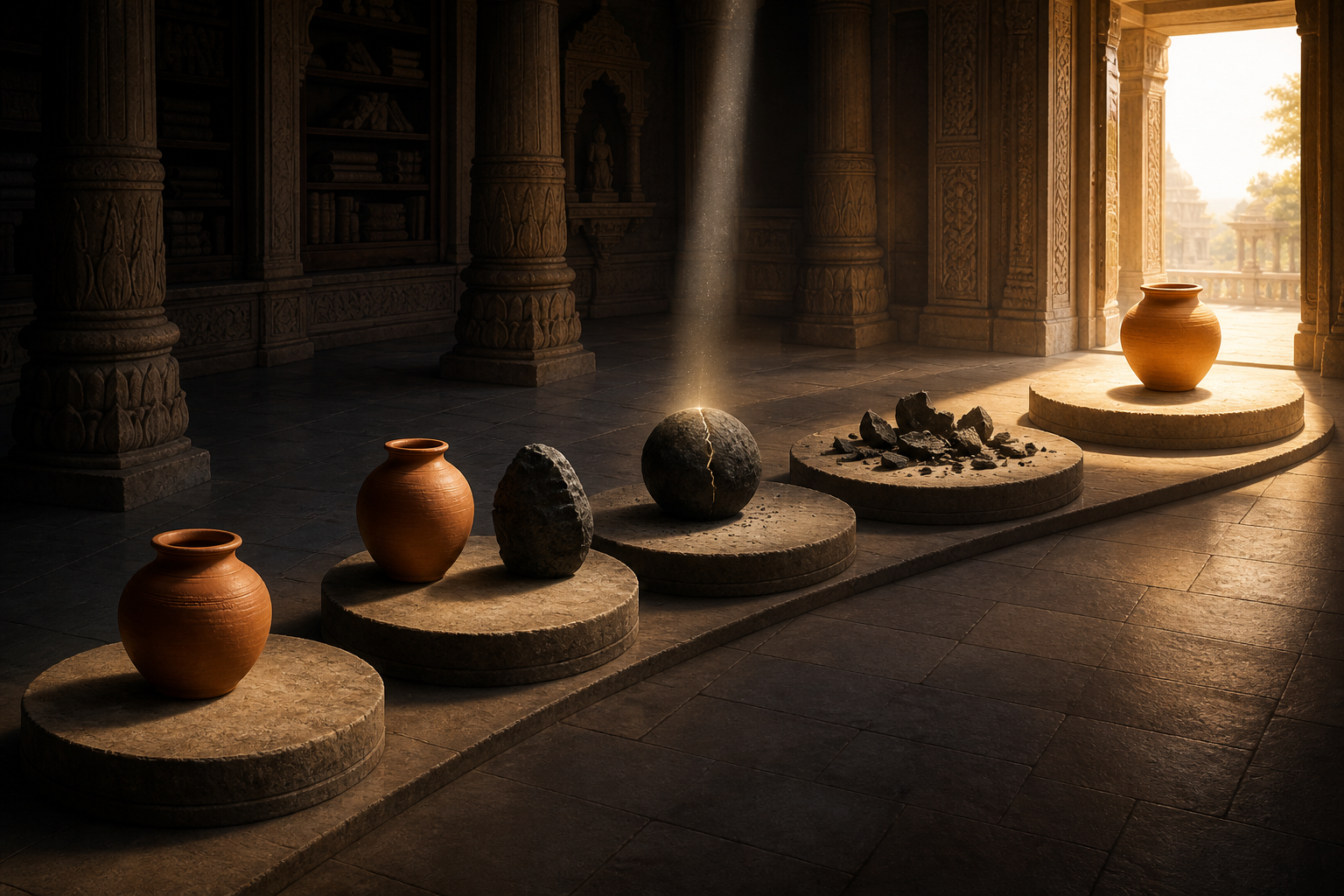
Vimuktatman’s purvapaksha-siddhanta method is not ornamental scholasticism. A purvapaksha presents an opposing case strongly enough to test the Advaita position; the siddhanta gives the established conclusion after that challenge has been met. Skipping the objection usually produces a weaker understanding than the one the text is trying to give you.
- State the proposition in one sentence. Do not begin with a whole chapter. Identify the exact claim under examination, such as the self-revelatory character of consciousness or the status of the empirical world.
- Reconstruct the strongest objection. Write it as something an intelligent opponent could affirm. If your version sounds foolish, you have probably missed the purvapaksha.
- Find the governing assumption. Ask what the objection presumes about the self, knowledge, causation, difference or the relation between knower and known.
- Locate the Advaita response. Does it refute a contradiction, distinguish two levels, reinterpret a term or show that the objection presupposes consciousness?
- Write the consequence for inquiry. Record what you should stop looking for, stop identifying with or stop treating as ultimately independent if the response succeeds.
This method becomes especially important when Mīmāṁsā, Nyāya, Sāṅkhya, Buddhist or Jaina positions enter the discussion. Do not turn those names into a generic category of “other Indian philosophies.” Each signals a live disagreement about what exists, how it can be known or what liberation requires. You need not master every rival system before beginning, but you should preserve the force of the objection instead of translating it immediately into Advaita language.
That discipline also gives dharmic dialogue its proper dignity. Unity among dharmic traditions does not require pretending that their metaphysical conclusions are identical. Respect appears in the willingness to state another position accurately, accept the burden of answering it and let disagreement clarify what is genuinely at stake. The purvapaksha-siddhanta form models that intellectual hospitality without surrendering conviction.
Consider the claim that consciousness is self-revealing. A weak reading merely repeats the phrase. A stronger reading asks how consciousness could be known if it were not another object. The objection may demand a further cognition that reveals consciousness. But if every act of awareness required a second awareness to reveal it, the same demand would arise again. The inquiry therefore turns back toward the awareness presupposed by the demand itself.
Do not draw too much from that argument. Self-revealing consciousness does not make every thought correct. “This belief is present to awareness” and “this belief is valid” are different claims. The first concerns the evident presence of experience; the second still requires the appropriate means of knowledge. Keeping that distinction intact protects Advaita from becoming subjectivism, where whatever appears in the mind is declared true.
A compact reading sheet can hold six lines: claim, level, warrant, objection, response and consequence. Complete it for one argument before moving to the next. If you cannot fill a line, return to the transition between the objection and conclusion. That is usually where the decisive distinction has been made.
Turn epistemology into contemplative inquiry without chasing states

Test what “self-revealing consciousness” actually means
Choose an ordinary present event: a sound, a bodily sensation or a thought. Identify its changing content. Then notice the uncomplicated fact that the content is known. Ask whether awareness has appeared as another sound, sensation or thought, or whether all of those have appeared to awareness.
Next, ask whether a second awareness is required before the first can be present. Do not answer by manufacturing an image of consciousness. Any image is another known content. The exercise is useful precisely when it exposes your habit of searching for the knower as though it were one more thing to be known.
This is not a proof that every Advaita conclusion has already been established. It is a way to locate the problem correctly. If you keep seeking consciousness as an object with a shape, mood or boundary, more conceptual information will not fix the category error. You must first distinguish awareness from the contents whose qualities you have been assigning to it.
Distinguish liberating knowledge from a temporary experience
Ishtasiddhi connects jñāna with moksha because ignorance is removed by knowledge. This does not mean that memorising a proposition is liberation. It means that the decisive correction concerns mistaken identity and mistaken reality, not the production of a new object called Brahman.
A temporary state begins, changes and ends. If non-duality is understood only as a silent mind, an intense meditation or the absence of ordinary perception, its truth will depend on conditions. Knowledge has a different task: to correct the assumption that the changing condition defines the self. A calm mind may assist careful inquiry, but the calm itself should not be mistaken for the conclusion.
After reading an argument, therefore, do not ask only, “Did this produce a special feeling?” Ask, “Which identification has become less defensible?” If the reasoning concerns self-revealing consciousness, perhaps you can no longer coherently treat awareness as merely one more observed thought. If it concerns empirical and ultimate reality, perhaps you can no longer move carelessly from “this appears and functions” to “this exists independently and absolutely.” Those are precise shifts in understanding.
Use a disciplined reading cycle
Before each session, choose one claim rather than a large quantity of text. During the reading, mark the purvapaksha and siddhanta, then add your S-Y-A and E-U codes. Afterward, paraphrase both sides without technical vocabulary. Finally, write one sentence beginning, “If this response succeeds, I should no longer assume that…”
Keep a working glossary, but define terms by function rather than by a single English substitute. Brahman is not merely a very large being; Atman is not the personality or ego; maya is not adequately captured by saying that nothing exists; jñāna is not accumulated information; moksha is not a manufactured result. Revise each definition as you see how the term operates in an argument.
Do not confuse the clarity of Ishtasiddhi with ease. Its clarity lies in the disciplined sequence of claims, objections and replies. Your task is to recover that sequence. Reading slowly enough to reconstruct one argument will take you further than racing through technical terms and retaining only the final slogans.
Key takeaways for your next reading session
- Ask what ignorance or misidentification an argument is intended to remove; do not collect its conclusion as isolated doctrine.
- Mark every major claim as empirical or ultimate so that practical validity is not confused with metaphysical ultimacy.
- Separate the functions of shruti, yukti and anubhava: disclosure, rational clarification and direct examination are related but not interchangeable.
- Reconstruct the purvapaksha sympathetically before accepting the siddhanta. A weak objection produces a weak grasp of the answer.
- Treat self-revealing consciousness as a question about the condition of knowing, not as an invitation to picture awareness as an object.
- Measure progress by the mistaken assumptions you can now identify and question, not by the intensity of a passing mental state.
On your next encounter with Ishtasiddhi, take one argument and fill the six-line sheet: claim, level, warrant, objection, response and consequence. Do that before consulting more commentary. The immediate goal is not to finish a celebrated treatise, but to learn how Advaita turns an assertion of non-duality into a disciplined correction of how you know yourself.
References
