

You may already know what the right action is, yet lose access to it when anger, anxiety, pride, or distraction takes command. The difficulty is not always ignorance. Often, it is the brief interval between impulse and action: the moment when you either remember your values or surrender to your agitation.
Murugan offers a demanding model for that moment. His discipline is not about becoming passive, emotionless, or outwardly severe. It is about developing enough inner command that your speech, decisions, and strength remain answerable to dharma even under pressure.
The first battlefield is the ungoverned mind

Murugan is revered as Kartikeya, Skanda, and Subrahmanya. Although his form is martial, the deeper battle concerns restlessness, fear, anger, attachment, and the ignorance that prevents clear discernment. The warrior image therefore should not be used to romanticize aggression. It asks whether you can face conflict without letting conflict determine your character.
Inner discipline begins before outward action. First, you notice the impulse trying to rule you. Then you stop feeding it. Only after the mind has become steadier do you decide what duty requires. This sequence matters because an agitated mind can make revenge look like justice, avoidance look like peace, and wounded pride look like principle.
Murugan’s silence is therefore active, not evasive. It is the interval in which reaction becomes discernment. You are not refusing to speak or act. You are refusing to let the loudest movement in the mind issue your orders.
- Name the movement: Is this anger, fear, attachment, vanity, or simple restlessness?
- Separate it from the duty: If the emotional heat were removed, what would still need to be done?
- Choose the clean action: What response is truthful, proportionate, and respectful of the other person’s dignity?
This is the beginning of inner sovereignty. You do not need to deny an emotion in order to stop obeying it.
Read the vel and peacock as practical instructions

Murugan’s iconography becomes useful when you treat it as a set of instructions rather than as decoration. The vel represents incisive wisdom that cuts through avidya, or ignorance, while the peacock represents pride and turbulent energy brought under disciplined command. Together, they show that clarity and self-mastery belong to the same practice.
The vel does not ask you to attack another person. It asks you to cut through the confusion within your own perception. When you face a difficult decision, divide what is happening into three parts:
- What you know: the observable facts, including words actually spoken and commitments actually made.
- What you have added: assumptions about motives, imagined outcomes, remembered injuries, and stories about what the event means.
- What dharma asks: the responsibility that remains after fear, desire, and self-display are set aside.
The second part is usually where confusion accumulates. The vel question is simple: What must be cut away so that I can see the duty clearly?
The peacock teaches a different movement. Pride, ambition, intensity, and the desire to prevail are not merely crushed; their energy is disciplined and redirected. If criticism makes you want to humiliate someone, the disciplined response is not to pretend you feel nothing. It is to use that energy to correct what is wrong, defend what is true, or improve your own conduct without staging a performance of superiority.
Use the peacock test when your ego has been touched: Can I do the right thing without needing to display my victory, advertise my virtue, or punish the other person? If the answer is no, wait before acting. The mind may still be seeking vindication rather than dharma.
Yoga supplies a practical grammar for this training. Pratyahara means withdrawing attention from the sensory and mental material that keeps an impulse alive. In daily life, that may mean putting down the phone, ending the rehearsal of an argument, or stepping away from a provocative exchange. Dharana gathers attention around one point. Dhyana allows that gathered attention to become sustained contemplative steadiness. You do not force your way into silence; you repeatedly stop supplying the disturbance.
A ten-minute Murugan practice you can sustain
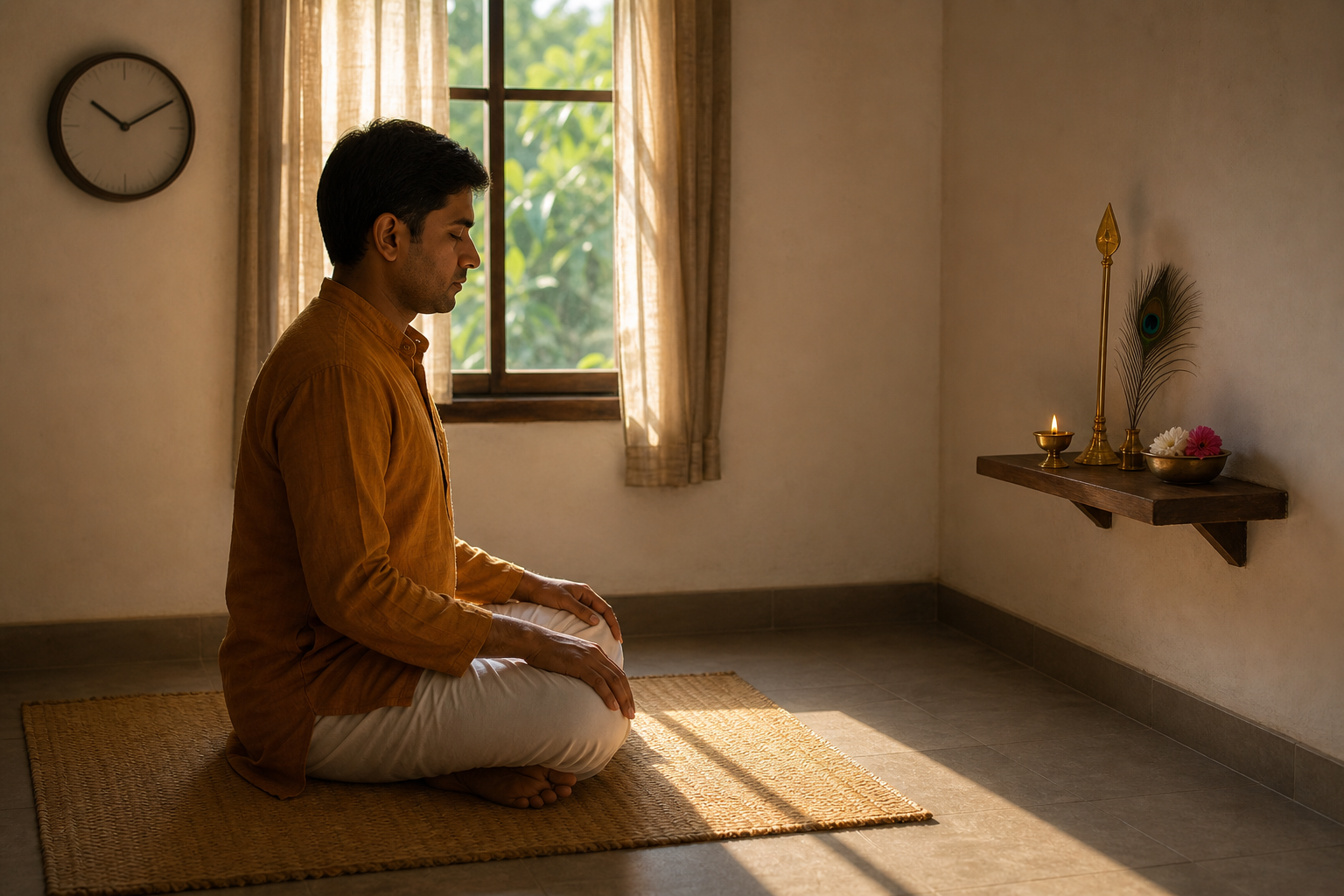
An elaborate spiritual schedule is unnecessary if it collapses after enthusiasm fades. Begin with a ten-minute practice: three minutes of breath awareness, five minutes of mantra japa, and two minutes of silence. Practice at brahma-muhurta if that time genuinely fits your life. Otherwise, choose a consistent time you can protect every day. Regularity is more valuable than an ideal hour you rarely keep.
- Spend three minutes with the breath. Sit upright without making the posture rigid. Let the breath remain gentle. Feel it at the nostrils or notice the natural movement of inhalation and exhalation. When attention wanders, return without argument.
- Spend five minutes in mantra japa. Repeat either “Om Subrahmanyaya Namah” or “Om Saravanabhava” silently or softly. Choose one mantra for the session instead of switching whenever the mind becomes bored.
- Spend two minutes in silent observation. Stop repeating the mantra. Notice thoughts, emotions, and bodily sensations without pursuing them. If useful, hold the mental image of the vel as a beam of clarity passing through confusion.
Distraction does not invalidate the session. The return is the training. Each time you notice that the mind has wandered and bring it back to breath, mantra, or the vel, you are rehearsing the same movement required in conflict: notice, withdraw, gather, and choose.
Do not judge the practice mainly by whether it produces a dramatic feeling. Look for changes that can survive outside the prayer space:
- You pause before sending the message written in anger.
- Your speech becomes more precise and less needlessly harsh.
- You recover attention sooner after distraction.
- You can distinguish a genuine obligation from the wish to be admired.
- You make a difficult decision without repeatedly reopening it to satisfy fear.
These are better signs of discipline than intensity during meditation. The purpose of practice is not to create a private refuge from responsibility. It is to improve the quality of your presence when responsibility arrives.
Carry the silent-warrior discipline into ordinary conflict

The test of Murugan-inspired discipline comes in conversation, work, family obligation, and service. A person can sit quietly for ten minutes and still use silence to avoid an apology, postpone a necessary decision, or punish someone through withdrawal. That is not mastery. Silence serves dharma only when it prepares truthful and proportionate action.
Before a difficult conversation, take one unforced breath and identify the outcome you are responsible for. It may be to correct a falsehood, establish a boundary, admit a mistake, or protect another person. Enter the exchange with that duty in view. If the conversation shifts toward humiliation, point-scoring, or rehearsing every past injury, return to the duty.
Strength without ethics becomes domination. Gentleness without courage becomes avoidance. Murugan’s model joins the two: speak honestly without cultivating cruelty, protect dignity without surrendering truth, and act firmly without feeding hatred. This is disciplined kshatra, not aggression disguised as spirituality.
Watch for four common distortions:
- Hardness mistaken for discipline: If practice makes you contemptuous of people who struggle, pride has taken possession of the practice.
- Suppression mistaken for peace: An emotion pushed out of awareness can still direct conduct. Name it before choosing whether to act on it.
- Silence mistaken for virtue: Remaining quiet is not noble when dharma requires a warning, defence, apology, or correction.
- Ritual intensity mistaken for transformation: More recitation does not excuse careless speech, broken promises, or avoidable harm.
This pattern also makes Murugan intelligible within the wider Dharmic family without pretending that different traditions are interchangeable. The Buddha’s unwavering meditation before Mara presents victory over inner disturbance. Jain samayik and pratikraman cultivate attentive restraint and correction of conduct. Sikh simran and the sant-sipahi ideal unite remembrance with courageous service while confronting kama, krodh, lobh, moh, and ahankar: lust, anger, greed, attachment, and ego.
The practices, theological settings, and lineages remain distinct. Their practical convergence lies in a disciplined insight: power becomes trustworthy only when the mind is not enslaved by its own impulses. You can honour that shared principle while practising through the vocabulary, obligations, and forms proper to your own tradition.
The Skanda Purana presents Kartikeya as a teacher of disciplined wisdom and right action. Arunagirinathar’s Tiruppugazh hymns praise Murugan as a purifier of the mind. Both dimensions matter in practice: devotion gathers the heart, wisdom clarifies perception, and disciplined action carries that clarity into the world.
Key takeaways: use Murugan’s discipline in the moment
- When agitation rises, name the impulse before deciding what it means.
- Use the vel question: “What must be cut away for the duty to become clear?”
- Use the peacock test: “Can I act rightly without displaying superiority or demanding vindication?”
- Train daily with three minutes of breath awareness, five minutes of one mantra, and two minutes of silence.
- Measure progress in conduct: steadier attention, more measured speech, clearer decisions, ethical restraint, and useful service.
- Do not use calmness to avoid action. The silent warrior becomes quiet enough to perform the necessary action cleanly.
At your next consistent practice time, keep one ten-minute appointment with Murugan. Then carry a single question into the day: What would clarity do here if pride, fear, and anger were not giving the commands? Answer it through one clean action. That is where inner discipline stops being an ideal and begins becoming character.
References
