-
Saka Chamkaur: Guru Gobind Singh’s valor, Sahibzadas’ sacrifice, and timeless dharmic unity

ਸਾਕਾ ਚਮਕੌਰ (Battle of Chamkaur) is presented with historical precision and a dharmic lens, highlighting Guru Gobind Singh’s leadership and the Sahibzadas’ sacrifice. Readers gain a clear timeline from the siege of Anandpur Sahib to the stand at Chamkaur. The narrative emphasizes dharma-yuddha—moral courage, restraint, and protection of the vulnerable—rather than glorifying conflict. Emotional resonance…
-
Magh Month (Magha Masam): Auspicious Power, Shiva Worship, Surya and Saraswati Puja

Magh month (Magha masam) is the eleventh month of the Hindu calendar and is widely regarded as auspicious, with a devotional focus on Lord Shiva. Its hallmark observances—Magh Snan, Mauni Amavasya, Maghi Purnima, and Vasant Panchami—highlight purification, silence, learning, and reverence for Saraswati Devi and Surya Bhagwan. The month encourages practical sadhana such as dawn…
-
Kurukesha, Disciple of Ramanujacharya: A Revered Beacon of Sri Vaishnava Wisdom

Kurukesha is honored in Sri Vaishnava tradition as a devotee-disciple of Ramanujacharya who exemplified humility, disciplined practice, and compassionate service. While historical details are limited, devotional memory preserves his role in transmitting Visishtadvaita Vedanta and strengthening the Bhakti Tradition through study, worship, and community service. This portrait highlights practical lessons for today: inclusive institutions, shared…
-
Bhagavan Sri Ramana Maharshi Jayanti 2026: Sacred Date, Punarvasu Meaning, and Ways to Observe

Bhagavan Sri Ramana Maharshi’s 146th Jayanti will be observed on January 4, 2026, aligned with Punarvasu (Punarpoosam/Punartham) Nakshatra in Margazhi Masam per the Tamil calendar. The day is traditionally marked at Sri Ramanasramam, Tiruvannamalai, with Veda parayana, recitations of Ramana’s works, meditative silence, and reflective satsanga. Observing the Jayanti by Nakshatra rather than solar birthdate…
-
Narayana and the Waters of Creation: Profound Symbolism, Etymology, and Shiva Purana Insights

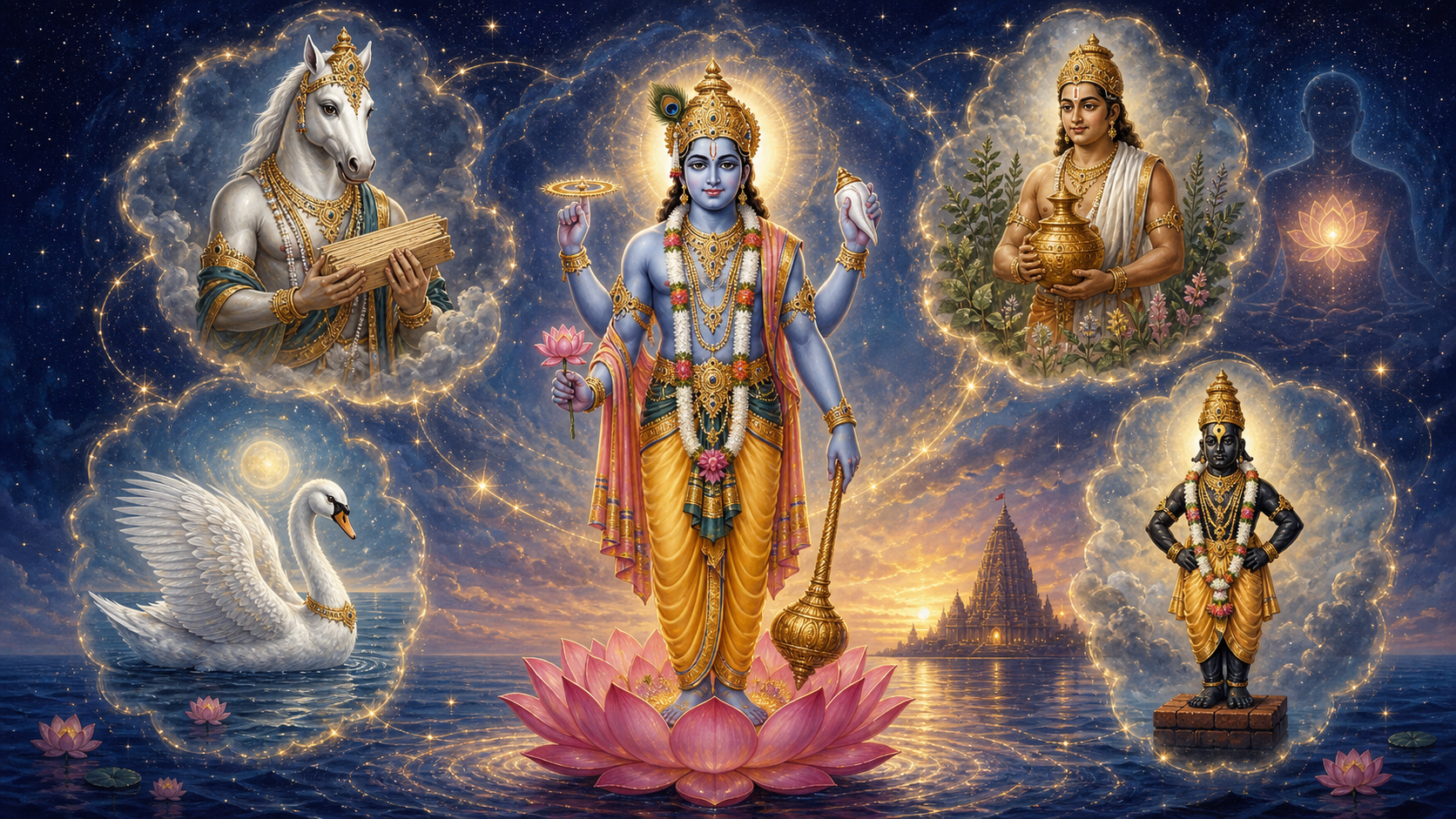
This article explores Narayana as a symbol of creation through water, uniting Sanskrit etymology, Hindu symbolism, and Puranic cosmology. It explains how the roots “nara” (water) and “ayana” (abode) reveal a precise theological insight anchored in the Shiva Purana (2.1.6). Readers gain a clear view of Vishnu iconography and Kshira Sagara as metaphors for potentiality…
-
Why Book Distribution Reignites Devotion: HH Niranjana Swami at ISKCON Mayapur

This reflection from ISKCON Mayapur captures HH Niranjana Swami’s core insight: inspiration in book distribution flows from seva—pleasing Srila Prabhupada by sharing Krishna consciousness—rather than from taking breaks. By compelling compassionate dialogue about Krishna, the service aligns with Lord Chaitanya’s instruction to tell everyone about Krishna and “become a guru.” Practitioners commonly report that outreach…
-
Srimad Bhagavatam 11.2.11 at ISKCON Juhu: The Transformative Power of Devotional Questions

Delivered at ISKCON Juhu on 30 December 2025, this Srimad Bhagavatam 11.2.11 discourse by H.G. Ramarupa Prabhu demonstrates how intelligent, sincere questions about Krishna and devotional service deepen understanding and accelerate spiritual growth. Set within the dialogue of Maharaja Nimi and the Nine Yogendras, the lecture shows that inquiry benefits the questioner, the speaker, and…
-
Conquering Fear through Vedic Wisdom: SB 10.87.32 on Māyā, Time and Liberation

Srimad-Bhagavatam 10.87.32 presents a clear Vedic pathway from discerning Māyā to cultivating devotion and attaining fearlessness. It frames the wheel of time as a constant force, inviting a shift from anxiety to service-oriented steadiness. Read alongside the Upanishads, the verse underscores how insight (vidyā) and bhakti mutually reinforce liberation. Parallels across Buddhism, Jainism, and Sikhism…
-
Standing Together in Prayer: Hari Sauri Prabhu’s Heart Surgery and Dharmic Solidarity

His Grace Hari Sauri Prabhu, a senior disciple and long-standing personal servant of Śrīla Prabhupāda, is undergoing heart surgery, prompting thoughtful solidarity across ISKCON and the wider Hindu community. The update emphasizes dignity, privacy, and collective hope rather than requests or appeals. It reflects how dharmic traditions—Hinduism, Buddhism, Jainism, and Sikhism—converge around compassion, metta/maitrī/karuṇā, dayā,…
-
Gita 2099 at School of Bhakti: Inspiring Future-Focused Wisdom with H.H. S.B. Keshava Swami

In late December, the School of Bhakti hosted Gita 2099 with H.H. S.B. Keshava Swami, uniting more than 650 attendees around future-focused guidance from the Bhagavad-Gita. The evening opened with a warm interaction with 2025 Gita Life students, affirming intergenerational learning and accessibility. Discussions linked timeless dharma to modern challenges such as ethical leadership, digital-age…
-
Kolabou as Lakshmi: Sacred Symbolism of the Banana Plant in Bengali Hindu Tradition

This article explores Kolabou (Kola Bou) worship in Bengali Hindu tradition, where the banana plant is revered as Goddess Lakshmi and also understood within the Nabapatrika during Durga Puja. It highlights the practice’s cultural roots in Faridpur and Barisal, its migration into the diaspora, and its layered meanings that embrace plural interpretations without conflict. The…
-
Hinduism Beyond Miracles: Supersensual Knowledge Rooted in Reason and Lived Experience
Hinduism is often mischaracterized as supernatural, yet its core affirms supersensual knowledge—truths beyond the senses that remain coherent, rational, and experientially verifiable. Drawing on pramāṇa theory, Upanishadic inquiry, and Yoga, it advances a disciplined path where meditation, ethics, and contemplation yield repeatable inner transformations. This perspective aligns with Buddhism’s experiential insight, Jainism’s Anekantavada, and Sikhism’s…
-
Beyond Labels: Dharmic Wisdom on Simply Being, Free from Success, Failure, and Fear

This essay distills a unifying Dharmic insight: being precedes every label of success, failure, adventure, and disappointment. Drawing on Hindu philosophy, Advaita Vedanta, Buddhism, Jain Anekantavada, and Sikh remembrance of the One, it explains Maya and Avidya without denying lived experience. The approach reduces anxiety, strengthens resilience, and encourages ethical action aligned with dharma. Practical…
-
Anjana’s Sacred Teachings: Maternal Wisdom That Forged Hanuman’s Eternal Devotion

This essay explores how Anjana’s maternal wisdom formed the inner discipline behind Hanuman’s legendary devotion in the Ramayana. It highlights her role as an apsara-turned-seeker whose tapas and ethical guidance laid the foundation of spiritual strength. Readers discover how humility, service, and steadfastness—instilled early—shaped Hanuman’s fearlessness and discernment. The discussion frames bhakti as practical ethics…
-
Daily Dharmic Wisdom for Calm and Clarity: A Grounding Companion for 2026 and Beyond

This piece presents a calm, academically grounded overview of a daily reflection practice designed to foster mindfulness, clarity, and emotional resilience. It situates the practice within a community that values honest stories, compassionate self-acceptance, and unity across Hinduism, Buddhism, Jainism, and Sikhism. The 2026 cycle continues a sixth year of concise daily insights, offering a…
-
Mesha Rashi 2026 Auspicious Days: Powerful Shubh Muhurat under Ashwini–Bharani–Krittika

This guide explains how to identify auspicious days for Mesha Rashi in 2026 using the Hindu calendar and Vedic astrology. It clarifies Mesha Rashi’s composition—Ashwini, Bharani, and the first quarter of Krittika—and outlines how Moon transit, Nakshatra, Tithi, and weekday factors shape Shubh Muhurat. Readers learn a clear, location-specific method for using the 2026 Panchang…
-
Beyond Willpower: How Breathwork and Yoga Rewire the Nervous System in Addiction Recovery

This analysis traces a journey from relapse to stability, showing how yoga and breathwork can regulate the nervous system during addiction recovery. It explains why rooting in the body must precede rising into lasting change, linking somatic healing with practical pranayama. It outlines three evidence-aligned breathing techniques—Anulom Vilom, Sama Vritti, and Dirgha Pranayama—that reduce anxiety,…
-
Nigrahasthana in Hindu Philosophy: Transforming Disagreement with Logic, Humility, and Grace

Nigrahasthana—“ground of defeat”—is a cornerstone of Hindu philosophy’s debate ethics, signaling the point where confusion, contradiction, or irrelevance requires a respectful concession. Set within Nyaya’s tarka, it protects truth-seeking dialogue (vāda) from lapses that derail inquiry. The concept aligns with Jain Anekantavada and Buddhist logic, and resonates with Sikh traditions of honest, community-centered discourse. It…
-
Dharma in a Distracted Age: Powerful Ways to Live Authentically with Dharmic Wisdom

This article explores how the timeless wisdom of dharma enables authentic living in a distraction-saturated age. It explains dharma across Hinduism, Buddhism, Jainism, and Sikhism, highlighting shared values of truth, non-harm, discipline, compassion, and service. Readers gain practical tools—viveka, svadharma, Aparigraha, mindfulness, prāṇāyāma, seva, and community support—to stabilize attention and purpose. It offers a four-part…
-
Ravana’s Karmic Reckoning: Sage Dvaipayana’s Curse and Surpanakha’s Tragic Turn in the Ramayana

This exploration presents a lesser-known strand in Ramayana storytelling that links a curse attributed to Sage Dvaipayana with Surpanakha’s ordeal, highlighting the theme of karmic justice. It clarifies that while Valmiki’s text is primary, regional and later traditions use this motif to teach moral causality. Readers gain an academic yet accessible account that balances empathy…