
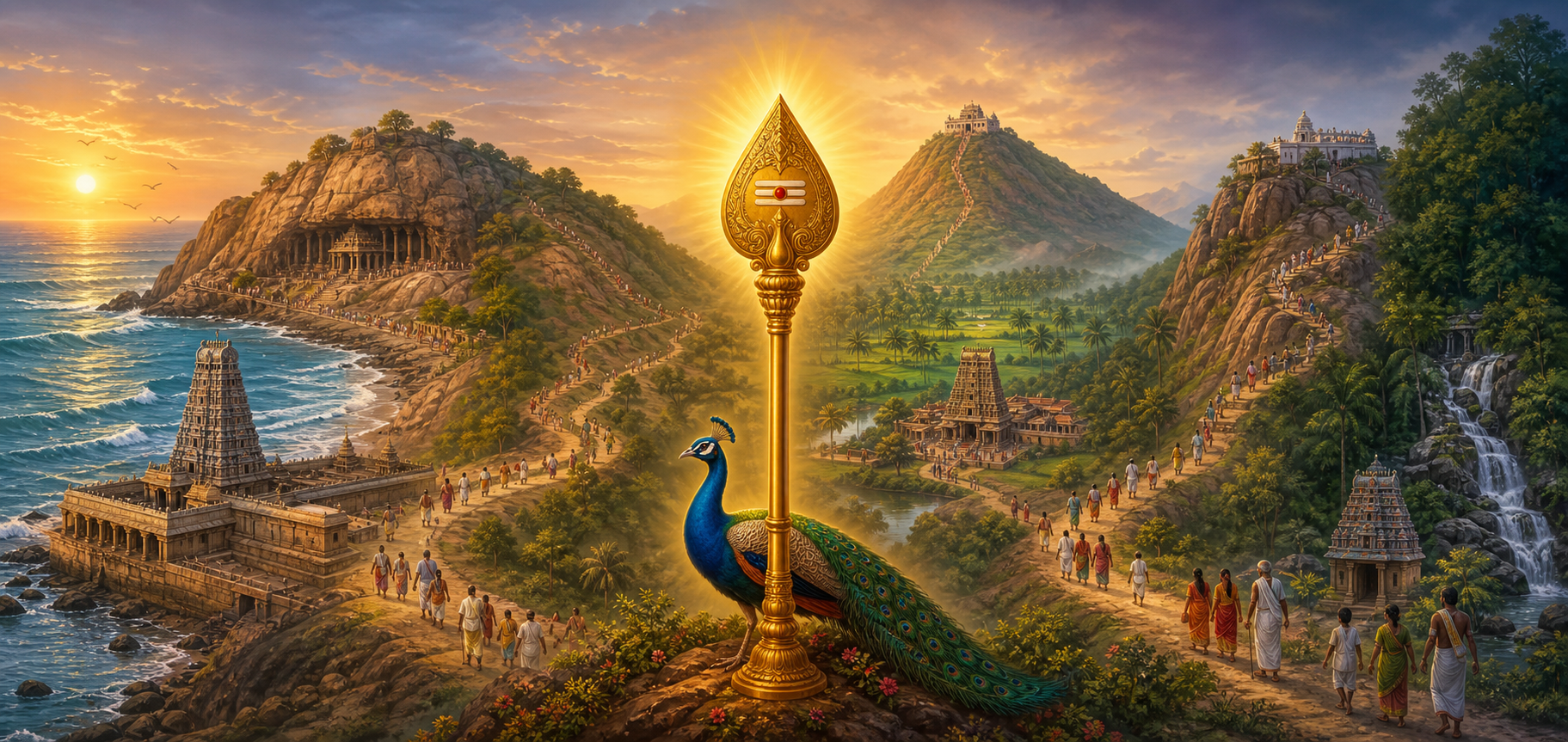
You may know Murugan’s names, recognize the Vel, and even hope to visit the Arupadai Veedu, yet still wonder how the temples, landscapes, symbols, and festivals belong together. The way through is to stop treating them as separate objects of devotion. They form a practical grammar for moving from courage to self-mastery, and from victory to peace.
This guide will help you read that grammar. You can use it while planning a pilgrimage, attending Skanda Sashti, maintaining a home altar, or deciding what Murugan bhakti should change in your conduct.
Start with the six abodes, not six isolated legends
The six sacred abodes in Tamil Nadu are Thiruparankundram, Tiruchendur, Palani, Swamimalai, Thiruthani, and Pazhamudircholai. Their narratives can be read as a coherent progression: commitment, righteous action, renunciation, knowledge, reconciliation, and grace. That progression is more useful than a checklist of famous temples because it gives each visit a question to answer.
| Abode and setting | Sacred encounter | Inner work for the pilgrim |
|---|---|---|
| Thiruparankundram, a cave-temple setting near Madurai | Murugan’s marriage to Deivayanai | Commitment, sacred union, and entry into a life ordered by dharma |
| Tiruchendur, beside the sea | Victory over Surapadman | Confronting disorder without allowing courage to become cruelty |
| Palani, approached as a hill shrine | Murugan as Dandayudhapani Swami and the insight expressed in “Pazham nee appa” | Renunciation, contentment, and the discovery that inner worth is not secured by possessing the prize |
| Swamimalai, marked by ascent | Murugan teaches the meaning of Om to Shiva | Humility before knowledge and willingness to recognize wisdom wherever it appears |
| Thiruthani, associated with tranquility after conflict | Reconciliation after victory and, in regional tellings, Murugan’s marriage to Valli | Letting force subside once its dharmic purpose has been fulfilled |
| Pazhamudircholai, a forested sanctuary near Madurai | Murugan with Valli and Deivayanai, alongside the Avvaiyar episode | Inclusive grace, intellectual humility, and renewed delight in learning |
This sequence should not be turned into a rigid ranking of temples. It is a way to prepare your attention. Before entering an abode, name the spiritual movement associated with it. While there, notice how the landscape, deity, narrative, and ritual reinforce that movement. Afterward, identify what must change in your ordinary life.
At Tiruchendur, for example, the sea is not merely scenery for a photograph. Its vastness and movement deepen themes of purification, renewal, and resolve. At Palani, the climb and the austere form of Dandayudhapani make renunciation physical rather than theoretical. At Pazhamudircholai, the grove and the humbling of Avvaiyar turn learning into an encounter with living, playful wisdom.
A useful pilgrimage question is therefore not simply, “What happened here?” Ask, “What quality does this place require from me?” That change of question converts sacred geography into sadhana.
Read the Vel, peacock, and serpent as one ethical teaching
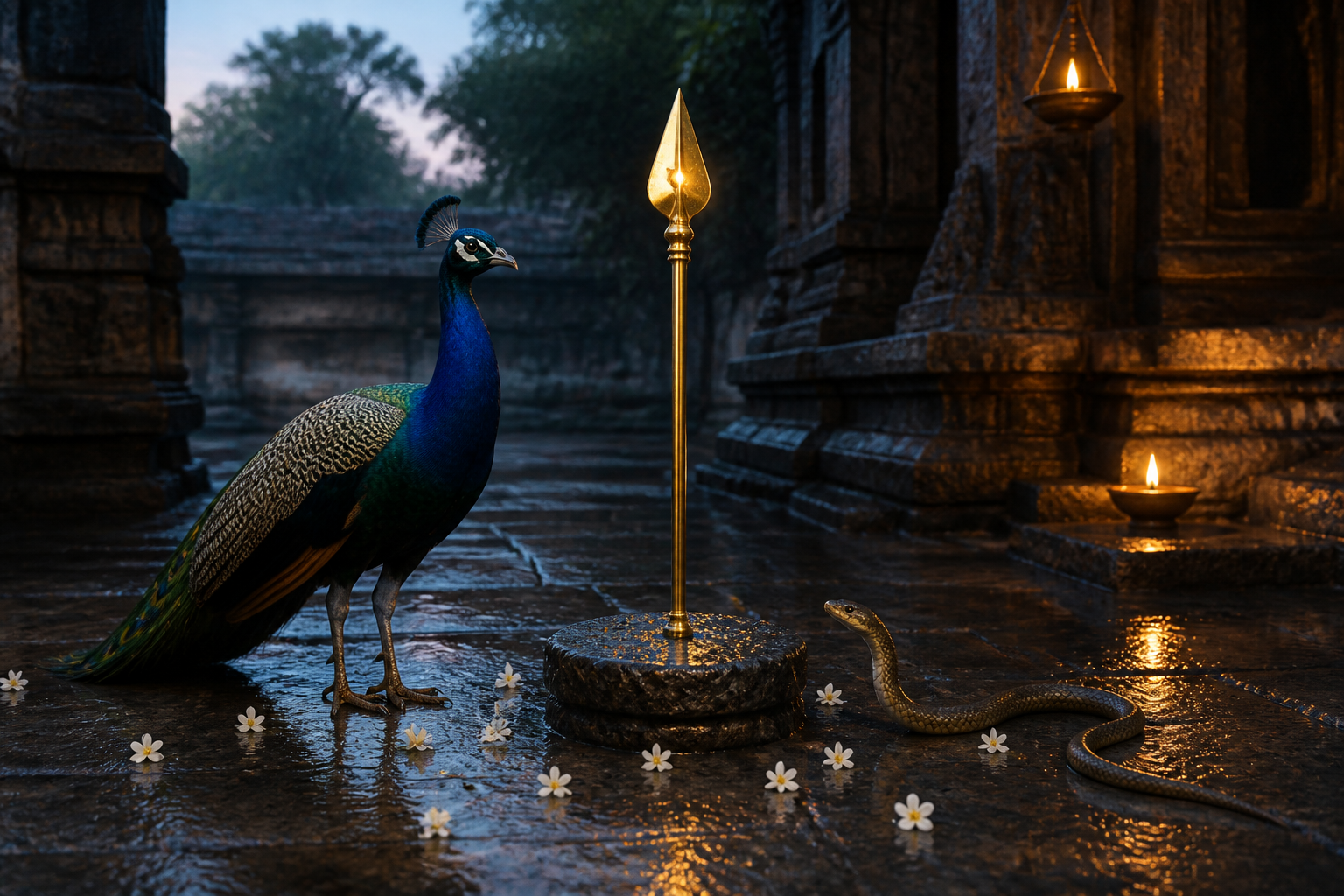
Murugan’s symbols become clearer when you read their relationships rather than interpreting each object alone. The Vel expresses penetrating clarity, disciplined power, and the protection of dharma. The peacock carries splendor, vigilance, valor, purity, and guardianship. The serpent subdued beneath it is commonly read as ego, toxicity, and ignorance brought under control.
The important action is subduing, not hating. The image does not license hostility toward creatures, people, or parts of yourself that you find inconvenient. It asks whether brilliance is governing poisonous impulses. If pride, resentment, or confusion controls your decisions, the peacock’s beauty is decoration. If awareness masters those impulses and turns strength toward protection, the symbol is doing its work.
The peacock as Murugan’s vahana therefore joins aesthetics to ethics. Tiruppugazh praises its protective spiritual force, while temple murals, home altars, and Mayil Attam keep its meaning present outside formal textual study. When you see the image, use a simple three-part reading:
- Name the power. In Murugan’s iconography, courage and beauty are not passive qualities; they are placed in the service of dharma.
- Name what must be mastered. Look for the ego, agitation, ignorance, or bitterness that is distorting your judgment.
- Name whom your clarity should protect. The Vel is not an ornament for personal superiority. Its moral direction is protective and responsible.
This method also prevents a common misreading of Surasamharam. Victory is not the final spiritual achievement. Force must be transformed into guardianship, and the warrior must be capable of peace. That is why Tiruchendur’s victory belongs in the same sacred arc as Thiruthani’s reconciliation.
The peacock also carries resonances across the wider dharmic family without erasing the differences among traditions. Mahamayuri in Buddhist lore is associated with healing and protection. The Jain pichhi expresses ahimsa and carefulness toward life. The kalgi associated with Guru Gobind Singh evokes bravery and noble bearing in Sikh history. These are not interchangeable doctrines. They do, however, let you notice a shared civilizational conviction: disciplined nobility should protect life rather than dominate it.
That conviction has an ecological consequence. A feather on an altar cannot be separated from concern for the living bird and its habitat. If a peacock’s call or monsoon dance feels auspicious, receive it as a prompt toward clarity and care, not as a prediction that excuses you from judgment. Reverence becomes credible when it produces responsibility for the life represented by the symbol.
Let Surasamharam form your conduct, not feed your curiosity
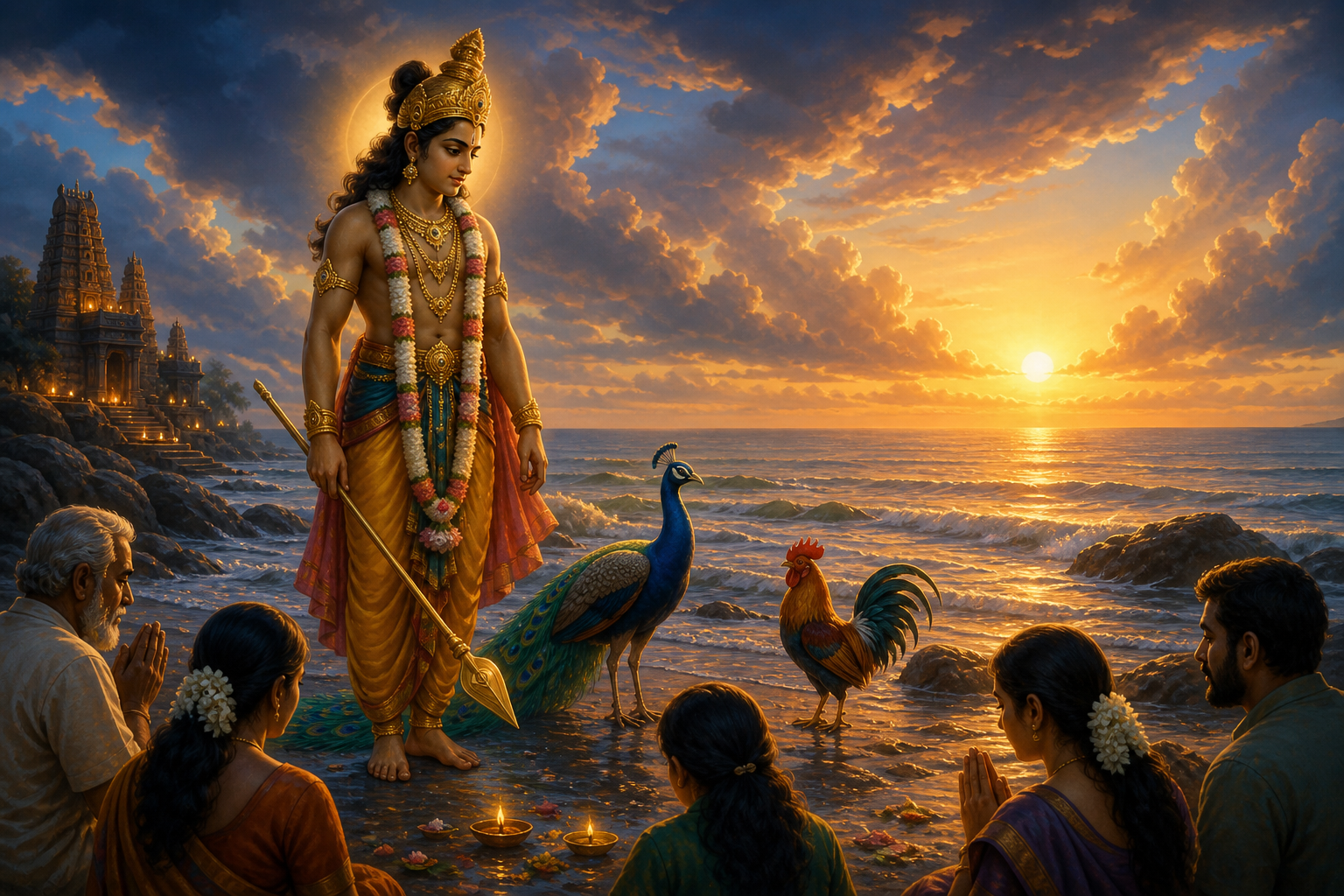
Skanda Sashti gives Murugan’s symbolism ritual movement. Surasamharam dramatizes the defeat of Surapadman and the restoration of dharmic order. The observance is compelling because it does not leave courage as an idea: worshippers encounter preparation, divine resolve, confrontation, and victory through liturgical action.
At Sikkal Singaravelan temple, a particularly striking moment occurs when Murugan’s utsava murti receives the Vel. Moisture appears on the image and is popularly described as the deity “sweating”. Priests gently wipe the visible droplets as the ritual proceeds. Devotional interpretation understands the moment as Murugan’s concentrated resolve and protective compassion before battle.
You do not have to reduce this event either to a spectacle or to a contest over proof. The careful description is straightforward: devotees and temple custodians observe moisture during a particular ritual sequence; faith, sanctum conditions, and ritual materials all belong to the context in which the event is understood. Saying more than you can establish weakens rather than strengthens a serious account of living tradition.
If you attend Surasamharam, use the following discipline:
- Learn the moral arc before arriving. Surapadman’s defeat represents the restoration of order and the conversion of martial force into protection. Do not approach the event as religious theatre detached from ethics.
- Attend to the sequence. At Sikkal, the alankaram, presentation of the Vel, appearance of moisture, and priests’ careful service belong together. Hunting only for the unusual moment makes the rest of the ritual disappear.
- Separate observation from interpretation. Describe what is seen accurately, then explain the devotional meaning without pretending that the two are the same kind of claim.
- Respect local temple discipline. Follow the instructions governing movement, worship, and recording. Your desire to document an event does not outrank the sanctity of the rite or the needs of other worshippers.
- Carry away a vow, not merely an image. Identify the disorder you need to confront, the reaction you must master, and the person or principle your courage should protect.
This final step is the difference between watching Murugan receive the Vel and receiving its instruction yourself. A person struggling with anger may need restraint before action. Someone avoiding a necessary duty may need resolve. Someone who has prevailed in a dispute may need Thiruthani’s lesson: stop fighting when the dharmic purpose of the struggle is complete.
Make pilgrimage or home worship answer a real question
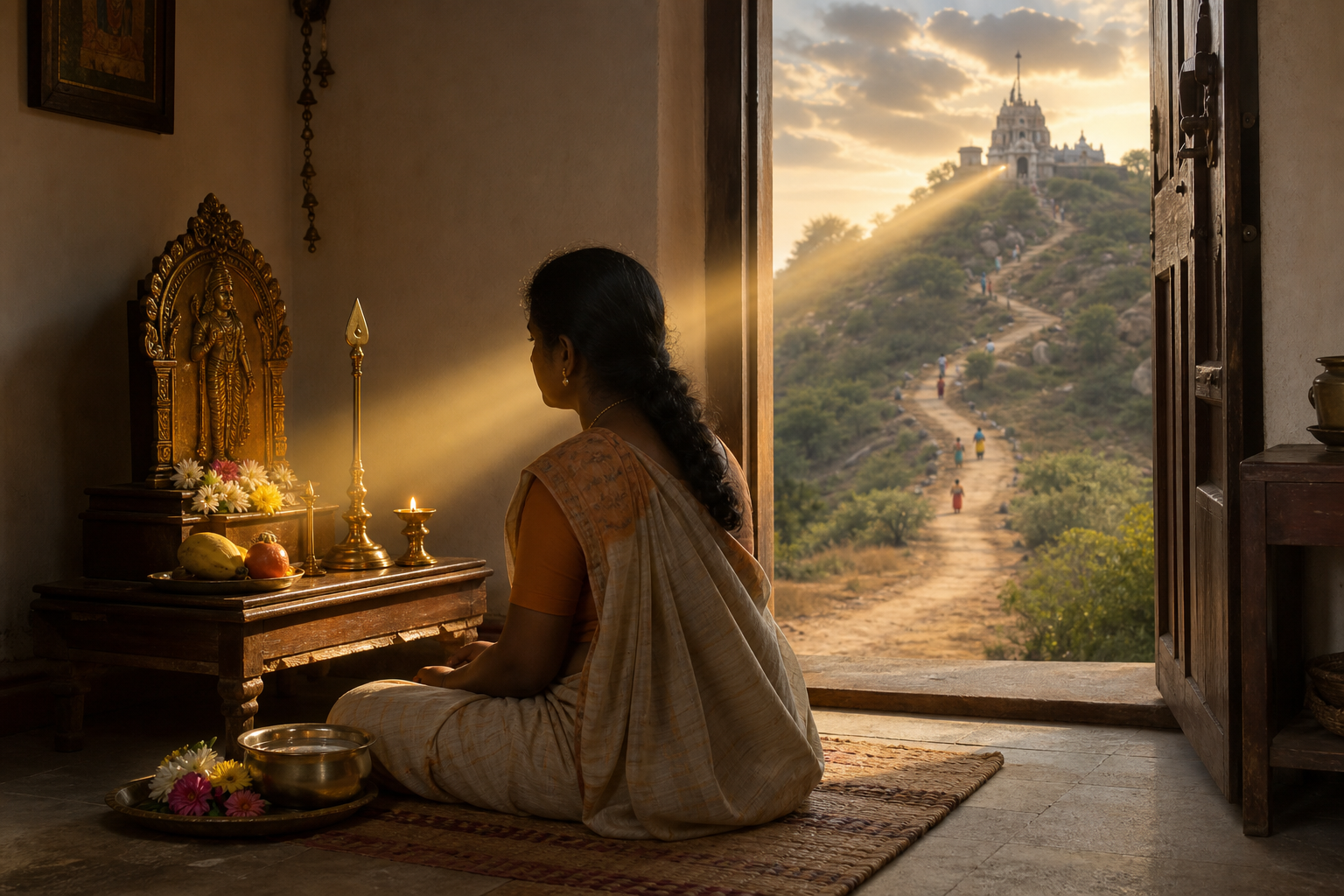
A Murugan practice becomes focused when it begins with a real decision. Name what you are carrying in ordinary language: a commitment you are postponing, an injustice you must face, an attachment you cannot release, a teaching you resist, a conflict you cannot end, or pride that prevents you from learning. Then choose the abode and symbol that expose the problem most honestly.
- For an unmade commitment, begin with Thiruparankundram. Ask what dharma you are willing to enter, not merely admire.
- For fear or moral confusion, turn to Tiruchendur and the Vel. Define the boundary that must be defended and ensure that your method does not reproduce the disorder you oppose.
- For attachment to recognition or possession, contemplate Palani. Decide what you can relinquish without resentment and what inner wealth remains when the prize is gone.
- For intellectual pride, use Swamimalai and Pazhamudircholai together. Ask whether you can receive instruction from an unexpected teacher and whether you can accept correction without humiliation.
- For a conflict that has outlived its purpose, turn to Thiruthani. Choose the act of restraint, reconciliation, or protective distance that permits genuine peace.
If you can travel, carry the same question through the temple’s landscape, darshan, and ritual rather than rushing to collect visits. Keep a brief pilgrimage record with the place, the quality it revealed, the resistance you noticed, and the action you will take. This gives you something concrete to revisit after the emotional intensity of darshan has passed.
If you cannot travel, the sacred pattern can still order a personal devotional reflection. This does not reproduce temple liturgy, and it should not be presented as though it does. You can contemplate the abodes in their spiritual sequence, read Murugan’s image through the Vel and peacock, sing or listen to established bhakti compositions such as Tiruppugazh, and connect prayer to an observable change in conduct.
Home altars with peacock imagery, the embodied discipline of kavadi, observances during Karthigai and Skanda Sashti, and Palani’s panchamrita abhishekam all show that Murugan devotion engages body, place, calendar, and community. Choose practices rooted in the tradition you have actually received, and seek guidance from the relevant temple or lineage when the procedure matters. Personal reflection can deepen ritual, but it should not invent ritual authority.
The same care applies to heritage. Murugan’s temples preserve more than stone structures. Their continuity carries liturgy, music, dance, inscriptions, artistic knowledge, and artisanal work. Supporting a temple tradition therefore means valuing the people and practices that keep it alive, as well as conserving its architecture and natural setting.
Key takeaways
- Read the Arupadai Veedu as a movement through commitment, justice, renunciation, knowledge, reconciliation, and grace.
- Interpret the Vel by asking what requires clear action, what impulse must be disciplined, and whom your strength should protect.
- Read the peacock and subdued serpent together: beauty becomes dharmic when vigilance masters ego, toxicity, and ignorance.
- At Surasamharam, attend to the whole ritual sequence and distinguish careful observation from devotional interpretation.
- Whether you travel or worship at home, connect each symbol or sacred place to a specific decision in your conduct.
- Let reverence include ecological care and support for the living communities that sustain temple tradition.
Begin with the question you are actually carrying. Match it to an abode, sit with the corresponding symbol, and choose the conduct it demands. Murugan’s sacred geography becomes intelligible when the journey continues after darshan: courage becomes disciplined, knowledge becomes humble, and victory learns how to become peace.
References
- DharmaRenaissance Blog – Peacock Symbolism in Hinduism: Majestic Vahana of Subrahmanya Swamy and Auspicious Grace
- DharmaRenaissance Blog – Why Muruga’s Utsavar ‘Sweats’ at Sikkal Singaravelan: Surasamharam Ritual Explained
- DharmaRenaissance Blog – Arupadai Veedu Unveiled: The Profound Wisdom and Valor Behind Murugan’s Six Abodes
