
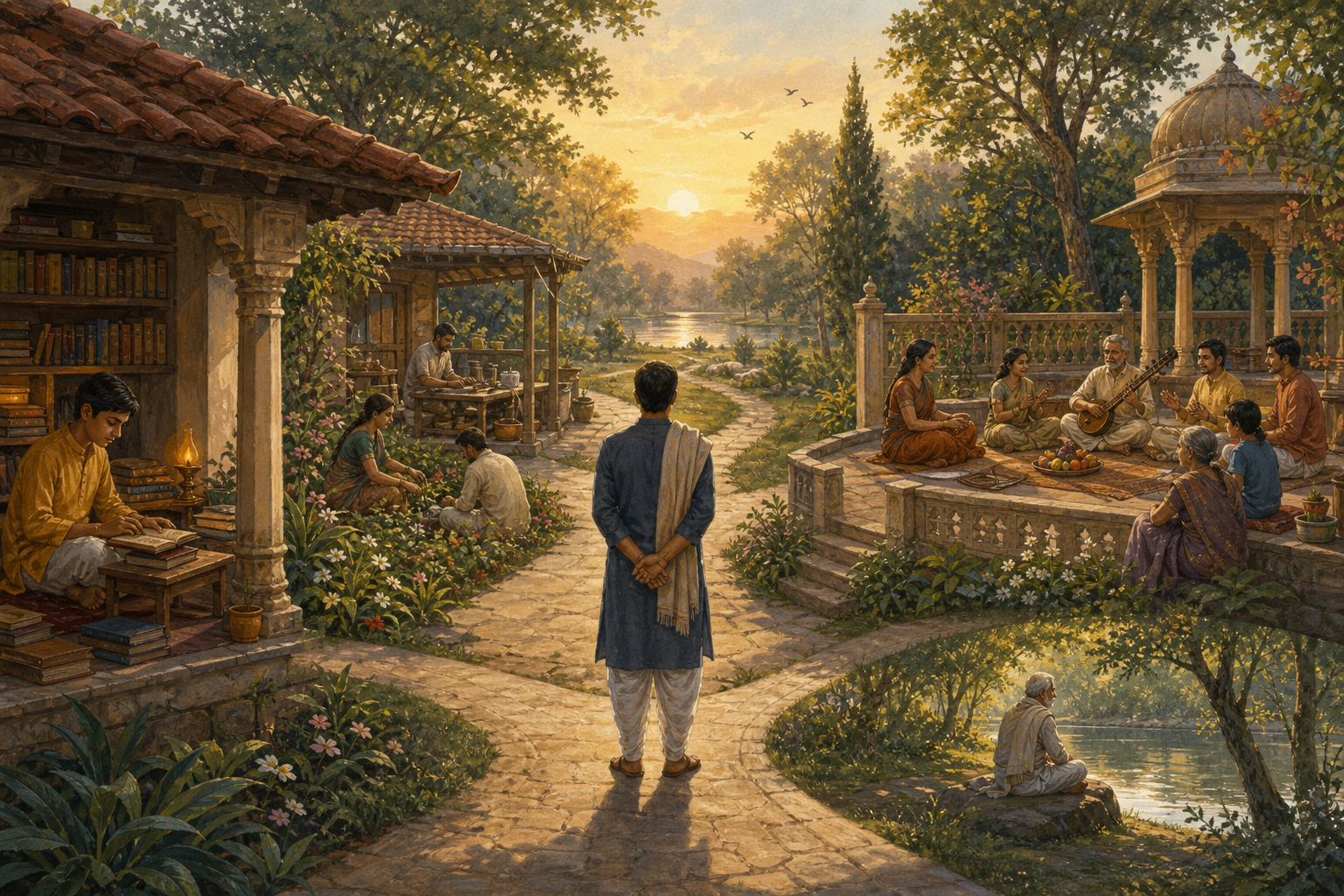
You may be trying to advance your career, care for family, enjoy the life you have built, and deepen your spiritual practice at the same time. The difficulty is not that any of these aims is automatically wrong. It is that they compete for attention, and no single one can tell you what a whole life requires.
Purusharthas and Ashramas give you two different but connected ways to make sense of that tension. One tests what you are pursuing; the other clarifies what you are responsible for in your present season of life. Used together, they help you make a coherent decision without pretending that worldly responsibility and spiritual aspiration belong to separate lives.
Key takeaways
- The Purusharthas identify four legitimate aims: dharma, artha, kama, and moksha.
- The Ashramas describe a changing rhythm of learning, household stewardship, gradual withdrawal, and renunciation.
- Dharma governs how artha and kama are pursued; prosperity or pleasure does not become right merely because you desire it.
- Moksha keeps every finite achievement in perspective, but it cannot be used to evade obligations already placed in your care.
- When aims conflict, ask both what the choice serves and whose well-being will bear its cost.
Two maps answer two different questions
The two frameworks are often placed beside each other, but they are not interchangeable. Purusharthas answer, “What is worth seeking?” Ashramas answer, “What kind of responsibility should take precedence now?” The first is a compass of ends. The second is a rhythm for the development and eventual relinquishment of roles.
| Framework | Central question | Practical use |
|---|---|---|
| Purusharthas | What am I seeking, and is the pursuit rightly ordered? | Tests motives, methods, benefits, and spiritual direction |
| Ashramas | What is mine to learn, sustain, transfer, or relinquish? | Clarifies which duties deserve emphasis in the present season |
The four Purusharthas
Dharma is ethical order expressed through right conduct, obligation, and discernment. It asks whether your method is truthful, responsible, and consistent with the well-being of those affected. Dharma is not merely whatever other people expect from you. A social demand can still be unjust, selfish, or harmful. The test is ethical, not simply conventional.
Artha is material well-being: the means, stability, and capability needed to sustain life and fulfil legitimate responsibilities. Money belongs here, but artha is not reducible to money. Competence, dependable work, sound institutions, and the resources needed by a household or community are also part of material stewardship. Treating artha as spiritually suspect can leave real duties unsupported. Treating it as the supreme aim can make every person and principle negotiable.
Kama is enjoyment, affection, beauty, and the cultivated appreciation of life. It includes more than sensual gratification. Friendship, art, intimacy, celebration, and the delight found in a well-lived day all belong within its field. Kama becomes disordered when enjoyment depends on deceit, exploitation, betrayal, or the steady erosion of self-command. Dharma does not eliminate pleasure; it makes pleasure fit for a human life shared with others.
Moksha is liberation, the ultimate freedom toward which spiritual life is directed. Hindu sampradayas articulate liberation and its realization in different ways, but the practical challenge is immediate: do you possess your achievements and pleasures, or do they possess you? Moksha prevents temporary success, social identity, and personal desire from claiming the status of ultimate truth.
This integration of ethical duty, material stability, meaningful enjoyment, and liberation is the heart of the framework. It does not demand equal attention to every aim at every moment. It demands that no aim be pursued as though the others do not exist.
The four Ashramas
Brahmacharya centres learning, discipline, and formation. Grihastha centres household stewardship and active contribution to family and society. Vanaprastha begins a gradual withdrawal from possession and control. Sannyasa is renunciation, in which liberation rather than social acquisition becomes decisive.
The movement is from preparation to stewardship, from stewardship to transfer, and from transfer to relinquishment. That sequence matters. Learning without later service becomes sterile. Authority without eventual transfer becomes possessiveness. Renunciation claimed before responsibilities are honestly settled can become abandonment dressed in spiritual language.
For present-day application, do not treat the Ashramas as permission slips activated automatically by a birthday. Begin with the kind of duty actually in front of you. Modern circumstances can place study, family care, professional work, mentoring, and spiritual withdrawal in the same calendar. The stages remain useful when you preserve their direction while discerning which responsibility is primary.
Use the Purusharthas as decision filters

Balance is too vague to guide a difficult choice. A better method is to turn each Purushartha into a test. Apply all four to the same decision rather than using whichever one happens to justify what you already want.
Begin with dharma, not preference
Ask what the choice requires you to do, not merely what it promises to give you. Would you need to deceive someone, conceal a relevant cost, break a rightful commitment, exploit another person’s weakness, or push an avoidable burden onto someone with less power? If so, the attractive result does not repair the method.
Dharma functions as a boundary. It does not guarantee that every choice within that boundary will be wise, but it removes choices whose apparent benefits depend on adharma. This prevents artha and kama from becoming rationalizations for conduct you would condemn in someone else.
Define what artha must actually accomplish
Do not ask only whether a choice produces more. Ask what the material gain is for. Does it secure a genuine need, strengthen your capacity to meet obligations, or make useful work possible? Or is the pursuit driven mainly by comparison, fear, or an identity built around accumulation?
The distinction between sufficiency and endless expansion is crucial. Artha should give your duties a stable foundation. Once accumulation begins damaging the very household, health of relationships, or ethical commitments it was supposed to support, the means have displaced the purpose.
Distinguish kama from compulsion
Ask whether the pleasure leaves you more capable of affection, gratitude, and clear attention. A life without beauty or enjoyment can become brittle, and neglected relationships do not become holy merely because the neglect was busy or austere. Yet an urge is not sanctified simply by calling it kama.
Look at the conditions surrounding the enjoyment. Is it mutual? Can it be acknowledged without deception? Does it deepen relationship, or reduce another person to an instrument? Can you stop without resentment or panic? These questions let dharma refine kama without turning spiritual life into hostility toward joy.
Let moksha expose the attachment
Finally, ask what part of your identity has become attached to the outcome. If the promotion, possession, admiration, pleasure, or role disappeared, what would you believe had been taken from your essential self? The point is not to become indifferent to every result. It is to notice when a finite result has become the condition on which you place your worth or peace.
Write your answers under four plain prompts: “I must uphold,” “I need enough material support to,” “I want to enjoy,” and “I need to loosen my attachment to.” If one answer contradicts another, you have found the real decision. You are no longer wrestling with an undefined demand to have everything.
Let Ashrama clarify what you owe now
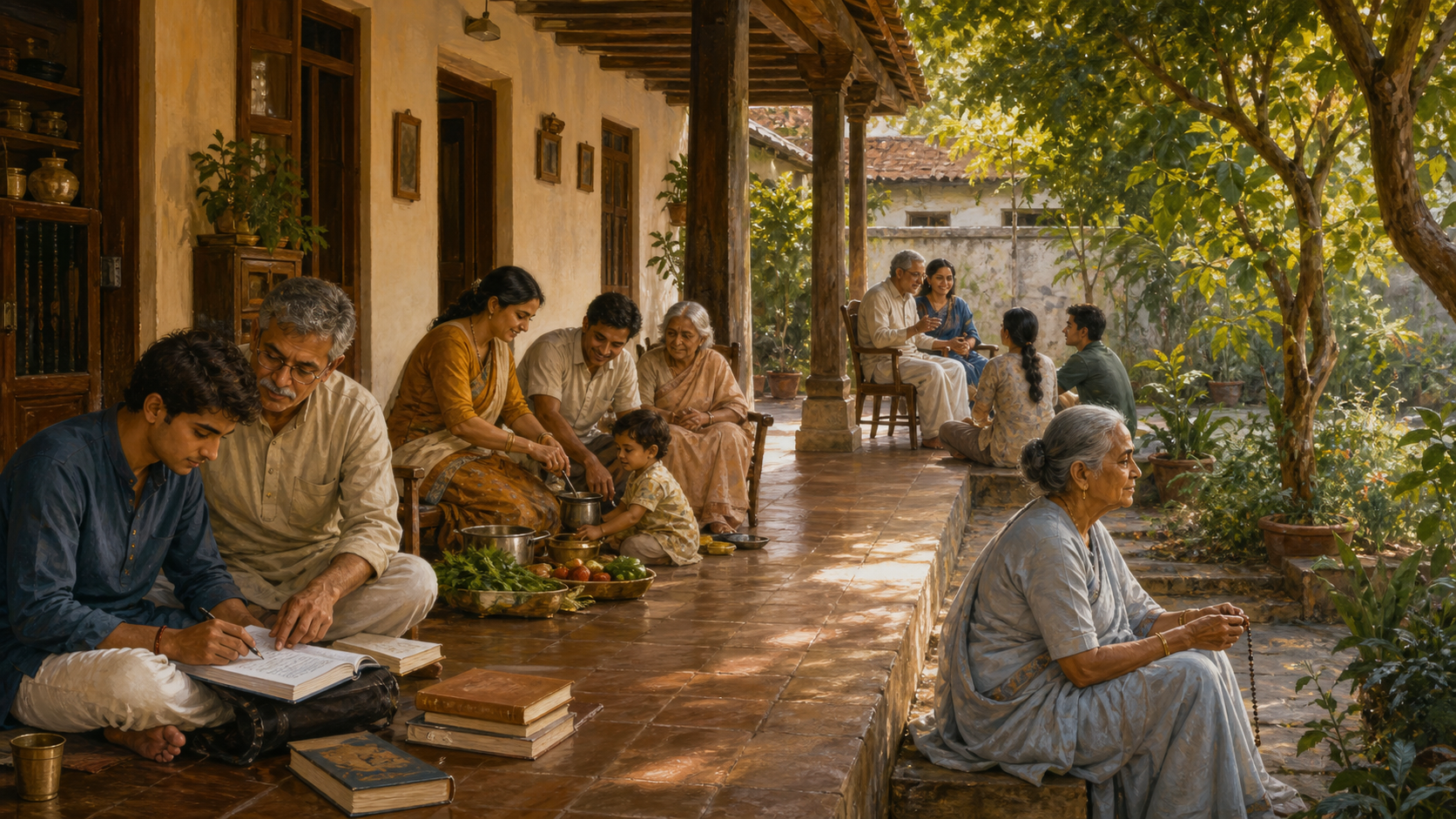
The same opportunity can be dharmic for one person and irresponsible for another because their obligations differ. Ashrama brings role, timing, and dependency into the decision. It asks whether you should be preparing, sustaining, handing over, or relinquishing.
In Brahmacharya, resist counterfeit mastery
When you are still being formed in a field, discipline deserves priority over appearance. Seek instruction, practise attention, accept correction, and build character alongside competence. This applies to formal education, the beginning of a vocation, and entry into a serious spiritual discipline. The Brahmacharya error is to seek the status of knowledge before accepting the work of learning.
Your practical question is: what must you learn before other people should rely on your judgement? Naming that gap protects you from avoidable arrogance and tells you where study belongs in your schedule.
In Grihastha, count the people who depend on the choice
Household life is not a spiritual interruption. It is a field in which dharma is made concrete through earning, care, relationship, hospitality, and social contribution. Before making a risky professional move, undertaking a demanding retreat, or abandoning an established role, identify who relies on your time, labour, steadiness, and promises.
This does not mean that every demand made by relatives must rule you. It means that liberation cannot honestly be pursued by sending the unchosen cost of your withdrawal to those placed in your care. A Grihastha decision should make its burdens visible before it celebrates its freedom.
In Vanaprastha, transfer rather than disappear
Gradual withdrawal is an active discipline. It means loosening control, preparing others to carry responsibility, sharing knowledge, and reducing the need to remain at the centre. A person can stop holding a title while still controlling every successor; that is departure without relinquishment.
Ask what would fail if you stepped back. Then teach, document, delegate, or reconcile whatever another person needs in order to carry the work without your constant intervention. Vanaprastha is not neglect. It is stewardship completed through an orderly handover.
In Sannyasa, do not confuse escape with renunciation
Sannyasa is more demanding than a change of clothing, address, or public identity. Weariness with work, disappointment with family, or wounded pride can produce a desire to flee, but flight does not by itself free the mind from possession. External simplicity can coexist with an intense hunger for recognition and control.
You can cultivate the inward direction of renunciation before formally entering such a life: loosen claims of ownership, serve without demanding praise, and remember that roles are not the Self. But do not use the language of Sannyasa to sanctify duties left for unwilling people to absorb.
No Ashrama owns a single Purushartha. A student requires dharma and material support. A householder can be deeply directed toward moksha. A person withdrawing from authority still has ethical obligations. Renunciation does not make truthfulness or compassion unnecessary. The stages change the centre of gravity; they do not cancel the wholeness of life.
Make the framework a living practice

Bring a real decision to the framework. A vague wish to “find balance” will produce vague answers. Name the choice in a sentence that includes the action, the people affected, and the obligation or desire creating the conflict.
- Name the decision. State what you are considering and what would change if you acted.
- Locate the Ashrama duty. Identify whether the situation primarily calls for learning, sustaining, transferring, or relinquishing.
- Apply the dharma boundary. Remove options that require deception, exploitation, avoidable harm, or abandonment of a rightful commitment.
- Clarify artha. State the material need the choice must meet, and distinguish that need from prestige or accumulation without purpose.
- Give kama its proper place. Name the relationship, beauty, rest, affection, or enjoyment worth protecting, then test it for mutuality and responsibility.
- Turn toward moksha. Notice the identity, fear, craving, or possessiveness that makes one outcome feel absolute.
- Assign the cost honestly. Ask who loses time, security, care, freedom, or opportunity under each option. Do not hide that cost inside noble language.
Suppose you are offered better-paid work that would sharply reduce the attention available to family, study, or spiritual discipline. Artha asks whether the additional means answer a genuine obligation. Dharma asks whether existing promises and new burdens are being handled fairly. Kama asks whether excitement and status are being mistaken for lasting well-being. Moksha asks how much of your identity has become tied to the title. Ashrama asks whether your present responsibility is still household stewardship or whether a genuine movement toward transfer has begun.
The framework does not manufacture the same answer for everyone. It makes the moral structure of the choice visible. You may still accept the work, decline it, or renegotiate its demands, but you will know what you are preserving and what you are sacrificing.
Watch for imbalance disguised as virtue
- Dharma used as fear: you obey expectation without examining whether it is truthful, just, or compassionate.
- Artha used as an absolute: every sacrifice is defended as necessary for success, even after success has begun consuming its purpose.
- Kama used as entitlement: desire is treated as self-justifying while secrecy, betrayal, or harm is ignored.
- Moksha used as avoidance: spiritual language excuses neglected work, relationships, or dependants.
- Grihastha prolonged into control: stewardship becomes a refusal to prepare successors or make room for another generation.
- Sannyasa reduced to appearance: possessions are renounced publicly while status, praise, and authority remain inward necessities.
Use a short recurring check at the beginning of your week: What must you uphold? What material means must you secure? What wholesome joy needs attention? What attachment can you release? Then ask whether your present role calls you to learn, sustain, transfer, or relinquish.
Start with the decision already waiting for you. Write the four Purushartha answers, name the Ashrama duty, and refuse any option whose benefit depends on hiding its cost. That is how an ancient framework becomes present-tense dharma rather than a diagram admired from a distance.
References
