
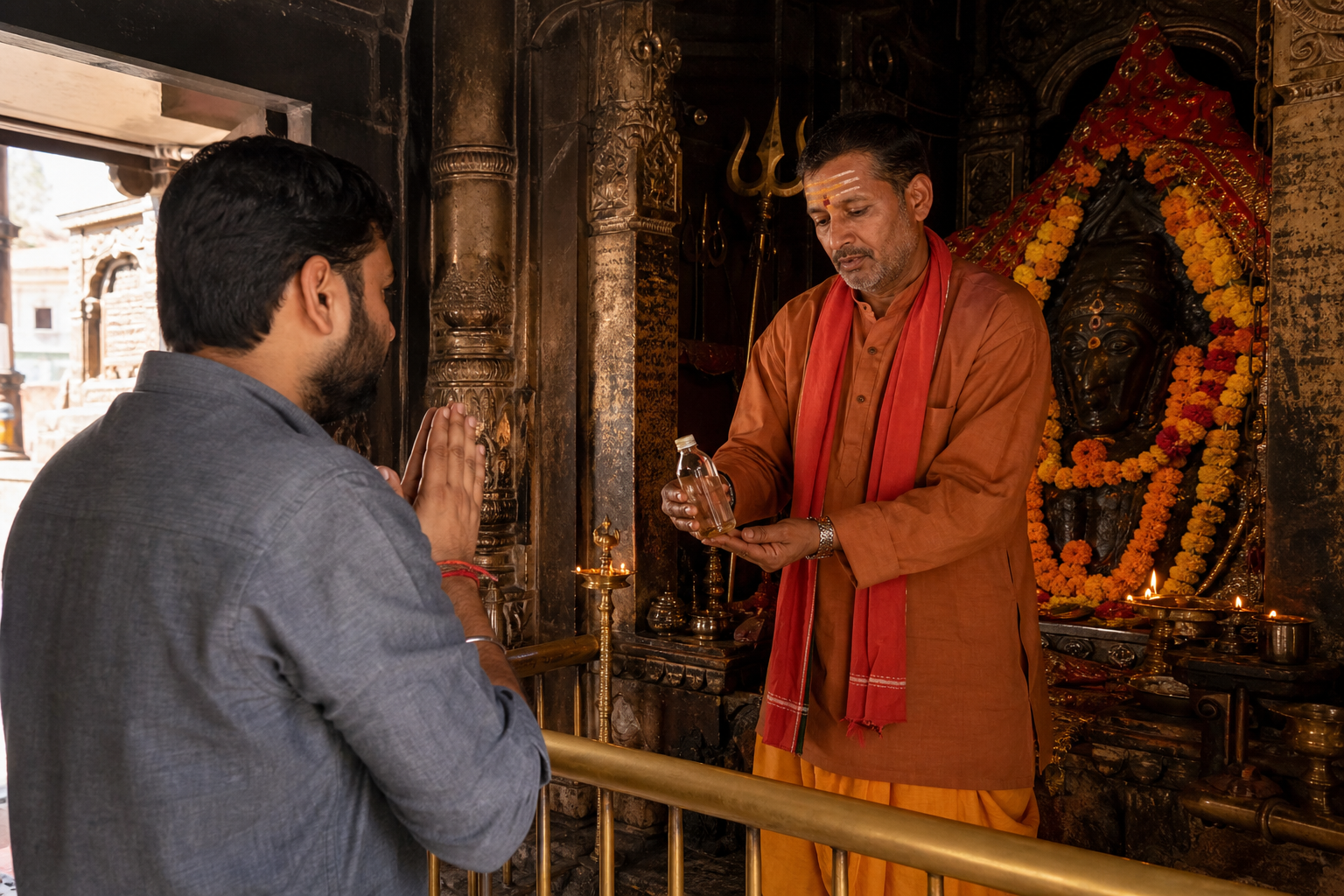
You may be planning darshan at a Kal Bhairav temple and wondering whether you are expected to carry alcohol, offer it, or drink anything afterward. The short answer is no universal rule applies. The custom belongs to particular temples and lineages, and the priest serving that shrine determines what is appropriate.
What matters is the distinction between ritual offering and personal indulgence. In Bhairav worship, alcohol can represent the volatile parts of human life – fear, anger, compulsion, heat, and loss of control – being placed under divine guardianship. You can honor that meaning without treating intoxication as sacred or necessary.
The offering is an act of surrender, not permission to drink
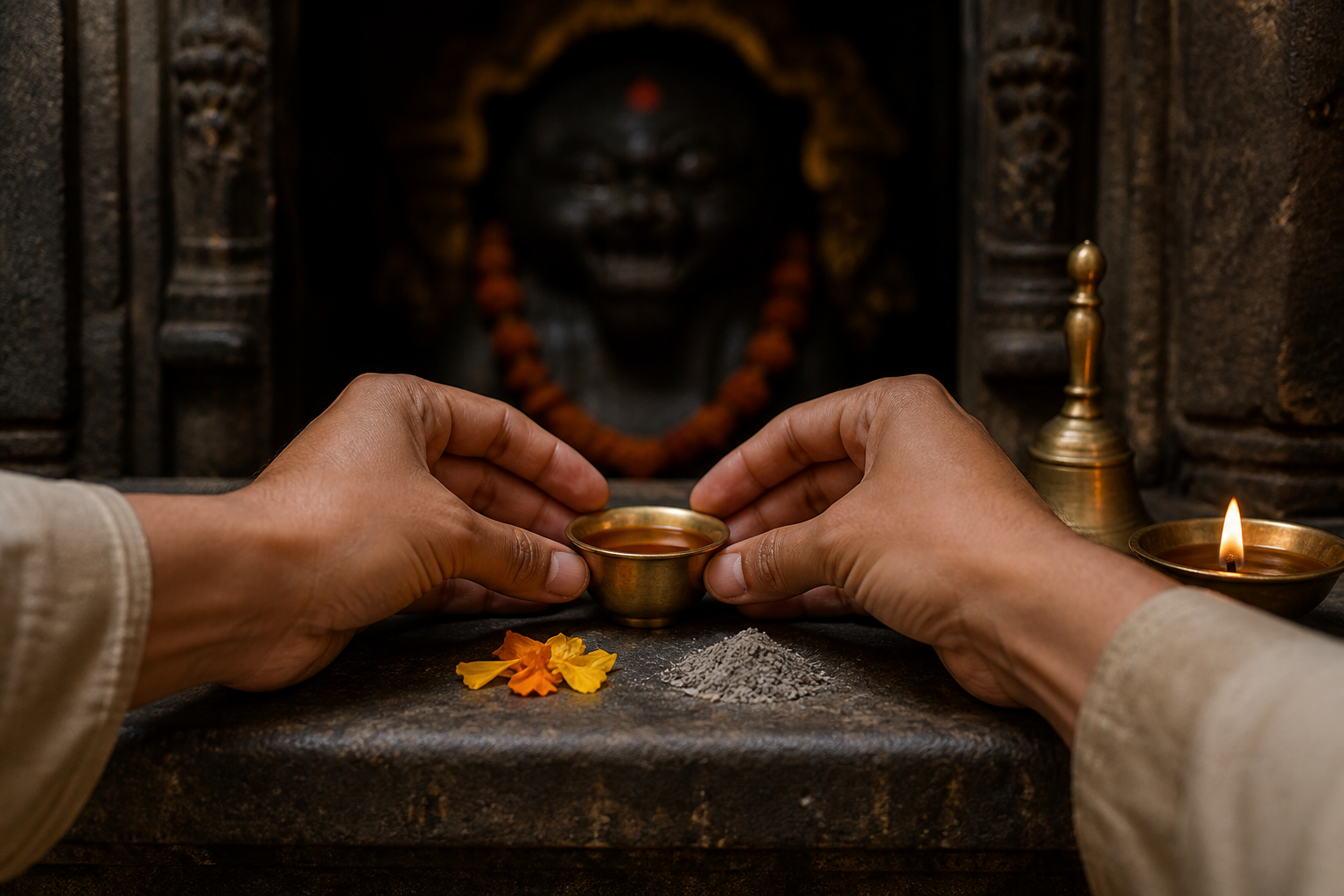
The most common misreading begins with the substance rather than the ritual action. Alcohol outside a sacred setting may be consumed for pleasure or intoxication. Alcohol placed before Kal Bhairav has a different ritual function: something potentially destabilizing is presented to the deity who governs boundaries, confronts fear, and disciplines unruly force.
The offering therefore does not communicate that every devotee should drink. It communicates that no part of human experience is beyond the reach of sadhana. Instead of pretending that anger, craving, or fear does not exist, you acknowledge it and ask that its energy be redirected toward steadiness, courage, and responsible action.
How to read the symbolism
- The substance: Alcohol signifies potency, fermentation, heat, and the possibility of losing control.
- The presentation: Placing it before Bhairav admits that raw impulses exist and cannot always be overcome through denial.
- The consecration: Mantra, intention, and regulated ritual place those impulses within a sacred discipline.
- The prayer: The devotee seeks mastery of the mind, not a religious excuse for intoxication.
- The ethical result: The rite should lead toward clearer judgment, fearlessness, restraint, and protection of the community.
This last point provides a practical test. If your interpretation makes self-control less important, it has reversed the ritual’s direction. Consecration changes the substance’s place in the rite; it does not make alcohol physiologically harmless or turn compulsive use into spiritual practice.
Why Bhairav receives what another shrine may not
Kal Bhairav is a fierce manifestation of Shiva and a ksetrapala, a guardian of sacred territory. His traditional associations with city gates, crossroads, cremation grounds, and other boundary places are not incidental. A boundary is where order meets uncertainty. Bhairav stands there to prevent disorder from passing unchecked.
The same guardianship operates inwardly. Fear can become paralysis, anger can become cruelty, and appetite can become compulsion. Bhairav worship asks you to meet these forces at the threshold – before they govern your conduct. Offering a difficult substance to a boundary-guardian makes sense within that spiritual grammar: the power is neither ignored nor allowed to roam freely.
The more specific ritual background comes from Kaula and related Tantric streams. Their pancamakara, or five Ms, include madya, meaning wine or alcohol. Some lineages employ regulated external offerings. Others interpret the elements inwardly or replace them with symbolic substances. This is why the custom cannot be turned into a blanket claim about Hindu worship. A rite authorized in one lineage may be unnecessary or inappropriate in another.
That diversity is not a contradiction to be solved. Hindu ritual life recognizes differences of deity, lineage, place, initiation, capacity, and purpose. The disciplined question is not whether every temple follows the same menu. It is whether a particular practice has a legitimate ritual setting, competent guidance, a coherent spiritual aim, and conduct consistent with dharma.
A shared Dharmic aim does not mean an identical ritual
Vajrayana Buddhist offerings to wrathful deities such as Mahakala use a comparable language of transforming afflictive emotions into insight. Jain and Sikh disciplines place stronger visible emphasis on restraint, non-harm, service, and freedom from attachment. These are not interchangeable ceremonies, and it would be misleading to pretend that they are. Their point of convergence is ethical: fear, anger, and craving must be transformed rather than permitted to rule human action.
One tradition can have several legitimate ritual forms
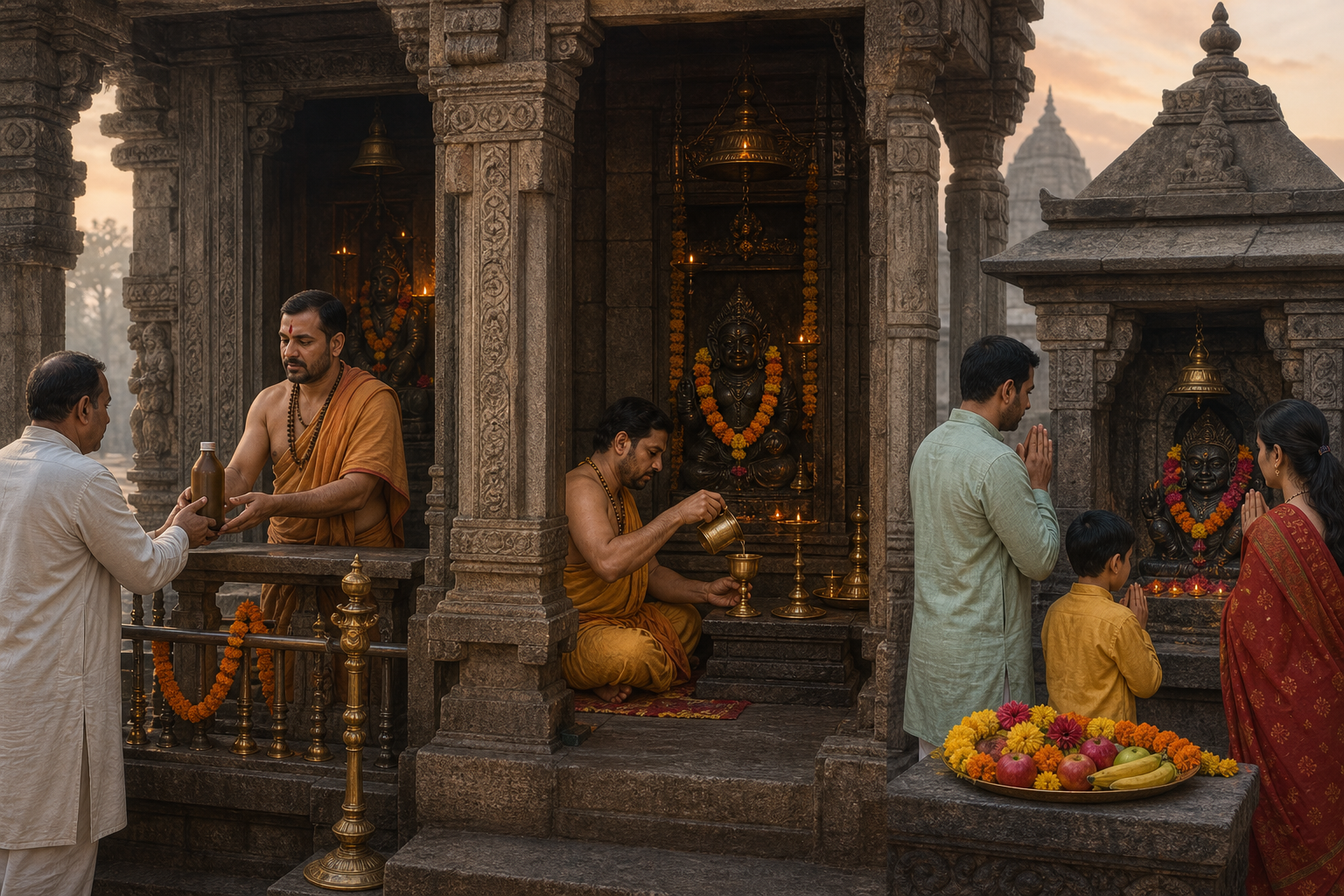
Knowing that a Bhairav shrine accepts alcohol still does not tell you how its rite works. Practice differs by temple and community, including who handles the offering, whether the container is opened, how much is used, and whether a substitute is accepted.
- At the Kal Bhairav shrine in Ujjain, priests ceremonially offer liquor under temple protocols. The relevant lesson for a visitor is simple: priestly procedure governs the act, not personal improvisation.
- In the Kathmandu Valley, Newar traditions include offerings of aila, a rice liquor, to Bhairav during particular festivals. The offering belongs to a local ritual and cultural setting; it is not a generic instruction for every Bhairav devotee.
- At some shrines, a sealed bottle may only be touched to the murti as a token gesture. Elsewhere, a measured quantity may be poured ceremonially. One form should never be copied into another temple without permission.
- In families and communities that abstain, coconut water, milk, or honey may carry the intention of surrender and transformation. Acceptance still depends on the custom of the shrine where you are worshipping.
The variation protects an important principle: bhava, the devotee’s orientation, matters more than mimicking an outward action. A non-alcoholic offering made with discipline is not spiritually inferior merely because it is less dramatic. Likewise, an alcoholic offering made for curiosity, display, or intoxication does not become profound because Bhairav’s name is attached to it.
How to participate without turning worship into spectacle
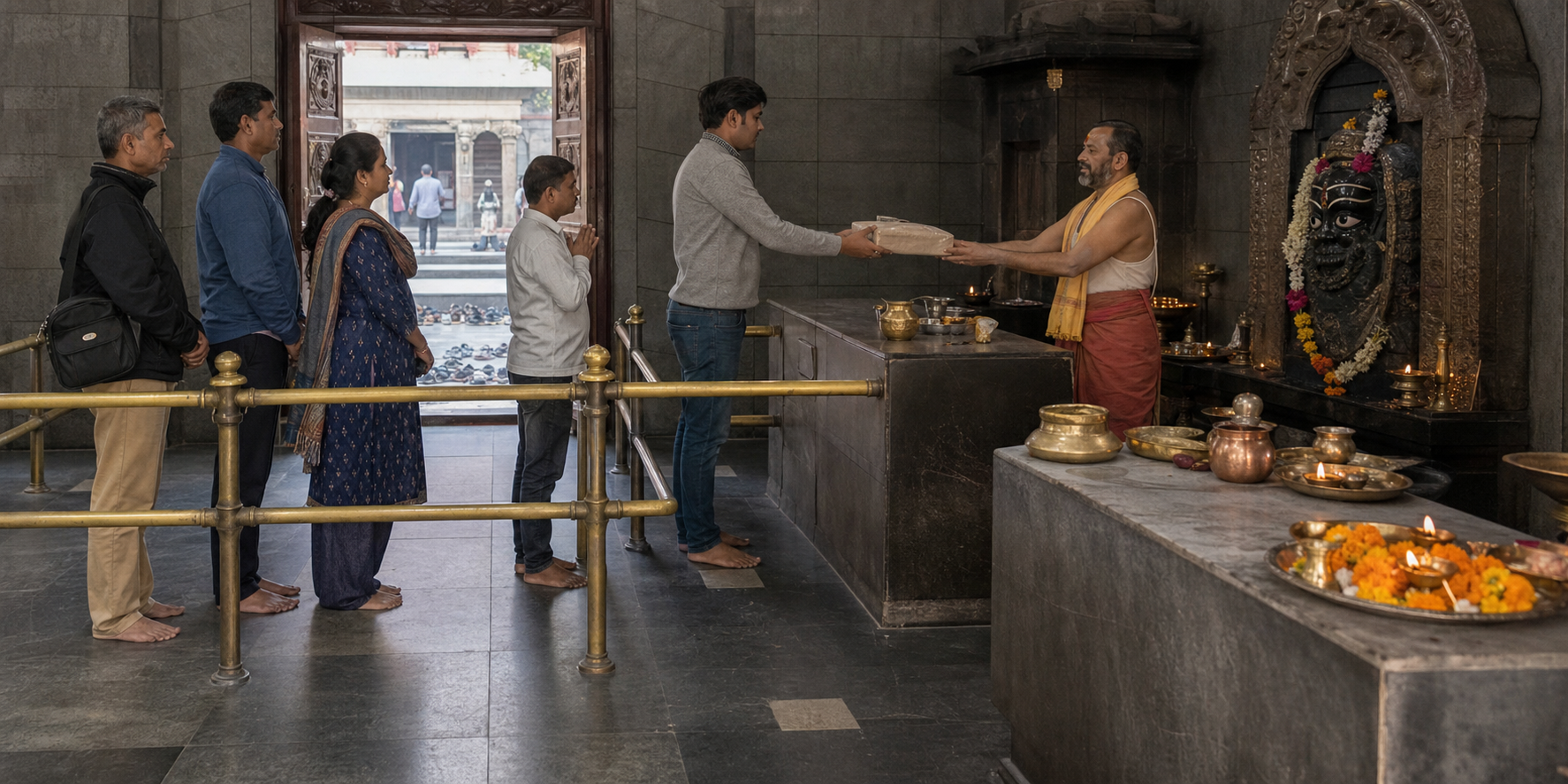
If you are visiting a temple known for this custom, decide nothing from a photograph, video, or story about another shrine. Use the following sequence instead.
- Ask before bringing anything. Check posted instructions or ask the officiating priest whether the temple accepts alcohol, a particular form of it, or a non-alcoholic substitute.
- Do not open or pour it yourself. Keep any accepted offering sealed and untouched until the priest tells you what to do. Some rites are token presentations; others use measured amounts.
- Let temple authority determine the quantity and handling. More is not more devotional. Regulation and restraint are part of the meaning.
- Do not assume that offering requires consumption. The presence of alcohol in a rite is not an instruction that you must drink it. If anything is returned or distributed, ask what the local custom permits and decline consumption when abstinence is necessary for you.
- Protect the sanctity of the setting. Do not joke about the offering, handle it casually, or photograph the rite without explicit permission. Treat the ceremony as darshan, not as unusual footage to collect.
- Choose a substitute when alcohol would cause harm. If you are abstinent, in recovery, concerned about compulsive use, or responsible for a household in which keeping alcohol is unsafe, do not purchase or store it for the sake of appearances. Ask whether coconut water, milk, or honey is accepted, or offer your prayer without a material substitute.
- Complete the symbolism with conduct. Name the quality you are surrendering – fear, anger, resentment, craving, or recklessness – and pair the prayer with one concrete act of restraint after darshan.
The sixth step is a real safety boundary. A temple offering is not treatment for alcohol dependence, withdrawal, or any mental-health condition connected with substance use. Ritual support can accompany a person’s recovery, but it should not replace qualified medical or psychological care. Nor should a devotee be pressured to handle or consume alcohol against a vow, health need, or recovery plan.
The seventh step prevents symbolism from remaining theatrical. If you surrender anger, delay the message you would otherwise send in anger. If you surrender compulsion, remove one predictable trigger from your day. If you seek fearlessness, carry out one necessary duty you have been avoiding. The offering finds its ethical completion in what you do after leaving the shrine.
Key takeaways
- Alcohol offerings belong to particular Bhairav temples and Tantric lineages; they are not a requirement for all Hindus or all Kal Bhairav devotees.
- Madya within the pancamakara can be offered externally, interpreted inwardly, or represented by a substitute, depending on lineage and local custom.
- The ritual places volatile human energies under the guardianship of Bhairav. Its aim is mastery and moral steadiness, not intoxication.
- Ujjain, Kathmandu Valley traditions, and other shrines may use different substances and procedures. Follow the temple you are actually visiting.
- If alcohol conflicts with abstinence, recovery, safety, or a personal vow, ask for an accepted substitute or worship without it. Sincere intention does not require avoidable harm.
Before your next Bhairav darshan, form a one-sentence sankalpa: identify the force you are placing at the guardian’s feet and the disciplined action you will take when you return to ordinary life. Then follow the shrine’s rules exactly. That combination – inner honesty, local authority, and conduct after worship – keeps a fierce ritual aligned with dharma.
References
