-
Idle Mind, Restless Life: Dharmic, Yogic, and Mindfulness Practices to Build Purposeful Focus

The age-old saying that an idle mind becomes a workshop for unwholesome impulses is reframed here through the shared wisdom of Hinduism, Buddhism, Jainism, and Sikhism. Instead of moralizing idleness, the analysis distinguishes healing rest from tamasic drift and presents a technical, evidence-aligned path to train attention and action. Readers gain a clear map of…
-
Design Your Destiny: A Dharmic Guide to Karma, Choice, and Responsible Living

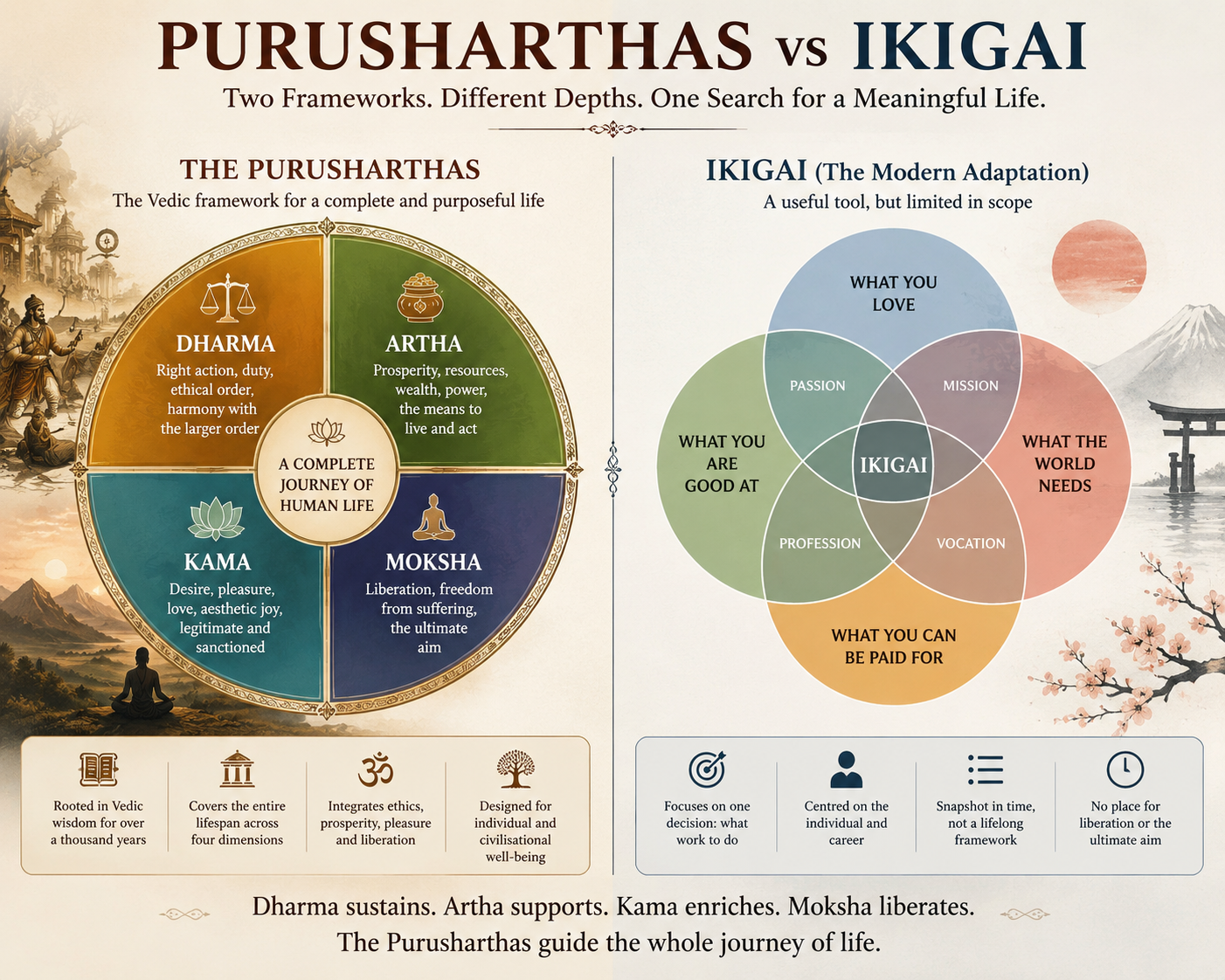
This article examines how Hindu philosophy and related dharmic traditions align on a rigorous, empowering approach to choice, karma, and destiny. It clarifies the technical distinctions among sanchita, prarabdha, and agami karma, and explains how the purushartha framework and the shreyas–preyas distinction guide ethical decision-making. Drawing on the Bhagavad Gita, Yoga philosophy, and insights from…
-
Raising God-Conscious Children: Parenting as Daily Seva and a Living Practice of Dharma

Parenting as service to God reframes the household as a sacred space where love, responsibility, and everyday choices become a living practice of dharma. Grounded in social learning research, the approach emphasizes that children internalize what they observe, making adult role modeling decisive. Practical routines—brief daily prayer or mindfulness, ethical storytelling, shared meals with gratitude,…
-
Washington’s Moral Authority in 2026: The Constitution as a Dharmic, Pluralist Compass

Washington’s moral authority in 2026 should be anchored in the U.S. Constitution understood as a moral covenant rooted in popular sovereignty, natural law, and inalienable rights. Treating separation of powers, checks and balances, and federalism as ethical constraints on power safeguards liberty while enabling responsive governance. The piece offers a practical constitutional impact protocol—rights risk…
-
Beyond Degrees: Reclaiming Education’s Purpose to Awaken Spiritual Identity and Shared Dharma

Modern education excels at producing skilled professionals, yet it risks losing its soul when detached from deeper purpose. This article proposes a rigorous, plural approach that integrates scientific excellence with dharmic insights from Hinduism, Buddhism, Jainism, and Sikhism. Drawing on frameworks like pañcakośa, UNESCO’s four pillars, and NEP 2020, it outlines research-aligned methods to cultivate…
-
Ekadasha Parayana of Vishnu Sahasranama: Transformative Benefits, How-To, and Daily Discipline

Ekadasha Parayana is an eleven-day observance in which the Vishnu Sahasranama is recited eleven times daily, uniting devotion, attention training, and ethical living. Rooted in the Mahabharata and the Vaishnava bhakti tradition, the practice is accessible to householders and monastics and adaptable to individual contexts. Practitioners commonly report cognitive clarity, emotional balance, and a deepening…
-
Embracing Sukha and Dukha: Dharma’s Transformative Science of Resilience and Freedom

This essay explains why Sanatana Dharma views Sukha (happiness) and Dukha (distress) as complementary threads woven into the fabric of life. Drawing on the Bhagavad Gita, the Yoga Sutra, and convergent insights from Buddhism, Jainism, and Sikhism, it shows how Dharma transforms hardship into clarity and compassion. Readers learn practical methods—Karma Yoga, Bhakti, Jnana, Raja…
-
Drupada of Panchala in the Kurukshetra War: Dharma, Betrayal, Destiny, and Fatal Valor

Drupada of Panchala stands at the crossroads of Dharma, strategy, and tragic inevitability in the Mahabharata’s Kurukshetra War. His youthful friendship with Drona, later ruptured by humiliation, set in motion a cycle of vows, rituals, and alliances that reshaped the subcontinent’s political map. The births of Dhrishtadyumna and Draupadi through yajña translated personal injury into…
-
Science of Sacrifice: Dharmic principles to practice tyaga, seva, and everyday yajna wisely

Sacrifice in a dharmic sense is intelligent, freely chosen renunciation that serves a higher, shared good. This comprehensive guide defines tyaga in relation to dana, tapas, seva, and yajna, and shows how sattva, rajas, and tamas shape the quality of any offering. It unifies insights from Hinduism, Buddhism, Jainism, and Sikhism—linking loka-sangraha, dana, Aparigraha, and…
-
Idle Mind Is the Devil’s Workshop: A Dharmic, Scientific Guide to Focus and Virtue

This article reframes the proverb ‘An idle mind is the devil’s workshop’ through a dharmic and scientific lens, unifying insights from Hinduism, Buddhism, Jainism, and Sikhism with contemporary psychology. It distinguishes restorative rest from unstructured idleness and shows how right effort, seva, and mindfulness reduce rumination and impulsivity. Readers gain a practical framework: align purpose…
-
Dharma Paripalana Moorthy: Sri Rama’s Timeless Blueprint of Rajadharma in Rama Rajya

Sri Rama as Dharma Paripalana Moorthy embodies a rigorous model of ethical governance—Rama Rajya—that continues to inform discussions on justice, welfare, and leadership. Grounded in the Valmiki Ramayana, including the Uttara Kanda’s portrayal of an 11,000-year reign, the narrative articulates rajadharma as personal virtue aligned with fair institutions and compassionate law. The analysis situates this…
-
Sita Navami 2026 (Apr 25): Auspicious Puja Vidhi, Vrat Guide, Panchang Rules & Significance

Sita Navami 2026 falls on April 25, aligning with Vaishakha Shukla Navami in the Hindu calendar. This comprehensive guide explains the festival’s scriptural foundations, cultural depth, and ecological symbolism, spotlighting Sita as an embodiment of dharma and a manifestation of Goddess Lakshmi. It clarifies Panchang-based tithi rules, the Udaya Tithi and Madhyahna approaches, and why…
-
Myth-Busting the ‘Traitor’ Label: Vibhishana’s Dharma-First Loyalty in the Ramayana

This analysis challenges the popular notion of Vibhishana as a betrayer and demonstrates, with reference to Ramayana ethics, that his alignment with dharma over family partisanship constitutes exemplary loyalty. It explains how Rajadharma and Sharanagati frame his choice as morally necessary rather than opportunistic. By contrasting Vibhishana with Kumbhakarna and drawing on Dharmashastra principles, it…
-
Unveiling the Soul’s Journey: Life After Death in Hinduism—Karma, Yama, Moksha

Hinduism presents life after death as a just, compassionate, and educative journey governed by karma and oriented toward moksha. Foundational texts—the Upanishads, Bhagavad Gita, and Puranas—affirm that the immortal ātman continues through realms (lokas) or returns via reincarnation according to ethical causality. Lord Yama Dharma embodies impartial moral order, while rites such as antyeṣṭi, śrāddha,…
-
Akshaya Tritiya Dāna: The Definitive Guide to Inexhaustible Blessings and Scriptural Merits

Akshaya Tritiya, the sarva-siddhi day of Vaishakh, is celebrated across Dharmic traditions as an auspicious time for dāna (charitable giving) that yields inexhaustible merit. This guide explains the day’s scriptural footing in the Puranas and Dharmaśāstra, unifies perspectives from Hinduism, Jainism, Buddhism, and Sikhism, and details practical, ethical ways to give. It highlights Jala Daanam…
-
Rama Rajya, Then and Now: A Timeless Blueprint for Justice, Welfare, and Unity

Rama Rajya—also known as Rama Rajyam—presents a rigorous, non-sectarian blueprint for ethical governance rooted in the Ramayana and allied texts. Its core—Rajadharma—balances rule of law, welfare with dignity, ecological stewardship, and accountable leadership. The tradition’s portrait of Ayodhya under Sri Rama, supported by Lakshmana, Bharata, Shatrughna, Hanuman, and a wise council, functions as a normative…
-
Śrīmad-Bhāgavatam 4.4.29–35: Dakṣa’s Pride Unveiled and Practical Lessons in Humility

Śrīmad-Bhāgavatam 4.4.29–35 provides a rigorous ethical and spiritual analysis of Dakṣa’s conduct, showing how pride and ego distort judgment at the very heart of sacred duty. The passage underscores that neglect of basic respect and hospitality is not a minor lapse but a systemic failure that corrodes communal harmony. Verse 29 in particular crystallizes the…