

If Sampati is the figure you remember and Swayamprabha is only a name, the search for Sita can look as though it jumps from failure straight to revelation. It does not. The southern search party has to be rescued twice: first from a place it cannot leave, and then from ignorance it cannot overcome by effort alone.
You can read these encounters as a practical map for any dharmic undertaking that has stalled. Swayamprabha restores the seekers’ capacity to move. Sampati gives their movement a true direction. Neither takes over Rama’s work, and that restraint is exactly what makes both forms of service effective.
The search is repaired in two different stages
In the Valmiki Ramayana, the southern expedition is led by Angada and includes Jambavan and Hanuman. The vanaras are exhausted, hungry, and running out of time when they enter a dazzling subterranean realm associated with riksha-bila. It contains mansions, fruit, and water created by Maya Danava for the apsara Hema. Its beauty, however, does not make it safe. Once inside, the searchers cannot find an ordinary way out.
Swayamprabha is the tapasvini entrusted with guarding this realm on behalf of her friend Hema. She receives the vanaras, relieves their immediate hunger and thirst, explains the nature of their predicament, and uses the power of her tapas to carry them out. They reappear by the seashore.
That rescue ends their confinement, but it does not complete their mission. The allotted search time has passed, Sita has not been found, and the ocean now stands before them. In despair, the vanaras contemplate fasting unto death rather than returning in failure. Freedom from the cave has revealed the real problem; it has not supplied the missing answer.
Sampati supplies that answer. The aged vulture is the elder brother of Jatayu. Although he has long been unable to fly, his far-reaching sight and memory disclose Sita’s location in Lanka, across the southern sea. The traditional distance is given as one hundred yojanas, though the length assigned to a yojana varies among premodern traditions. The important narrative fact is that an undefined failure becomes a definite destination and a formidable but intelligible crossing.
Notice what changes after each encounter. Before Swayamprabha intervenes, the vanaras cannot get out. Afterward, they can finally stand before the true obstacle. Before Sampati speaks, they do not know where to go. Afterward, they know what must be crossed. Their despair is not dismissed with encouragement; it is divided into two solvable conditions.
When your own work stalls, write two separate sentences: “We cannot move because…” and “We do not know…” If both sentences have real answers, you have two problems, not one. Remove the confinement before demanding a destination. Then obtain trustworthy direction before demanding heroic effort.
Swayamprabha restores freedom without claiming the mission

Swayamprabha’s hospitality is neither passive kindness nor an invitation to remain in comfort. She gives the vanaras what their condition requires: nourishment, an accurate explanation, and release. She does not let a refuge become another form of captivity.
Her name sharpens the meaning of the episode. Svayam means “oneself,” while prabha means “light” or “radiance.” Swayamprabha therefore evokes self-radiance, and a philosophical reading naturally recalls the Vedantic language of self-luminous consciousness. The symbolism does not require us to reduce her to an abstraction. She is first a capable guardian making a precise ethical decision. The symbolic force arises from what she actually does.
The cave can likewise be read as a concentrated image of maya. Its danger is not obvious ugliness. It is plenitude without orientation: attractive surroundings, immediate satisfaction, altered attention, and no visible exit. That is a more demanding test than simple deprivation because the seekers may mistake relief for arrival.
You can recognize the same pattern whenever a comfortable system consumes the time meant for a vow. Endless information can feel like study while preventing practice. Constant discussion can resemble service while postponing a decision. A temporary refuge can quietly become an identity. The test is simple: does this place restore your ability to fulfill the commitment, or does it make you forget that the commitment has a deadline?
Swayamprabha also shows what disciplined power looks like. Her tapas is not displayed to establish superiority. It is held in reserve, used at the decisive moment, and limited to the need before her. She does not accompany the party to Lanka, reorganize its leadership, or ask to share in its eventual recognition. Her intervention ends when the vanaras can again carry their own responsibility.
This is an important expression of feminine spiritual agency in the Ramayana. Swayamprabha is identified through tapas, friendship, stewardship, and competence rather than through a husband’s or father’s authority. She protects Hema’s trust while responding intelligently to unexpected guests. Her autonomy is not isolation, and her service is not subordination. Both are ordered by dharma.
If you are helping someone who is overwhelmed, her example gives you a demanding standard. First restore enough stability for action. Then name the boundary honestly. Use only the authority needed to remove the immediate obstruction. Finally, return the work to the person whose duty it is. Help that creates permanent dependence has crossed beyond Swayamprabha’s model.
Sampati offers coordinates, not propulsion
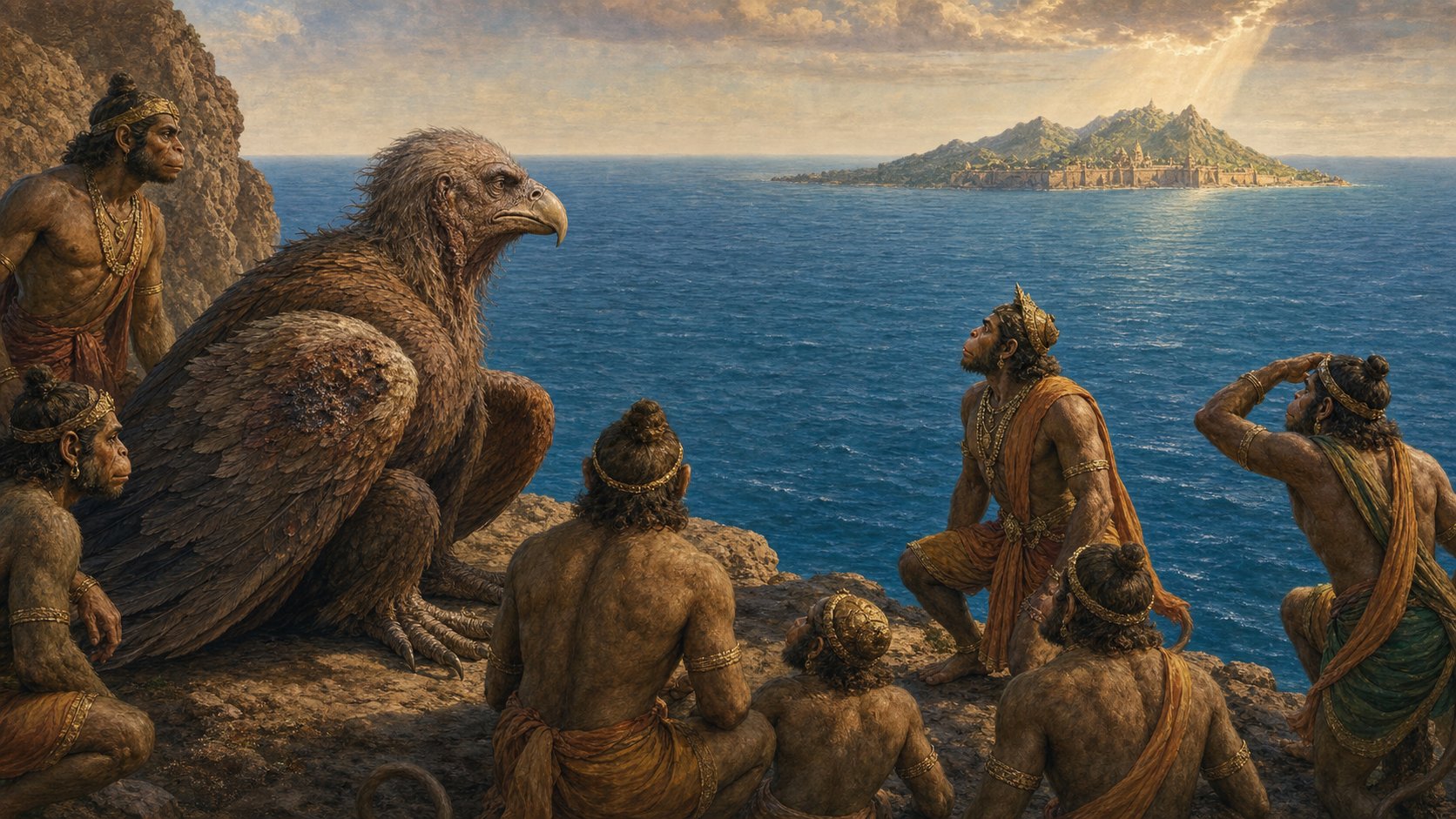
Sampati reaches usefulness by a very different path. In his youth, he and Jatayu flew upward toward the blazing sun. When the heat threatened his younger brother, Sampati spread his wings over Jatayu and took the injury himself. His wings were burned, and the great flier was left grounded near the Vindhyas.
The loss matters because Sampati’s later gift is not a recovered version of his youthful strength. He cannot carry the vanaras over the sea. What remains is vision: the capacity to see across a distance that defeats everyone around him, joined to the memory of having seen Sita carried southward by Ravana. A diminished power of movement has not erased his power to bear witness.
That distinction corrects a common mistake people make after loss. We often inventory only what has disappeared and then conclude that usefulness has disappeared with it. Sampati instead acts through the faculty still entrusted to him. If your former role is no longer possible, ask a narrower question: what can you now see, remember, verify, or explain that the people still moving cannot? The answer may be more valuable than an attempt to imitate your old strength.
His life also contrasts ungoverned want with dharmic need. The youthful ascent is an urge toward ever greater height, unchecked by measure. The later disclosure is exact and sufficient. Sampati does not need to soar again before he can serve Rama’s purpose; he needs to tell the truth he possesses. Desire is not destroyed but reordered under dharma.
This is why surrender in the Sampati episode should not be confused with resignation. Sharanagati does not require a person to become inert. It releases the insistence that service must occur in the form the ego prefers. Sampati accepts that he is not the ocean-crosser and still gives the indispensable gift that only he can give.
In many retellings, Sampati’s wings are restored after he fulfills this duty. That detail should be kept with its textual qualification rather than treated as identical in every recension. Its symbolic meaning is nevertheless clear within the versions that preserve it: truth-aligned service regenerates a life that had seemed permanently reduced.
The one hundred yojanas also require care. Because historical measures of the yojana vary, converting the number through one fixed modern formula and presenting the result as an exact geographical measurement creates certainty the tradition does not supply. For understanding the episode, the number establishes the scale of the challenge and prepares the question of who can cross it. It is narrative orientation, not a modern survey coordinate.
Why the Ramayana needs both guides
Swayamprabha and Sampati are sometimes treated as isolated minor figures because each appears briefly. Read in sequence, they reveal the architecture beneath Hanuman’s great leap. Capacity must be restored before direction can be used, and direction must be established before courage can become purposeful action.
| Guide | Immediate obstacle | Gift | Boundary of the gift | Result |
|---|---|---|---|---|
| Swayamprabha | Enchantment, exhaustion, and inability to leave | Hospitality, clear explanation, and release through tapas | She does not assume the search for Sita | The vanaras return to the open world at the seashore |
| Sampati | Ignorance of Sita’s location and despair over failure | Truthful witness and direction toward Lanka | He does not make the ocean crossing for them | The mission gains a definite destination |
The limits in the fourth column are not deficiencies. They are ethical boundaries. Swayamprabha possesses the power to free the seekers, but their vow is not hers to appropriate. Sampati possesses decisive knowledge, but the crossing is not his assigned act. Each gives completely without trying to become the protagonist.
Using the wrong form of help at the wrong stage produces predictable failure. Directions shouted to someone who is still trapped become another burden. Release without truthful orientation produces wandering. Completing every difficult act for the seeker may solve an immediate task while weakening ownership of the vow. The two encounters therefore suggest a sequence: free attention, establish reality, and then let responsibility awaken strength.
They also embody two complementary forms of abundance. Swayamprabha has a realm of material plenty under her protection, yet she does not grasp at either the treasure or the visitors. Sampati appears materially diminished, yet his one truthful disclosure expands the entire field of action. Abundance is therefore not measured by possession alone. It appears as sufficiency: having the exact resource dharma requires and releasing it at the right time.
A wider Dharmic reading can deepen this pattern without pretending that different traditions use identical doctrines. Swayamprabha’s self-radiance can be placed beside the Buddhist language of the luminous mind, the Jain understanding of the jiva’s intrinsic knowing capacity, and the Sikh teaching of the divine jot. Her non-appropriative guardianship resonates with aparigraha, while her quiet service resembles seva. Sampati’s restraint similarly recalls contentment, the Middle Way, and the surrender of self-importance to purposeful action. The shared grammar is clarity, non-grasping, and service; the distinct philosophical meanings should still be allowed to remain distinct.
Hanuman’s leap is not diminished by acknowledging these prior gifts. It becomes more intelligible. Heroic capacity does not emerge in a vacuum. A guardian has already broken the enclosure, and a wounded witness has already named the destination. The hero can then own the act that no guide should perform in his place.
Key takeaways for your own moment of failure
- Separate confinement from uncertainty. Complete the sentences “I cannot move because…” and “I do not know…” separately. A full answer to each means you need two interventions.
- Deal with the cave first. If exhaustion, distraction, comfort, or a closed system is consuming your attention, restore basic stability and create an exit before asking for a grand strategy.
- Then seek the missing fact. Identify the witness, observation, or piece of trustworthy knowledge that would turn a vague crisis into a defined next step. More motivation cannot replace missing direction.
- Match the gift to the actual gap. Offer release when someone is trapped, evidence when someone is uncertain, and responsibility when someone is ready to act. Do not confuse helping with taking over.
- Use the capacity that remains. A lost role does not erase every form of service. Inventory what you can still see, remember, verify, protect, or communicate.
- Respect the limits of what is known. Sampati gives a destination and a traditional measure, not a modern survey. Preserving uncertainty is part of truthful guidance.
- Leave the leap with its rightful doer. Good guidance should end in renewed dharmic action, not permanent dependence on the guide.
When your next undertaking stalls, do not demand a Hanuman-like leap too early. First ask whether the moment calls for Swayamprabha’s release or Sampati’s direction. Clear the false enclosure, establish the true destination, and then take the part of the journey that is actually yours.
References
- DharmaRenaissance Blog – Unlocking Swayamprabha’s Inner Light: Ramayana Symbolism, Feminine Resilience, and Modern Relevance
- DharmaRenaissance Blog – Sampati’s Timeless Wisdom in the Ramayana: From Want to Need, Abundance Through Surrender