
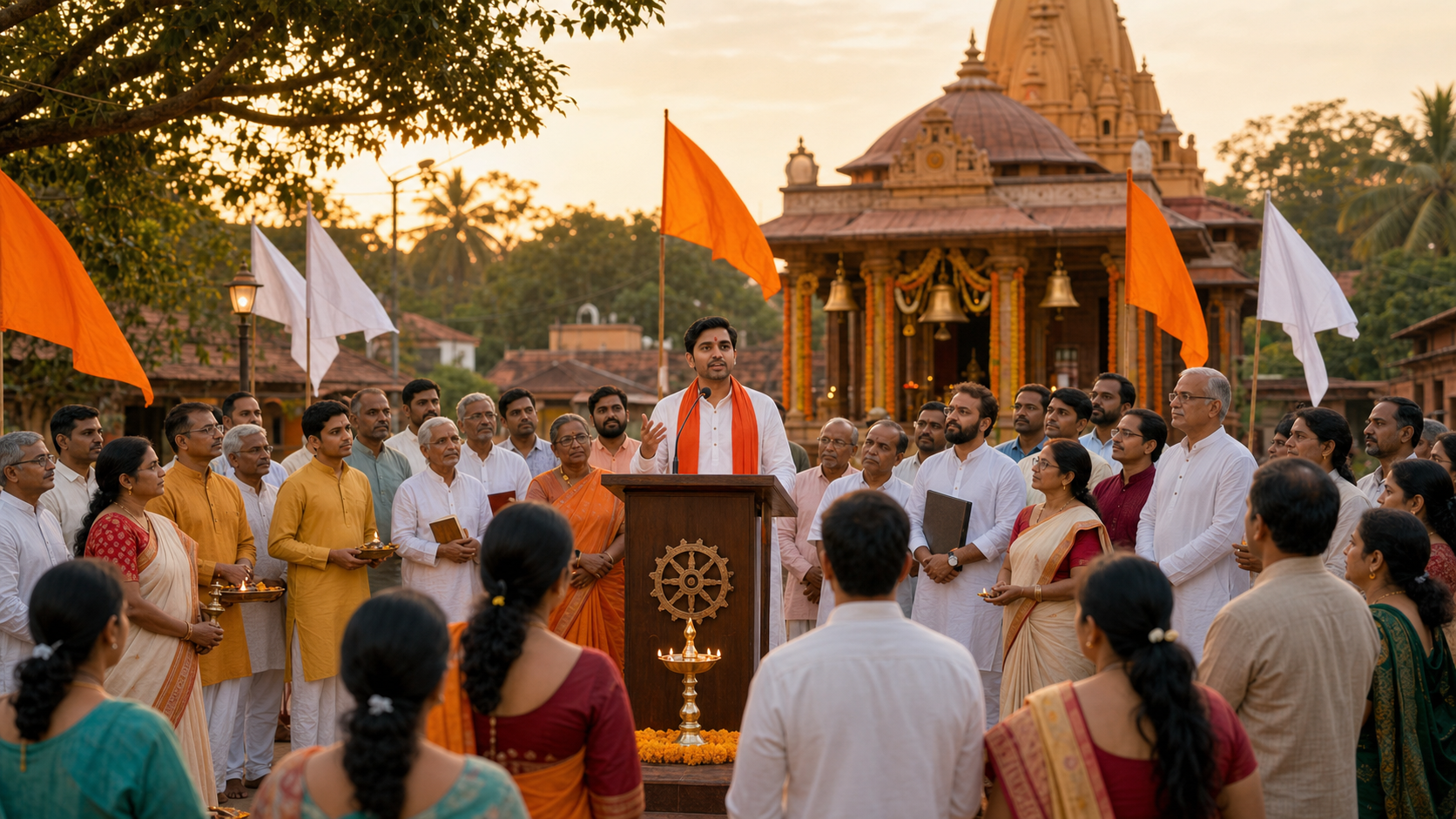
The Hindu Rashtra-Jagruti Sabha held at Rajapur in Maharashtra on 28 March 2026 was reported as a public gathering centered on Hindu unity, civic vigilance, and the protection of Dharma. Based on the available source material, the event delivered a strong message that safeguarding Dharma is not merely a matter of religious identity, but also a social responsibility tied to cultural continuity, ethical conduct, and organized community awareness.
In academic terms, such gatherings are best understood as part of a wider pattern of cultural advocacy in contemporary India, where communities seek to preserve religious traditions, temple-centered life, inherited customs, and civilizational memory in a rapidly changing social environment. Rajapur, like many towns in Maharashtra, exists within a living cultural landscape shaped by festivals, local temples, family traditions, devotional practices, and public assemblies. A Sabha focused on Dharma therefore carries both symbolic and practical significance.
The central theme of the Rajapur event was unity. In the Dharmic worldview, unity does not require uniformity. Hindu traditions have historically included many sampradayas, regional practices, forms of worship, philosophical schools, and devotional temperaments. A call for Hindu unity, when expressed constructively, is a call to recognize this diversity as a civilizational strength rather than a source of division. It encourages Shaiva, Vaishnava, Shakta, Smarta, folk, tribal, and regional traditions to see themselves as parts of a shared cultural inheritance.
This emphasis also aligns with the broader objective of harmony among Dharmic traditions, including Hinduism, Buddhism, Jainism, and Sikhism. These traditions differ in theology, practice, metaphysics, ritual discipline, and institutional history, yet they share important civilizational concerns: ethical self-discipline, reverence for spiritual knowledge, respect for teachers, the cultivation of inner refinement, and the pursuit of liberation from narrow ego-centered life. A responsible public discourse on Dharma should therefore strengthen mutual respect among Dharmic communities rather than deepen sectarian separation.
The phrase protection of Dharma requires careful interpretation. Dharma is not limited to ritual observance, nor can it be reduced to political vocabulary. In classical Indian thought, Dharma includes duty, justice, moral order, restraint, truthfulness, social responsibility, and the conditions that allow righteous life to flourish. To protect Dharma, therefore, is to preserve the ethical and cultural environment in which individuals and communities can live with dignity, faith, self-respect, and responsibility.
The Rajapur Sabha reportedly emphasized vigilance. In a democratic society, vigilance should be understood as lawful awareness, disciplined civic participation, and peaceful community organization. It may include awareness of temple administration, religious education, social harmony, legal rights, cultural preservation, media narratives, youth engagement, and the need to respond calmly and responsibly to social challenges. This form of vigilance becomes constructive when it is rooted in knowledge rather than fear, and in Dharma rather than reaction.
Maharashtra has a long public tradition of religious and social mobilization. From kirtan and pravachan traditions to public festivals, reform movements, saint literature, and community sabhas, the region has often used public platforms to discuss moral life, social duty, and collective identity. A Hindu Rashtra-Jagruti Sabha in Rajapur can be placed within this wider history of community education, where the spoken word becomes a vehicle for shaping collective memory and public conduct.
The use of the term Hindu Rashtra in public discourse often evokes strong reactions because it intersects with history, law, identity, and contemporary politics. A factual and balanced discussion should distinguish between cultural self-understanding and constitutional governance. India remains a constitutional republic with legal protections for religious freedom, equality before law, and plural civic life. Within that framework, communities are free to articulate cultural aspirations, preserve heritage, organize public meetings, and advocate for lawful protection of their institutions and traditions.
For many participants in such gatherings, the emotional core is not abstract ideology but lived experience. Dharma is encountered through the morning lamp lit at home, the sound of temple bells, the memory of grandparents reciting stories from the Ramayana or Mahabharata, the discipline of fasting, the reverence shown to a guru, the celebration of festivals, and the quiet strength that comes from belonging to a long civilizational chain. When people speak of protection, they often mean protection of this inherited world of meaning.
At the same time, academic clarity requires acknowledging that cultural protection must remain ethically grounded. The language of unity becomes meaningful only when it avoids hostility, respects lawful order, and remains anchored in self-correction. Dharma is not defended merely by opposing external pressures; it is also defended by addressing internal weaknesses such as ignorance of scriptures, neglect of temples, caste arrogance, social fragmentation, indifference toward youth, and loss of respect for traditional learning.
A central challenge before Hindu society is the transmission of knowledge. Many families continue to observe festivals but may not know their philosophical significance. Many young people inherit names, rituals, and symbols without receiving a structured explanation of their meaning. Events such as the Rajapur Sabha can serve an educational function when they encourage study of Hindu scriptures, local history, temple traditions, Sanskrit terms, saint literature, and the ethical foundations of Sanatan Dharma.
Temple protection is another important dimension of Dharma protection. Temples are not only places of worship; they are cultural institutions, archives of architecture, centers of music and dance, sites of charity, and spaces where collective identity is renewed. In many parts of India, the temple has historically supported education, food distribution, artistic patronage, ritual continuity, and social coordination. Protecting temples therefore includes preserving their sanctity, architecture, resources, festivals, and community role.
However, protection must be understood broadly. A temple is secure not only when its walls are preserved, but when devotees understand why it exists, priests are treated with dignity, children are welcome, rituals are performed with integrity, local communities participate responsibly, and heritage is documented for future generations. Dharma protection is strongest when cultural institutions are supported by knowledge, transparency, service, and disciplined participation.
The Rajapur message of unity also has a social dimension. Hindu society has often suffered when internal divisions have been allowed to outweigh shared civilizational commitments. Differences of caste, language, region, sect, and political preference can weaken collective confidence when they become absolute identities. A mature call for Hindu unity should therefore emphasize social cohesion, mutual respect, shared service, and the recognition that Dharma is diminished when any section of society is treated as disposable or inferior.
The Dharmic ideal of unity also extends to service. Seva is not secondary to Dharma; it is one of its most visible expressions. Food distribution, education, assistance to vulnerable families, preservation of local water bodies, support for traditional artisans, care for cows and animals, and help during crises all translate religious conviction into social welfare. Public gatherings become more meaningful when they connect speeches on Dharma with practical programmes of service.
In the contemporary media environment, vigilance also includes narrative awareness. Communities often feel that their traditions are misunderstood, caricatured, or selectively represented. A responsible response is not anger alone, but intellectual preparation. This includes producing accurate historical writing, training young speakers, supporting research, documenting local temples, engaging with law and policy, and communicating Hindu traditions in clear, dignified language.
Hindu unity in the twenty-first century must also be digitally literate. Social media can amplify awareness, but it can also intensify emotion without deepening understanding. Dharma-based communication requires restraint, verification, and accountability. Before sharing claims, responsible citizens should examine sources, avoid inflammatory exaggeration, and distinguish between legitimate criticism and careless provocation. Truthfulness remains a Dharmic obligation even when the subject is emotionally charged.
The Rajapur Sabha also points toward the importance of youth participation. Younger generations often seek meaning, identity, discipline, and community, but they may not respond to inherited language unless it is explained with clarity and relevance. Teaching Dharma to youth requires more than slogans. It requires intellectual honesty, accessible study material, role models, opportunities for service, exposure to temples and pilgrimage, and an environment where questions are welcomed rather than dismissed.
Women also occupy a central place in the continuity of Dharma. In many homes, women preserve festival traditions, food practices, family rituals, songs, vows, stories, and everyday forms of devotion. Any serious movement for Dharma protection must recognize this cultural labor and ensure that women participate not merely as symbolic figures but as teachers, organizers, scholars, professionals, and community leaders. A society that claims to protect Dharma must also protect the dignity and agency of women.
The language of Dharma protection should therefore remain constructive, disciplined, and future-oriented. It should ask practical questions: Are children learning the meaning of festivals? Are temples clean, accessible, and well-managed? Are local histories being documented? Are intergenerational conversations happening at home? Are community disputes being resolved with fairness? Are Dharmic traditions being presented to the wider world with accuracy and confidence?
Such questions make the Rajapur event relevant beyond one date and one location. A Sabha becomes historically meaningful when it inspires sustained action after the gathering ends. The true measure of a call for unity is not the intensity of applause, but the continuity of disciplined work: study circles, temple service, youth education, cultural documentation, legal awareness, inter-community dialogue, and everyday ethical conduct.
From a civilizational perspective, Dharma survives through institutions, memory, practice, and character. Institutions provide structure, memory provides continuity, practice provides embodiment, and character provides moral credibility. If any one of these is neglected, public declarations become fragile. The Rajapur Sabha’s reported message of unity and vigilance can therefore be read as a reminder that Dharma protection is both external and internal, social and personal, cultural and ethical.
The most productive interpretation of Hindu unity is not a narrow consolidation against others, but a disciplined awakening within society. It asks Hindus to study more seriously, serve more generously, organize more responsibly, and relate to fellow Dharmic communities with respect. It also asks that public advocacy remain rooted in truth, restraint, courage, and compassion. These qualities are not ornamental; they are the substance of Dharma itself.
The Rajapur Hindu Rashtra-Jagruti Sabha of 28 March 2026 thus stands as a local expression of a larger conversation taking place across India: how to preserve Sanatan Dharma, Hindu heritage, temple culture, and Dharmic values in a period of social change. Its reported message was clear: unity and vigilance are necessary. The deeper task is to ensure that such unity is ethical, inclusive within the Dharmic family, intellectually grounded, and committed to the peaceful strengthening of society.
Inspired by this post on Hindu Jagruti Samiti.
