

If you are trying to decide whether Indra simply cheated Karna, or whether Karna’s generosity made him morally superior, the Mahabharata will not give you a clean verdict. The encounter brings several valid duties into conflict: a father’s protection of his son, a warrior’s obligation to his allies, fidelity to a vow, generosity toward a supplicant, and the preservation of balance in war.
You can reach a clearer judgment by separating four things that are often collapsed: what Indra does, why he does it, what Karna chooses, and who bears the consequences. That distinction lets you honor Karna without romanticizing every decision he makes, and criticize Indra’s deception without pretending that his purpose is morally irrelevant.
The exchange is a bargain, not a simple theft
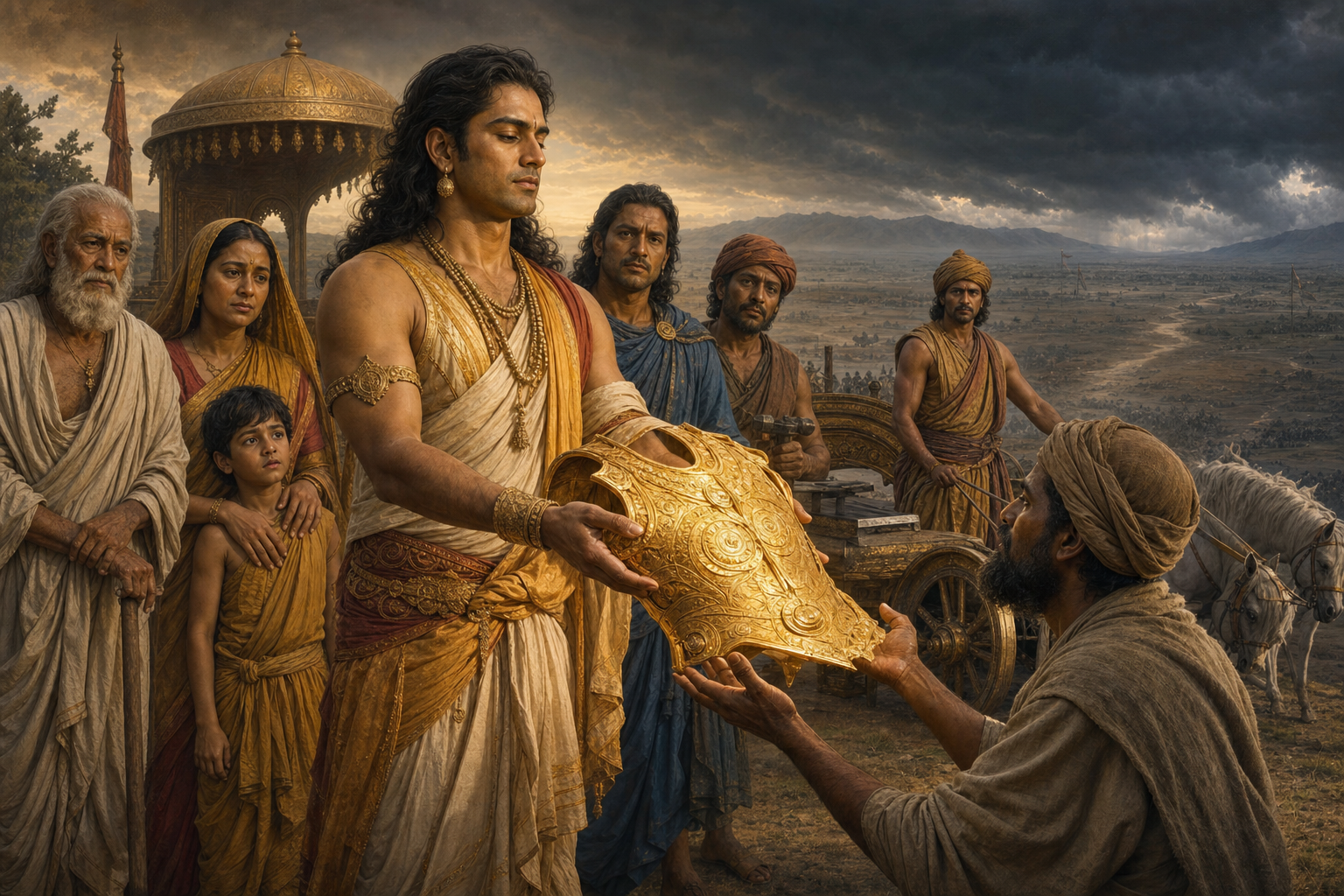
Karna’s Kavacha-Kundala are not ordinary equipment that he can remove without changing his condition. He is born with this armor and these earrings, which are connected with Surya and give him extraordinary protection. Their removal therefore changes the expected contest between Karna and Arjuna, Indra’s son. What appears to be an act of almsgiving is also an intervention in the military balance before Kurukshetra.
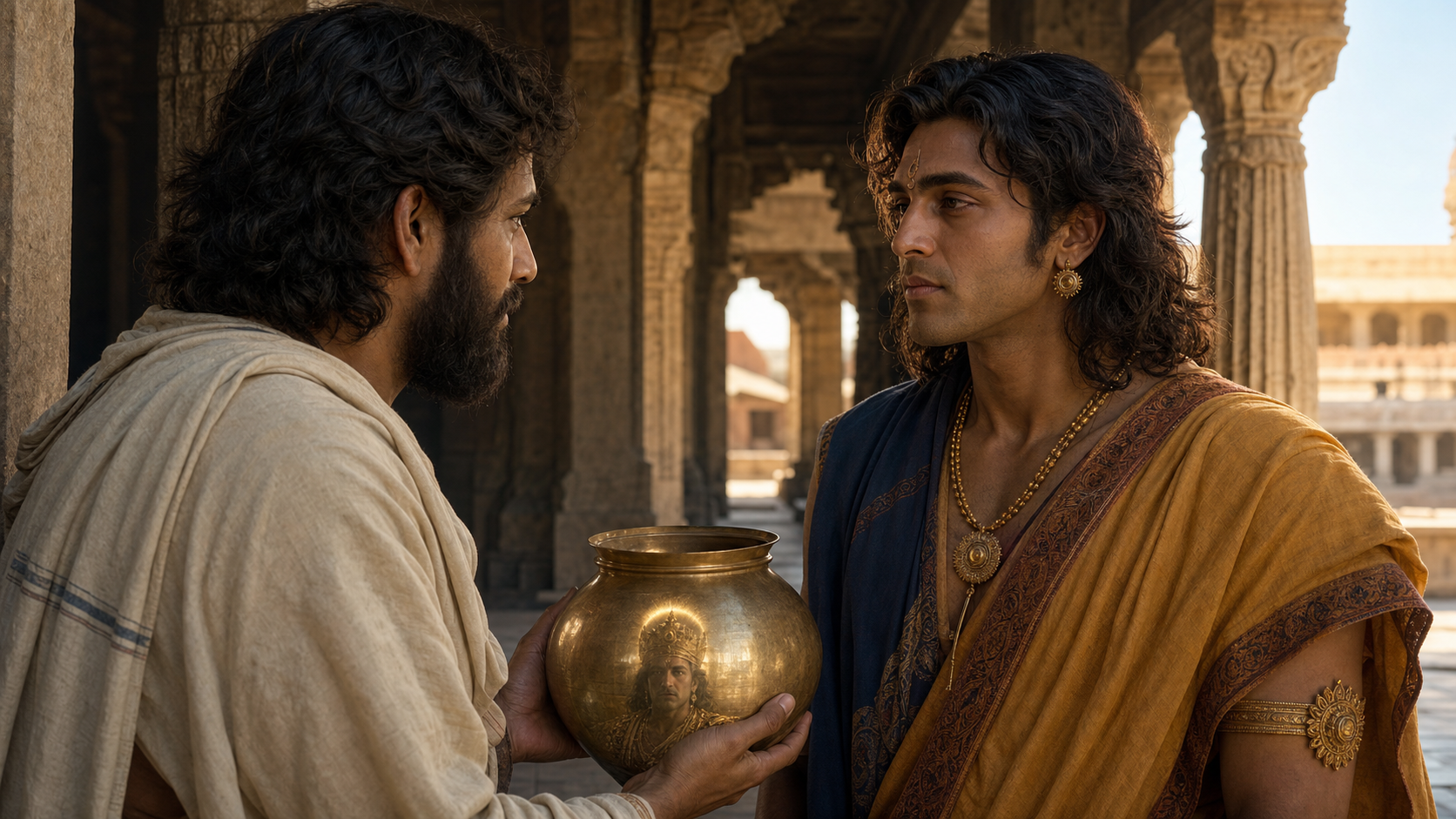
Indra approaches in the guise of a brahmana and asks for the Kavacha-Kundala. Karna grants the request but secures a return gift: the Vasavi Shakti, an irresistible missile that can be used only once. He exchanges enduring protection for a single decisive attack. That is why it is more accurate to call the encounter a morally compromised bargain than either a straightforward theft or an ordinary act of charity.
The warning attached to this episode must be handled carefully. In the widely attested Udyoga Parva sequence, Surya warns Karna directly about Indra’s plan. A related motif found in later, regional, and oral tellings has a Rakshasa alert Duryodhana, who then tries to dissuade Karna. These versions illuminate different relationships, but they should not be presented as though they occupy the same textual layer.
The Surya warning isolates Karna before his own conscience: he knows the danger and must decide what his vow requires. The Rakshasa warning emphasizes kingship and counsel: Duryodhana receives useful intelligence but cannot make his ally obey it. In either form, foreknowledge is essential. Karna is neither ignorant of the danger nor merely stripped of his protection by force.
That does not absolve Indra. A choice can remain a real choice even when another person has deliberately manipulated its setting. Indra conceals his identity and selects a form of request that activates Karna’s most uncompromising virtue. Karna still consents, but Indra has arranged the encounter so that refusal would require Karna to violate the public identity he has built around giving.
Why warning Karna does not save him
The obvious strategic answer is that Karna should refuse. Keeping the armor would preserve the Kaurava coalition’s most formidable defense against Arjuna. Karna has also accepted Duryodhana’s friendship and political patronage, so his survival is not purely a private concern. Other warriors will bear the battlefield consequences of his gift.
But Karna does not understand his vow of dana as a preference that applies only when convenient. It is a rule by which he recognizes himself. If he abandons it precisely when generosity becomes costly, he may preserve his body while destroying the truth of the vow. His decision therefore joins dana with satya: giving and fidelity to one’s pledged word.
This is why better information cannot solve the problem. The warning tells Karna what Indra intends, but it does not alter what Karna believes he must be. Intelligence changes action only when it can be reconciled with the actor’s governing commitments. Duryodhana can explain the military danger, yet the danger itself is what makes the vow decisive for Karna.
You can admire that consistency and still question its prudence. A virtue does not cease to be genuine because it causes a disaster. Nor does a disastrous consequence automatically turn a sincere virtue into vice. The episode becomes tragic because Karna’s generosity is real, its price is foreseeable, and that price extends beyond Karna.
There is a practical leadership lesson here. If someone central to your cause has a known non-negotiable commitment, last-minute warnings will not make that commitment disappear. Planning must account for the person’s moral architecture before a crisis. Duryodhana possesses the relevant intelligence but lacks a way to align Karna’s vow with the coalition’s need to preserve him. The failure is not a lack of facts; it is a mismatch between strategy and character.
Karna’s foreknowledge also prevents an easy victim narrative. Indra exploits him, but Karna knowingly chooses the gift. Removing Karna’s agency would diminish the very quality for which the episode remembers him. His dignity lies in accepting the cost, not in being unaware of it.
Does Indra’s disguise make the act adharmic?
Judged only by its means, Indra’s conduct is deeply troubling. He hides his identity, assumes the socially protected appearance of a brahmana supplicant, and turns Karna’s generosity into leverage against him. A direct request from Indra would not place Karna under the same pressure. The disguise is therefore not decorative; it is the mechanism of the plan.
Judged by role and purpose, the picture changes but does not become spotless. Indra acts to protect Arjuna and to remove an overwhelming advantage from the coming war. As father, deva, and partisan in the conflict, he is not a detached moral examiner. He has someone to save and a balance of power to alter.
The mistake is to assume that a defensible purpose automatically purifies the method. The Mahabharata repeatedly makes readers hold purpose and method in view at the same time. Indra’s strategic objective can be intelligible while his deception remains morally uncomfortable. Dharma is not reduced to whatever helps the eventual victor.
Use four questions when judging this or any comparable conflict in the epic:
- Means: What exactly does the person do, and would the plan succeed without concealment or pressure?
- Role: Whom is the person responsible for protecting, and which obligation is being fulfilled?
- Cost: Who pays for the decision, including allies and dependants who did not choose it?
- Consequence: Does the act restore a workable balance, create a new injustice, or do both at once?
Indra fares differently under each question. He fails the test of openness, fulfills a protective and strategic role, makes Karna bear the immediate cost, and changes the war’s balance. Karna also produces a mixed result: he keeps faith with his vow, gives freely despite danger, gains a formidable counter-gift, and exposes both himself and Duryodhana’s army to a risk they hoped his armor would contain.
This method guards against two common errors. Karna’s personal nobility does not certify every political cause he supports. Indra’s association with Arjuna does not make every tactic used on Arjuna’s behalf transparently dharmic. Character, allegiance, method, and consequence must be judged separately before they can be brought into one moral view.
The armor-for-missile bargain changes the war twice
The exchange first transforms Karna’s military power. The Kavacha-Kundala provide continuing protection; the Vasavi Shakti provides one irresistible strike. Karna turns a permanent shield into a weapon whose value disappears after a single use. The weapon may decide one encounter, but it cannot protect him through the many contingencies of a long war.
The exchange changes the war a second time when Ghatotkacha devastates the Kaurava forces with his Rakshasa prowess at night. Karna uses the Vasavi Shakti to kill him. That use solves the immediate battlefield crisis, but it also removes the weapon that posed the greatest direct threat to Arjuna. A tactical victory over Ghatotkacha becomes a strategic relief for Arjuna.
After the Shakti has been spent, Karna has neither his birth armor nor the single-use missile. Arjuna, guided by Krishna, kills him on the seventeenth day. The armor exchange is not the only cause of Karna’s death, because the epic surrounds that death with several vows, curses, choices, and battlefield contingencies. It does, however, narrow Karna’s future options at two decisive moments.
This sequence gives you a useful way to follow boons and divine weapons throughout the Mahabharata. Ask how long an advantage lasts, what conditions govern it, who can compel its use, and what becomes possible after it is gone. A boon is rarely just a symbol of strength. It is also a structure of limits, and those limits often carry the plot.
The name Vasavi Shakti reinforces the theology of the transaction: the power comes from Vāsava, Indra, in exchange for Karna’s solar-linked protection. Dana does not merely remove something from the giver’s possession. It redirects shakti. Indra gains a safer future for Arjuna; Karna receives concentrated destructive power; Ghatotkacha eventually absorbs that power; and Arjuna survives to face a now-vulnerable Karna.
Seen this way, the exchange is neither a decorative legend nor a simple reward for generosity. It is the mechanism through which moral character becomes military consequence. Karna’s vow shapes Indra’s strategy, Indra’s strategy reshapes Karna’s arsenal, and Karna’s use of that arsenal reshapes the final contest.
Key takeaways for a dharmic judgment
- Keep the textual layers distinct: Surya’s warning belongs to the widely attested Udyoga Parva account, while the Rakshasa’s warning to Duryodhana circulates in later, regional, and oral tellings.
- Karna is deceived but not stripped of agency. He gives despite knowing the danger and negotiates the Vasavi Shakti in return.
- Indra’s purpose explains his intervention but does not erase the ethical problem created by disguise and moral leverage.
- Karna’s dana is authentic even though its foreseeable cost falls partly on his allies. Virtue and prudence do not always point in the same direction.
- The military exchange is asymmetric: permanent protection becomes a one-use attack, which kills Ghatotkacha but is then unavailable against Arjuna.
- A sound judgment should examine means, role, distributed cost, and consequence rather than assigning a single label to either man.
Karna’s act also speaks to a wider Dharmic concern with loosening one’s grasp on possession and self-interest. Hindu dana, Buddhist dāna-pāramitā, Jain aparigraha, and Sikh seva are not interchangeable doctrines, but each gives moral weight to disciplined generosity, non-attachment, or self-offering. Karna presents the grandeur of that impulse in an extreme form.
His extremity is also a warning. Renunciation does not automatically cancel relational duty. Before treating a promise as an absolute, name the people who will pay for its fulfillment. If the cost is yours alone, the act may be personal sacrifice. If allies, dependants, or a whole community will carry it, private honor has become a public decision and requires a wider dharmic accounting.
When your own vow collides with another real obligation, write down the same four questions: means, role, cost, and consequence. Do this before declaring that consistency alone settles the matter. Karna deserves reverence because he pays the price of his word; the price itself is why his choice should be contemplated carefully rather than copied automatically.
Read the encounter with both shraddha and viveka: honor the courage of Karna’s gift, see the wound in Indra’s method, and notice every life drawn into their decision. That habit of attention is more faithful to the Mahabharata than an easy verdict of hero or villain.


References
