
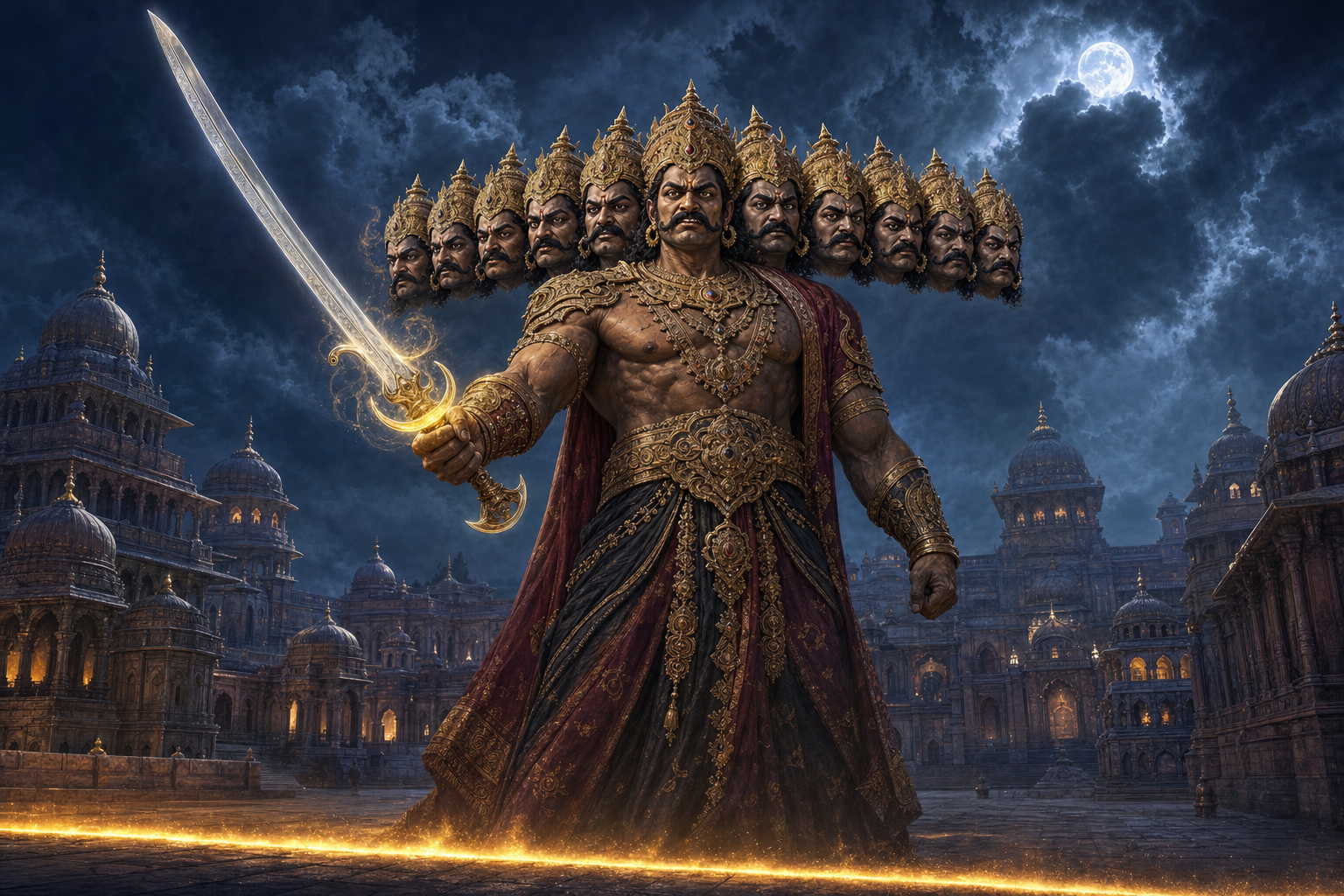
If you came looking for the exact battlefield moment when Ravana’s celestial sword stopped working, the honest answer is that there isn’t one universally fixed Chandrahasa scene. The named sword becomes prominent in later layers of the Ramayana tradition, and different tellings place its limit, curse, or withdrawal at different moments.
That variation doesn’t make the story useless. It tells you how to read it properly: first identify which Ramayana tradition is speaking, then examine the ethical principle carried across the variants. Chandrahasa matters because it separates possession of power from the right to exercise it.
Start by asking which Ramayana tradition is speaking
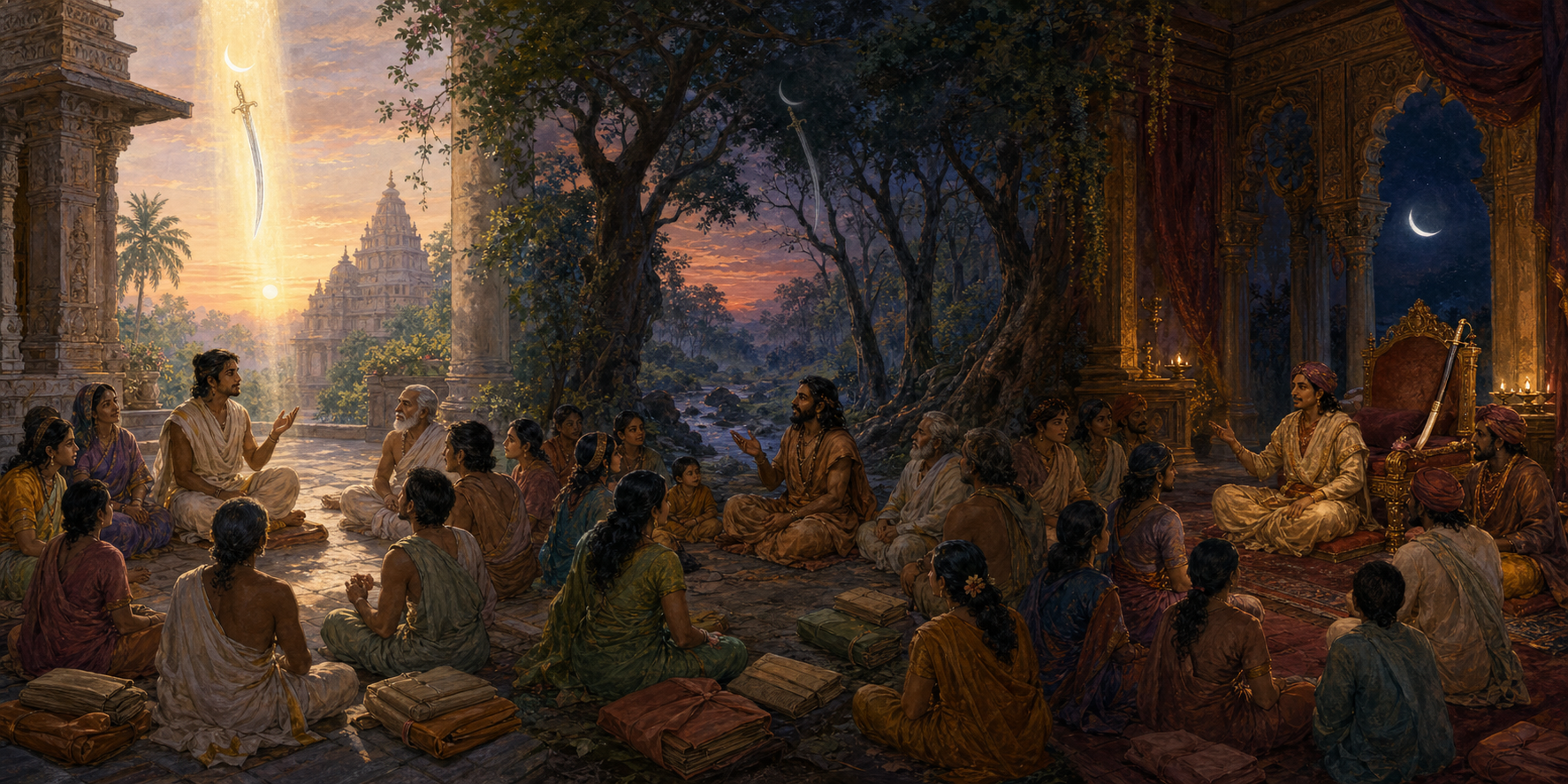
Chandrahasa is often presented in popular narration as though every version of the Ramayana describes the same weapon, curse, and moment of failure. That claim is too neat. The early Valmiki narrative does not foreground Chandrahasa by name in the way later accounts do.
The moon-bright sword occupies a larger place in later Puranic material, the Krittivasi Ramayan, the Ananda Ramayana, vernacular kathas, Shiva-centred accounts, performance traditions, and some regional and Southeast Asian formations of the Ramayana. These traditions don’t all supply the same narrative details. Some describe a condition attached to Shiva’s boon. Some attribute a curse to Parvati, Nandi, or sages offended by Ravana’s conduct. Others make the sword powerless against one who remains established in dharma.
You can avoid most confusion by applying three reading rules:
- Don’t assign a later episode automatically to Valmiki. If a retelling names Chandrahasa and its curse, ask which recension, regional Ramayana, Purana, or performance lineage supplies that form.
- Don’t turn a family of variants into one fabricated master version. A boon with a condition, a curse pronounced after an offence, and a weapon unable to overcome a dharmic opponent are related explanations, not necessarily one continuous episode.
- Don’t dismiss a later teaching merely because it is later. Chronology tells you where a motif belongs; it doesn’t decide whether its theological or ethical insight is serious.
The Ramayana lives as a textual and performative family, not as a modern novel with one authorised expanded edition. Later tellings often make an existing moral tension visible through a new image. Chandrahasa gives physical form to a question already central to Ravana’s life: can tapas, learning, devotion, and extraordinary capability protect their possessor from the consequences of adharma? The answer is no.
What a dharma-conditioned divine weapon actually means
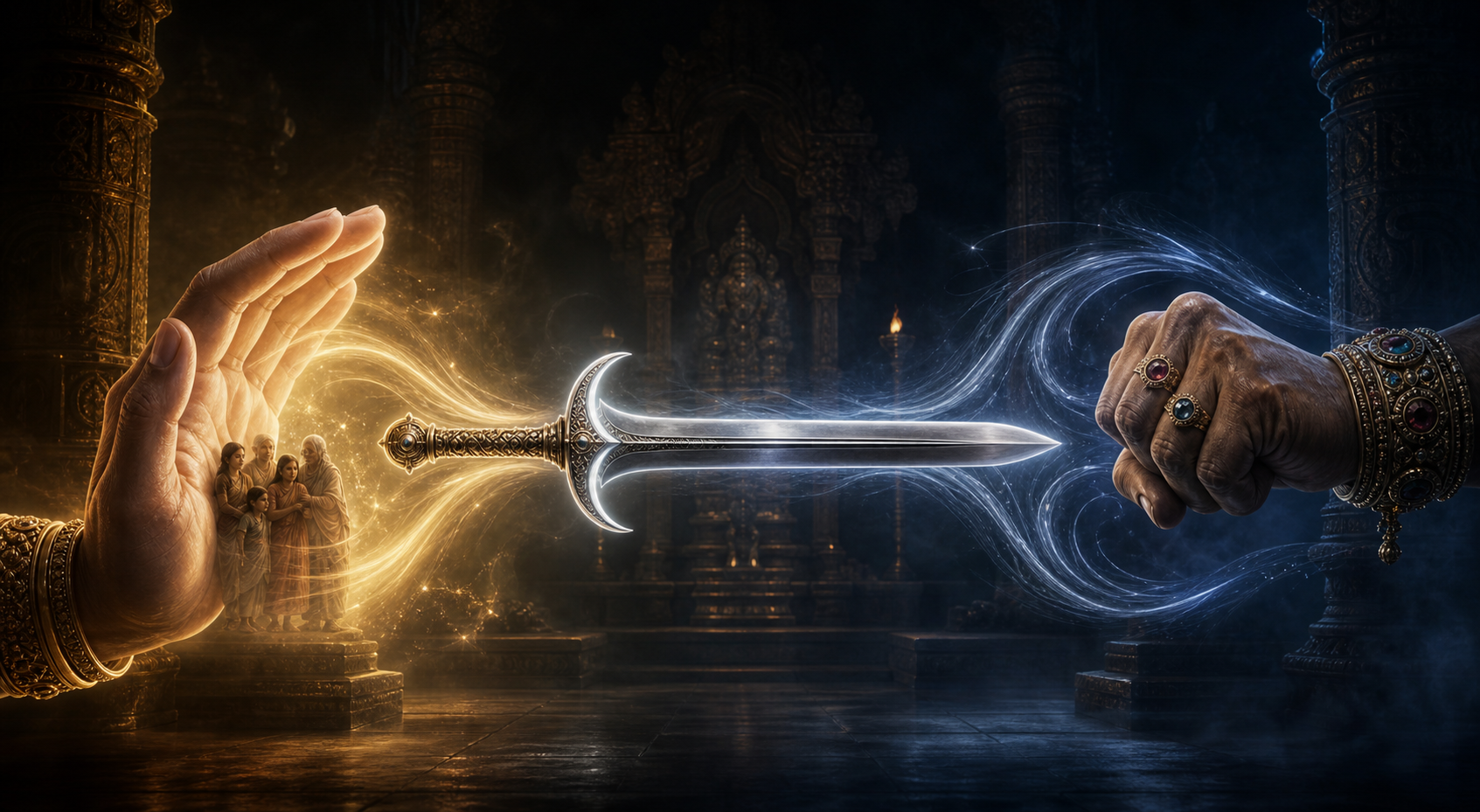
In the Chandrahasa traditions, Shiva’s gift recognises the force of Ravana’s tapas. It does not grant moral approval to everything Ravana may later choose. That distinction is essential. A divine gift can testify to an accomplishment without becoming a permanent endorsement of the recipient’s character.
The weapon’s potency, or shakti, is therefore mediated by ethical qualification. Three Sanskrit terms make the structure easier to see:
| Dimension | The question it asks | How Ravana fails it |
|---|---|---|
| Adhikara | Are you presently qualified to exercise this power? | Past tapas establishes capability, but pride and misconduct erode the qualification needed for rightful use. |
| Sankalpa | What intention is directing the act? | Protection and righteous combat give way to anger, domination, wounded status, or cruelty. |
| Maryada | What boundaries govern the means, target, and extent of force? | Ravana rejects restraint and refuses counsel, including Vibhishana’s appeal to return Sita. |
This is why the curse need not be understood as a deity’s unpredictable change of mood. It functions more like a self-executing term within the boon: power acquired through discipline remains auspicious only while its use stays within the order that made the power meaningful. Once intent crosses that boundary, the wielder may retain the object yet lose its legitimate potency.
The distinction is between ability and authorisation. Ability answers, “Can this be done?” Authorisation asks, “May it be done, to this target, for this purpose, by these means?” Ravana repeatedly treats the first answer as though it settles the second. Chandrahasa exposes the mistake.
This also clarifies why dharmic weapon lore is rarely just a catalogue of supernatural hardware. A divine shastra belongs within a moral relationship involving giver, bearer, purpose, target, and restraint. Remove those conditions and the weapon has been reduced to force. Kshatra without dharma can dominate, but it can no longer claim the dignity of protection.
Why Chandrahasa fails without needing to break
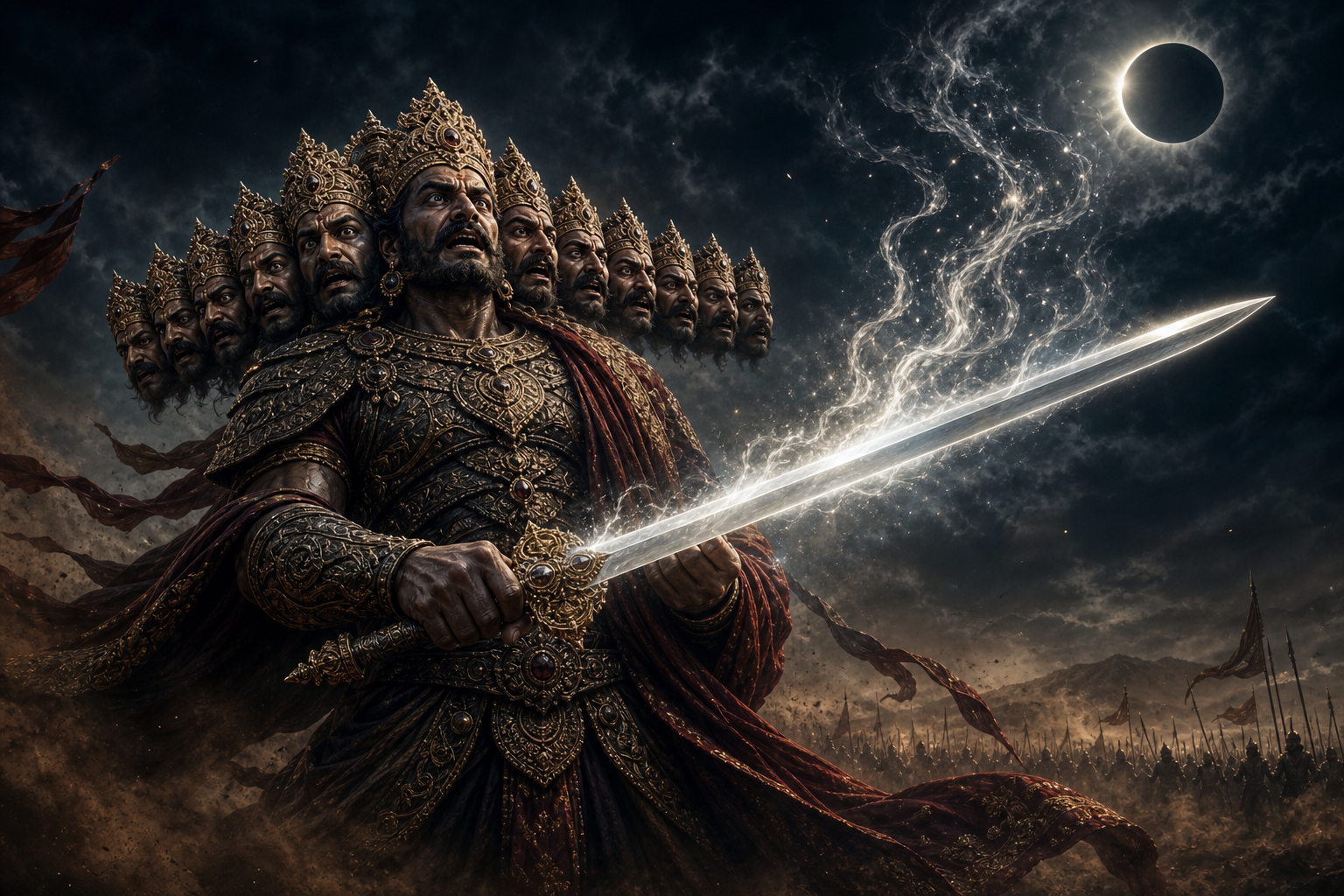
A modern reader may hear “the sword failed” and imagine damaged metal. The traditional possibilities are subtler. The blade may dim, refuse to cut, become inert, withdraw from Ravana’s command, or return to its divine origin. Its physical edge is not necessarily defeated by a stronger material. Its metaphysical warrant has been withdrawn.
The variants organise that withdrawal in three main ways:
- A condition on use: Chandrahasa serves in dharma-yuddha but not when drawn in uncontrolled anger, against the innocent, or for cruelty.
- A curse following hubris: Parvati, Nandi, or wronged sages become the voice of the boundary Ravana has scorned.
- A limit before established dharma: the sword cannot prevail against a being whose conduct remains aligned with dharma, anticipating its futility against Sri Rama.
You don’t have to force these explanations into false harmony. Their dramatic machinery differs. Their moral logic converges: tapas-generated power is not stable in the service of adharma. The “curse” makes that law visible and memorable.
The sword’s name deepens the image. Chandrahasa is commonly rendered as “the laughter of the moon.” The moon’s association with manas, the mind, allows the blade to signify coolness, measure, rhythm, and mastery of impulse. When conceit clouds Ravana’s judgement, the lunar brilliance fades. This is best treated as symbolic interpretation, not as proof that every telling explicitly explains the name in those terms.
The symbolism also corrects a common misreading. The motif does not teach that every righteous person is physically invulnerable, that every good decision succeeds immediately, or that every material failure proves guilt. Its claim is narrower and more demanding: power used outside dharma loses rightful authority, even when the possessor remains outwardly formidable. Adharma may produce temporary results; it cannot become the stable bearer of divine accomplishment.
Sri Rama’s victory consequently isn’t reduced to having better equipment. Within this moral frame, Rama’s steadiness, respect for bounds, calibrated use of means, and willingness to hear counsel matter as much as martial capability. Dharma is not an ornamental claim added after victory. It governs how power is acquired, why it is used, and where it must stop.
Use Ravana’s mistake as a decision test
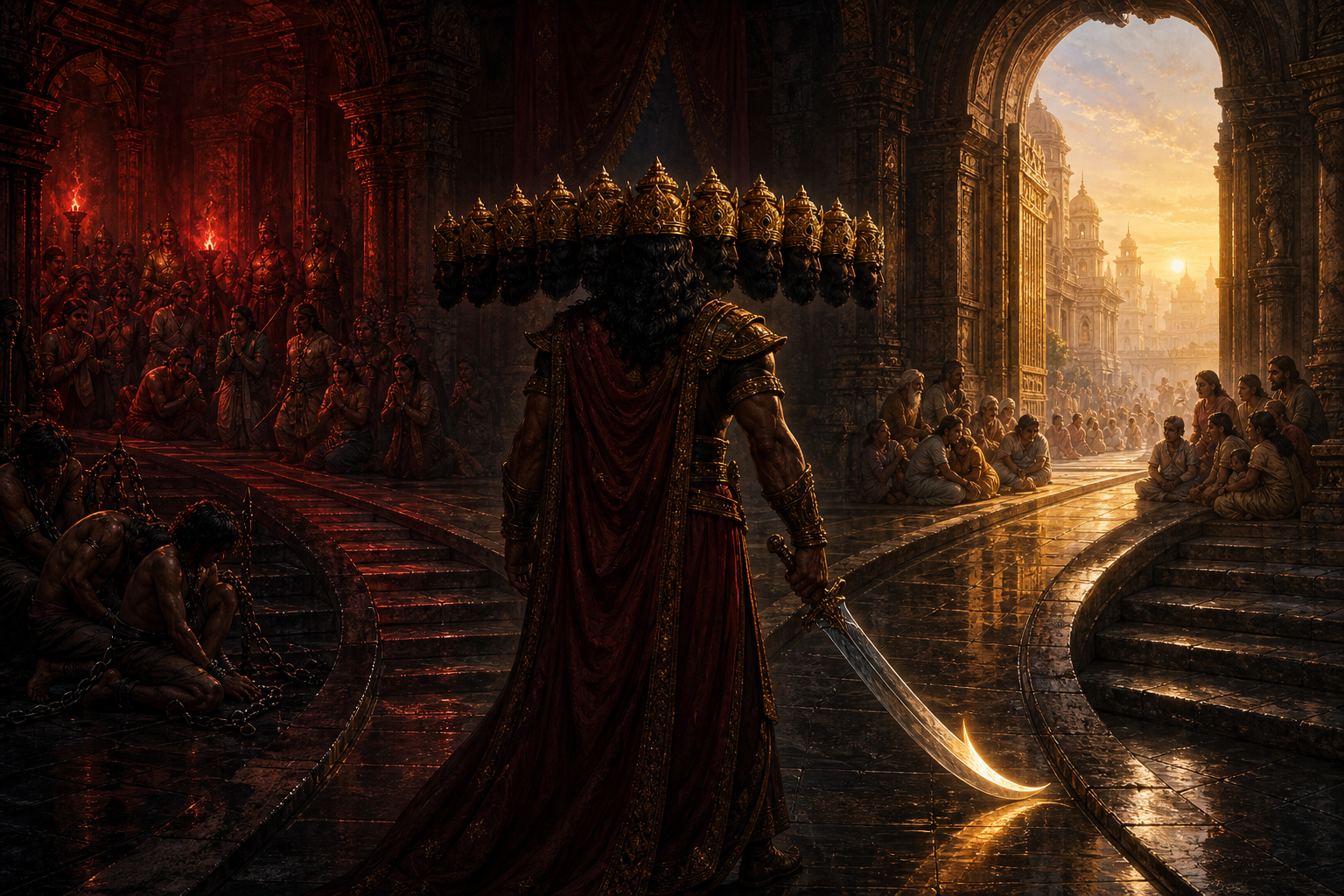
Ravana would be a shallow warning if he possessed no virtues or accomplishments. His learning, devotion to Shiva, austerity, courage, and strength make the warning harder: genuine excellence in one domain doesn’t cancel wrongdoing in another. Past discipline cannot be stored as moral credit and spent on an unjust act.
Before you exercise authority in a family, institution, community, political movement, or technological system, run the decision through a Chandrahasa test:
- Name the protected good. State who or what the action is meant to protect. If the only clear beneficiaries are your status, control, or desire to win, your sankalpa needs examination.
- Identify the target and the boundary. Ask who will bear the force of the decision, whether that person is actually responsible, and what action would exceed a proportionate response.
- Find your Vibhishana. Give an independent counsellor enough safety and information to tell you that you are wrong. Advice that cannot alter the decision is ceremony, not counsel.
- Define the stopping point before acting. Decide what success looks like and what you will not do to obtain it. Boundaries invented after anger takes over rarely restrain anything.
- Remove the audience. Ask whether you would make the same choice if nobody saw you win and nobody saw your opponent yield. A different answer reveals how much wounded pride is directing the act.
This test is especially useful when capability itself is intoxicating. Legal authority, institutional rank, technical access, wealth, physical strength, or command of a public audience can all answer “Can I?” very loudly. They cannot answer “Should I?” for you.
Nor should you reverse the teaching and judge every setback as proof of adharma. Righteous conduct can meet resistance and suffer material loss. The test concerns legitimacy, not fortune-telling. Examine purpose, qualification, limits, and openness to correction rather than treating success as its own moral certificate.
Ravana’s decisive failure is therefore not a shortage of information. He receives counsel and rejects it because obedience to dharma would require surrendering the object of his pride. When preserving face becomes more important than repairing wrong, the wielder has already begun to disqualify himself.
Key takeaways
- Chandrahasa is not foregrounded by name in the early Valmiki narrative as it is in later Ramayana and Puranic traditions.
- The exact giver’s condition, speaker of the curse, scene of failure, and outward effect vary across tellings.
- The stable principle is that divine potency remains subject to adhikara, right intention, and maryada.
- Shiva’s recognition of Ravana’s tapas does not authorise Ravana’s later conduct or exempt him from its consequences.
- The sword’s failure marks a loss of legitimate power, not necessarily a piece of metal snapping in combat.
- The practical question is not only whether you possess power, but whether your purpose, target, means, and willingness to hear correction qualify you to use it.
The same ethical pattern resonates beyond Hindu weapon lore. Buddhist emphasis on disciplined mind and skilful restraint, Jain images of royal splendour losing lustre when violence corrupts it, and Sikh maryada governing shastar through defence and justice all refuse to equate capacity with righteousness. These traditions aren’t interchangeable, but they share a civilisational suspicion of power liberated from moral restraint.
The next time you hear a confident account of Chandrahasa, ask three questions: Which tradition contains this version? What condition governs the weapon? What does Ravana’s choice reveal about qualification to wield power? If those questions disappear and only the invincible sword remains, the most important part of the story has been lost.
Then turn the blade inward. Before your next consequential decision, name the counsel you would least like to hear and test it before acting. Ravana’s warning becomes useful at the precise moment when you still have enough freedom to listen.