-
Nirupadhika in Advaita Vedanta: Adjunct-Free Brahman, Practice Insights, and Dharmic Parallels

Nirupadhika—“without the upadhis”—names Advaita Vedanta’s insight that Brahman is never altered by limiting adjuncts such as body, mind, maya, or avidya. The article maps how nirupadhika contrasts with sopadhika, clarifies tri-level reality, and shows how Upanishadic hermeneutics (neti neti, tat tvam asi via bhaga-tyaga-lakshana) reveal the adjunct-free Self. It unpacks core methods—adhyaropa-apavada, Drig-Drishya Viveka, and…
-
Uragas vs. Nagas in Hinduism: Origins, Scriptural References, and Sacred Symbolism

Hindu texts distinguish clearly between uragas and nāgas. Uraga is a generic Sanskrit term for serpents—a poetic synonym alongside sarpa, ahi, and bhujaṅga—while nāga denotes a semi-divine class with genealogy, kingship, and realm (nāga-loka). Epic and Purāṇic narratives feature named nāga personages such as Śeṣa, Vāsuki, and Takṣaka, whose roles in cosmology and ethics far…
-
Gupt Daan Explained: The Transformative Power of Anonymous Giving in Dharmic Traditions

Gupt Daan—literally the “secret gift”—is the dharmic practice of giving anonymously so that compassion, not ego, remains at the center of charity. Rooted in the Bhagavad Gita’s ideal of sāttvika dāna and mirrored in Buddhist dāna pāramitā, Jain aparigraha, and Sikh seva, it unites Hindu, Buddhist, Jain, and Sikh ethics around selfless, dignified giving. By…
-
Vishu Phalam 2026–2027: Definitive Zodiac & Nakshatra Forecasts, Remedies and Auspicious Dates

Vishu Phalam 2026–2027 offers a comprehensive yearly horoscope for all 12 rashis and Nakshatra Phalam from 14 April 2026 to 14 April 2027. Grounded in Mesha Sankramana and the Kerala tradition of Vishu, it explains how predictions are derived using the sidereal zodiac, Panchanga, and key transits. The guide summarizes the planetary backdrop (Saturn in…
-
Chithirai Vishu 2026: Powerful Tharpana Mantras, Puthandu Sankalpam & Punya Kaalam (14 Apr, 9:25–12:17)

Chithirai Vishu and Puthandu on 14 April 2026 coincide with Mesha Sankranti, inaugurating the Tamil solar New Year during an auspicious Punyakala. The Mesha Sankramana Punya Kaalam runs from 9:25 AM to 12:17 PM, a window traditionally reserved for Tharpanam, Sankalpam, Surya-ārghya, snana, dana, and japa. This guide explains the astronomical basis of the Punyakala,…
-
Rakta Chamundi: Blood-Red Shakti of Wrathful Compassion, Liberation, and Cosmic Balance

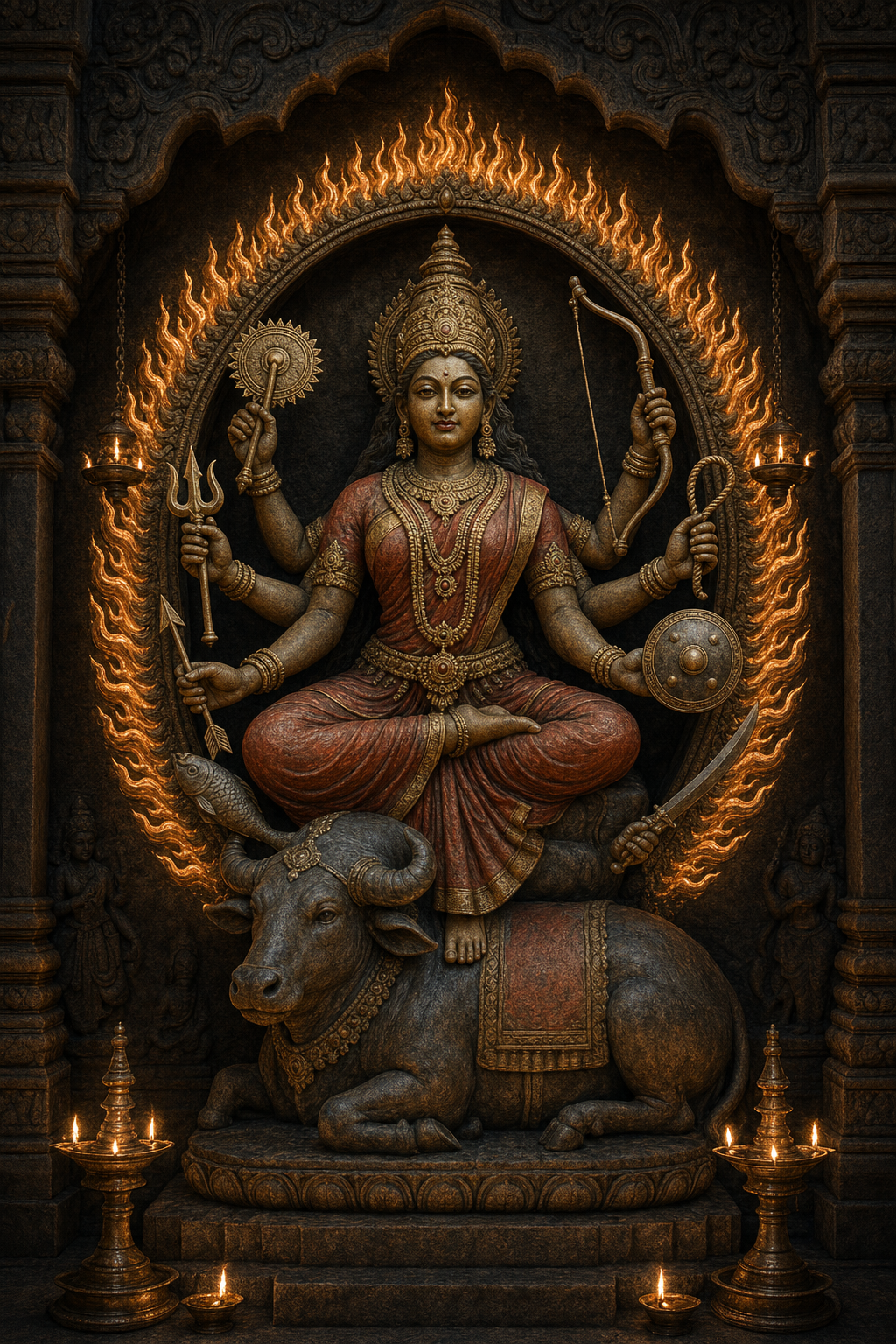
Rakta Chamundi, or Raktha Chamundi, embodies the Hindu Goddess as blood-red Shakti: fierce in aspect, compassionate in purpose, and liberative in effect. Grounded in the Devi Mahatmya’s episodes of Chanda, Munda, and Raktabija, she symbolizes a precise ethical force that ends the repetition of harm. Iconography—skull-garland, cremation-ground setting, and Panchamundi Asana—teaches impermanence, vigilance, and mastery…
-
Egolessness and Emptiness in Hindu Thought: The Transformative Power of Ego-Death

Emptiness in Hindu philosophy is not nihilism but the liberating absence of egoic grasping, revealing the intrinsic fullness (pūrṇatā) of awareness. Drawing on Advaita Vedānta, the Bhagavad Gītā, and Yoga, and in harmony with Buddhism’s śūnyatā and anatta, Jainism’s Anekantavada, and Sikhism’s remembrance (simran) and seva, the discussion shows how egolessness cultivates fearlessness, compassion, and…
-
Chithirai Vishu 2026 Punyakaala Tharpana Guide: Exact Timings, Puthandu Sankalpam, Mantras

Chithirai Vishu (Puthandu) in the Parabhava year falls on 14 April 2026, coinciding with Mesha Sankranti. The Mesha Sankramana Punya Kaalam runs from 9:25 AM to 12:17 PM IST, with the Maha Punya Kaala closest to 9:25 AM. This guide explains the significance of Chithirai Vishu Punyakaala Tharpana, lists essential steps, and provides concise mantras…
-
Advaita Unveiled: Realizing Oneness with the Supreme for Freedom from Fear and Sorrow

This article examines the Advaita Vedanta insight that true wisdom is to see the Self (Atman) as not different from the Supreme Being (Brahman), and shows how that vision resonates across Hinduism, Buddhism, Jainism, and Sikhism. It outlines Advaita’s precise metaphysics (maya, avidya, adhyasa) and its methods (sravana–manana–nididhyasana, neti neti, drg-drishya-viveka, panchakosha-viveka). Readers gain a…
-
March 31, 2026 Panchang Guide: Shukla Trayodashi–Chaturdashi, Nakshatra, Rashi, Auspicious Times

Tuesday, March 31, 2026 features Shukla Paksha Trayodashi until 6:33 AM and Shukla Paksha Chaturdashi thereafter. The day falls in Chaitra Shukla paksha under both Amanta and Purnimanta systems. Near Chaitra Purnima, many regions will observe Chitra Nakshatra for a significant portion of the day, with some seeing an earlier transition from Hasta depending on…
-
Beyond the Mirror: A Wedding Dress Metaphor for Unshakable, Authentic Leadership

A bridal studio offers an unexpected lens on authentic leadership: selection is less about universal approval and more about precise alignment. This long-form analysis translates a wedding dress metaphor into actionable principles for values-based leadership, emotional resilience, and psychological safety. It distinguishes healthy adaptability from self-abandonment and explains why excellence without congruence erodes influence. Drawing…
-
Laghima Siddhi in Hinduism: The Sacred Science of Lightness to Elevate Mind, Body, and Life

Laghima Siddhi, one of the classical ashta-siddhis in Hinduism, signifies far more than levitation; it encodes a holistic science of lightness spanning ethics, breath, posture, diet, and contemplation. Anchored in sources like the Bhagavata Purana and thematically aligned with Patanjali’s Yoga Sutra, Laghima relates to mastery of udana vayu and the cultivation of sattva. In…
-
From Fearlessness to Surrender: Prabhupada’s Doctrine of Divine Protection at ISKCON Mombasa

This reflection from ISKCON Mombasa distills how A. C. Bhaktivedanta Swami Prabhupada’s life fuses bold action with śaraṇāgati to reveal the true meaning of divine protection. It clarifies Gita-based principles (18.66, 9.22, 9.31) and the six limbs of surrender, showing that protection preserves and deepens bhakti rather than promising a risk-free life. Scriptural exemplars like…
-
Chhinnamasta Unveiled: The Mahavidya of Sacred Paradox, Kundalini, and Fearless Compassion

Chhinnamasta, one of the ten Mahavidyas, distills the paradox of creation and destruction into a single, coherent symbol. Her iconography—self-severed head, three streams of blood, and stance atop Kama and Rati—teaches sublimation of desire, mastery over ego, and the redistribution of life-energy as compassion. Read through the lenses of Shakta-Tantra and kundalini yoga, the triple…
-
When Nothing Remains, Fear Ends: A Dharmic Science of Abhaya beyond Ego and Identity

This essay maps a dharmic science of fearlessness (Abhaya) grounded in Hindu philosophy and harmonized with Buddhism, Jainism, and Sikhism. It clarifies how fear originates in avidya and duality, then outlines practical paths—Jnana, Karma, Bhakti, and Raja Yoga—to dissolve misidentification and regulate reactivity. Readers gain scriptural anchors from the Upanishads, the Bhagavad Gita, and the…
-
Beyond Possessions: A Dharmic, Research-Backed Guide to Vairāgya and Inner Freedom

In an age of constant consumption and comparison, the dharmic disciplines of non-clinging provide a precise, research-aligned path to inner freedom. Drawing on Hindu philosophy’s vairāgya, the Bhagavad Gita’s karma-yoga, Patañjali’s abhyāsa and pratyāhāra, Jain Aparigraha, Buddhist mindfulness, and Sikh seva, this essay shows how engagement without entanglement enhances clarity, compassion, and performance. It explains…
-
Gupt Daan Explained: The Transformative Power of Anonymous Giving in Dharmic Traditions

Gupt Daan—hidden giving without publicity or expectation—stands at the intersection of dharma and dignity. Anchored in the Bhagavad Gita’s ideal of sattvika dāna and echoed in Buddhism’s dāna pāramitā, Jain aparigraha, and Sikh nishkam seva and dasvandh, it nurtures humility while delivering tangible social good. This comprehensive guide explains its scriptural basis, ethical psychology, and…
-
March 30, 2026 Panchang: Shukla Dwadashi to Trayodashi, Som Pradosh, Auspicious Timings

March 30, 2026 features Shukla Paksha Dwadashi until 07:20 AM (IST), then Shukla Paksha Trayodashi through the evening, enabling Som Pradosh observance at sunset. The post explains what a tithi is and why the transition time matters, ensuring accurate planning for Parana after Ekadashi and Pradosha Vrata. It clarifies how Nakshatra and Rashi are derived…