
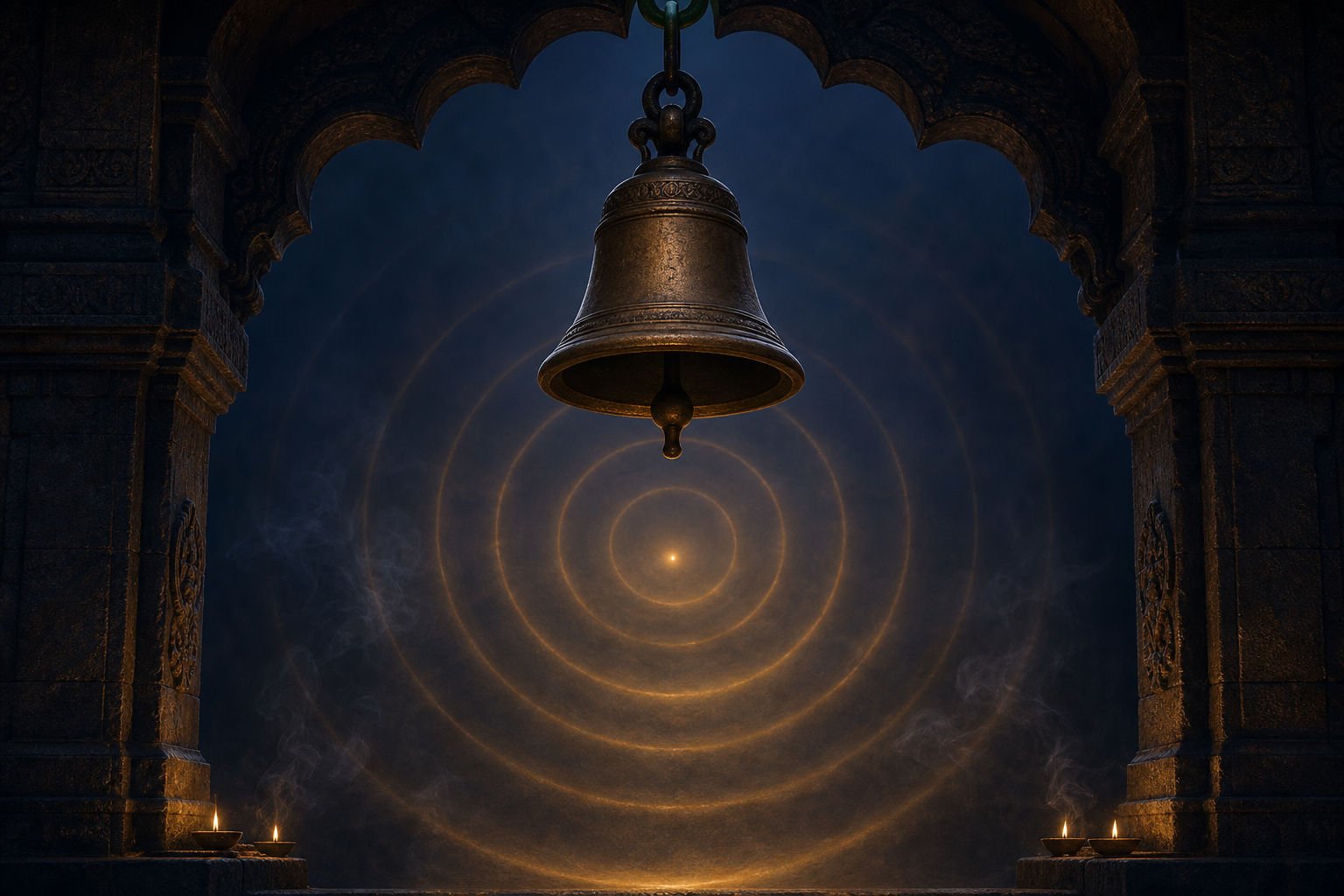
You may have stayed seated after a temple bell, listening as its clear tone thinned into silence, and wondered whether that fading resonance was nāda. It was a doorway. In Shaiva and Shakta thought, however, nāda reaches deeper than anything the ear can hear: it names the unstruck dynamism through which consciousness becomes expression.
That distinction matters when you chant a mantra, meditate on inner sound, or encounter claims about anāhata and Kuṇḍalinī. Audible sound can collect your attention, but the point is not to accumulate unusual noises. The practice moves in the opposite direction: from utterance to thought, from thought to undivided meaning, and from meaning toward its silent source.
Nāda is the movement from consciousness to form

Begin with a distinction that prevents most confusion: sound as physics is not identical to nāda as metaphysics. An audible note requires vibration within a medium and an organ capable of receiving it. Nāda, in its highest sense, precedes that arrangement. It is called anāhata, or unstruck, because it does not arise from two objects colliding.
In nondual Shaiva thought, Paramaśiva is pure consciousness rather than a distant maker standing outside creation. Śakti is that consciousness as self-awareness, luminosity, and power of manifestation. They are not two independent realities. The primordial dynamism of consciousness is described as spanda, while nāda names its vibrational or incipiently expressive character.
This is why creation is better understood here as articulation than as manufacture. The world does not begin with gross matter and later acquire meaning. Intelligibility is present from the beginning. Nāda, bindu, and kalā provide a vocabulary for the passage from undivided potential toward determinate form: vibration becomes concentrated, differentiated, and capable of appearing as ordered experience.
Kashmir Shaivism maps this manifestation through thirty-six tattvas. The sequence extends from the most subtle registers of consciousness to limitation, mind, the senses, the subtle elements, and finally the gross elements. Nāda should not be imagined as an acoustic signal travelling through all thirty-six levels. It names the expressive pulse that makes such differentiation possible.
Several related terms therefore need to remain distinct:
- Spanda is the primordial pulse or dynamism of consciousness.
- Nāda is that dynamism considered as vibrational and expressive potential.
- Anāhata identifies the unstruck character of subtle sound, not merely a pleasant tone or the name of the heart cakra.
- Śabda-Brahman presents ultimate reality under the aspect of sacred sound or word.
- Vaikharī is the gross, audible speech that can lead attention back toward subtler levels.
These terms do not have to be collapsed into synonyms. They illuminate different aspects of one movement: awareness expressing a world without ceasing to be awareness. Treat this as a shared Shaiva-Shakta grammar, not as proof that every lineage assigns every term an identical technical meaning.
The four levels of speech show you where to listen

The doctrine of four levels of vāc turns cosmology into something you can notice directly. Before a sentence leaves your mouth, it has already passed through subtler stages. Speech exists first as undivided power, then as a whole intention, then as mental formulation, and only then as audible words.
| Level of vāc | Character of speech | What you can notice |
|---|---|---|
| Parā | Undivided speech-power in consciousness; word and meaning have not separated | The silent ground from which intention arises |
| Paśyantī | Meaning present as a whole, before internal wording | The intention or insight before you phrase it |
| Madhyamā | Mental speech taking conceptual and grammatical form | Your inward rehearsal, naming, and sentence-making |
| Vaikharī | Articulated sound produced through breath and the organs of speech | Pronunciation, cadence, volume, and the effect of your words |
Nāda is especially associated with parā and paśyantī, where sound has not yet become a chain of audible phonemes. That does not make vaikharī spiritually disposable. Correct recitation, attentive singing, and measured speech matter precisely because the gross level can either obscure or disclose its source.
You can test this map in an ordinary conversation. Before responding, pause long enough to notice the difference between your first impulse, the meaning you intend, the sentence forming inwardly, and the words you finally speak. That pause is not itself liberation, but it exposes the path by which an inward movement becomes an outward act. It also gives you a practical place to interrupt careless speech.
Bhartṛhari’s idea of sphoṭa helps clarify why meaning cannot be reduced to a row of separate sounds. You hear syllables one after another, yet understanding can arrive as a unified disclosure. Shaiva and Shakta thought extends this insight beyond linguistics: the world’s meaningful order expresses consciousness rather than being an accidental layer added to inert matter.
Read the four levels upstream during practice. Do not merely repeat a mantra and count completed utterances. Hear the spoken syllable, observe its mental counterpart, recover its unified intention, and then rest as closely as you can to the awareness from which all four arise. The movement from vaikharī toward parā is the practical heart of nāda.
Mantra, Oṁ, and ritual embody the doctrine

Shaiva and Shakta ritual does not treat sound as decorative accompaniment. Mantra, mudrā, and yantra coordinate voice, body, gesture, attention, and sacred form. A mantra works within this grammar because sound, meaning, intention, and consciousness belong to one continuum.
Oṁ offers the most compact way to contemplate that continuum. The Māṇḍūkya Upaniṣad relates A, U, and M to waking, dreaming, and deep sleep, while the amātra, the measureless or soundless fourth, points to turīya. The audible syllable matters, but so does its completion. If you stop attending the moment the voice stops, you miss the transition that the practice is designed to reveal.
When you chant Oṁ, listen through the whole arc:
- Notice the intention before the first audible vibration.
- Feel A opening into articulation rather than treating it as a detached phonetic unit.
- Attend to the continuity through U and the gathering or closure of M.
- Listen to the resonance after vocal production ends.
- Remain attentive when even the residual resonance can no longer be heard.
The final silence is not simply dead air after a sacred sound. It directs attention toward what does not appear and disappear with the chant. Tantric representations add bindu, nāda, and visarga to this contemplative grammar, allowing the written and sounded form of Oṁ to mirror the movement between concentration, vibration, emission, and repose.
The body also participates. In Śakta and Kaula settings, the mātṛkā-cakra presents Sanskrit letters as powers of manifestation. Nyāsa places mantras or seed-syllables at designated bodily locations, ritually reconstituting the practitioner as a temple of sound. This is not the claim that letters are imaginary ornaments projected onto an otherwise profane body. The rite trains you to encounter embodiment itself as Śakti’s patterned expression.
Bīja-mantras and nyāsa should therefore not be assembled casually from attractive syllables. Their placement, pronunciation, intention, and relation to a deity belong to a lineage and ritual system. Public devotional chanting can be approached openly, but technical mantra installation and Kuṇḍalinī-oriented practice call for competent upadeśa, or instruction.
Naṭarāja’s ḍamaru gives the same teaching an iconic form. Tradition associates its pulsation with the fourteen Maheśvara Sūtras that organize Sanskrit sounds. The image joins dance, language, rhythm, manifestation, concealment, and release. When you see the drum, do not reduce it to a symbol for music. It marks the ordered emergence of form from the freedom of consciousness.
A grounded way to practise inner listening

Nādānusandhāna means sustained attention to nāda. Haṭha and Laya Yoga use inner sound as a support for laya, the settling or absorption of mental activity. Traditional descriptions compare increasingly subtle tones to an oceanic hum, drum, flute, bell, or fine whistle. Those comparisons are orientation markers, not a spiritual scorecard.
If you chase a prescribed sound, strain to manufacture it, or continually ask which stage you have reached, the search itself keeps mental narration active. The more useful question is whether attention is becoming steady enough to remain with a subtle object without grasping at it.
The following sequence is a simple orientation, not a substitute for lineage initiation:
- Establish the base. Sit in a stable posture and allow the breath to become balanced. Agitation in the body usually becomes agitation in listening.
- Use a sound you already know. Choose Oṁ, a familiar devotional name, or a mantra you have properly received. Pronounce it clearly without forcing volume or length.
- Follow rather than abandon the resonance. When vocalization ends, keep listening as the audible trace becomes finer.
- Observe mental repetition. Notice whether the mantra continues inwardly as madhyamā. Do not suppress it. See how it forms.
- Recover whole meaning. Let attention move from the internal wording toward the unified devotion, recognition, or intention carried by the mantra.
- Rest without demanding an event. If an inner tone appears, receive it without naming its rank. If none appears, remain with quiet awareness rather than inventing one.
- Test the result in speech. After practice, notice whether you can listen longer, react less quickly, and choose words more carefully. That is a more reliable measure than novelty.
Bhrāmarī prāṇāyāma and gentle sensory withdrawal through śanmukhī mudrā can make internal resonance more noticeable. They should remain gentle. More pressure does not produce a higher nāda, and over-efforting can turn a practice of absorption into one of agitation.
Do not use an inner sound as proof that Kuṇḍalinī has reached a particular cakra. The anāhata-cakra at the heart is traditionally linked with unstruck resonance, and Kuṇḍalinī maps describe changes in sonic perception during ascent through suṣumṇā. These are contemplative maps interpreted within disciplined practice, not a licence to diagnose every bodily or auditory event as spiritual advancement.
If a sound is distressing or interferes with ordinary life, do not force it into a spiritual explanation. Seek appropriate medical assessment. Nāda practice is a way of training attention; it is not a substitute for hearing care or other treatment.
Modern observations about rhythmic entrainment, attentive breathing, and parasympathetic regulation offer a modest embodied parallel. Slow, sonorous exhalation may help settle attention, but preliminary physiological convergence does not prove the Shaiva or Shakta metaphysics of nāda. You do not need that reduction for the practice to remain intelligible: breath, sound, and attention plainly condition one another.
Key takeaways for worship and daily speech
- Audible sound is a doorway to nāda, not the full meaning of nāda.
- Spanda, nāda, anāhata, and Śabda-Brahman overlap, but each identifies a different aspect of consciousness and expression.
- The four levels of vāc let you trace speech from audible words back through mental formulation and undivided intention.
- Oṁ includes the silence into which A-U-M resolves; stopping your attention with the vocal sound leaves the contemplation incomplete.
- Mantra and nyāsa unite sound with body, meaning, deity, and lineage. Technical bīja and Kuṇḍalinī practices deserve guidance.
- Inner tones are supports for steadiness and laya, not trophies or automatic evidence of attainment.
- The most practical fruit is better listening and more deliberate speech.
This last point gives nāda an ethical force. If speech carries the same expressive power by which consciousness manifests an intelligible world, words are not spiritually neutral. Truthfulness, proportion, cadence, and the ability to remain silent become parts of sādhanā. Listening is no longer passive; it is how you make room for meaning before reaction hardens into speech.
The temple bell, conch, ḍamaru, Vedic accent, stotra, kīrtana, Dhrupad tone, and Carnatic cultivation of śruti all train this receptivity in different ways. Their forms should not be flattened into one technique. What they share is the use of disciplined resonance to gather scattered attention and direct it beyond discursive noise.
Related Dharmic traditions preserve meaningful parallels without becoming interchangeable. Sikh teaching speaks of anhad nād and the revelatory Śabad in simran. Vajrayāna uses bīja-syllables within deity and maṇḍala practice. Jain devotion gives contemplative weight to the Namokār Mantra. The shared intuition is that sacred sound can refine awareness; the doctrinal account of what sound is, how it functions, and what liberation means remains particular to each tradition.
At your next pūjā or mantra session, choose one transition and stay with it: the instant before utterance, the point at which sound becomes thought, or the silence after resonance fades. Do not hurry to interpret what happens. Learn to hear the movement itself. That disciplined return from word to source is where nāda becomes more than an idea.