-
Navratri Day 4, 22 March 2026: Definitive Kushmanda Puja Guide with Ritual Steps and Mantras

The fourth day of Chaitra Navratri on 22 March 2026 honors Goddess Kushmanda, revered as the radiant source of warmth and the cosmic egg of creation. This definitive guide outlines accurate, region-sensitive practice: preparing the altar, making a clear sankalpa, installing the kalasha, and offering Panchopachara or Shodashopachara. It details mantras—including ॐ देवी कूष्माण्डायै नमः…
-
Parabhava 2026–2027: Ugadi’s Transformative Year of Karmic Renewal, Resilience, and Dharmic Unity

Parabhava Nama Samvatsaram begins on Ugadi (March 19, 2026), the 40th year of the 60-year Hindu calendar cycle, and is best understood as a period of purposeful karmic transformation. While often translated as “defeat,” Parabhava is more fruitfully read as a call to transcend limiting patterns and turn setbacks into resilience. In Vedic astrology, the…
-
Dhata the Aditya of Well‑Being: Origins, Mantra, Rituals, Iconography—A Comprehensive Guide

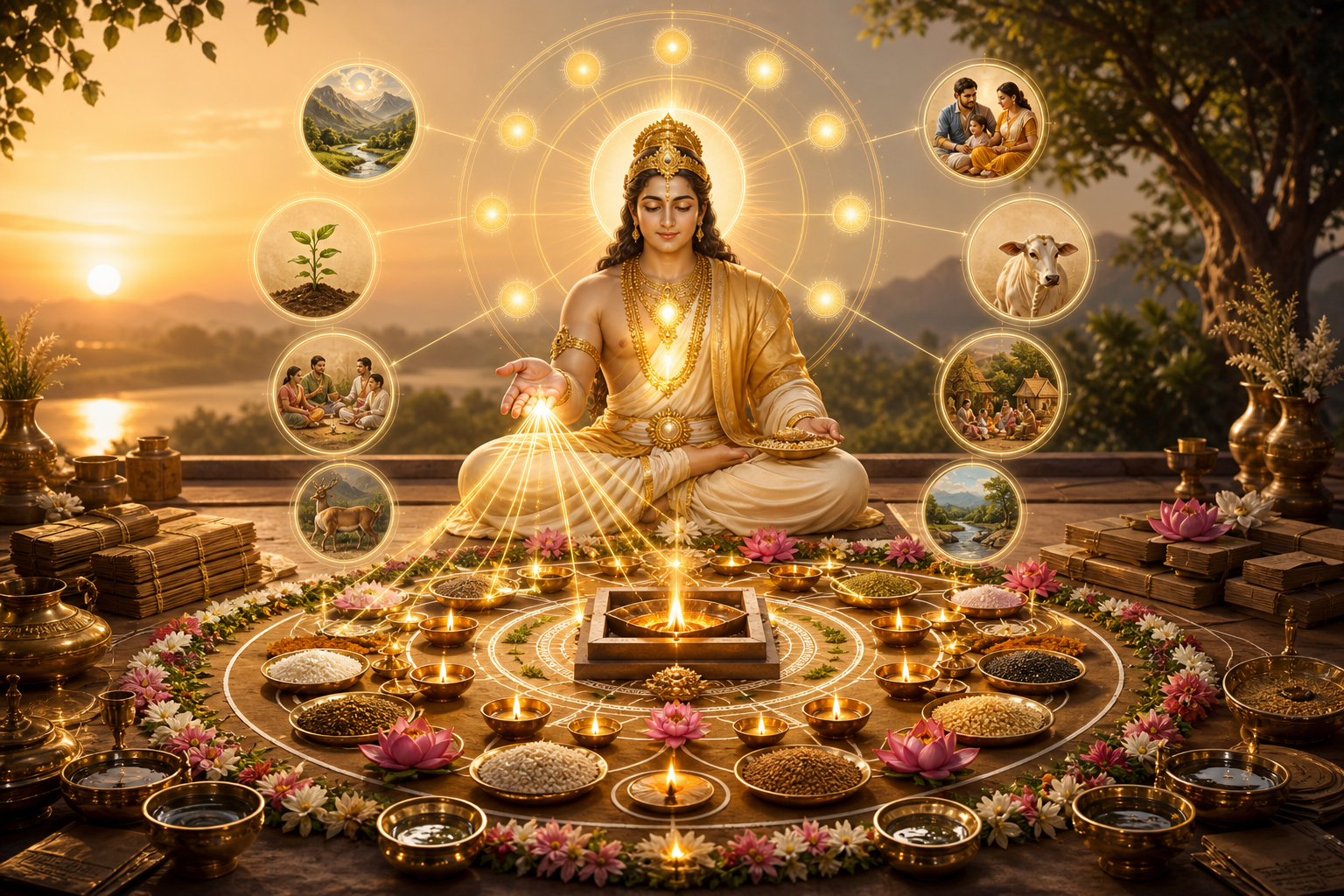
Dhata, one of the Dwadasha Adityas and son of Aditi and Kashyapa, is revered as an establisher of cosmic order and a benefactor of health, wealth, and peace. This comprehensive guide explains Dhata’s Vedic etymology, his place among the Adityas, and why traditions often worship him with Mata Lakshmi Devi for holistic well-being. It outlines…
-
Navratri Day 5 (23 March 2026): Skandamata Puja Vidhi, Mantras, Color, Bhog and Key Rituals

Navratri Day 5 on 23 March 2026 honors Skandamata, the embodiment of maternal grace and protective courage. This comprehensive guide explains Skandamata’s iconography, significance in living traditions, and how Panchami supports clarity and compassionate speech. Readers receive a practical, step-by-step puja vidhi with mantra japa—ॐ देवी स्कन्दमातायै नमः—alongside vrat guidelines, muhurta pointers, and a traditional…
-
Krishna’s Masterclass on Letting Go: Powerful Non‑Attachment Strategies for a Changing Life

Bhagavan Sri Krishna’s teaching on non-attachment offers a precise, actionable way to navigate change without clinging to the past. Grounded in the Bhagavad Gita and enriched by the Mahabharata and the Bhagavata Purana, it reframes excellence as duty fulfilled with freedom from possessiveness. The article clarifies anāsakti, vairāgya, aparigraha, tyāga, and sannyāsa, and shows how…
-
Sadashiva Unveiled: Decoding the Five Faces and Ten Arms of the Pancha Brahma Icon

This in-depth guide decodes Sadashiva as Panchamukha (five-faced) and daśa-bāhu (ten-armed), uniting art history with Shaiva metaphysics for a complete, reader-friendly understanding. It clarifies the Pancha Brahma faces, their orientations, and the pañcakṛtya functions they embody. It details the attribute vocabulary (triśūla, ḍamaru, mṛga, pāśa, aṅkuśa, agni, kapāla, akṣamālā) and explains how variations across Agamic…
-
Taming Unreasonable Expectations: A Dharmic, Neuroscientific Guide to Peace and Performance

Unreasonable expectations are a predictable byproduct of miscalibrated predictions, ego-involvement, and ignored constraints; they drive anxiety, burnout, and disappointment. Grounded in dharmic wisdom and modern neuroscience, this article outlines how Hinduism, Buddhism, Jainism, and Sikhism converge on a practical antidote: calibrated aspiration. The Bhagavad Gita’s karma-yoga, Buddhist mindfulness of anicca and anatta, Jain anekāntavāda and…
-
Shani Sade Sati for Vrishabha Rashi: Conquer the First 2½ Years of Viraya Shani

Shani Sade Sati for Vrishabha Rashi begins when Shani enters Mesha (Aries), initiating the first 2½-year Viraya Shani phase focused on disciplined spending, rest, and boundary-setting. Saturn’s lordship of the 9th and 10th from the Taurus Moon sign links duty and career, while transit aspects emphasize finances (2nd), health and service (6th), and faith/mentors (9th).…
-
Vrishabha Rashi Janma Shani Decoded: Shani Sade Sati Effects, Timing, and Powerful Remedies

Janma Shani—the middle 2½ years of Shani Sade Sati for Vrishabha Rashi—begins when Saturn transits Taurus, joining the natal Moon. This period often feels intense yet formative, maturing habits, relationships, and professional conduct through discipline and steady effort. Because Shukra (Venus) is a friend of Shani, Taurus Moon natives can convert restraint into elegant simplicity…
-
Shani Sadesati for Vrishabha Rashi: Paada Shani Effects, Timelines, Remedies, and Guidance

Paada Shani, the final 2.5 years of Shani Sadesati for Vrishabha Rashi, places Saturn in the 2nd house from the Moon in Mithuna and concentrates karma around family, finances, and speech. This phase often brings unexpected hiccups in family affairs, tighter budgets, and a call for measured communication. Technically, Saturn’s special aspects to the 4th,…
-
Trichy Rockfort Pilgrimage: Abhishekam, 400 Steps, and Timeless South Indian Heritage

This research-driven account documents a 09.02.2026 pilgrimage to the Trichy Rockfort Temple complex, tracing an early start from Kalyanapuram via Kumbakonam to Tiruchirappalli and culminating in multiple Abhishekham rites with honey, milk, curd, and Panchamirtham. It explains the sacred sequence of Manikka Vinayakar, Thayumanaswami, and Ucchi Pillayar temples, the significance of climbing over 400 steps,…
-
Parabhava 2026–2027: Powerful Remedies, Ugadi 2026 Guide, and Dharmic Harmony

Ugadi 2026 falls on Thursday, 19 March, inaugurating the Parabhava Nama Samvatsaram in the 60-year Hindu calendar cycle used in Telugu and Kannada traditions. Far from predicting defeat, Parabhava invites steadiness, humility, and practical remedies grounded in the Panchang. This guide organizes year-long upāyas into mantra, pūjā, dāna, vrata, niyama, seva, svādhyāya, and yoga, with…
-
Parabhava 2026–2027: Hidden Risks, Aaya‑Vyaya Warnings, and Dharma‑Centered Remedies

Parabhava 2026–2027, the 40th year in the 60-year Samvatsara cycle, traditionally signals a period where unforced errors—overspending, hasty policy shifts, and social friction—can magnify risks. Interpreted prudently, it is a cautionary lens rather than a fixed fate, urging budgetary discipline (Aaya Vyaya 2026-2027), conservative execution, and ethical steadiness. Classical jyotisha places weight on the Aries…
-
Navratri Day 4 (22 March 2026): Complete Kushmanda Puja Vidhi, Mantras, Fasting & Seva Guide

Navratri Day 4 on 22 March 2026 (Chaitra Shukla Chaturthi) honors Goddess Kushmanda, the radiant source linked to the cosmic egg. This comprehensive guide clarifies muhurat selection via local pañcāṅga, explains the symbolism of Kuṣhmāṇḍā and her solar association, and details a practical home puja-vidhi. It outlines ten essential practices: space purification, altar setup, clear…
-
Parabhava 2026–2027 (Ugadi to Ugadi): Transform Obstacles into Opportunity with Vedic Insights

Parabhava Nama Samvatsaram (2026–2027) begins on Ugadi, March 19, 2026, and invites a disciplined, optimistic approach to karmic transformation, deep reflection, and overcoming obstacles. As the 40th year in the 60-year Hindu calendar cycle (Śaka 1948), it encourages clarity of intention, ethical restraint, and steady practice. Practical frameworks such as Aaya–Vyaya 2026–2027 support prudent budgeting,…
-
Timeless Wisdom of Dhata: The Aditya of Well-Being, Health, and Peaceful Prosperity

Dhata, one of the Adityas and the son of Aditi and Kashyapa, is venerated in Hindu scriptures as a stabilizing force who bestows health, ethical prosperity, and peace. The name Dhata signifies the establisher, linking the deity to creation, order, and benevolent protection across Vedic and Puranic traditions. Devotees commonly invoke OM SRI DHATA DEVAYA…
-
5th Day of Navratri (23 March 2026): Skandamata Puja Guide, Mantras, Fasting Rules, and Ritual Steps

The fifth day of Chaitra Navratri 2026 (23 March 2026) honors Goddess Skandamata, whose motherly grace and fearless protection guide devotees toward peace, prosperity, and inner steadiness. This step-by-step guide details an altar setup, concise puja-vidhi, core mantras like “Om Devi Skandamatayai Namah,” and sattvic bhog offerings favored on this tithi. It explains vrat options…
-
When Shiva Halted Time for King Shveta—and Why the Wise King Chose Order Over Immortality

Skanda Purana’s Kedara Khanda narrates how Shiva conquered Time to protect King Shveta, only for the king to ask that Time be restored for the sake of cosmic order. The episode explores the interplay of divine grace with rta, showing why lawful process remains sacred even when miracles are possible. It models rajadharma by placing…
-
Mastering the Modern Mind: Bhagavad-gita, Patanjali, and Dharmic Paths to Clarity

Delivered at Hsuan Chuang University (Hsinchu City, Taiwan) on 18 March 2026, this lecture by Dr. Kenneth Valpey (HH Krishna Kshetra Swami) offers a rigorous, practical roadmap for mastering the modern mind. It integrates the Bhagavad-gita, the Yoga Sutras of Patanjali, and allied dharmic traditions to explain manas, buddhi, citta, and the five koshas. Listeners…
-
Dvārakā’s Radiant Splendor (SB 10.90.18–20): Divine Opulence, Social Grace, and Harmony

Śrīmad-Bhāgavatam 10.90.18–20 evokes Dvārakā as a model dharmic city where divine presence, social grace, and ethical prosperity converge. The passage situates wealth as a theological outcome of virtue rather than a standalone aim, emphasizing refined leisure, communal safety, and aesthetic culture. Readers gain clarity on Vaishnava theology (aiśvarya versus mādhurya), classical aesthetics (rasa), and the…