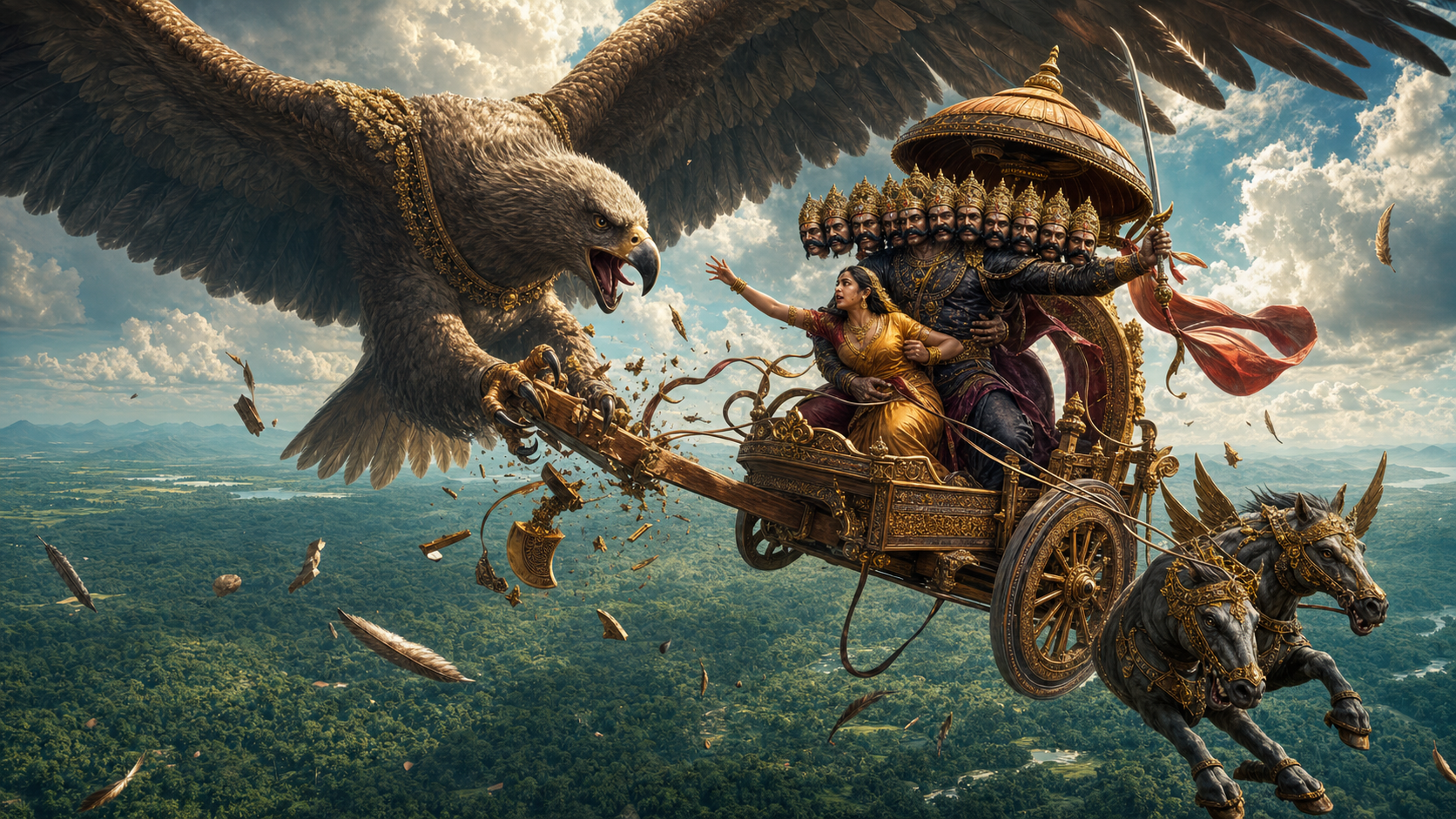
If you are trying to picture Sita’s abduction clearly, one question quickly becomes unavoidable: after Jatayu wrecked Ravana’s aerial conveyance, how did Ravana continue to Lanka? A common answer names the Pushpaka Vimana and assumes it remained available throughout the encounter. That is possible within some later tellings, but it is not the only reading, nor the safest one to impose on every Ramayana tradition.
The clearest way through the difficulty is to separate three things: what the Valmiki Ramayana’s narrative firmly establishes, what its vehicle terminology does and does not establish, and how South Indian traditions explain Ravana’s renewed flight. Once you make those distinctions, the apparent continuity problem disappears and the ethical purpose of the scene comes into sharper focus.
What the abduction sequence firmly establishes
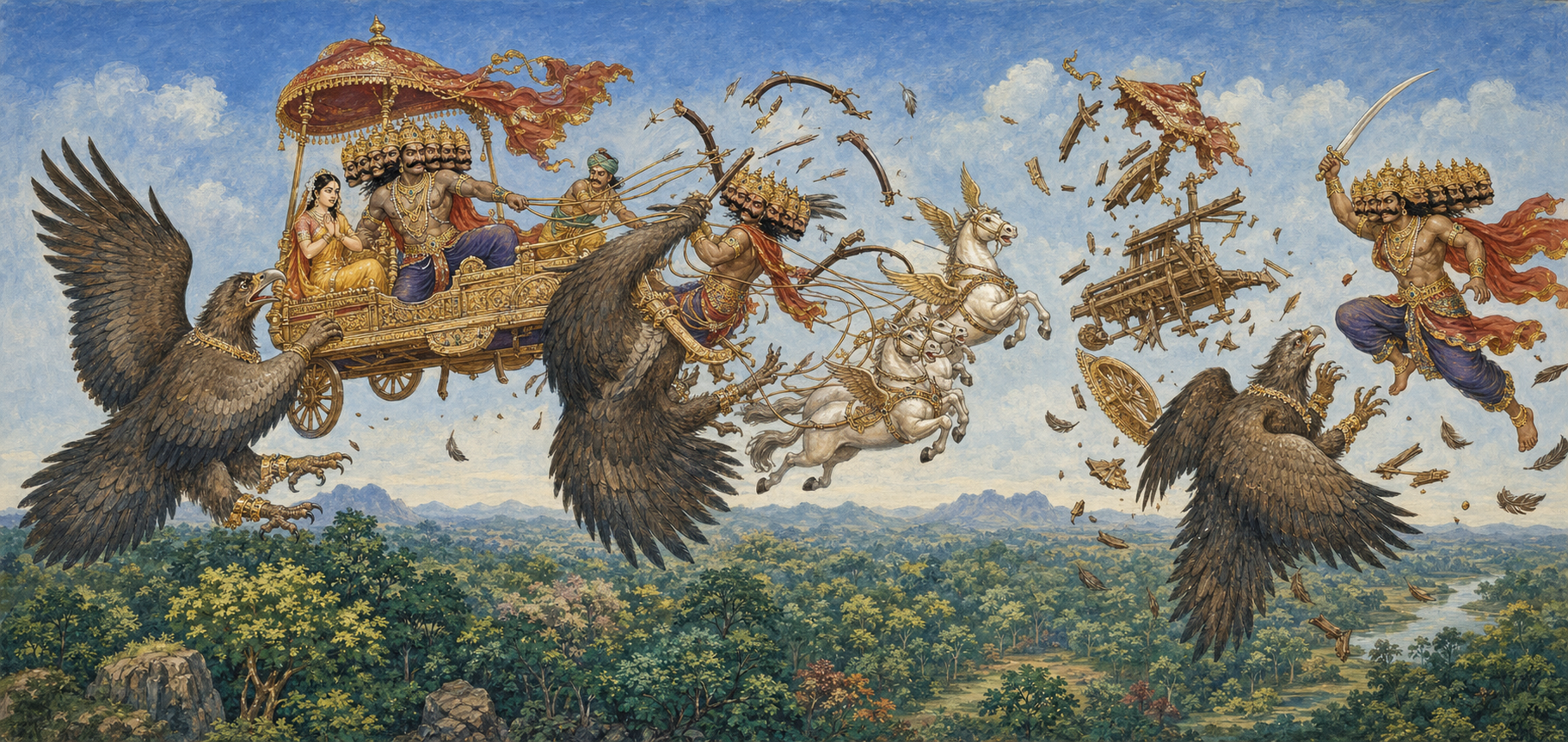
The encounter unfolds as a continuous contest between coercive power and protective duty. Rama and Lakshmana have been drawn away from Panchavati. Ravana, having approached Sita in the guise of a mendicant, seizes her and carries her away through the sky in an aerial chariot. Jatayu sees the crime in progress and intervenes despite his age and the overwhelming danger.
Keep the sequence in view, because it prevents several popular images from being mistaken for textual certainties:
- Ravana begins the escape with Sita in an air-going chariot.
- Jatayu intercepts him while the abduction is underway, not after Ravana has safely completed it.
- The vulture-king attacks both Ravana and the equipment enabling his escape.
- Ravana eventually uses his sword to sever Jatayu’s wings.
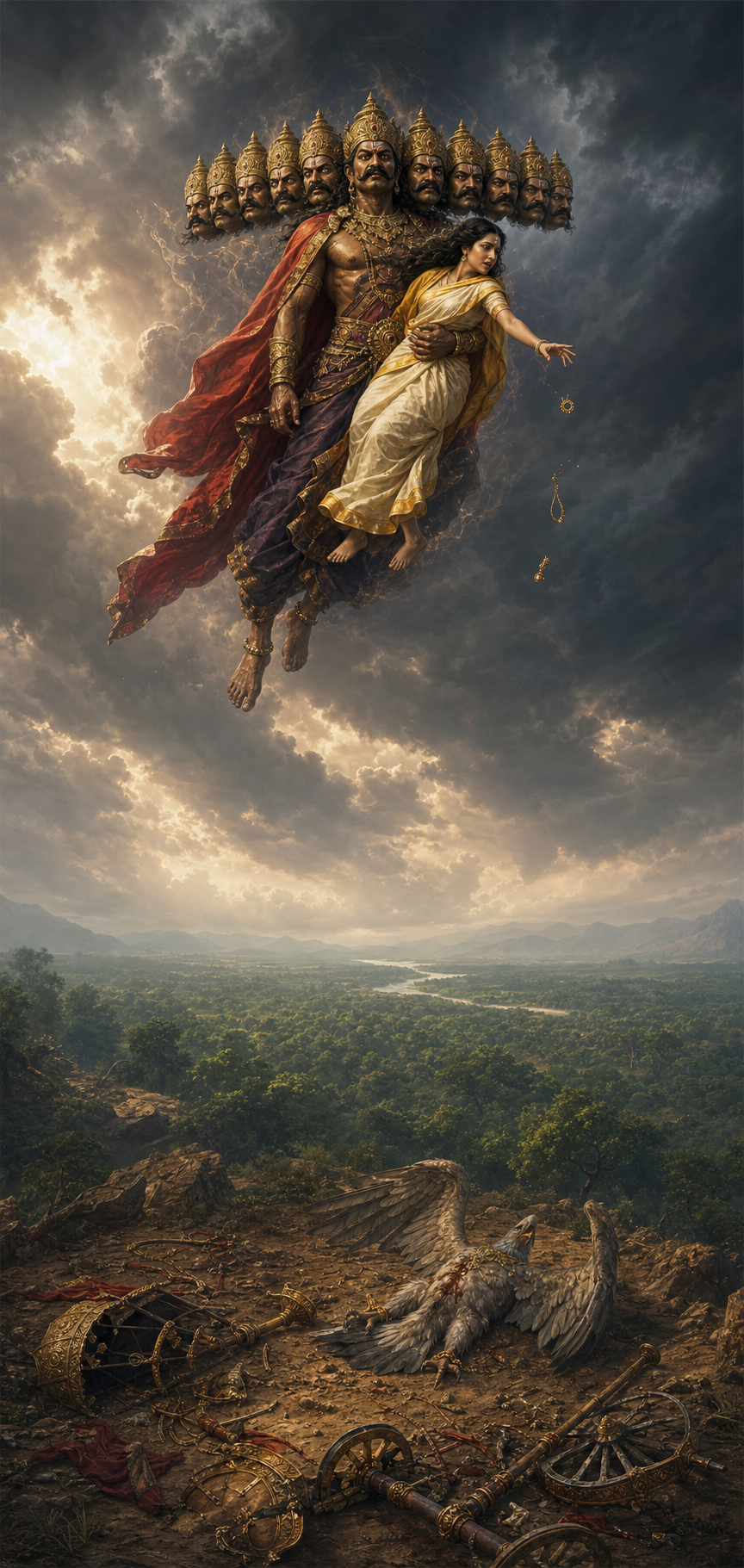
- After Jatayu falls, Ravana again rises into the sky with Sita and continues toward Lanka.
The damage inflicted during Jatayu’s assault is not a token gesture. He breaks Ravana’s bow, tears away the golden parasol, attacks the yoke and brings down the chariot’s ornaments. Some recensional readings also make the destruction more comprehensive by including the charioteer and draft animals. The details vary, but the dramatic point remains stable: Jatayu turns a seemingly effortless escape into a battle and seriously disrupts the mechanism of the abduction.
This is the first distinction to carry into any discussion of the episode. The destruction of a vehicle and the interruption of an abduction are not the same as the final rescue of the captive. Jatayu accomplishes the first two but cannot complete the third. Ravana’s escape therefore does not erase what Jatayu achieved.
The chariot question: ratha, vimana, and Pushpaka
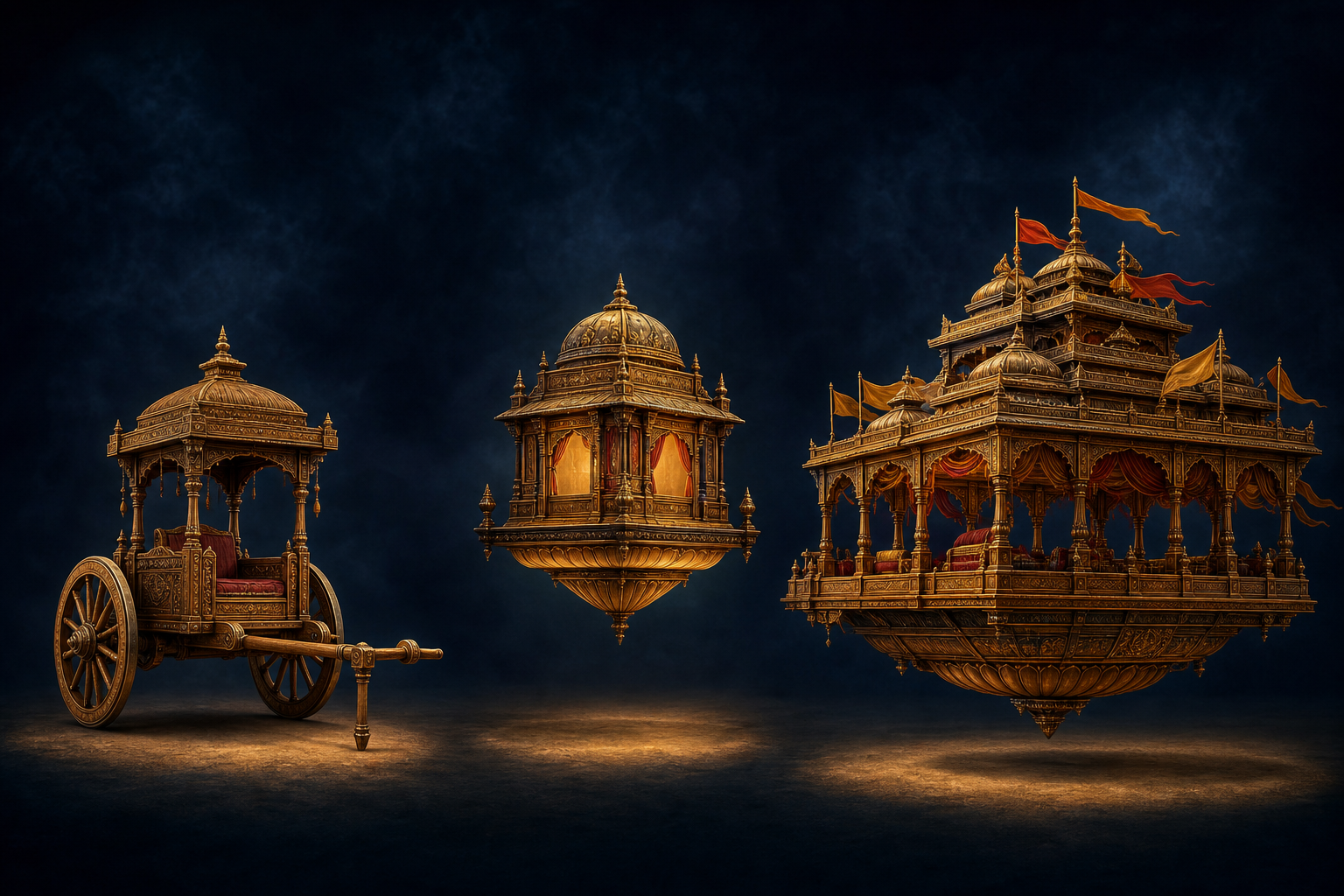
Was Ravana using the Pushpaka Vimana? The careful answer is that the Valmiki Ramayana’s abduction sequence does not require that identification. It presents an aerial ratha, or chariot, but does not unambiguously name that conveyance as Pushpaka. Pushpaka has a much clearer individual role later, when Rama returns to Ayodhya upon the divine craft associated with Kubera.
| Term | What it can mean here | What it does not prove by itself |
|---|---|---|
| Ratha | A chariot, including one described as moving through the air | That the vehicle must be Pushpaka |
| Vimana | An elevated structure, palace, shrine, or aerial conveyance, depending on context | That every aerial craft is a single named machine |
| Pushpaka | A distinct divine, flower-decked conveyance associated with Kubera and later used by Rama | That every episode involving Ravana’s flight necessarily features it |
These words do not map neatly onto modern categories such as aircraft model, vehicle class, and propulsion system. Epic Sanskrit allows semantic overlap: a ratha may be air-going, while a vimana may function as a celestial conveyance. Later recensions, translations, regional compositions and visual traditions can then identify the iconic Pushpaka with an earlier unnamed air-chariot. That is a natural development in a living epic tradition, but it remains an interpretive development.
You therefore do not need to choose between two equally rigid claims: either Pushpaka was certainly present, or every depiction of it in the abduction is somehow illegitimate. Use a more precise formulation. Say that Ravana departs in an aerial chariot in the Valmiki narration, while some later and regional tellings identify or visually merge that conveyance with Pushpaka. This preserves both textual accuracy and respect for the tradition’s many forms.
The same discipline helps when looking at temple panels, paintings or performances. An image can compress several remembered features into one recognizable symbol. Pushpaka may appear because audiences immediately associate it with Ravana and supernatural flight, not because the artist is making a philological claim about one Sanskrit noun.
How Ravana continues after Jatayu brings the vehicle down
The Valmiki narration has Ravana resume his movement through the sky after disabling Jatayu, but it does not insist in every reading that the damaged chariot has suddenly become serviceable again. That gap is where the South Indian motif of a grounded conveyance followed by supernatural flight becomes especially useful.
In the Kamba Ramayanam and allied regional and performance traditions, Jatayu’s attack can disable the conveyance so thoroughly that Ravana must abandon it. Ravana then relies on his own extraordinary capacity, carrying Sita onward through akasha-gamana, movement through the air. His maya-bala and powers gained through formidable tapas make such a feat coherent within the epic cosmos.
This explanation is not an attempt to repair the Ramayana with modern engineering. It belongs to the metaphysical vocabulary of the tradition itself. Yogic and Puranic discussions recognize siddhis that release movement from ordinary physical restrictions, including laghima, extraordinary lightness, and anima, minuteness. Ravana’s combination of tapas-derived potency, mastery of maya and moral corruption makes him a fitting example of power severed from dharma.
You can now read the continuation in two disciplined ways:
- In a reading where the aerial chariot remains usable or is restored to use, Ravana resumes the journey with it.
- In traditions where Jatayu has completely grounded the conveyance, Ravana substitutes personal supernatural power for the ruined vehicle.
Neither reading changes the event’s moral grammar. What changes is the means by which adharma continues. One version emphasizes Ravana’s access to an extraordinary conveyance; the other emphasizes his personal siddhi. The South Indian transition from disabled vehicle to akasha-gamana sharpens the contrast: righteous resistance can break the instrument of wrongdoing even when the wrongdoer’s misused power allows the crime to continue for a time.
Avoid translating this into claims about ancient aeronautical technology unless a passage actually requires such a reading. The scene works within a sacred narrative world where celestial vehicles and siddhis are distinct but compatible modes of flight. Forcing both into modern technological language makes the episode less precise, not more.
Why Jatayu’s apparent defeat is a dharmic victory
If victory means only the immediate recovery of Sita, Jatayu loses. The Ramayana asks you to use a more demanding measure. Jatayu sees a vulnerable person being carried away by a powerful aggressor and acts without waiting for favorable odds. He cannot guarantee success, but he refuses the moral safety of being a spectator.
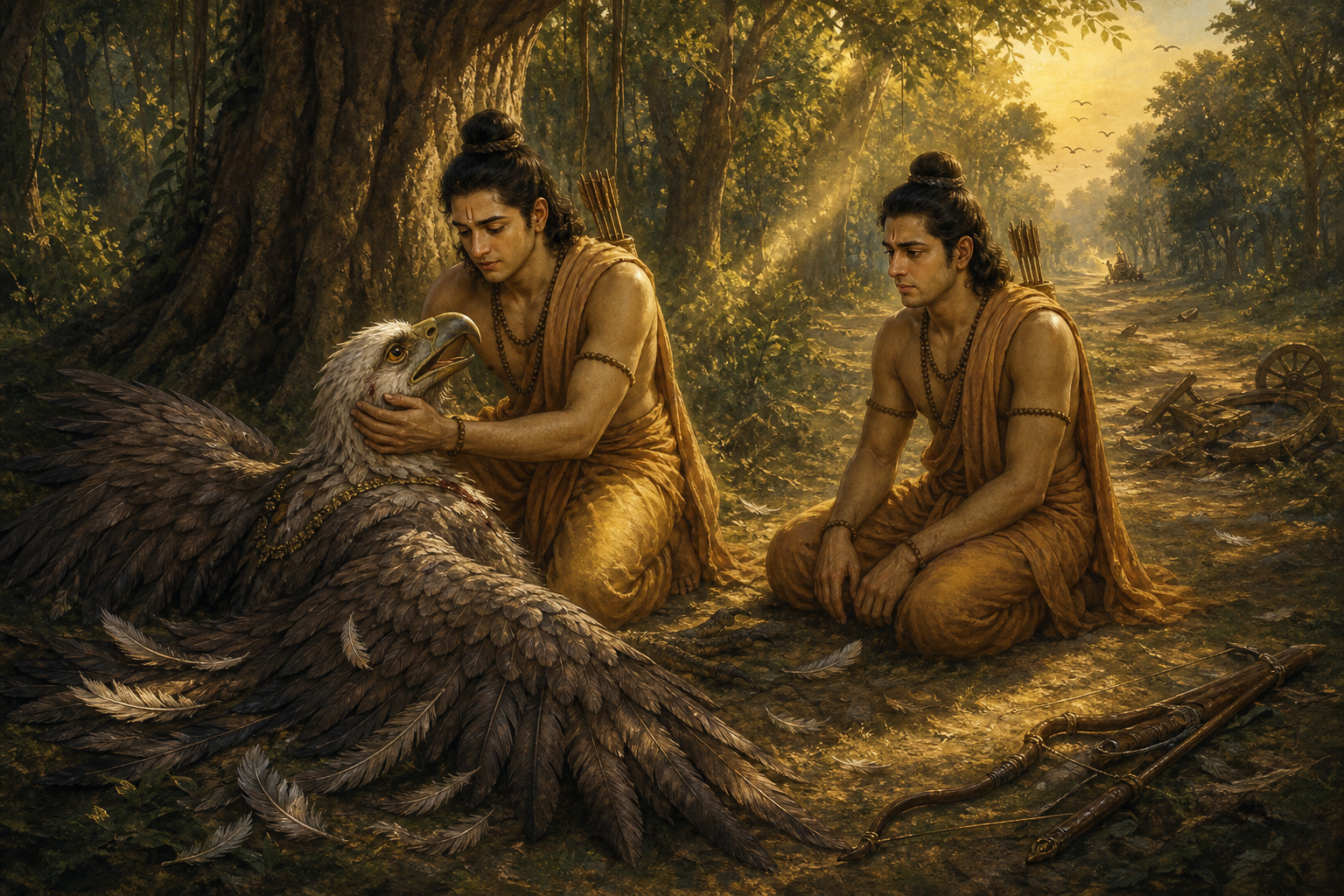
His intervention produces concrete consequences. It delays and challenges Ravana. It strips away the spectacle of unopposed power. It leaves a living witness on the route, enabling Rama to learn what occurred and where the search must turn. Jatayu’s body falls, but his testimony carries the pursuit of justice forward.
Sita also acts within the narrow possibilities available to her. As she is carried away, she drops ornaments and garments. The vanaras later recover these tokens and use them to reconstruct her passage. The trail from Panchavati toward the later search is therefore built from more than heroic combat: Jatayu leaves testimony, while Sita leaves evidence. Individual acts made under extreme constraint become the foundation for collective action in Kishkindha and, eventually, Hanuman’s mission in Sundara Kanda.
This gives you a practical way to recognize dharma in the episode. Look beyond the final outcome of each isolated moment. Ask whether an action protects the vulnerable, interrupts wrongdoing, preserves truth, or makes later justice possible. Jatayu’s stand does all four. His sacrifice is not valuable merely because it is emotionally moving; it changes what can happen next.
The episode can resonate across dharmic traditions without pretending that their doctrines are identical. A Jain reader may recognize fearlessness joined to the protection of life, rather than confusing ahimsa with passivity. A Buddhist reader may recognize compassionate intercession undertaken without concern for the self. A Sikh reader may recognize seva joined to righteous defense. In each case, power receives its moral worth from what it serves.
Ravana supplies the inverse lesson. Tapas, learning, maya and extraordinary capacities do not sanctify their possessor. When such powers serve coercion, they deepen culpability. Jatayu has less worldly power but acts in alignment with dharma; Ravana has immense power but subjects it to appetite and domination. The scene judges them by use, not possession.
Key takeaways
- Do not automatically call Ravana’s vehicle Pushpaka when discussing the Valmiki Ramayana. An aerial ratha is clear; the specific identification with Pushpaka is not.
- Do not assume that every retelling preserves identical mechanics. Some traditions keep the conveyance in the sequence, while South Indian tellings can have Ravana continue by maya or siddhi after Jatayu grounds it.
- Read akasha-gamana within the epic’s own metaphysics. It denotes supernatural aerial movement, not proof that every reference to flight describes modern-style technology.
- Judge Jatayu by what his intervention accomplishes, not only by whether he rescues Sita immediately. He interrupts Ravana, becomes a witness and helps direct the search.
- Notice Sita’s role in preserving a trace. Her scattered belongings later help the vanaras connect the abduction to the route toward Lanka.
- Keep the ethical contrast central: Jatayu spends limited strength to defend another, while Ravana misuses exceptional strength to violate another’s freedom.
When you next hear or retell this episode, identify the tradition you are using before settling the vehicle question. Then keep your attention on the detail every version preserves: Jatayu does not wait to know whether he can win. He acts because allowing adharma to pass unchallenged would already be a defeat.