
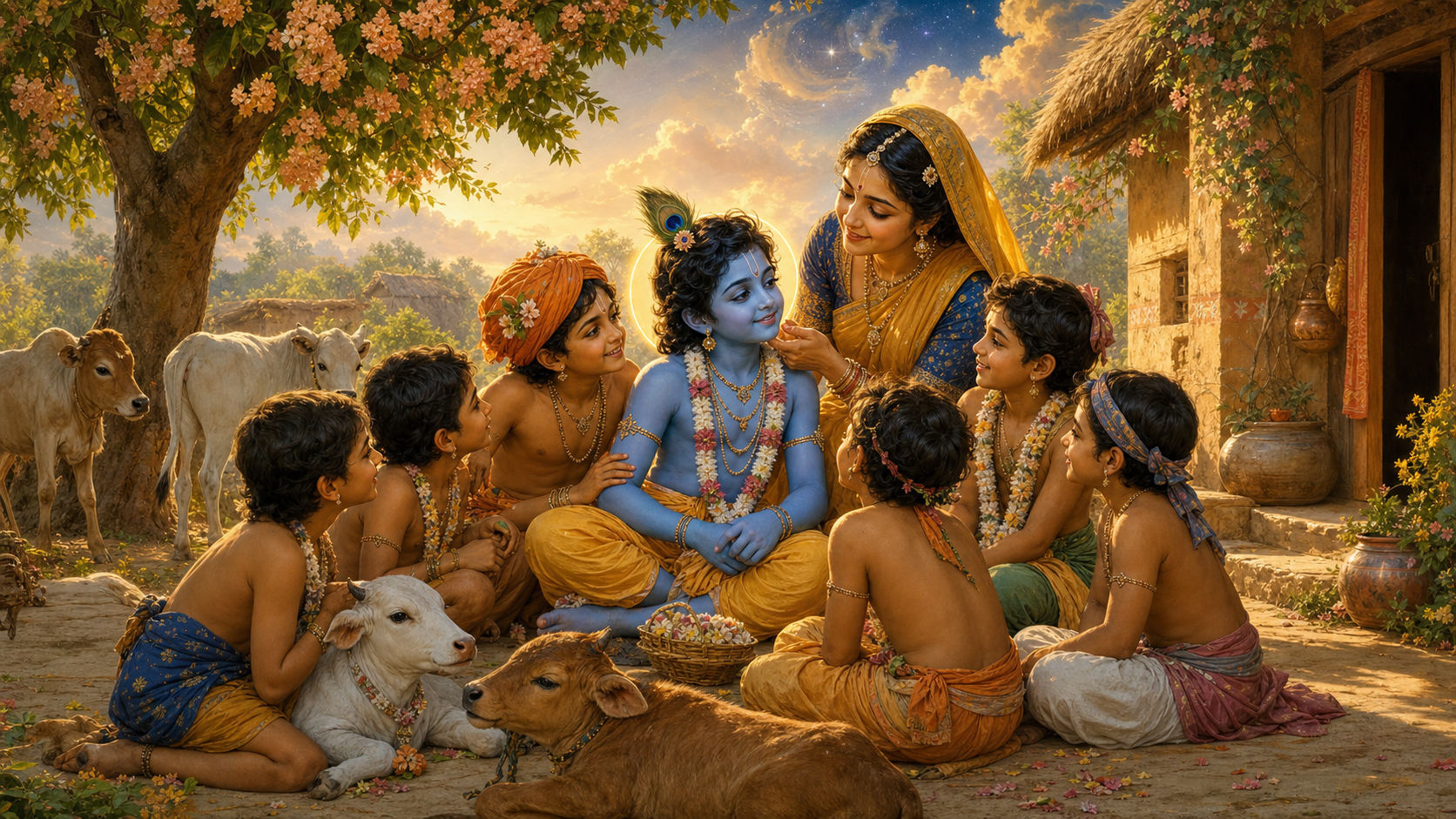
You may accept that Krishna is the Supreme while still wondering why Gaudiya Vaishnavas place His most informal relationships above displays of divine majesty. If God is unlimited, why should cowherd friends, affectionate parents and the residents of Vraja appear closer to Him than cosmic rulers and reverential worshippers?
The answer depends on two distinctions: majesty is not the same as intimacy, and divine love is not a created emotion added to God from outside. The movement from aiśvarya to mādhurya, and from the possessor of power to His śakti, reveals a coherent theology in which the Absolute can remain infinite while entering relationships of astonishing nearness.
Divine intimacy does not make Krishna less divine
Aiśvarya means divine majesty: awareness of God’s sovereignty, power and transcendence shapes the relationship. A worshipper knows that the Lord commands the cosmos, and that knowledge naturally produces reverence. Mādhurya means sweetness: Krishna’s supremacy remains real, but it recedes from the foreground so that friendship, parental affection and other intimate devotional relationships can flourish.
These are not two competing versions of God. The difference lies in what governs the devotee’s awareness. Before a king on his throne, even a loyal subject measures every word. At home with a trusted companion, the same king can be known through affection rather than office. Gaudiya theology presses this relational principle much further: Krishna’s complete divinity includes His freedom to be loved without His devotees continually calculating His status.
This is why familiarity in Vraja should not be confused with casualness. Casualness treats another person as unimportant. Vraja intimacy is the opposite: the devotee becomes so absorbed in Krishna’s happiness that awareness of His cosmic position no longer interrupts service. The Vrajavāsīs do not forget Krishna because they care too little. His grandeur becomes secondary because they care so completely.
The Govardhana and Brahmā-vimohana līlās provide two precise tests of this distinction. In Śrīmad-Bhāgavatam 10.25, Indra’s authority is humbled before Krishna’s effortless protection of Vraja. Power is not condemned; it is taught to serve. In Śrīmad-Bhāgavatam 10.13-14, Brahmā’s immense intelligence reaches its limit before Krishna’s exchanges with the cowherd boys. Knowledge is not discarded; it matures into wonder, humility and love.
You can apply the same test to your own spiritual life. If learning makes you impatient with less learned devotees, it has not yet followed Brahmā into wonder. If responsibility makes you expect recognition, it has not yet followed Indra into service. Knowledge and authority become spiritually fruitful when they reduce your need to stand above others.
Shakti explains how divine love belongs to the Absolute

The word śakti can be misunderstood in two opposite ways. One mistake treats divine energy as an impersonal force that the deity happens to control. The other imagines śakti and the possessor of śakti, the śaktimān, as two unrelated divine beings. Gaudiya acintya-bhedābheda holds both unity and distinction together: śakti is non-different from its possessor because it is God’s own power, yet it is genuinely distinguishable because divine existence, awareness, bliss and loving exchange have real functions and personal expressions.
Krishna’s internal energy, svarūpa-śakti, is described through three mutually related aspects. This map helps you see why intimacy is not a sentimental addition to theology:
| Aspect of svarūpa-śakti | Primary function | Question it answers |
|---|---|---|
| Sandhinī | Existence and support | How does divine reality abide and provide the ground of relationship? |
| Saṁvit | Cognition and awareness | How is divine reality known, and how is relationship understood? |
| Hlādinī | Bliss, love and beatitude | How does Krishna relish love and bestow spiritual joy? |
Hlādinī-śakti is therefore more precise than a general claim that God makes people happy. It is the internal potency through which Krishna experiences and gives ānanda. In its highest concentration as prema, hlādinī is personified as Śrī Rādhā. Rādhā is not merely a gifted devotee who acquires extraordinary love, nor an external supplement needed to complete a deficient deity. She is the personal fullness of Krishna’s own bliss and loving potency, simultaneously one with Him and distinct for the sake of relationship.
The familiar English rendering pleasure potency needs care. Here, pleasure does not mean sensory consumption, private gratification or indulgence. It names the bliss inherent in the Absolute and its overflow as loving reciprocation. A practical safeguard follows: if your use of the language of divine intimacy increases possessiveness, entitlement or appetite for emotional stimulation, you have reversed its meaning. Hlādinī moves toward giving, compassion and service.
At Caitanya-caritāmṛta Ādi 10.15, Gadādhara Paṇḍita is identified as an embodiment of Krishna’s hlādinī-śakti and as the fourth branch of the devotional wish-fulfilling tree. In Gaura-gaṇoddeśa-dīpikā 147-53, Vṛndāvaneśvarī, Śrī Rādhā, is identified with Gadādhara in Gaura-līlā. The continuity matters: the love active in Krishna’s Vraja pastimes appears within Caitanya’s community as tenderness, scriptural service and self-effacing devotion.
The fivefold structure of the Pañca-tattva makes the same point from another angle. Śrī Krishna Caitanya is Bhagavān; Nityānanda Prabhu is His first expansion; Advaita Ācārya is Viṣṇu-tattva and calls for the divine descent; Gadādhara embodies śakti; and Śrīvāsa represents the devotee. Divine grace enters history through a community of relationship, not through a solitary display of power.
Gadādhara’s conduct shows what this means without abstraction. Remembered as Caitanya’s childhood associate in Navadvīpa, he later remained in Jagannātha Purī under kṣetra-sannyāsa, served Toṭā-Gopīnātha and regularly recited Śrīmad-Bhāgavatam to Caitanya. His pattern is quiet but demanding: remain steady, serve a particular sacred responsibility, and let learning become an offering. If you want to recognise a life shaped by hlādinī, look first for fidelity and care, not dramatic emotional display.
Why devotion flows toward Gokula without belittling other paths

In Bṛhad-bhāgavatāmṛta 1.2.37-49, Sanātana Gosvāmī leads the seeker through increasingly intimate forms of devotion. Cosmic administrators, sages and heroic servants are genuinely honoured. Yet the movement continues toward Vraja, where loving service is least constrained by formal awareness of Krishna’s majesty. The hierarchy measures intimacy, not the worth of persons.
That qualification prevents a common sectarian error. Hanumān’s service does not become defective because the cowherd boys relate to Krishna differently. Devotion under majestic awareness is not false because Vraja reveals another degree of nearness. Each devotee can be perfect within a particular rasa, while a seeker drawn to Vraja may still recognise a progression toward greater relational immediacy.
The image of rivers meeting the ocean is useful here. Distinct rivers carry real water and follow real courses; reaching the ocean does not make their journeys fraudulent. In the same way, knowledge, disciplined reverence, heroic loyalty and humble service are authentic devotional excellences. The ocean of Gokula represents their fulfilment in sweetness-centred love, where service is no longer governed by distance from the Divine.
Gokula and Goloka should also be distinguished. Gokula names Krishna’s Vraja-līlā as manifest within the world, while Goloka names its eternal transcendental locus beyond the Vaikuṇṭha realms. They are not unrelated destinations. The manifest līlā reveals the same essential intimacy that belongs eternally to Goloka.
This helps clarify rāgānugā-bhakti. It is not permission to manufacture emotion or imitate the outward behaviour of perfected associates. It is devotion guided by attraction to the exemplary moods of Krishna’s Vraja companions. The operative word is guided. Attraction must be carried by hearing, remembrance, disciplined conduct and service; otherwise, the vocabulary of intimacy can become a disguise for spiritual ambition.
You can detect that ambition by the comparisons it produces. If studying Vraja-bhakti makes you dismiss devotees drawn to reverence, other Vaiṣṇava relationships or other dharmic disciplines, you have turned an ascent of intimacy into a contest of status. Sanātana Gosvāmī’s method first teaches reverence for each genuine devotional excellence and only then directs the heart toward Vraja. Gratitude is part of the route, not an optional courtesy.
This posture also creates room for serious dharmic dialogue. Buddhist karuṇā and maitrī, Jain ahiṁsā and aparigraha, and Sikh sevā and prem-bhakti are not interchangeable with Gaudiya rasa theology. They do, however, offer recognisable disciplines of compassion, non-possessiveness, service and love. You can honour those resonances without erasing doctrinal differences. Gaudiya conviction becomes more credible, not less, when it produces careful listening and generous conduct.
Turn the theology into a disciplined practice of nearness

The practical question is not whether you can reproduce the Vrajavāsīs’ perfected love. You cannot manufacture spontaneous devotion by declaring yourself advanced. The useful question is whether your present practice is removing the habits that obstruct intimacy: pride, possessiveness, the need for recognition and the tendency to treat sacred knowledge as personal property.
- Hear within a defined līlā. Choose a specific passage rather than an undefined devotional theme. Śrīmad-Bhāgavatam 10.25 is suited to examining power, shelter and humility; chapters 10.13-14 are suited to examining intellect, bewilderment and wonder. Note what Krishna reveals, what the devotee or deva initially assumes, and what changes in the relationship.
- Chant to train attention. During japa or kīrtana, notice the moment your attention turns toward performance, comparison or how others perceive you. Return to the Holy Name without dramatizing the lapse. The repeated return is itself a practice of surrendering control.
- Remember relationally. In smaraṇa, ask who is serving, who is receiving care, and how Krishna’s majesty recedes without disappearing. This keeps remembrance anchored in relationship instead of turning it into decorative imagination.
- Give the contemplation an ethical consequence. Perform one concrete service that does not enhance your visibility: clean a shared space, help someone complete an unnoticed task, listen without displaying your learning, or protect another person’s dignity. Divine intimacy that never alters conduct remains an idea.
- Approach rāgānugā language with guidance. Learn the distinctions among aiśvarya, mādhurya, rasa and śakti before making claims about your own inner attainment. Let attraction deepen practice rather than confer an identity or rank.
A five-question audit for your practice
Review these questions periodically. They are more revealing than asking whether a particular session felt elevated:
- Is your responsibility becoming service, as Indra’s authority had to become?
- Is your learning producing wonder and humility, as Brahmā’s certainty had to do?
- Are you becoming steadier in ordinary commitments, as Gadādhara’s life at Toṭā-Gopīnātha demonstrates?
- Does your attraction to intimacy increase respect for devotees in other rasas and stages?
- Are hearing, chanting and remembrance making you less possessive of attention, status and spiritual experience?
If several answers are no, the remedy is not a more esoteric vocabulary. Return to śravaṇa, kīrtana, smaraṇa and unadvertised sevā. Gaudiya theology locates the summit in intimacy, but it trains the climber through humility.
Key takeaways
- Aiśvarya and mādhurya describe different governing awareness within devotion: majesty remains present in Vraja, but it no longer creates relational distance.
- Śakti is neither an impersonal force nor a second, unrelated Absolute. Acintya-bhedābheda preserves real unity and real distinction between potency and its possessor.
- Hlādinī-śakti is Krishna’s own potency of bliss and love; its fullest personal manifestation as prema is Śrī Rādhā.
- Gadādhara Paṇḍita reveals hlādinī in Gaura-līlā through tenderness, scriptural service, constancy and self-effacement.
- Gokula stands at the summit because of intimacy, not because other devotees or rasas lack dignity.
- The safest evidence of growing intimacy is not emotional display but deeper humility, steadier service and less need for recognition.
For your next period of practice, take one līlā, one form of hearing or chanting, and one unnoticed act of service. Keep them connected. That is a modest but trustworthy way to let knowledge move toward relationship and relationship mature into sevā.
References
- Dandavats — Why All Rivers of Bhakti Flow to Gokula: Insights on Brihad Bhagavatamrita 1.2.37-49
- Dandavats — Gadādhara Paṇḍita as Hlādinī-Śakti: Unveiling CC Ādi 10.15 and Gaura-gaṇoddeśa-dīpikā