
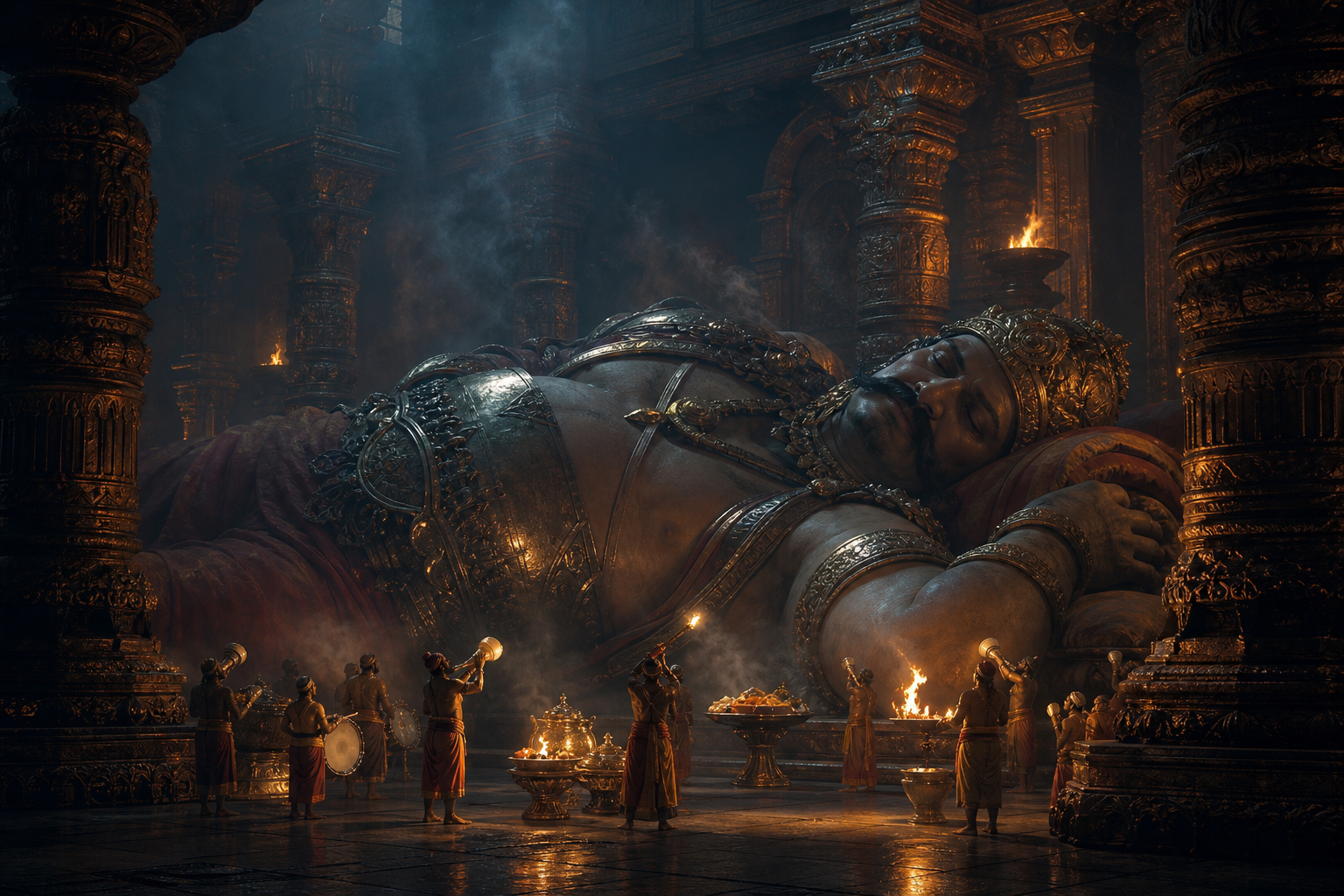
You have probably heard that Kumbhakarna slept for six months, woke for a day, ate an enormous meal, and then returned to sleep. If you have gone looking for that exact timetable in a critical reading of the Valmiki Ramayana, however, you may have wondered why the familiar rule is so difficult to locate.
The reliable answer is layered. The six-month cycle is firmly established in popular Ramayana memory, but the older Sanskrit epic is more definite about the enormity of Kumbhakarna’s sleep than about its precise calendar. Knowing that distinction lets you respect both scripture and living tradition without forcing either one to say more than it does.
The short answer: folklore gives a rule, scripture gives a condition
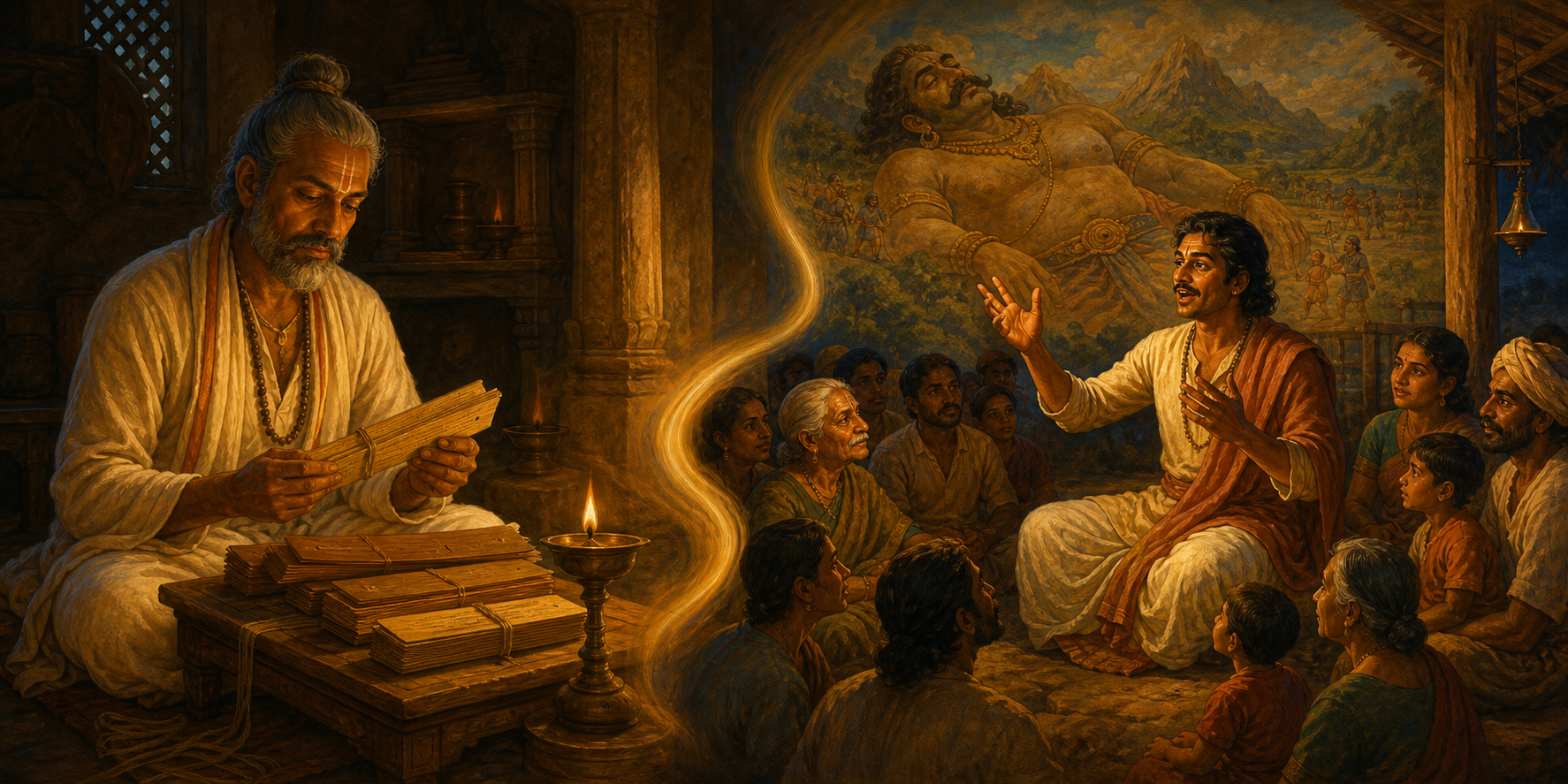
If someone asks whether Kumbhakarna sleeps for six months in the Ramayana tradition, the answer is yes. That is the standard formula in many oral kathas, Ramlila performances, vernacular retellings, and popular explanations. If the narrower question is whether the oldest critical form of the Valmiki Ramayana unambiguously prescribes a recurring six-month sleep, the careful answer is no. The Yuddha Kanda establishes an extraordinary, prolonged torpor but does not securely reduce it to the neat schedule most people remember.
Key takeaways
- The six-month sleep is a legitimate and deeply rooted feature of popular Ramayana tradition.
- The Valmiki Ramayana emphasizes mahanidra, or great sleep, prolonged duration, and the immense effort needed to wake Kumbhakarna; its critical textual baseline does not make the familiar six-month cycle equally explicit.
- The story in which Sarasvati disrupts Kumbhakarna’s request for Indra’s throne is best identified as a later explanatory tradition, not automatically presented as Valmiki’s version.
- The central teaching is not about counting months. It is about strength trapped by inertia, appetite, misplaced loyalty, and action without dharmic direction.
This is not a choice between a true Ramayana and a false one. It is a distinction between an epic’s textual core and the memorable forms through which communities have performed, taught, and interpreted that epic for centuries.
What the Yuddha Kanda actually makes certain
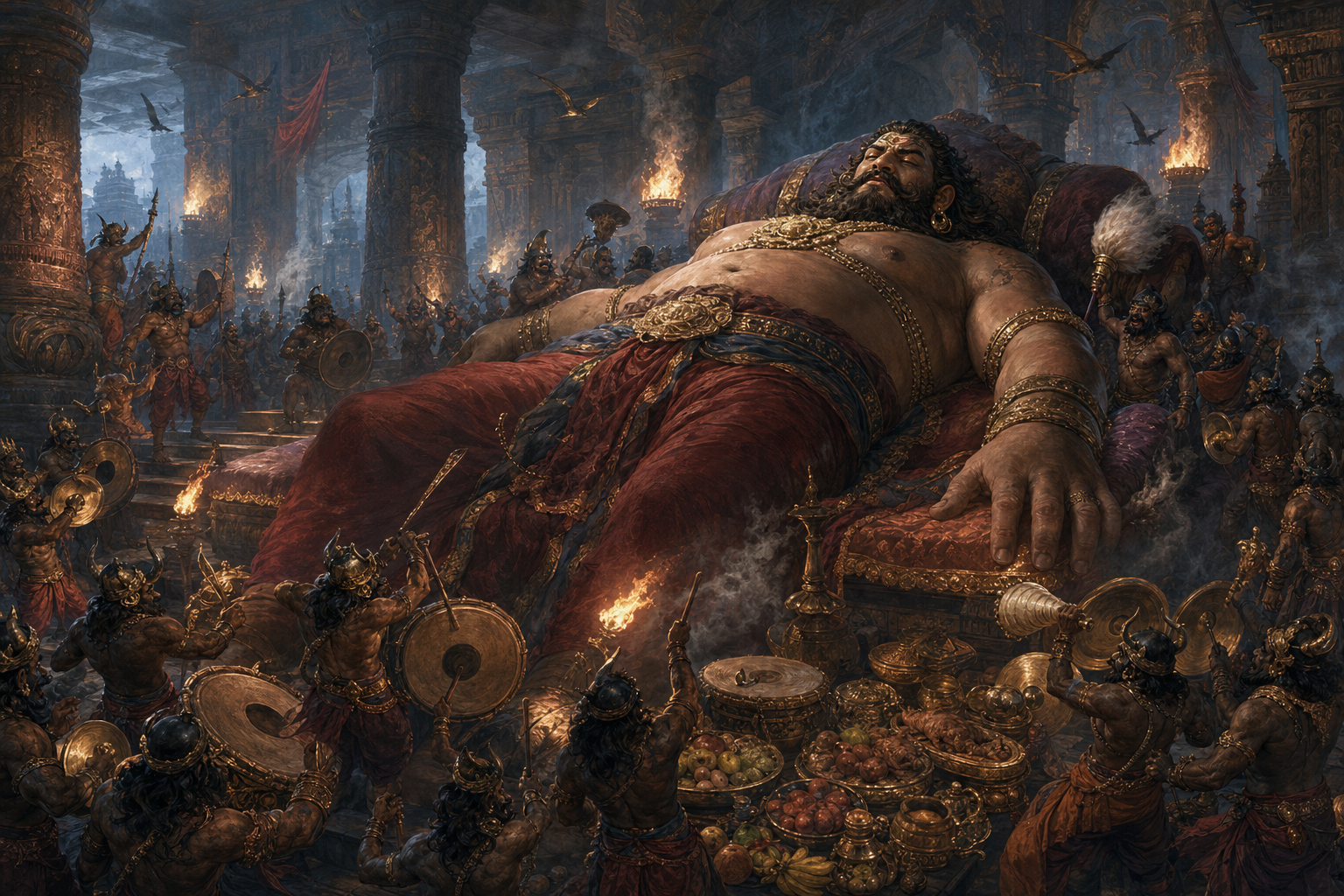
The Valmiki Ramayana makes Kumbhakarna’s sleep unmistakably abnormal. Its language includes mahanidra, great sleep, and expressions of extended duration such as dirgha-kala, along with formulations comparable to many months. The secure point is magnitude: this is no ordinary rest and no minor character detail. It is a condition powerful enough to remove one of Lanka’s greatest warriors from ordinary life.
The awakening scene supplies the practical measure of that condition. Lanka’s forces use drums, shouting, goads, animals, incantations, food, and drink to penetrate his torpor. The spectacle matters more than a clock would. A being of terrifying physical power has become almost unreachable, even to the kingdom that desperately needs him.
Three different questions are often collapsed into one. How profound is the sleep? How long does each period last? Why was the sleep imposed? Valmiki gives abundant narrative evidence for the first question. The critical textual baseline is less decisive about the exact arithmetic of the second. Later tellings offer a more elaborate and memorable answer to the third.
Edition also matters. Northern, Southern, and Western Sanskrit recensions contain smaller variations in the Lanka war material, while a critical edition reduces repetition and excludes passages judged to be later additions. A detail familiar from performance may therefore be absent from a scholarly Sanskrit edition without being invented in modern times. Its absence identifies a different layer of transmission; it does not erase the tradition that preserved it.
When you encounter a confident textual claim, check whether the speaker has identified a recension, edition, translation, or regional retelling. If no version is named, do not let the precision of the claim create an illusion of precision in the evidence.
How six months and the misunderstood boon entered public memory
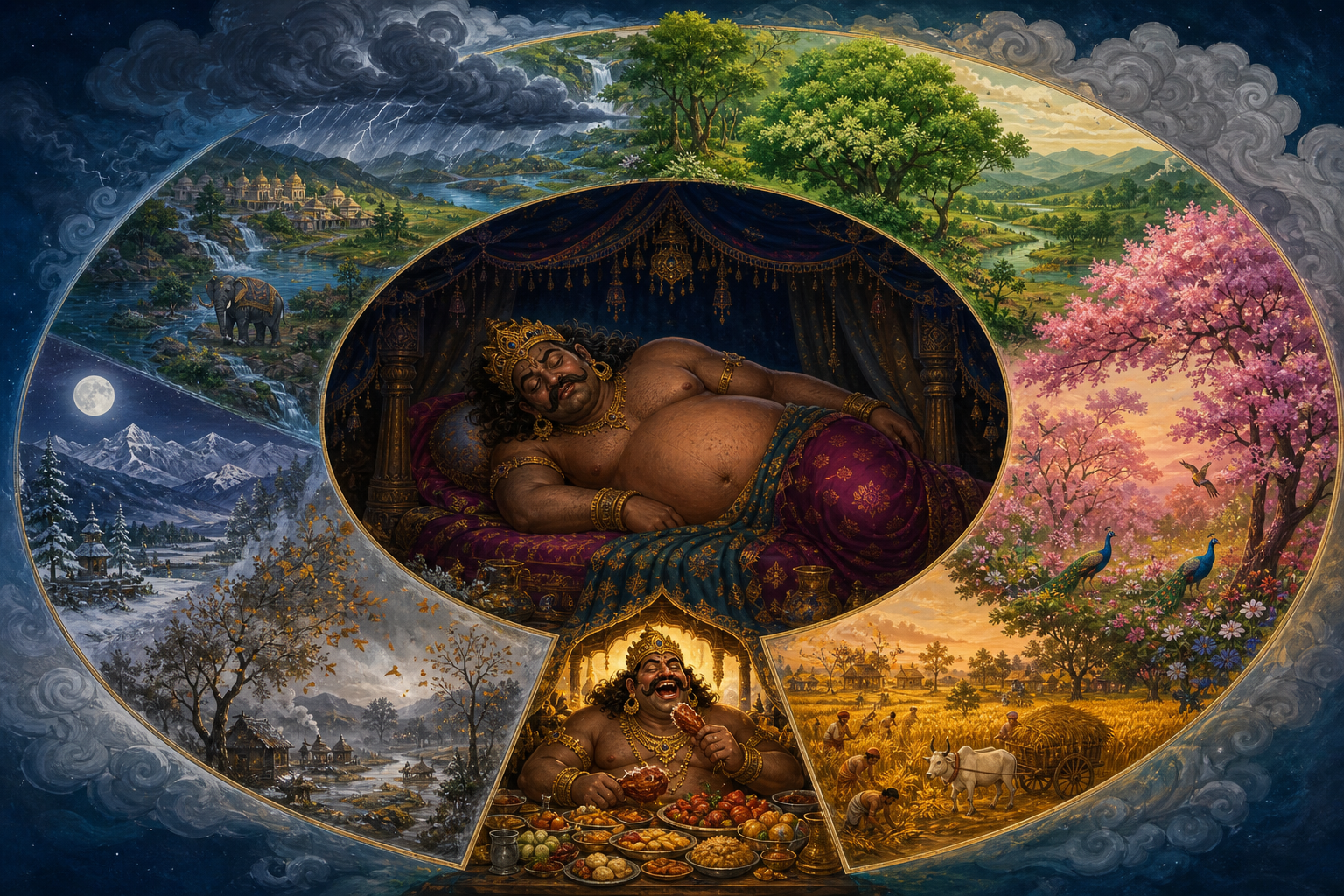
Popular tradition turns Kumbhakarna’s indefinite enormity into an unforgettable rhythm: six months asleep, followed by a very short interval of wakefulness. A common North Indian oral formula narrows that waking interval to a day. The number makes the character immediately intelligible to a listener. His entire existence has been swallowed by sleep, with only a sliver left for hunger, duty, and war.
The accompanying boon story explains how this could happen. Kumbhakarna approaches Brahma seeking a boon associated with Indra’s throne, Indrasana. The devas fear what such power would mean. Sarasvati confounds his speech, and the intended request emerges as one for nidra, sleep. Vibhishana then intercedes, and the devastating result is mitigated into recurring long periods of torpor. In many popular versions, those periods become the familiar six months.
The Indrasana-Nidra wordplay is memorable because it joins sound, intention, and consequence. It can teach that desire without restraint is dangerous and that speech without clarity may turn an ambition against the person who holds it. But you should not quietly insert the episode into Valmiki’s account when discussing the older epic. Introduce it as a later katha or popular explanatory tradition unless the particular edition in front of you contains it.
Six months also fits the Indian imagination unusually well. The ritual and solar year can be experienced through the two half-year arcs of Uttarayana and Dakshinayana, while the traditional calendar recognizes six seasons. A half-year sleeper therefore belongs naturally within a culture already accustomed to thinking in sixfold and half-year rhythms. This symbolic fit does not by itself prove when or where the number originated. It does explain why storytellers, teachers, and audiences could remember and transmit it so easily.
Regional practice never became completely uniform. Some South Indian performances prefer an immense stretch of months without insisting on exact arithmetic. Bengali and Odia kirtan traditions may emphasize that only a catastrophe or royal emergency can wake him. Kampaṉ’s Iramavataram and Krittivasa Ojha’s Bengali Ramayana intensify character and drama around the episode, while performance traditions sharpen whichever detail will work most clearly before an audience. In each case, excess is the stable idea; the number is its mnemonic form.
You can therefore choose your wording according to the claim you intend to make. For a family or devotional retelling, say that popular Ramayana tradition remembers Kumbhakarna as sleeping for six months. For textual discussion, say that the Valmiki Ramayana portrays him in a profound, prolonged mahanidra without an equally unambiguous six-month rule in its critical baseline. For interpretation, say that the half-year rhythm can be read as a cosmic image of overwhelming tamas. Each statement is accurate within its proper frame.
Why Kumbhakarna is more than a joke about oversleeping
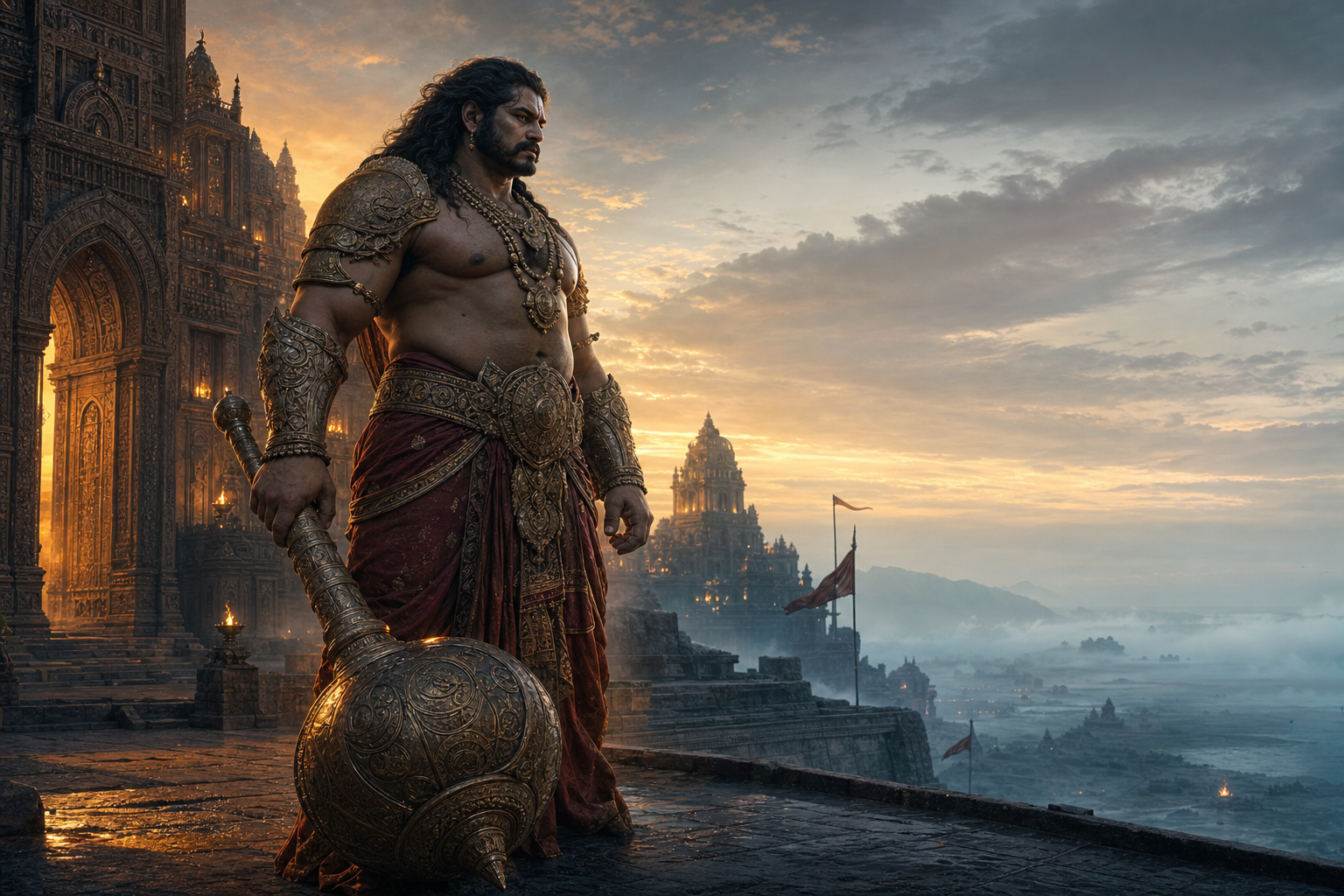
The comic surface is difficult to miss: a giant must be awakened with near-cataclysmic noise, then fed on a colossal scale before he can function. Yet reducing Kumbhakarna to a lazy glutton discards the tragedy that gives the episode its moral force. He possesses strength, courage, loyalty, and, in several tellings, moments of striking discernment. His failure is not a total absence of good qualities. It is his inability to bring those qualities under dharma.
A traditional guna-based reading places the three brothers of Lanka along a revealing spectrum. Vibhishana approaches sattva, the clarity that recognizes dharma and acts on it. Ravana manifests rajas, the restless ambition to possess, dominate, and conquer. Kumbhakarna dramatizes tamas, the obscurity of inertia, appetite, and stupefaction. This is a teaching lens rather than a claim that every action of each brother expresses only one guna.
Kumbhakarna’s brief awakening is especially important. Physical wakefulness does not become moral awakening. Once roused, his immense energy takes on a rajasic form: he eats, arms himself, and charges into battle. But that energy remains directed by the tamasic structure of his life and by loyalty to Ravana’s adharma. His courage makes him formidable; it does not make his cause righteous.
This is why the episode reaches beyond a warning against excessive sleep. You can be intelligent enough to recognize a disastrous course, loyal enough to accept sacrifice, and strong enough to act decisively, yet still serve the wrong end. Awakening without ethical reorientation merely gives greater force to the habits that already govern you.
The same pattern has recognizable, though not identical, parallels across Dharmic traditions. Buddhism treats thina-middha, sloth and torpor, as a hindrance to liberation. Jain teaching warns against pramada, negligence that interrupts right conduct, and against surrender to appetite. Sikh gurmat answers worldly inertia with truthful living, discipline, and simran. These are distinct doctrinal frameworks, not interchangeable labels, but all reject the condition in which awareness is repeatedly surrendered to heedlessness.
For personal reflection, the useful questions are sharper than asking whether you sleep too much:
- What duty do you already understand but keep postponing?
- Which appetite, comfort, or resentment consumes time that should be directed toward dharma?
- Where has loyalty become an excuse to support conduct you know is wrong?
- When energy finally arrives, does it serve a clear purpose or merely intensify an old habit?
Those questions preserve Kumbhakarna’s full warning. Tamas is dangerous not only when it leaves a person inactive. It is also dangerous when a sudden burst of action remains governed by an unexamined attachment.
How to teach the story without flattening the tradition
Kumbhakarna’s sleep offers a practical test of how responsibly we handle a living epic. Use this sequence when you explain the episode to children, students, a study group, or an online audience:
- Name the layer. Say whether you mean the Valmiki Ramayana, a critical edition, a regional epic, a Ramlila convention, or popular oral memory.
- Match the certainty of your wording to the evidence. Use six months confidently for the widespread folk convention. Use prolonged or great sleep when describing what the critical Sanskrit baseline establishes most securely.
- Separate duration from cause. The fixed timetable and the Sarasvati speech-confusion story answer different questions and need not come from the same textual layer.
- Label interpretation as interpretation. The guna framework and half-year symbolism illuminate the episode, but they should not be presented as though every element were an explicit statement in the epic narrative.
- Preserve Kumbhakarna’s moral tension. Mention his discernment, loyalty, and courage as well as his inertia and appetite. The character is instructive precisely because admirable capacities remain captive to an adharmic allegiance.
This approach avoids two common errors. One is to repeat a beloved popular detail as though every Sanskrit edition must contain it. The other is to dismiss folklore as corruption merely because it makes an implicit idea concrete. The Ramayana tradition has always lived through recitation, commentary, translation, theatre, devotion, and local memory as well as manuscripts. Careful reading distinguishes those forms without treating them as enemies.
The next time you hear that Kumbhakarna slept for six months, do not answer with a flat correction or an unqualified confirmation. Ask what kind of claim is being made. Use six months to identify the powerful folk memory, mahanidra to describe Valmiki’s secure emphasis, and the character’s final choice to confront the question that matters most: once strength awakens, will it serve dharma?