
You may recognize the wings and beak of Garuda yet still be unsure what a particular image is asking you to see. Is he carrying Vishnu, guarding sacred space, defeating a serpent, offering devotion, or representing royal authority? The answer rarely lies in one feature alone.
Use three questions in order: Whom is Garuda related to in the composition? What is his body doing? Where is the image placed? That sequence will help you read Garuda as a coherent expression of dharma rather than as a collection of exotic attributes.
Begin with Garuda’s role, not the number of his arms
Garuda can appear fierce, reverent, airborne, enthroned beneath Vishnu, or victorious over a serpent. These are not competing identities. They express different aspects of one relationship: immense power placed in the service of divine order.
His foundational identity is that of Vishnu’s vahana and foremost devotee. The Sanskrit term vahana is commonly translated as vehicle or mount, but the iconography conveys more than transportation. Garuda bears Vishnu’s presence into action. Speed, strength, vigilance, and flight become instruments of protection rather than displays of independent force.
| Configuration | What to notice | Primary meaning |
|---|---|---|
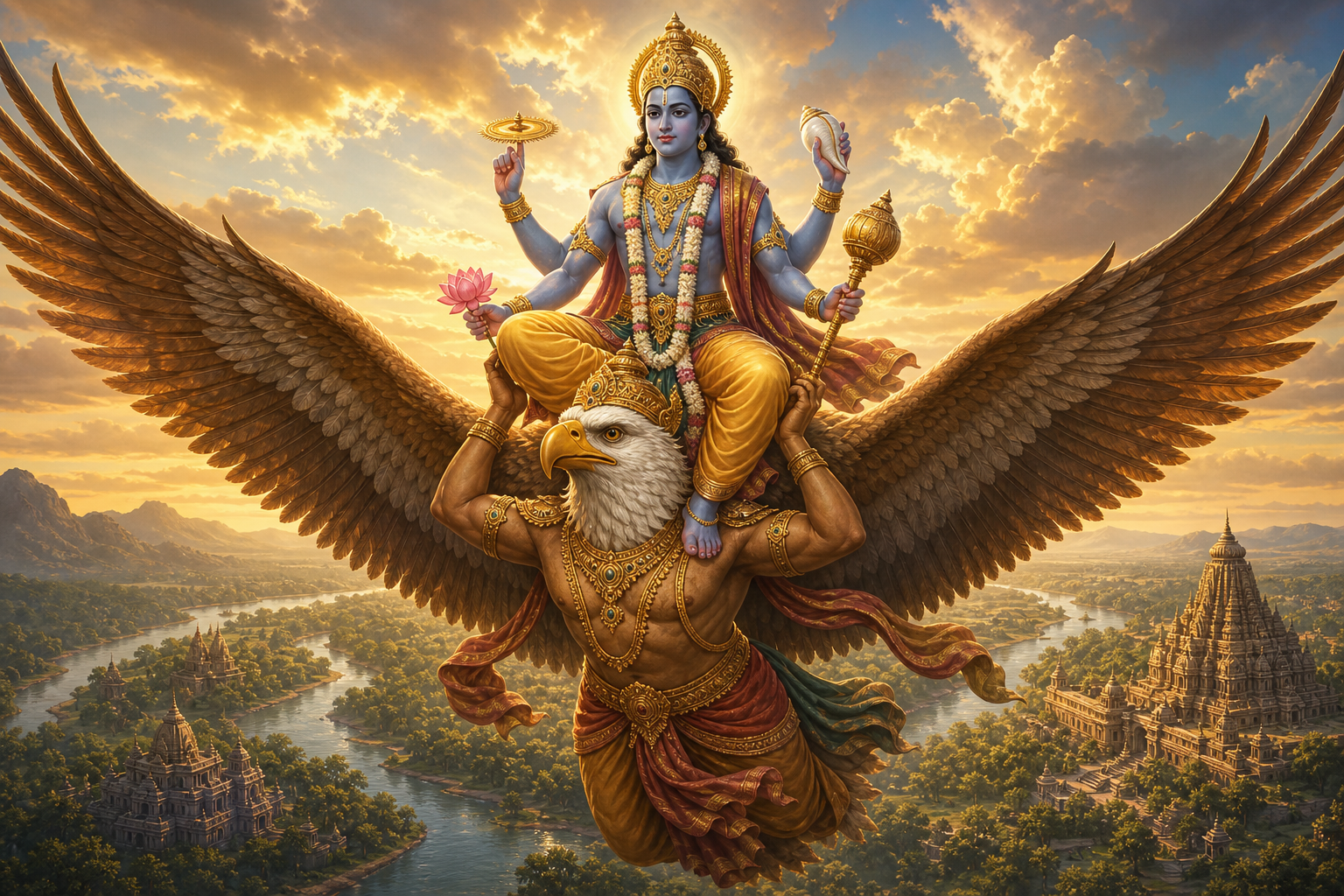
| Garuda bearing Vishnu | Vishnu is seated or standing above him; the wings and body suggest ascent, arrival, or forward movement | Divine purpose carried swiftly into the world |
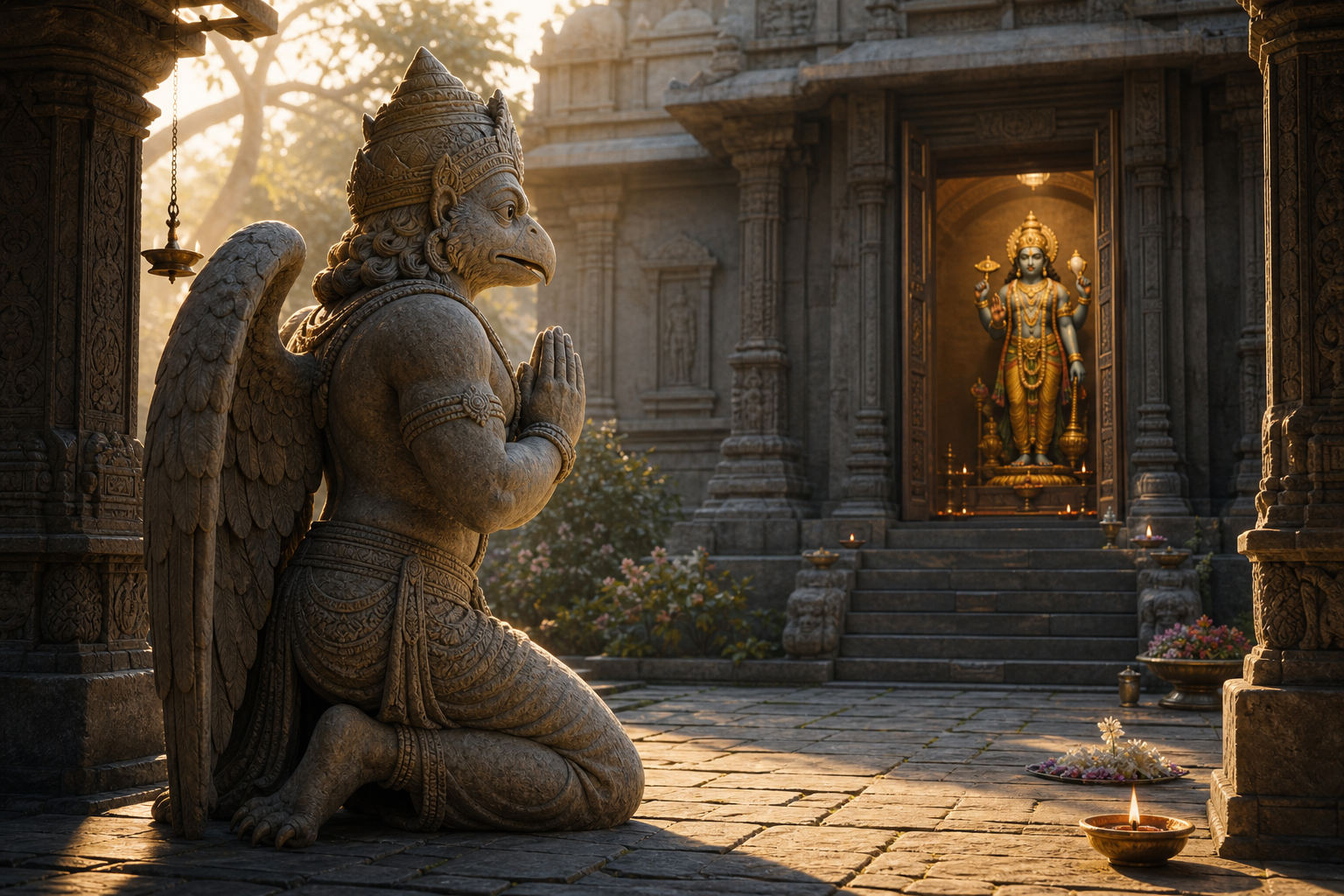
| Kneeling Garuda | Hands are joined in anjali mudra, wings are folded, and the figure faces the sanctum | Devotion, disciplined strength, and attentive service |
| Garuda with a subdued serpent | A serpent is held, restrained, or placed beneath his feet | Mastery over poison, fear, bondage, and obstructive force |
| Soaring or alighting Garuda | Wings open broadly while the torso and limbs create directional tension | Readiness, protection, and purposeful intervention |
This role-first method prevents a common mistake. A two-armed Garuda is not necessarily less developed than a four-armed one, and a kneeling Garuda is not less powerful than a flying one. Arm configurations vary across textual schools, periods, and regional practices. Begin with the relationship expressed by the whole composition; examine the arms only after you know what Garuda is doing.
The narrative background explains why service and liberation remain inseparable in his imagery. Garuda is born of Kashyapa and Vinata, while the Nagas belong to the lineage of Kadru. His rivalry with the serpent beings and his connection with amrita establish the symbolic vocabulary later artists use: the bird who rises, liberates, carries the deathless substance, and overcomes venomous constraint.
Read the body as a grammar of disciplined power
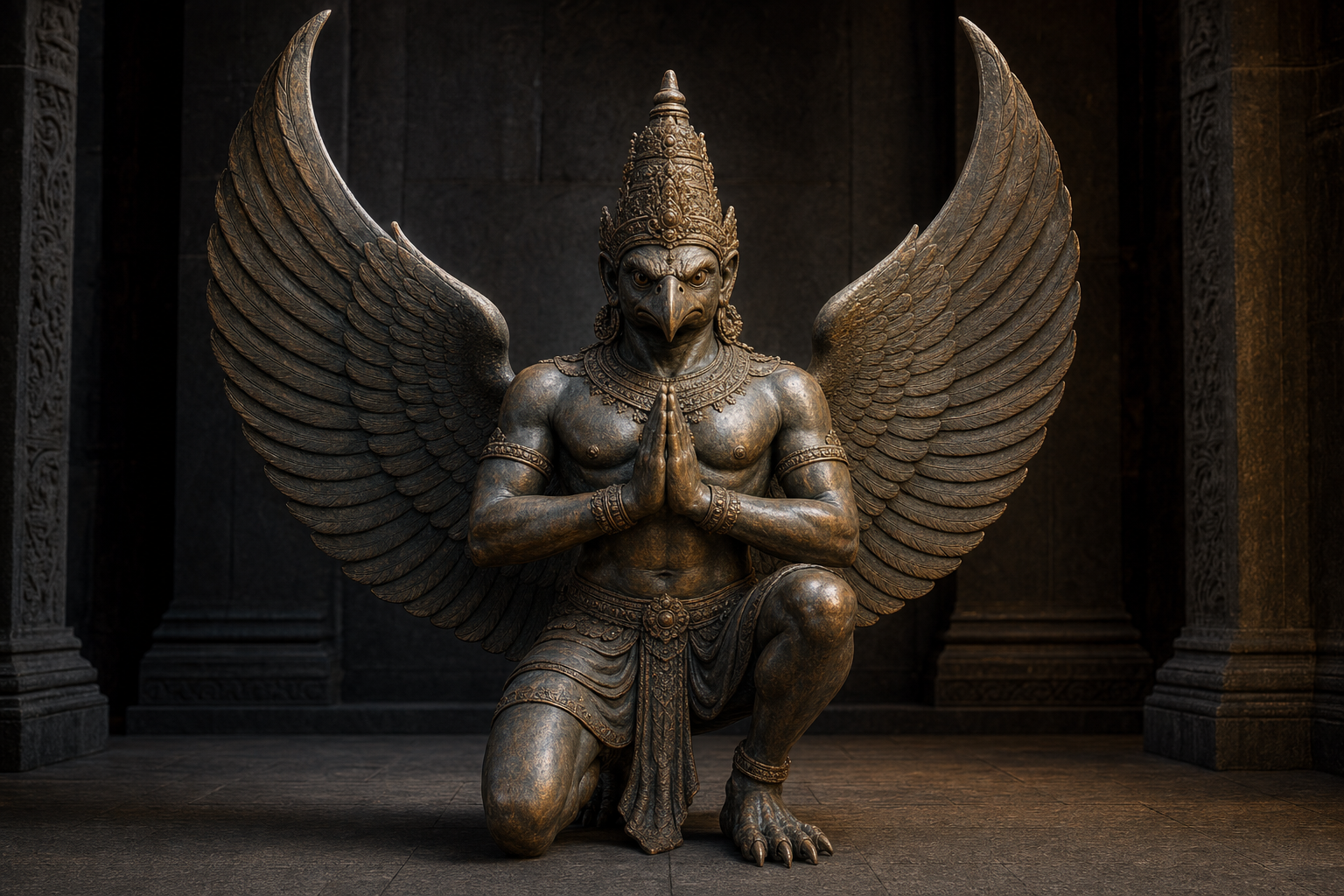
Garuda’s human-avian form is not merely a fantasy hybrid. Each part contributes to a visual argument. The human torso makes agency, intention, and devotion legible. The avian head, wings, beak, and talons convey aerial sovereignty, vigilance, speed, and the capacity to seize danger before it spreads.
Start with the silhouette. A broad chest and sinewy limbs communicate stored force. Open wings turn that force into movement, while folded wings hold it under restraint. A clearly defined beak intensifies the figure’s alertness and ferocity. Wide, focused eyes show that Garuda’s speed is not blind impulse; it is directed by attention.
Then look at the face. In a serpent-subduing composition, the expression may harden because the image emphasizes confrontation. Before Vishnu, the same underlying strength can soften into calm concentration. Ferocity and compassion are therefore not opposites here. They are responses appropriate to different duties: firmness toward a threat, humility toward the divine, and protection toward those placed under care.
Classical image-making disciplines associated with the Vishnudharmottara Purana coordinate pramana, bhava, and ayudha: proportion, expressive tenor, and identifying attribute. This means that a sacred image cannot be understood by inventory alone. A beak, serpent, mace, or pair of wings identifies very little unless scale, posture, expression, and relation make the intended disposition visible.
Color adds another layer when pigment or metal finish survives. Golden or sun-like tones point toward radiance, vitality, and lucid protective intelligence. Red or tawny wings emphasize energy and movement. Warm coppery alloys can embody this luminosity directly. In stone sculpture, where color may be absent or lost, polish, proportion, and muscular tension perform much of the same work.
Do not treat missing color as missing meaning. If you are examining an unpainted stone image, move from surface to structure: trace the sweep of the wings, the angle of the torso, the direction of the gaze, and the pressure carried through the feet or talons. Those features often preserve the intended action more reliably than later paint or decoration.
The serpent and weapons reveal what kind of victory is shown
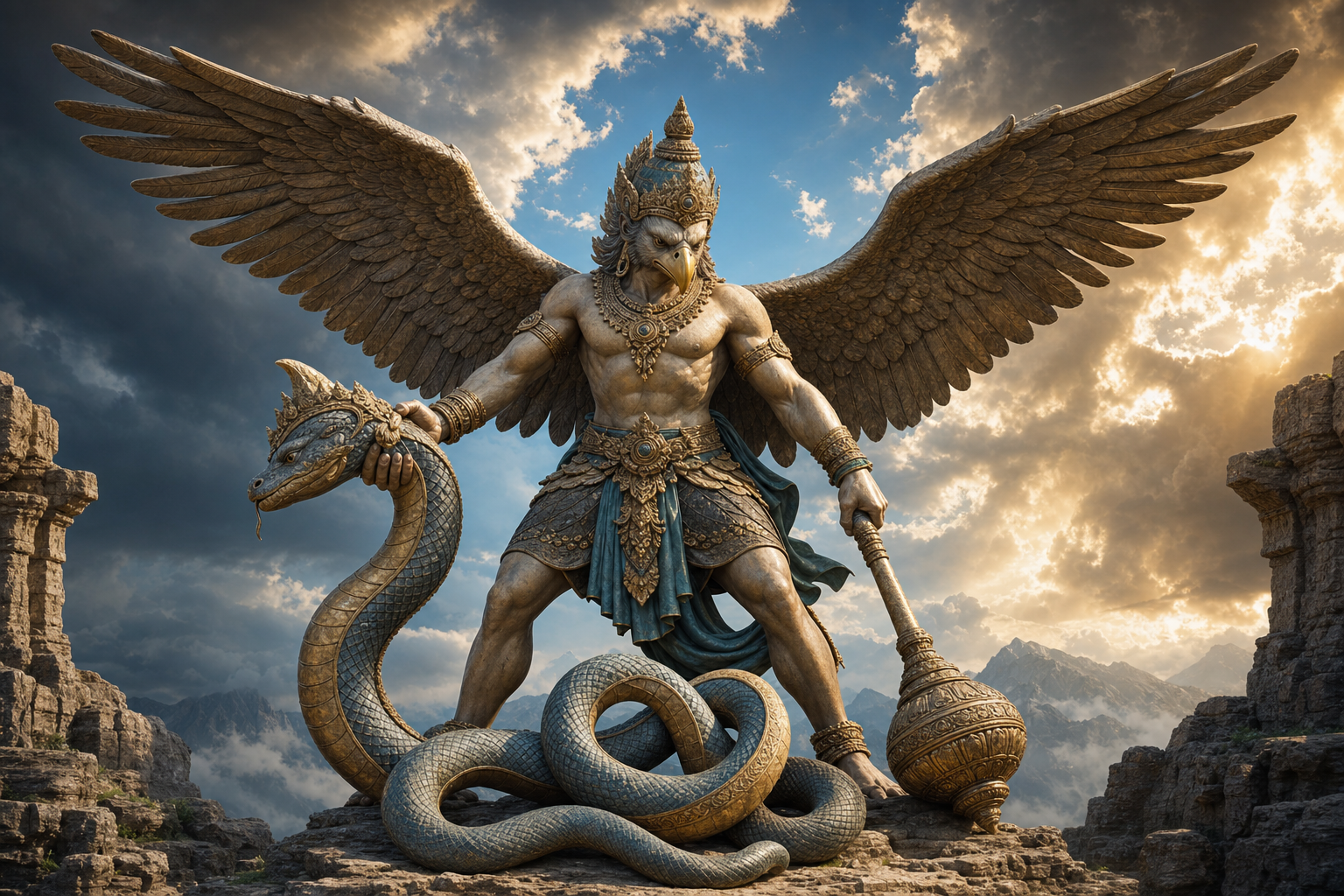
The serpent is Garuda’s most consistent emblematic opponent. When held or trampled, it marks the defeat of poison and the breaking of bondage. Yet the image should not be reduced to a zoological scene or a general declaration that every serpent is evil. Within this composition, the serpent gives visible shape to a force that coils, constricts, threatens, or corrupts; Garuda shows that such force can be mastered.
That distinction changes how you read the violence of the pose. The central claim is protective, not sadistic. Garuda does not attack in order to glorify appetite. He restrains what endangers right order. The ethical question raised by the image is therefore not whether strength exists, but whether strength has a rightful object, a disciplined purpose, and a higher allegiance.
Epic lore extends this logic through the Garuda-astra, a conceptual weapon associated with neutralizing serpent forces. In visual art, however, Garuda’s defining powers usually remain embodied in his own form: wings, talons, beak, focused sight, and commanding posture. A mace can occur in some regional or later representations, but it is not the safest feature by which to identify him.
If an unfamiliar sculpture has several weapons, ask which attribute carries the central action. A mace may add a martial register; a serpent directly activates Garuda’s characteristic mythology. Joined palms, by contrast, redirect the image away from combat and toward devotion. A figure with folded wings and anjali mudra should not be read as disarmed. The strength remains present, but it is consciously offered.
A yogic reading can deepen this symbolism, provided you recognize it as an interpretive layer rather than the only meaning. Garuda’s ascent can evoke prana lifting consciousness, while the serpent’s coils can represent inertia, confusion, or attachment. Under this reading, flight is not escape from earthly duty. It is the elevation of perception needed to act without becoming trapped by the very forces one must confront.
Temple placement turns the image into a relationship
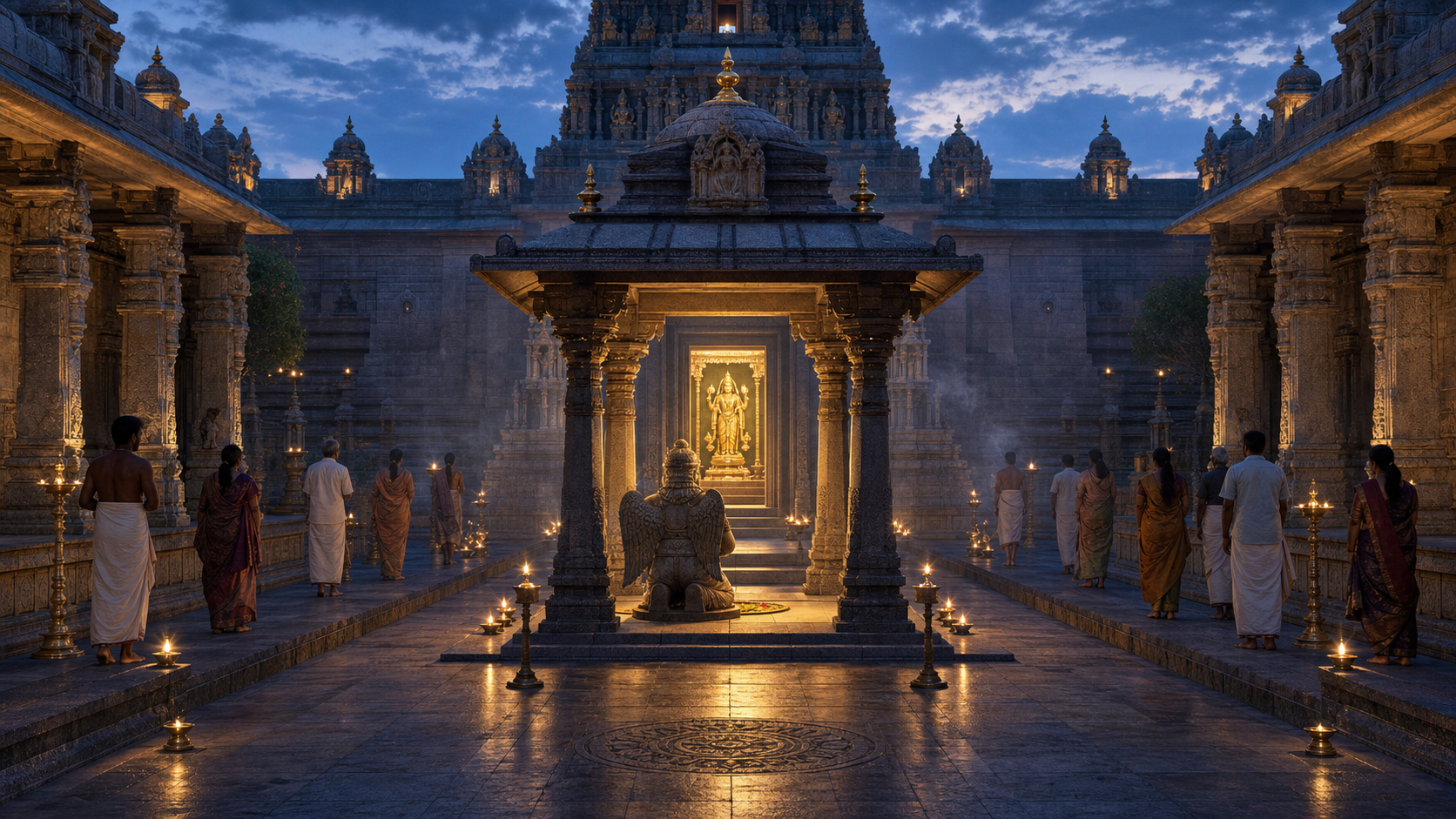
An image’s location can settle an ambiguity that its form alone cannot. In many Vaishnava temples, a kneeling Garuda occupies the approach to the sanctum with his hands joined and gaze directed toward Vishnu. He is not simply another guardian placed near the central deity. His orientation models how power should approach the sacred: awake, concentrated, and humble.
When you encounter Garuda on the temple axis, follow his line of sight before studying isolated details. Notice whether his body frames your own approach to the sanctum. A Garuda mandapa or Garuda-stambha can make this mediating role architectural, placing his protective and devotional presence along the devotee’s path.
This alignment also makes Garuda a practical model for darshana. The devotee does not merely look at a powerful being; the devotee sees a powerful being looking toward Vishnu. Garuda’s posture teaches the body’s part in worship: wings folded, attention gathered, hands joined, strength made still without being diminished.
Processional use changes the emphasis. During Garuda Seva in the Brahmotsavam at Tirumala, Vishnu’s processional form is borne upon Garuda. What was concentrated along the sanctum axis becomes movement through communal space. The symbolism of swift protection and divine agency is no longer only represented; it is enacted through procession, shared sight, and collective participation.
When Garuda moves beyond the temple
Outside a strictly liturgical setting, the same visual vocabulary can support political and civic meanings. The Gupta dynasty used the Garuda emblem on coins and standards, joining Vaishnava affiliation to ideals of guardianship, justice, and legitimate sovereignty. When you see Garuda on a standard rather than before a sanctum, the emphasis has shifted from an individual devotee’s posture to the public claim that authority should protect dharma.
The motif also travelled and took on regional forms across Asia. Khmer, Thai, and Javanese traditions adapted Garuda to local artistic and royal settings. Thailand’s Krut carries a strong association with protective royalty, while Indonesia’s Garuda Pancasila places the cosmic bird within a national emblem of unity and civic purpose. Bali’s monumental Garuda Wisnu Kencana returns the relationship with Vishnu to a vast public scale.
Context determines which meaning is foregrounded. A Garuda on a Vaishnava temple wall, a royal insignia, and a modern national emblem may share a visual ancestry without performing the same religious function. Before interpreting any example, identify whether you are looking at an object of worship, an architectural guardian, a dynastic sign, or a civic symbol.
Dharmic parallels require both openness and precision
Buddhist traditions include Garudas as a class of powerful beings, and the Tibetan Khyung occupies a related role as a sky-soaring guardian. Within Sikh heritage, the baaj associated with Guru Gobind Singh offers a meaningful ethical parallel through courage, clarity, vigilance, and sovereign composure.
These resonances do not make every sacred bird the same theological being. Comparison is strongest when it identifies a shared ethical vocabulary and weakest when it erases differences among Hindu, Buddhist, Jain, and Sikh teachings. Look for the quality being honored – fearless protection, self-mastery, disciplined power, service to truth – while allowing each tradition to define its own symbols.
A five-pass method for reading any Garuda image
You can apply the following method in a temple, museum, manuscript, photograph, coin collection, or civic setting. Keep the order intact. It moves from the most reliable visual evidence to the more interpretive layers.
- Identify the relationship. Look first for Vishnu, a sanctum axis, a serpent, a throne-like arrangement, or an official emblem. This tells you whether Garuda is functioning primarily as bearer, devotee, protector, or public symbol.
- Determine the action. Distinguish soaring, alighting, kneeling, carrying, holding, and trampling. Open wings alone do not prove flight; the torso, legs, and direction of force must support that reading.
- Read restraint as carefully as force. Folded wings and joined hands are positive attributes, not absences. They show power made attentive. A hard expression and active talons indicate confrontation; a calm gaze and anjali indicate devotional concentration.
- Rank attributes by relevance. The serpent is more characteristic than a generic mace. The beak, wings, talons, and relation to Vishnu can identify Garuda even when handheld attributes vary.
- Let the setting control the final interpretation. A temple-facing image concerns darshana and service; a processional vahana concerns divine action in communal space; a coin, standard, palace relief, or national emblem foregrounds guardianship and sovereignty.
Only after these five passes should you add contemplative or ethical meanings. Then you can ask what the image proposes about your own conduct. Are you mistaking agitation for speed? Are you exercising strength without service? Are you confronting something harmful without first bringing your attention under discipline? Garuda’s iconography holds these questions together because ascent, vigilance, devotion, and protection belong to one moral form.
Key takeaways
- Read Garuda’s relationship to Vishnu, the serpent, or the surrounding institution before counting arms or weapons.
- Open wings signify active readiness; folded wings and joined palms signify strength restrained by devotion.
- The subdued serpent represents victory over poison, fear, bondage, and obstructive force within the composition.
- Garuda’s natural attributes – wings, talons, beak, gaze, and posture – are usually more defining than a regional handheld weapon.
- Temple, processional, royal, and civic images share a symbolic inheritance, but their immediate functions are not interchangeable.
- Dharmic parallels are most useful when they illuminate shared virtues without collapsing distinct traditions into one identity.
The next time you meet Garuda, give the image one uninterrupted minute. Trace the silhouette, hands, feet, gaze, and spatial axis in that order. You will begin to see more than a mighty bird: you will see a disciplined account of how power rises, whom it serves, and what it is meant to protect.