
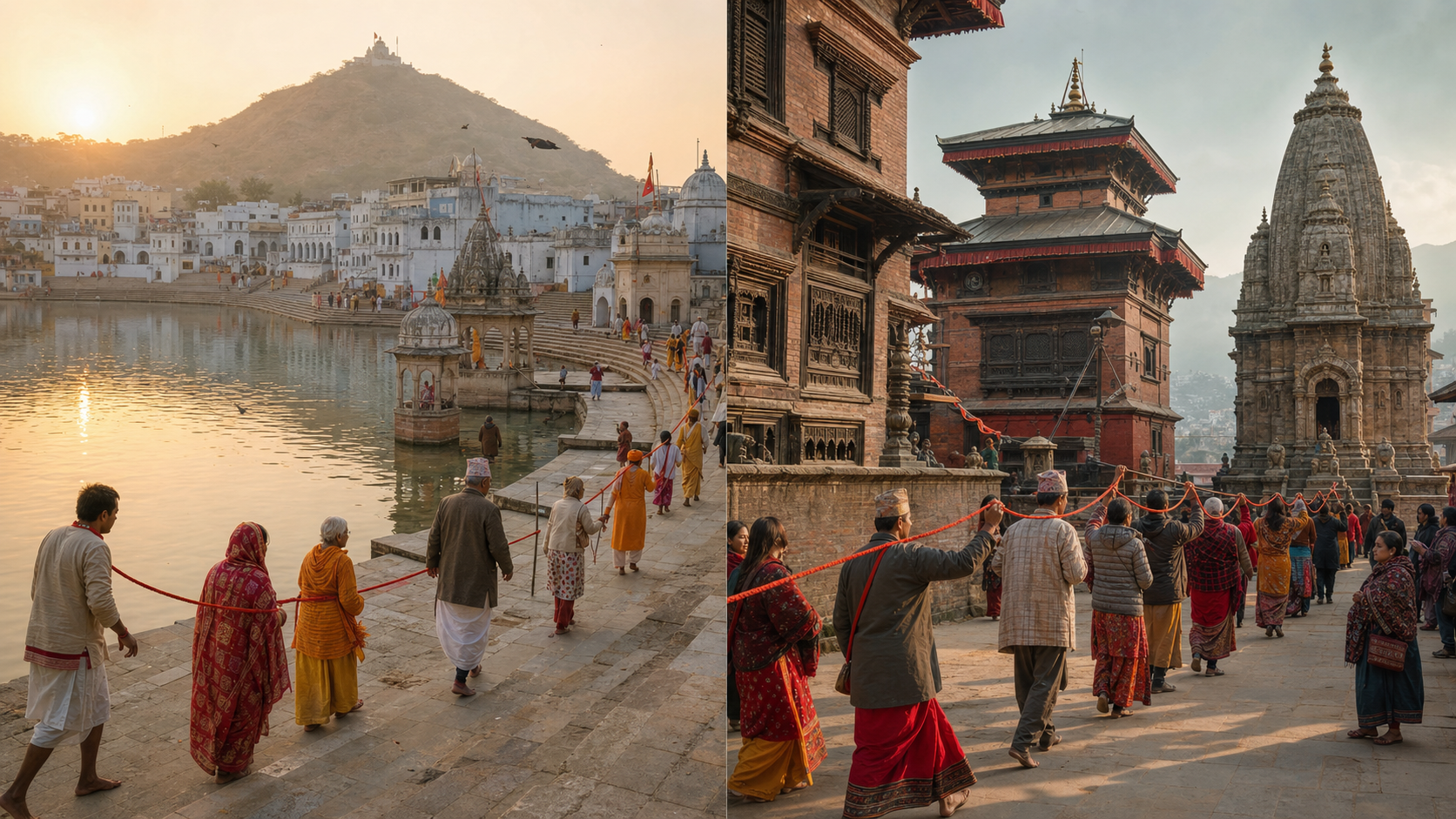
If you enter a temple town asking only, ‘Which shrine should I see?’, you may complete every darshan and still miss the place’s central teaching. At Pushkar and Nagarkot, much of the meaning lies between sanctums: in a lake circuit, a hilltop counterpoint, two facing spires, and a red cord held above a public street.
The practical shift is simple. Do not treat sacred geography as a backdrop. Read it as a ritual text through which you move. That changes how you plan your route, how you understand divine union, and how you behave when worship enters shared civic space.
The sacred unit is the relationship, not the building
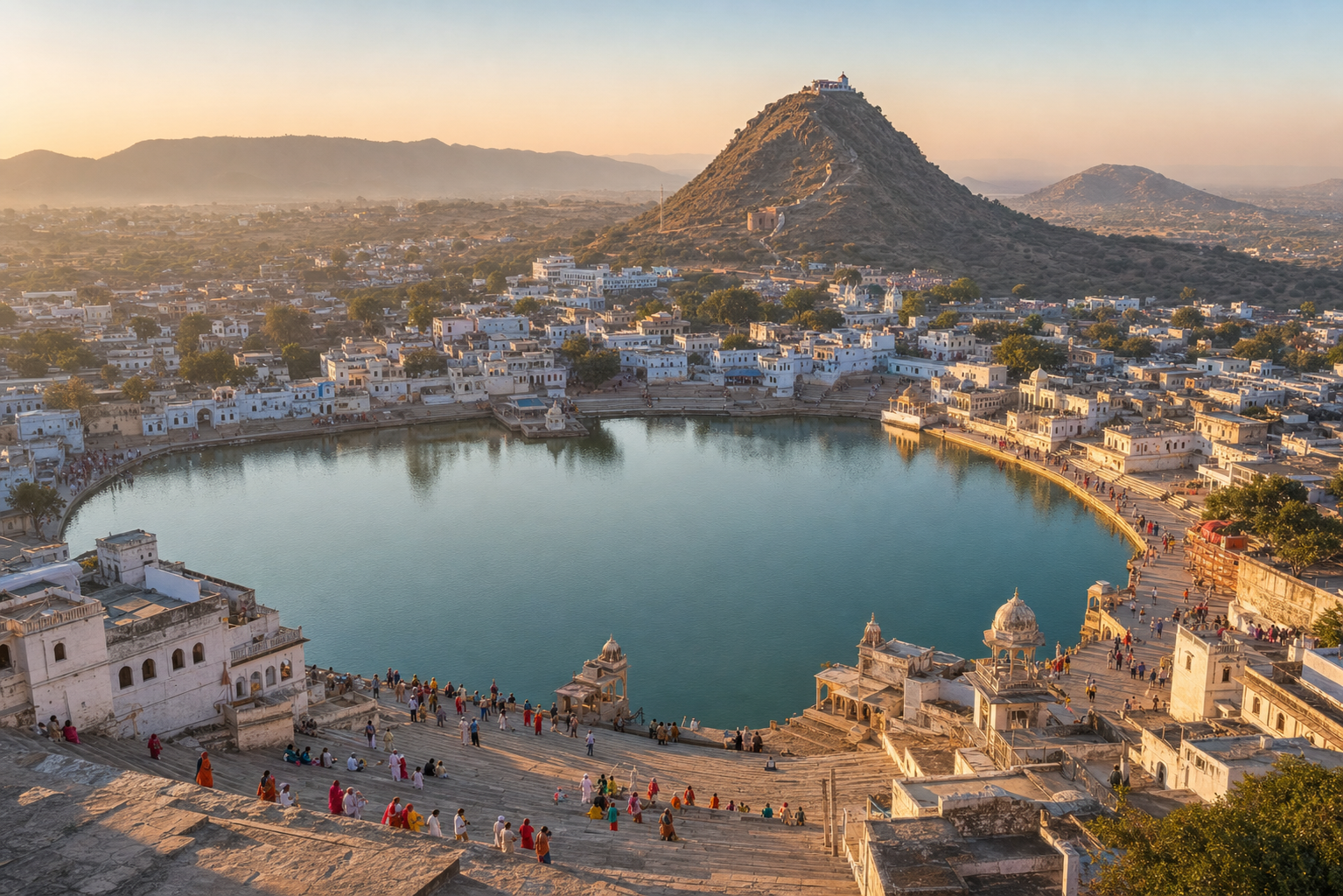
Modern sightseeing trains you to isolate monuments. You find the principal temple, join the queue, receive darshan, take a photograph, and leave. A tirtha often asks for a different kind of attention. Its meaningful unit may be a pair of shrines, a procession between them, a circumambulation around water, or an axis linking a temple to a hill.
At Pushkar, Jagatpita Brahma Mandir, Pushkar Lake, Savitri Mata Temple on Ratnagiri Hill, and Gayatri Mata Temple form a relational landscape. Brahma represents creative order; Savitri carries associations with luminous knowledge and sacred speech; Gayatri embodies mantra-shakti, prayer set into disciplined action. The lake and its 52 ghats provide the circular movement within which those relationships are remembered.
These are not interchangeable attractions. If you visit only the most famous sanctum, you encounter one figure. If you notice the hill, the lake, the ghats, and the other shrines, you encounter a theological relationship: creation requires knowledge, voiced prayer, timing, cooperation, and accountability.
At Nagarkot in the Kangra valley, the spatial grammar is more linear. Brajeshwari Devi and Vaidyanath face one another, while a red silken rope traditionally joins their shikharas. The street between them is therefore more than the empty distance separating two temples. It becomes the visible link between Shakti and Shiva. The line does not erase the distinct shrines; it makes their relationship impossible to overlook.
Before entering either landscape, make a brief orientation:
- Locate the principal shrine, but also identify its counterpart: another temple, a hill, a lake, a gateway, or a processional route.
- Notice whether the place asks you to move in a line, ascend, cross a threshold, make parikrama, or complete a paired darshan.
- Look for ritual boundaries. A rope, ghats, flags, steps, and processional clearances may regulate conduct as well as mark sacred space.
- Ask which local community maintains the relationship. Sacred geography survives through custodians, priests, merchants, pilgrims, pastoral communities, and residents, not through architecture alone.
Do not assume that every physical element must come from one ancient construction phase for the relationship to be authentic. Pushkar’s sanctity is ancient in textual and regional memory, while the present Brahma temple contains medieval reconstruction and later restoration. Nagarkot’s red rope carries strong communal meaning even though its precise historical beginning is not firmly fixed. A living tirtha can preserve an old sacred pattern through renewed materials and repeated practice.
Place must also be read with time and participant. The dharmic triad of desha, kala, and patra asks you to consider where an act occurs, when it occurs, and who is qualified or responsible for performing it. Pushkar’s ritual intensity gathers around Kartika Purnima, while Nagarkot’s Shakta and Shaiva meanings become especially pronounced within festival cycles such as Navratri and Maha Shivaratri. Local schedules and renewal customs vary, so confirm the current sequence with temple custodians rather than assuming that a remembered practice is performed identically every day.
Divine union means participation, not decorative symmetry
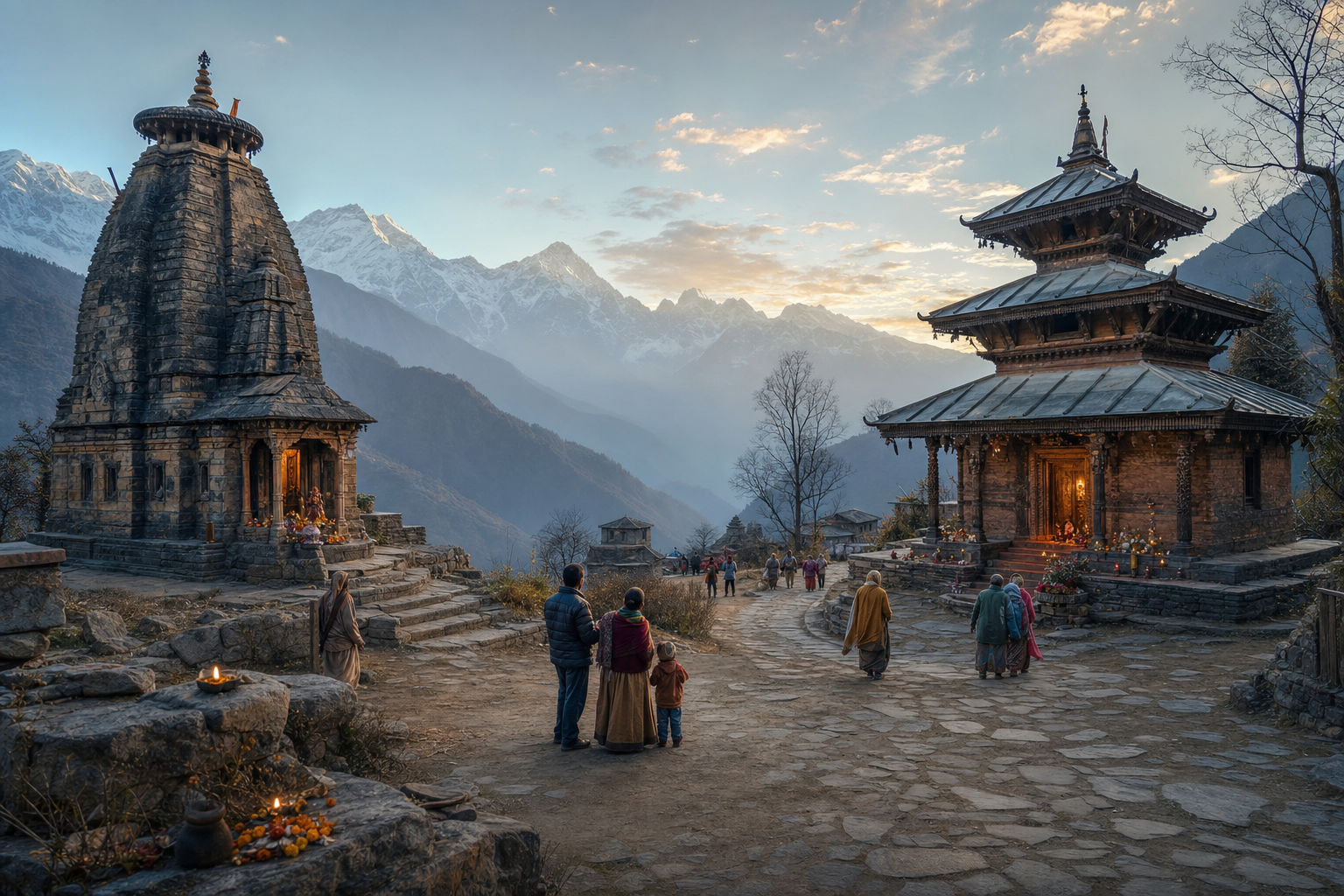
A divine pair is easily reduced to an attractive slogan about balance. The ritual logic is more demanding. Union means that a capacity which appears complete by itself is revealed to need a counterpart.
Pushkar expresses this principle through yajna. As yajamana, Brahma needed a patni for offerings that included the patni-samyaja. Savitri had not arrived as the auspicious muhurta was closing, so Brahma married Gayatri and proceeded with the rite. Regional and Puranic tellings vary in their treatment of Savitri’s delay, Indra’s role, and Gayatri’s identity. The Padma Purana, Brahma Purana, and the Pushkara-mahatmya of the Skanda Purana preserve different emphases rather than one flat account.
The technical point matters. The spouse is not present merely to watch a male sacrificer perform a complete act. As sahadharmini, she helps constitute the ritual agent. Correct fire, mantra, officiants, altar, sequence, and timing do not make her participation optional. The patni-samyaja therefore presents cooperation as part of ritual ontology, not as a social courtesy added after the essential work is done.
Gayatri also joins two levels of identity. In one register, Gayatri is the goddess of the 24-syllable gayatri metre and the force of mantra. In regional memory, she is a Gurjar daughter rooted in the pastoral life of Rajasthan. That combination is central to the meaning of a tirtha: cosmic history does not float above the land but takes local people, livelihoods, and custodianship into itself.
Savitri’s arrival prevents the story from becoming a simple endorsement of ritual urgency. Her protest establishes that a closing muhurta does not make relationship, consent, or a prior vow morally weightless. The resulting tradition associates Pushkar with the exceptional prominence of Brahma’s independent worship. Read in this way, the tension is not an embarrassing interruption to the sacred event. It is part of the teaching. Dharma must respond to time, but urgency cannot be allowed to define the whole of dharma.
Nagarkot gives complementarity a different public form. Shakti signifies dynamic power, manifestation, courage, fertility, and movement. Shiva signifies still consciousness, restraint, and transcendence. The red rope acts as a large civic sutra: both a literal thread and a concise teaching. Energy without conscious orientation becomes ungoverned force; stillness without expressive power remains inactive. The two poles become intelligible through relation.
When you encounter a divine pairing, ask a sharper question than ‘Which deity is greater?’ Ask what each makes possible in the other. At Pushkar, place knowledge, mantra in action, creative order, temporal discipline, and principled dissent beside one another. At Nagarkot, place energy beside stillness. Do not rush to dissolve every difference into sameness. Dharmic union can preserve distinction while refusing separation.
Public ritual turns shared space into ethical practice
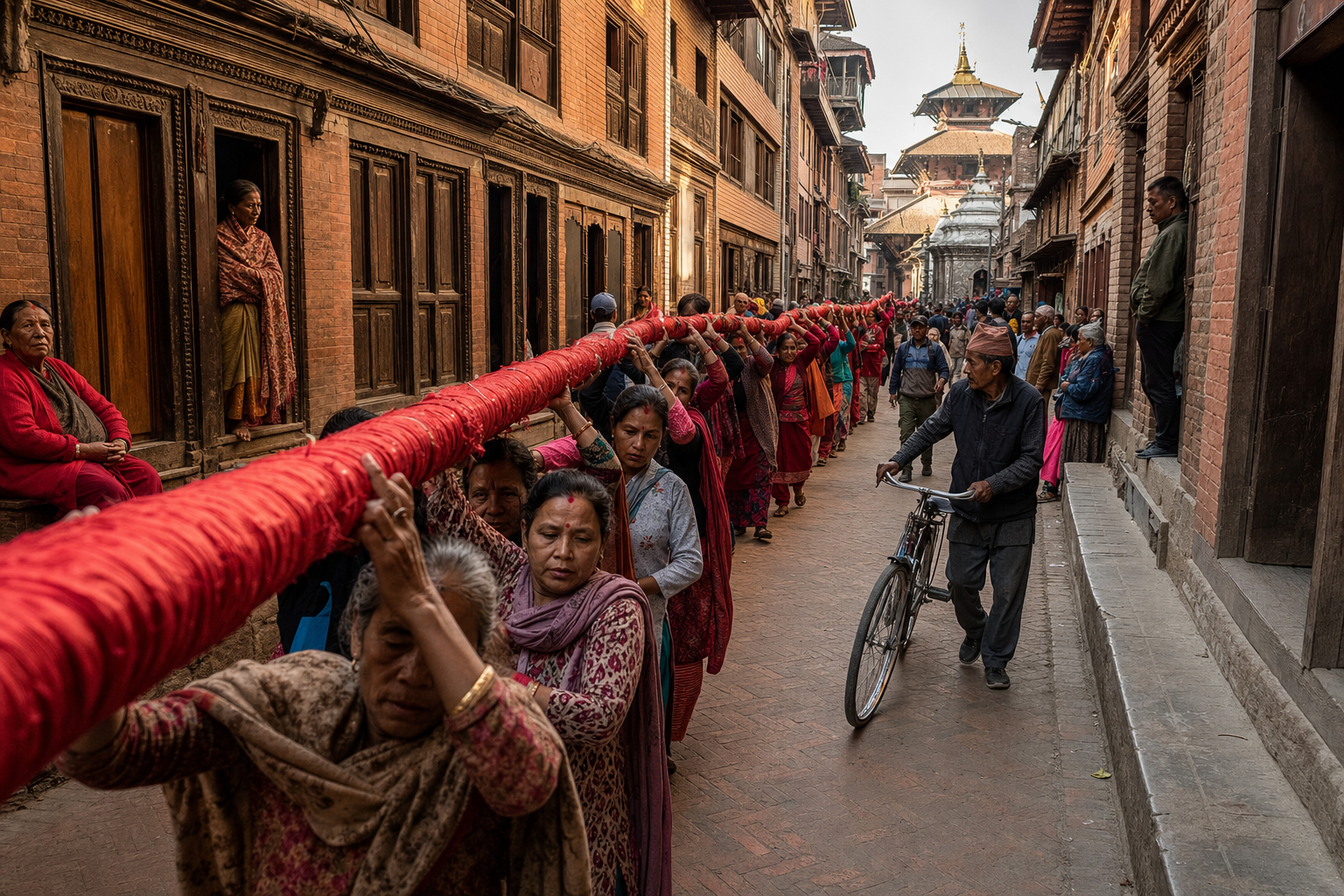
Ritual does not become less sacred because it is public. Publicness gives it a second task: it must coordinate bodies, attention, movement, and responsibility among people who do not all know one another.
At Pushkar, dawn snana, arghya to the rising sun, parikrama along the lake, pauses at principal ghats, and Gayatri mantra japa create an ordered devotional rhythm. During Kartika Purnima and the Pushkar Mela, lamps, bells, conches, vows, and collective movement bring that rhythm into a much larger gathering. The lake is simultaneously sacred water, pilgrimage destination, ritual setting, and a shared living system. Reverence must therefore include restraint in offerings, responsible waste practices, and care for the water on which everyone depends.
At Nagarkot, the red cord resembles a mauli or raksha-sutra expanded to the scale of the town. Its placement between the two shrines defines a protected ritual corridor and encourages a paired devotional circuit. Vendors, residents, pilgrims, officiants, and passersby all enter the field of the symbol, even when they are simply crossing the street.
The symbolism does not cancel physical reality. A rope installed between high architectural points must be anchored with attention to tension, wind, processional clearance, and emergency access. Temple custodians therefore treat its installation as both consecration and engineering. A visitor who pulls the rope, attaches an unauthorized offering, or blocks the route for a photograph is not participating more intensely. The visitor is interfering with the ritual and practical order that makes the symbol possible.
Use these rules whenever a sacred observance occupies a lakefront, street, market, or other common space:
- Follow the route indicated by custodians. Do not create a shortcut through an altar area, procession, or protected corridor.
- Do not touch, tug, climb on, or add objects to ritual cords, banners, pillars, or anchoring points unless you are explicitly invited to do so.
- Keep gateways, stairs, ghats, and emergency passages clear. Your preferred camera angle does not outrank the movement of worshippers or the safety of the gathering.
- At sacred water, make only the offerings permitted at that place. Do not leave packaging, food waste, cloth, or other residue for the lake and community to absorb.
- If two shrines form one ritual circuit, do not treat the less famous shrine as optional merely because it has a shorter queue. Completing the relationship is often the point of the route.
- Let visible cues change your conduct. A sacred boundary should affect your pace, voice, attention, and handling of objects, not merely provide an unusual photograph.
The wider Dharmic world offers related uses of thread and cloth without making them doctrinally identical. Hindu practice employs the mauli as a protective bond and the yajñopavita as a marker of discipline. Tibetan Buddhist communities use blessed cords. Jain rites may include auspicious threads in consecration and vows. The Sikh Nishan Sahib uses cloth to proclaim sacred presence, collective identity, and service. The useful comparison is a family resemblance: material objects can carry vows, protection, belonging, and ethical obligation into public view. The distinct teachings and disciplines behind them should still be learned on their own terms.
A practical method for visiting relational sacred sites
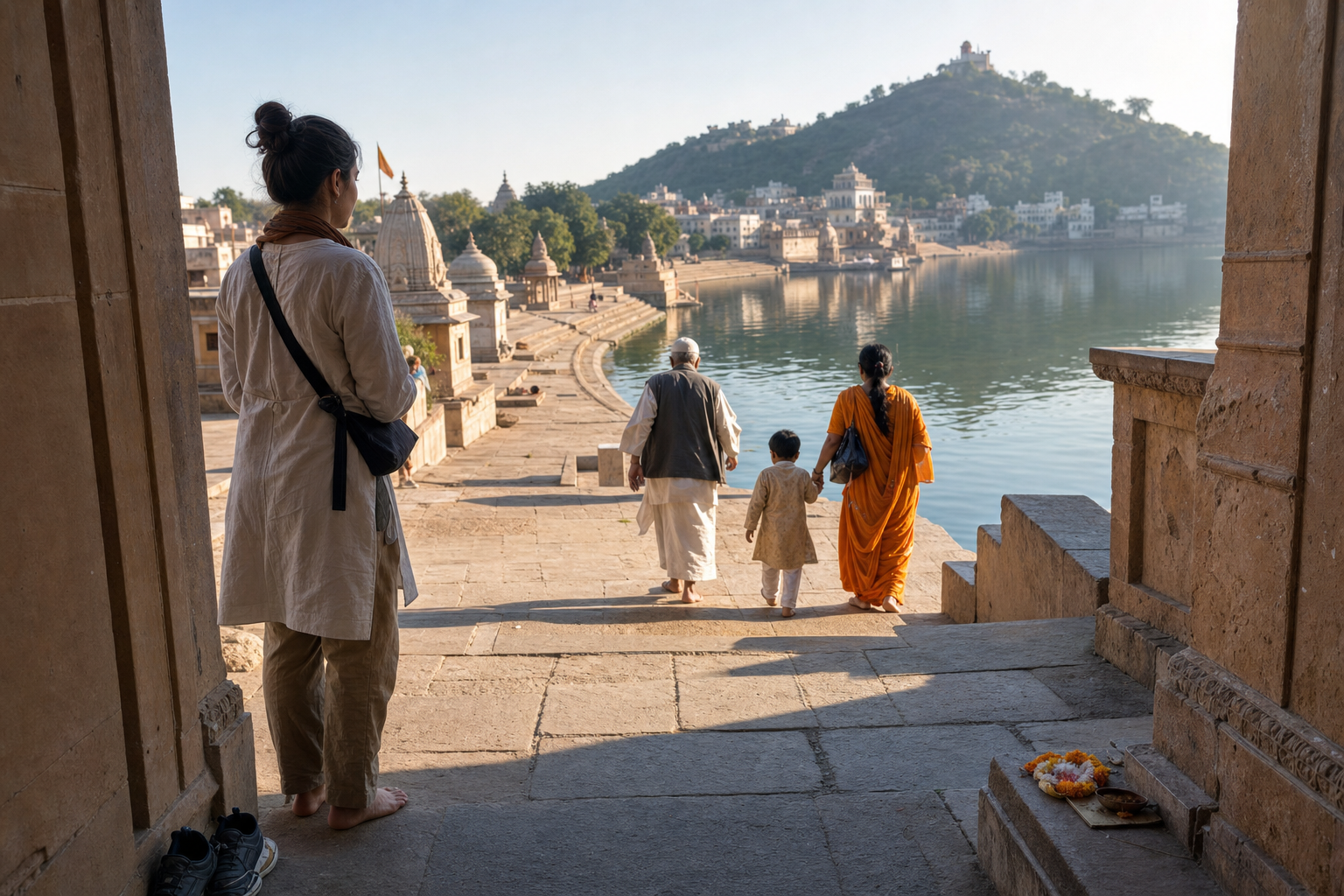
You do not need specialist training to read sacred geography well. You do need to resist the urge to collect isolated sights. Use this sequence at Pushkar, Nagarkot, or another temple landscape organized around a divine pair or ritual circuit.
- Orient before queuing. Find the main sanctum, its counterpart, the axis between them, and any water, hill, gate, cord, flag, or path that shapes movement. A site map is useful, but direct observation often reveals relationships that a list of attractions hides.
- Ask for the local sequence. Check whether darshan is paired, whether parikrama has a customary direction, and whether a festival has changed access. At Nagarkot, the devotional point is strengthened by visiting both Brajeshwari Devi and Vaidyanath. At Pushkar, the lake, Brahma, Savitri, and Gayatri belong to one narrative field even when your physical ability or available time limits the full route.
- Match time to your purpose. Sunrise and sunset suit quiet Gayatri japa at Pushkar. Kartika Purnima presents the communal, vow-centered intensity of the tirtha. Navratri foregrounds Shakti at Nagarkot, while Maha Shivaratri foregrounds Shiva’s austerity and wakefulness. If a rope renewal or procession matters to your visit, confirm its date locally because the schedule is not uniform.
- Carry one interpretive question. Ask what the route joins: knowledge and action, energy and stillness, vow and timing, deity and community, or sacred water and ecological duty. One clear question will teach you more than hurriedly accumulating many disconnected facts.
- Let your body perform the lesson. Walk the connecting route, pause where the landscape asks for a pause, and observe the prescribed boundary. If you undertake japa, arghya, snana, or another rite, do it with the sequence and restraint appropriate to the place.
- Leave the relationship intact. Take nothing from the landscape that is not given, add nothing that custodians have not permitted, and leave no waste. A pilgrimage is incomplete if private devotion transfers its physical cost to residents, volunteers, animals, or sacred water.
Key takeaways
- Sacred geography is a network of meaningful relationships, not a collection of independent monuments.
- Divine union signifies mutual participation while preserving real distinctions between the powers being joined.
- Public ritual teaches civic conduct through routes, boundaries, timing, material symbols, and shared responsibility.
- A careful pilgrim completes the prescribed relationship, follows local guidance, and treats stewardship as part of worship.
On your next temple visit, begin before the first photograph or offering. Identify an axis, a counterpart, and a rule of conduct. Then move through the site in the way that relationship asks. Sacred geography becomes legible when your attention, movement, and restraint become part of it.
References
- DharmaRenaissance Blog – Unveiling Brahma’s Wedding at Pushkar: Cosmic Timing, Gayatri’s Grace, and Yajna Power
- DharmaRenaissance Blog – Nagarkot’s Sacred Red Silk Rope: Uniting Brajeshwari Devi and Vaidyanath – Ritual, Symbol, Science