
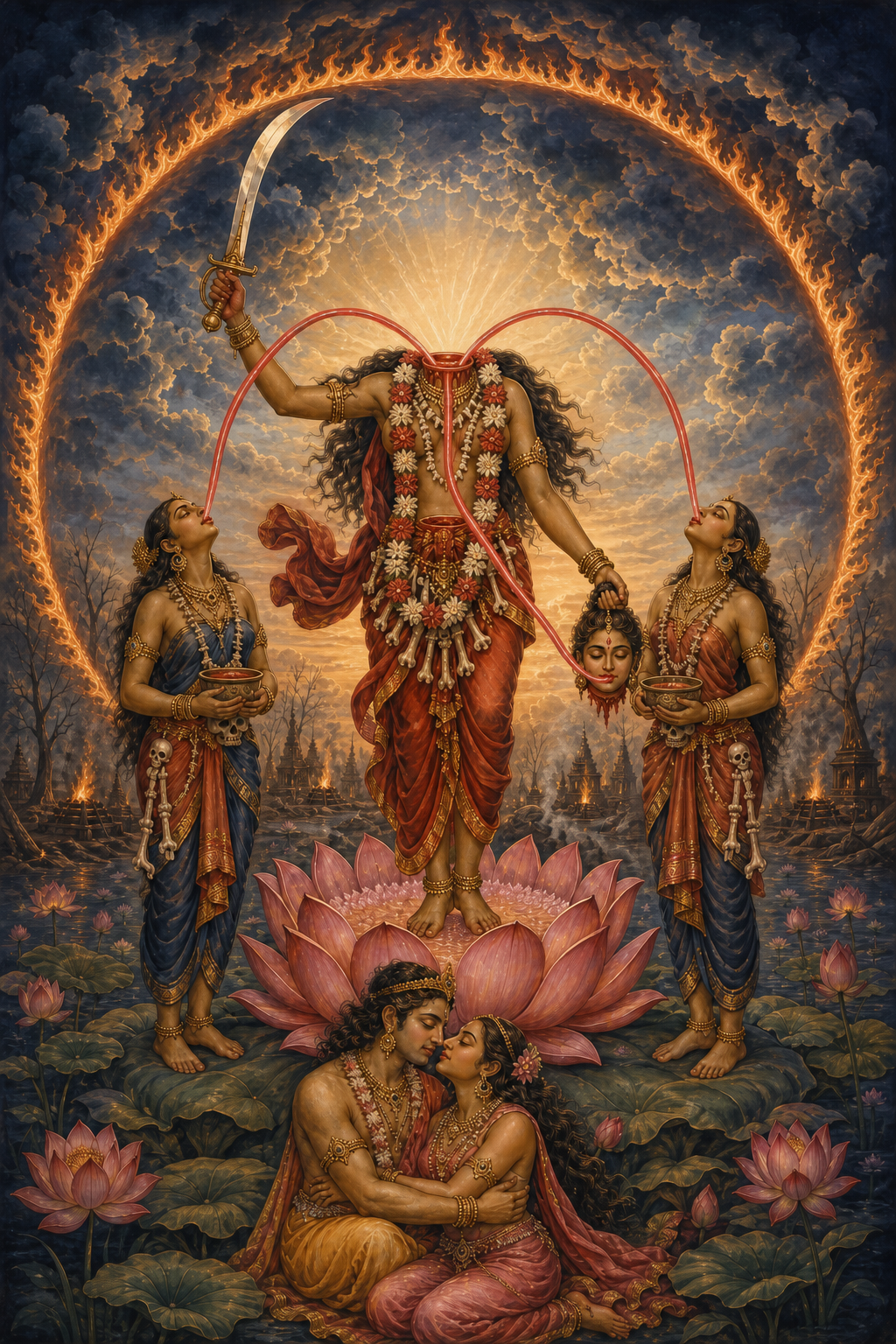
You may feel drawn to Chinnamasta and still hesitate before her image. A self-decapitated goddess, three streams of blood, a sword, a skull bowl, two attendants, and the figures of Kama and Rati do not resemble the devotional forms most householders first learn to approach.
The hesitation is useful if it makes you look more carefully. Chinnamasta is not an invitation to imitate violence, punish the body, or pursue spiritual intensity for its own sake. Her icon asks a harder question: can you interrupt ego and compulsion without interrupting awareness, compassion, or responsible action?
Read the whole image before interpreting any one symbol
The most common mistake is to isolate the decapitation from everything around it. Seen alone, it looks like destruction. Seen as part of the complete composition, it depicts a living circuit of consciousness, desire, nourishment, and power.
Chinnamasta has cut off her own head, yet awareness has not disappeared. Three streams of life sustain her and the attendants Dakini and Varnini. The image therefore does not end with severance. It shows what remains when an entrenched identification has been cut: conscious presence, circulating Shakti, and the capacity to nourish others.
The figures of Kama and Rati beneath her are equally important. Their presence is sometimes reduced to the slogan that spirituality must defeat desire. That reading is too crude. Chinnamasta does not make life-energy disappear. She stands above it. Desire remains powerful, but it no longer occupies the throne.
This distinction matters in ordinary life. Suppressed desire often returns in another form: resentment, secrecy, pride, or compulsive distraction. Mastered desire becomes available for disciplined work, devotion, protection, creativity, and service. Chinnamasta’s stance asks you to redirect energy, not pretend that you have none.
The three streams are traditionally associated with iccha-shakti, jnana-shakti, and kriya-shakti: the powers of intention, knowledge, and action. You can use that triad as a practical test whenever you face a charged decision:
- Iccha: What do you actually intend, beneath the explanation you are giving yourself?
- Jnana: What do you know, and what are you merely assuming because it suits the impulse?
- Kriya: What action would express both truth and responsibility?
If one stream is missing, the decision is incomplete. Intention without understanding becomes impulse. Understanding without action becomes evasion. Action without a clean intention can become aggression disguised as courage.
Use each emblem as a diagnostic, not a decorative label
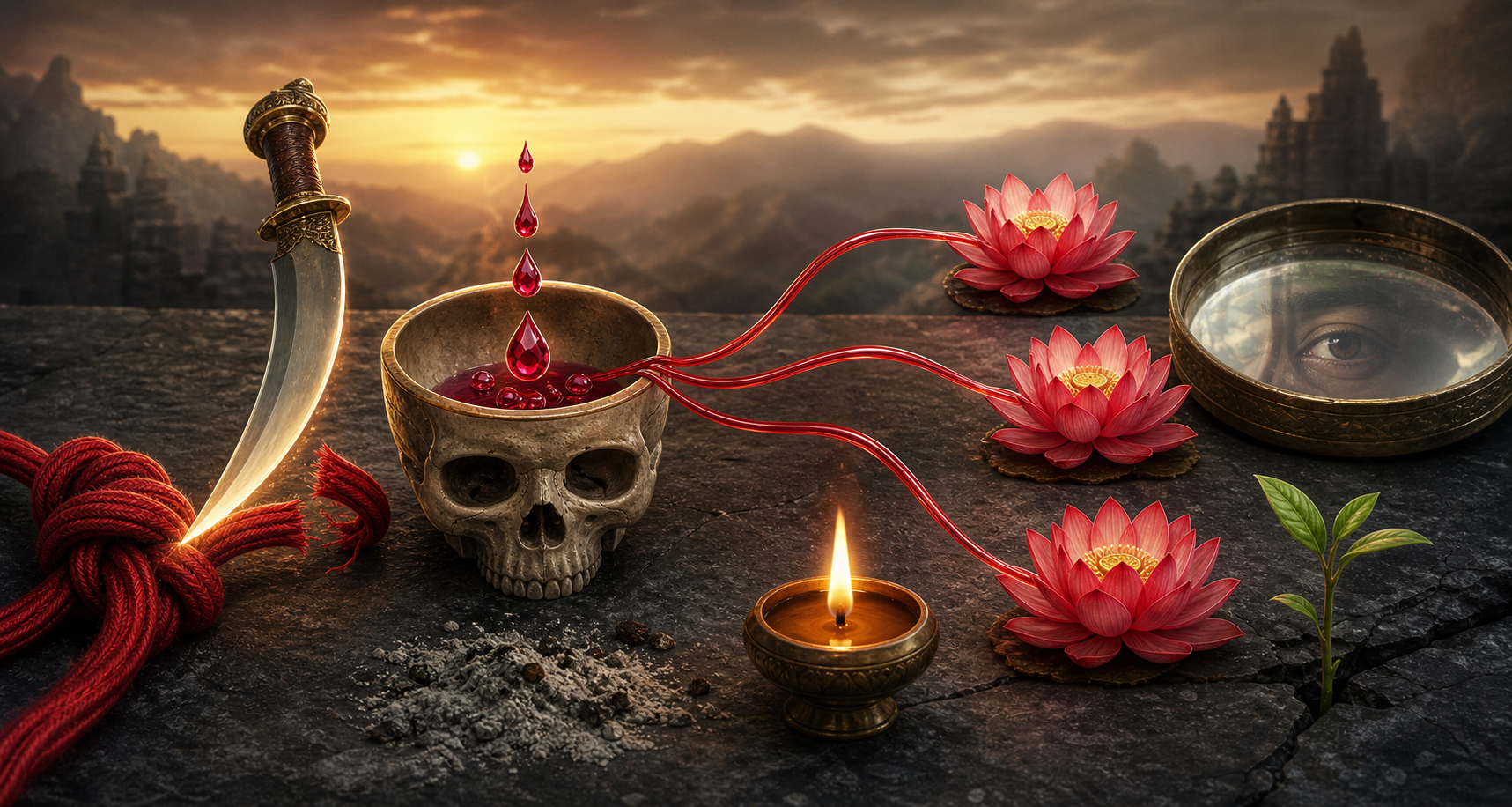
Chinnamasta’s symbols become useful when they expose a pattern in you. They become less useful when they are treated as a code in which every object has one rigid meaning. Shakta and Tantric lineages may emphasize different correspondences, so the aim is disciplined contemplation rather than pretending that one chart exhausts the deity.
| Element | A grounded reading | Question to take into practice |
|---|---|---|
| Severed head | The cutting of avidya and ego-fixation, not the destruction of consciousness | Which identity or self-protective story is preventing you from seeing plainly? |
| Khadga and kapala | Discernment severe enough to cut confusion and steady enough to face what follows | What must be distinguished before you act: fact from fear, duty from appetite, or courage from display? |
| Three streams | Intention, knowledge, and action operating as one current | Which of the three is weak or absent in your present decision? |
| Dakini and Varnini | Awakened energy is not hoarded; it also sustains others | Who besides you should benefit from the strength you are cultivating? |
| Kama and Rati | Life-energy brought under conscious direction rather than denied | Where is desire currently directing you, and where should dharma direct it? |
| Digambara form | Radical authenticity beyond social veneer | Which role, reputation, or performance are you mistaking for your real nature? |
Notice that these readings do not celebrate harshness. The sword cuts delusion, while the streams continue to nourish. Fierceness and compassion are not opposites in this icon. Fierceness removes what prevents compassion from acting cleanly.
You can apply this without turning every difficulty into a dramatic spiritual battle. Choose one recurring compulsion: angry speech, avoidance, craving for approval, an addictive distraction, or a promise you repeatedly postpone. Name the false story that protects it. Identify the energy locked inside it. Then redirect that energy into one concrete dharmic action. The symbolism becomes practice at precisely that point.
Place Chinnamasta within the Mahavidyas without flattening her
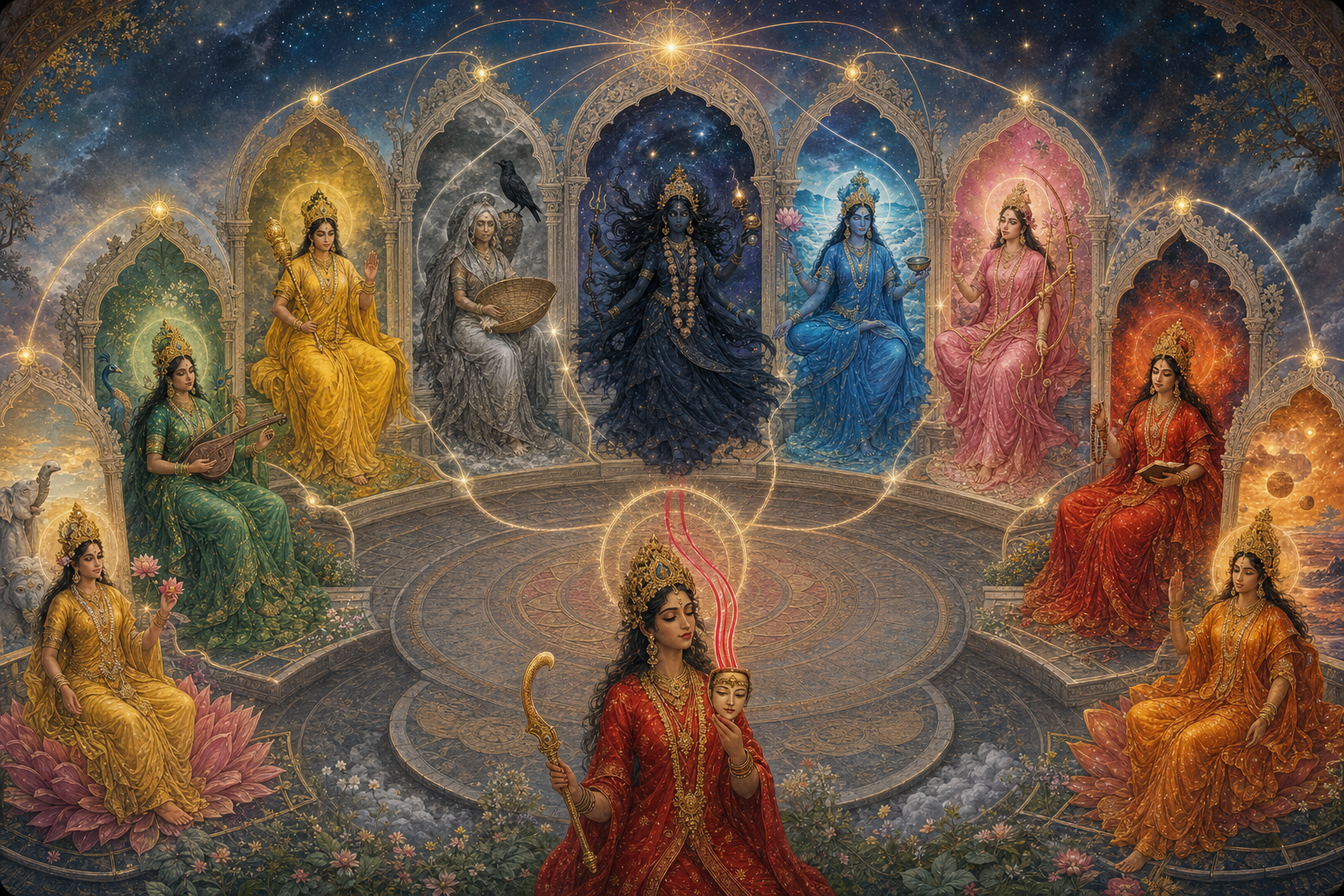
Chinnamasta is one of the ten Mahavidyas, the great wisdom forms through which the Divine Mother appears across a range that includes nurturing presence and uncompromising revelation. She should not be reduced to a generic “fierce goddess.” Her particular teaching lies in the paradox of self-severance without loss of awareness and self-transcendence without withdrawal from nourishment.
Several Tantric lineages connect her lightning-like transformation with prana moving through the sushumna nadi and with the region of manipura. That association is not a universal license to force breath, visualize violent internal events, or attempt an improvised kundalini awakening. The useful household reading is quieter: manipura contributes disciplined will, anahata keeps that will compassionate, and ajna subjects it to discernment. Power without heart becomes domination; heart without clarity becomes indulgence; clarity without action remains sterile.
Chinnamasta also has meaningful resonances elsewhere in the Dharmic family. The Buddhist Chinnamunda, associated in Vajrayana contexts with forms such as Vajrayogini or Vajra Vairochani, similarly presents sudden wisdom cutting craving and delusion. Jain aparigraha turns attention from possession and compulsion toward restraint. Sikh nishkam seva joins fearlessness to service without selfish reward.
These are affinities, not declarations that the traditions have identical theology, ritual, or liberating method. When you discuss Chinnamasta across Dharmic traditions, say exactly what is shared: disciplined freedom from compulsion, fearless encounter with truth, and strength placed in service. Do not erase the distinct deity, vocabulary, lineage, or goal of each tradition merely to manufacture unity.
Choose the level of worship that actually fits you
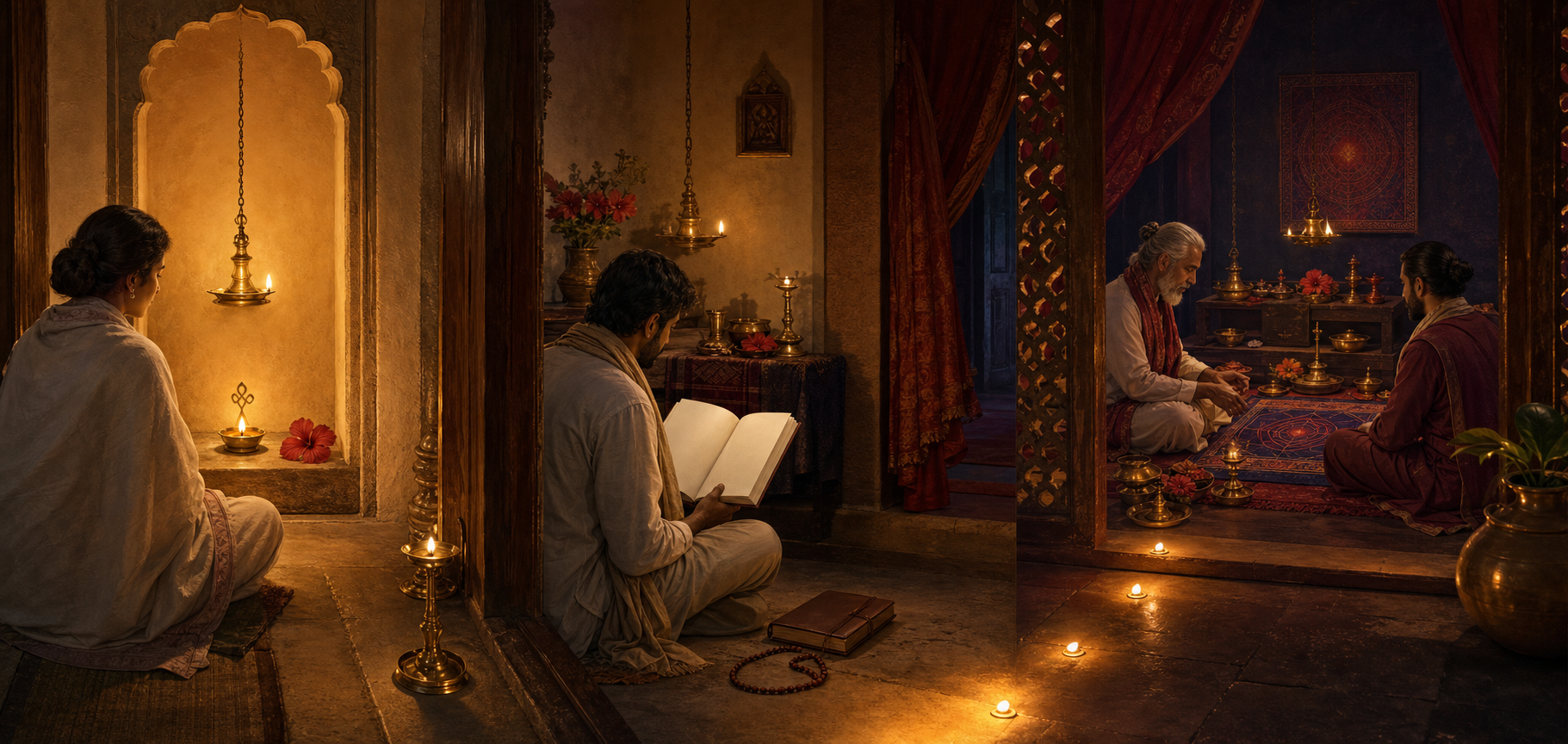
Simple household devotion
You do not need an esoteric mantra to honor Chinnamasta’s qualities. A sattvic home practice can remain simple, intelligible, and ethically demanding:
- Clean the worship space and yourself. Place a red or ochre cloth on the altar. Use an image of Chinnamasta if you can approach it reverently; otherwise, a general form of Devi is suitable for non-initiatory devotion.
- Set out a lamp, flowers, and fruit. Hibiscus and pomegranate are customary possibilities, but cleanliness and sincerity matter more than assembling an elaborate display.
- Make a precise sankalpa. Do not ask only for abstract fearlessness. Name one habit you will restrain, one truth you will speak responsibly, or one duty you will stop avoiding.
- Offer the lamp, flower, and fruit. Recite an established, generally accessible Shakta text such as a chosen portion of the Devi Mahatmya or the Lalita Sahasranama, according to your family practice and capacity.
- Sit with an easy, unforced breath. If you use the chakra framework, keep only a gentle awareness of the navel region, heart, and discerning mind. Do not use forceful retention or attempt to drive energy upward without qualified instruction.
- Review iccha, jnana, and kriya. Write down your intention, the clearest fact you know, and the next ethical action. Complete that action as part of the worship rather than treating puja as separate from conduct.
- Close with gratitude and sharing. Dana, annadanam, or a direct act of help allows the energy of the vow to nourish someone beyond yourself.
On Chinnamasta Jayanti, observance follows Vaishakh Shukla Trayodashi rather than a civil date alone. Check a trusted local Panchang because tithi boundaries vary by location and calendar convention. When the tithi crosses two dates, householders commonly give priority to the day on which Trayodashi is present at local sunrise, while local temple guidance remains the practical authority for collective worship.
Fasting should follow family tradition and physical capacity. A full daytime fast is not a measure of devotion. Fruit, milk, or a light sattvic meal is a legitimate adaptation where health makes stronger austerity unsuitable. The purpose is inward restraint and attentiveness, not injury or spiritual competition.
Temple worship and pilgrimage
If the icon still feels difficult to approach alone, temple worship gives you a living ritual context. Rajrappa Chhinnamasta Temple in Jharkhand, Chintpurni or Chhinnamastika Devi in Himachal Pradesh, and the Mahavidya shrines at Kamakhya in Assam are important places associated with her worship. Confirm current schedules with the temple before travelling, especially for a Jayanti or another high-attendance observance.
Go as a devotee, not as a collector of extreme experiences. Observe how worship, discipline, offering, and seva surround the fierce image. That ritual ecology often corrects the modern tendency to detach Chinnamasta’s appearance from devotion and turn it into spectacle.
Initiated mantra, yantra, and Tantric sadhana
Specific Chinnamasta mantras and advanced yantra practices belong to guru-shishya transmission in many lineages. A mantra copied from an anonymous page is not equivalent to diksha, and secrecy alone is not proof of competence. Before undertaking an esoteric discipline, you should be able to identify the lineage, understand the daily commitments, and receive direct guidance about suitability and correction.
If those conditions are absent, remain with general Devi worship, ethical vrata, and accessible recitation. That is not a lesser form of devotion. It is the form appropriate to the authority and support you presently have.
Key takeaways
- Read Chinnamasta’s full icon as a circuit of awakened energy, discernment, desire, and nourishment, not as an isolated scene of violence.
- Her position above Kama and Rati points to direction of desire, not hatred of embodied life.
- Use iccha, jnana, and kriya as a decision test: clarify intention, establish understanding, and take responsible action.
- Fierceness is valid when it cuts confusion while preserving compassion; cruelty, self-harm, and reckless austerity contradict that purpose.
- Householders can choose simple sattvic Devi worship. Lineage-specific mantra, yantra, and forceful energy practices require qualified guidance.
- Dharmic parallels can illuminate shared ethical aspirations without making Hindu, Buddhist, Jain, and Sikh traditions interchangeable.
Choose one compulsion that is currently scattering your energy. Before the day ends, write its hidden intention, the truth you have avoided, and one action that would place that energy under dharma. Then do the action. That is a sober place to begin understanding Chinnamasta.