-
How Rama and Lakshmana Overcame Viradha’s Boon: A Defining Battle in Aranya Kanda

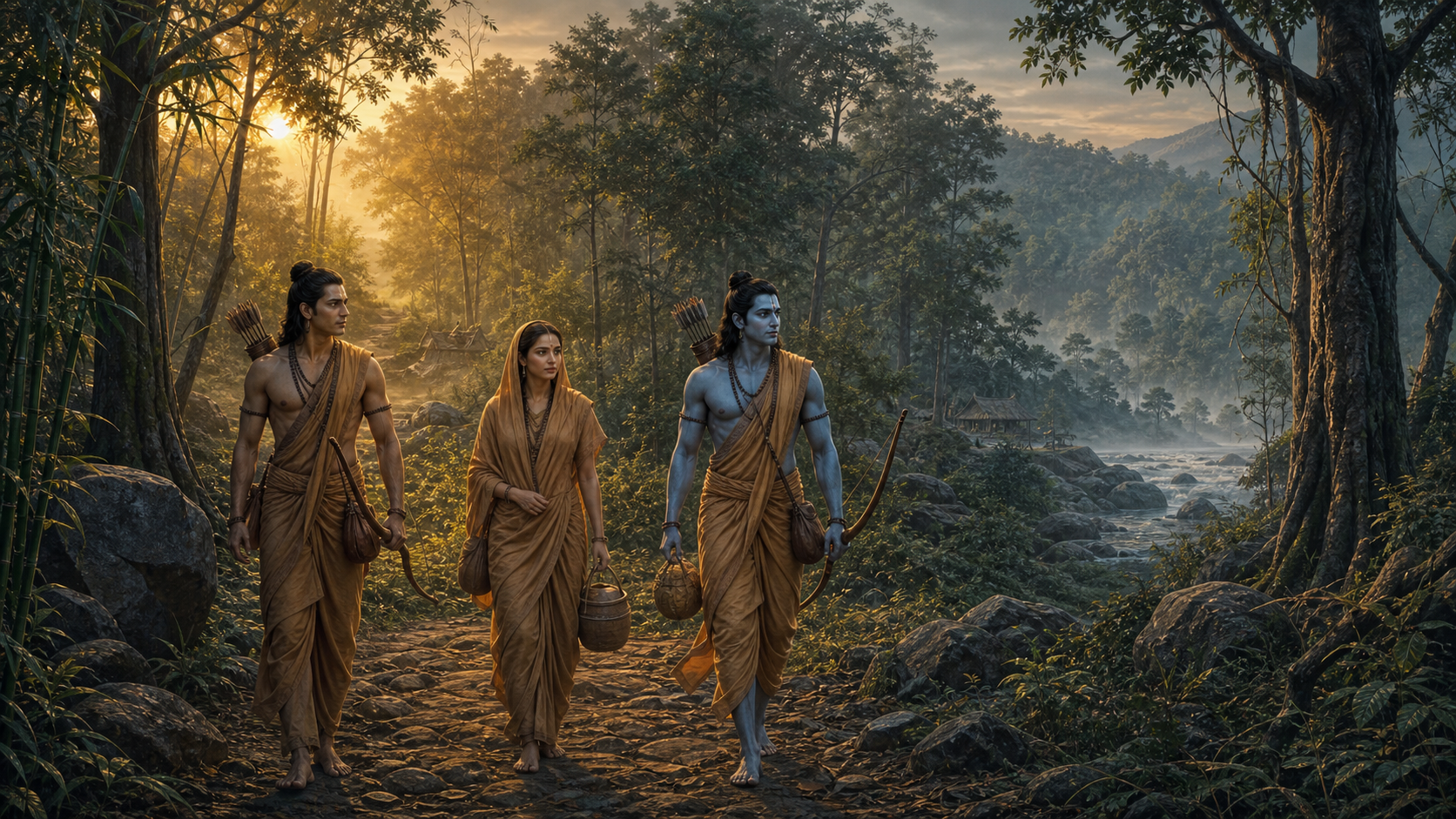
Set in the early sargas of the Aranya Kanda, the encounter with Viradha in Valmiki’s Ramayana demonstrates how Rama and Lakshmana combine disciplined courage with lawful ingenuity to defeat a rakshasa protected by a boon. The episode transforms a battlefield into a seminar in applied ethics: honor the letter and spirit of law, adapt strategy…
-
Ravana’s Doom Foretold: Dattatreya’s Disciples, a Vanara’s Kick, and Dharma’s Triumph

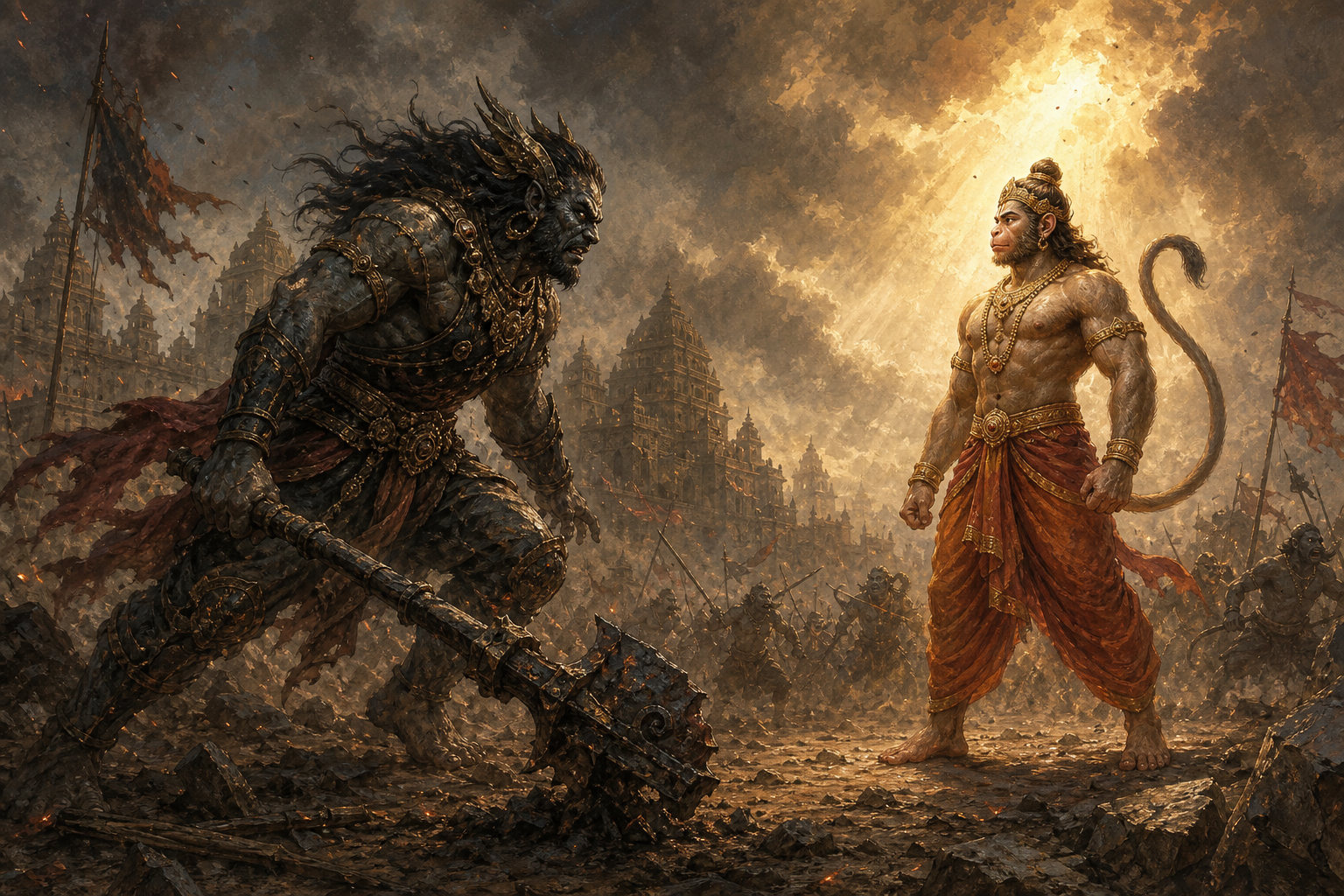
This long-form analysis examines a powerful Ramayana motif: a sage’s curse that Ravana, intoxicated by power and pride, would be humiliated—even kicked—by vanaras. It situates a regional strand that identifies the ascetics as disciples of Dattatreya alongside the canonical curse of Nandi in the Valmiki Ramayana’s Uttara Kanda. Readers gain a clear sense of how…
-
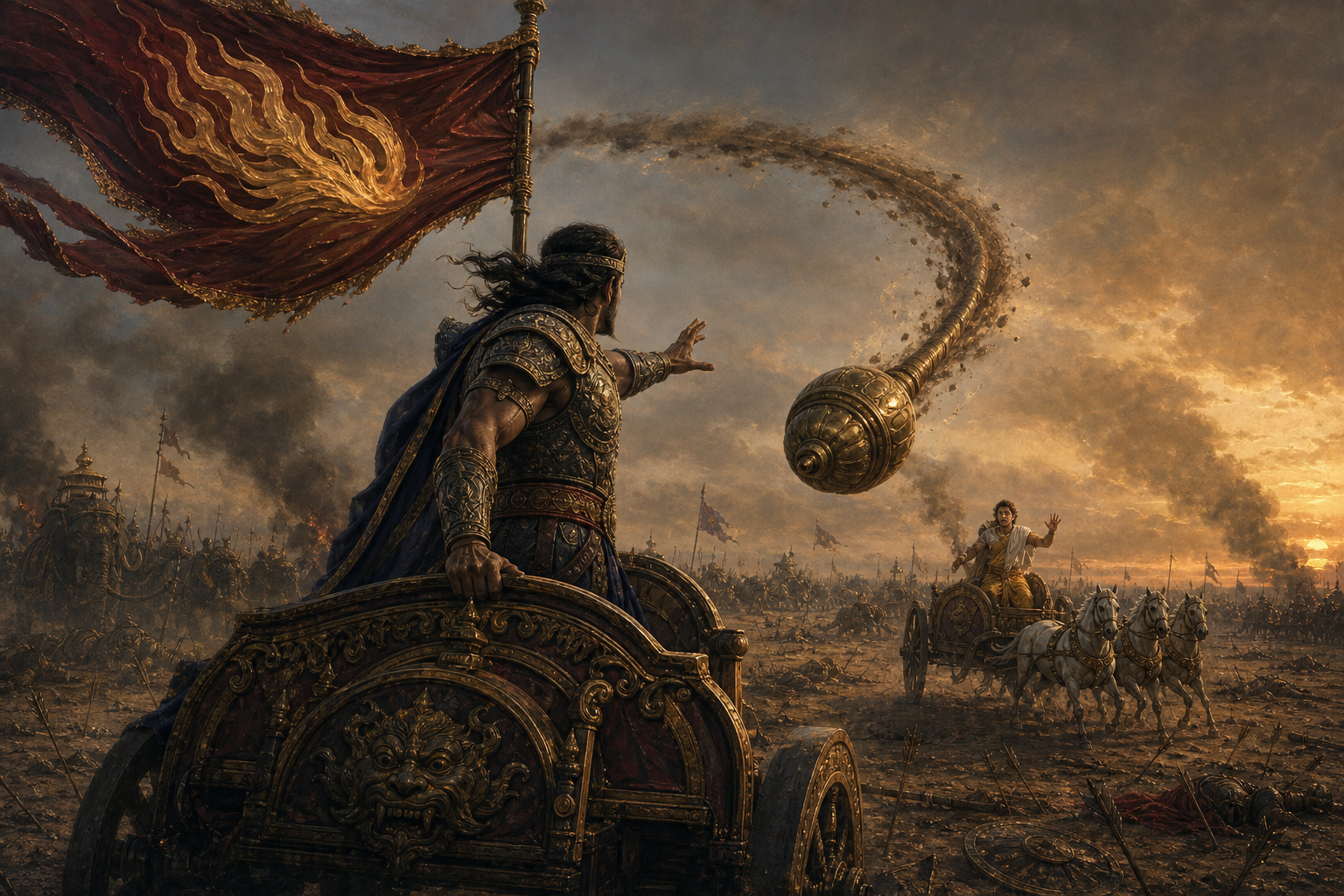
Krishna Lifts the Wheel: Kurukshetra’s Defining Clash of Dharma, Devotion, and Duty

This essay reconstructs the Kurukshetra War’s most arresting moment—when Sri Krishna seized a broken chariot wheel and charged Bhishma—through the converging lenses of history, scripture, and ethics. It situates the scene within the Mahabharata’s early war phase, explains the vows of Krishna and Bhishma, and shows why the choice to protect Arjuna illuminates the logic…
-
Who Is a True Guru? Shrimad Bhagavat’s 24 Transformative Lessons from the Avadhut

What is a true Guru according to the Shrimad Bhagavat? The Eleventh Canto’s dialogue between King Yadu and an Avadhut answers by expanding the Guru beyond a single figure to a universal function that dispels ignorance wherever it appears. Through 24 striking lessons from nature and human life—Earth’s forbearance, the Ocean’s equanimity, Pingalā’s renunciation, the…
-
Beyond ‘I Am’: Tripura Rahasya’s Bold Guide to Pure Consciousness and Nondual Freedom

Tripura Rahasya advances a radical Advaita Vedanta insight: genuine Self-Realization dissolves identity so completely that even the thought “I am” no longer arises, without slipping into blankness. The teaching redirects attention from concepts to pure, self-luminous awareness (cit), illuminating all states—waking, dream, and deep sleep—while resting as the nondual ground (turīya). It details a rigorous…
-
Karna’s Final Charity: Unbreakable Dāna, Dharma, and Lessons from Kurukshetra

This long-form analysis examines the widely remembered motif of Karna’s final charity on the battlefield of Kurukshetra and situates it within the Mahabharata’s ethical universe. It distinguishes between the critical Sanskrit text and later regional and oral retellings that amplify Karna’s identity as Dāna-vīra. Through the lens of the Bhagavad Gita’s typology of dāna, the…
-
Pingalamata Unveiled: The Bhairava Agama Guiding Linga Worship and Temple Consecration

Pingalamata is a Bhairava-oriented Shaiva Agama that codifies the ritual science and architectural norms of Linga worship and temple consecration. Closely allied with the Brahmayamalatantra, it aligns mantra, mudra, nyasa, yantra, and mandala to create a reliable pathway for manifesting Shiva’s presence. Readers gain a structured view of daily puja, abhishekam, prana-pratishtha, kumbhabhisheka, and the…
-
Sri Rama’s Virtue and Valor: A Timeless Dharma Blueprint for Courageous, Just Leadership

Sri Rama’s portrayal in the Ramayana unites virtue (dharma) with valor (kshatra), forming the ideal of Maryada Purushottama. This synthesis grounds strength in compassion and binds power to law, offering a reliable template for just leadership and community protection. The epic narratively encodes principles akin to just war ethics: just cause, right intention, last resort,…
-
Pranavopasana: Mastering Om for Self‑Realization, Inner Calm, and Dharmic Unity

Pranavopasana—meditation on the Pranava (ॐ)—is a disciplined path in Hinduism and Advaita Vedanta that moves attention from sound to silence and from symbol to the Ultimate Reality. Drawing on the Upanishads, Bhagavad Gita, and Patanjali, it unites devotion, meditation, and inquiry into a coherent practice for Self-realization. The article explains the A–U–M arc, the turiya…
-
Timeless Life Lessons from the Ramayana: Integrity in Action and Devotion with Patience

The Ramayana offers enduring guidance on ethics and spiritual discipline through two luminous episodes: Jatayu’s defense of Sita and Shabari’s patient, joyful preparation for Sri Rama. Read as a practical framework, Jatayu models courage that privileges dharma over short-term gain, while Shabari models disciplined readiness that turns daily tasks into sacred practice. Together, they show…
-
Matrisadbhava of Kerala: Authoritative Guide to Shakta Tantra and Bhadrakali (Rurujit)

Matrisadbhava stands out in Hindu scriptures as a Kerala-centered Shakta Tantra that systematically encodes the worship of Goddess Bhadrakali, also revered as Rurujit. It unites doctrinal depth with Kerala’s temple pragmatics—nyāsa, mantra, yantra, homa, and bali—while foregrounding an ethic of care and precision. The text’s maternal vision affirms unity in diversity across Dharmic traditions, highlighting…
-
Why Lord Shiva Eluded the Pandavas: The Haunting Aftermath of Kurukshetra and Panch Kedar

This article examines why, according to epic, Puranic, and Himalayan traditions, Lord Shiva eluded the Pandavas after the Kurukshetra War. It situates the narrative within the Mahabharata’s ethics, where victory still demands prayaścitta for wartime transgressions. It then traces the lore from Kashi to Guptkashi and the Panch Kedar, explaining how Shiva’s concealment pedagogically compels…
-
Washerman’s Whisper and Sita’s Ordeal: Unraveling Ramayana’s Most Debated Mystery

The ‘washerman episode’ in the Ramayana is more than a narrative twist; it is a rigorous exploration of ethics, governance, and compassion. This article situates the scene—five spies praising Sri Rama and a sixth overhearing a washerman’s harsh rebuke—in its textual and historical contexts, noting variations across Valmiki’s Uttara Kāṇḍa and later vernacular traditions. It…
-
Beyond ‘300 Ramayanas’: Valmiki’s Legacy, Rasa Aesthetics, and Dharmic Unity in Retellings

This essay maps the many Rāmāyaṇa traditions while reaffirming the aesthetic primacy of Vālmīki’s Sanskrit epic. It classifies adaptations into four clear streams—dharmic subtraditions, texts attributed to Vālmīki and folk narratives, classical kāvya and drama, and modern ideological readings—so readers can evaluate variations without losing the original’s moral and poetic center. Murāri’s verse and Ānandavardhana’s…
-
Andhatāmisra Unveiled: Inside Hinduism’s Blinding Hell of Deceit, Karma, and Justice

Andhatāmisra, the purāṇic “realm of blinding darkness,” illuminates Hinduism’s precise view of karmic retribution for deceit, cruelty, and willful ignorance. Drawing on sources such as the Garuḍa Purāṇa and the Bhāgavata Purāṇa, it explains how Naraka functions as a purgative, finite state aligned with Dharma and Adharma. The imagery of darkness serves as both cosmic…