
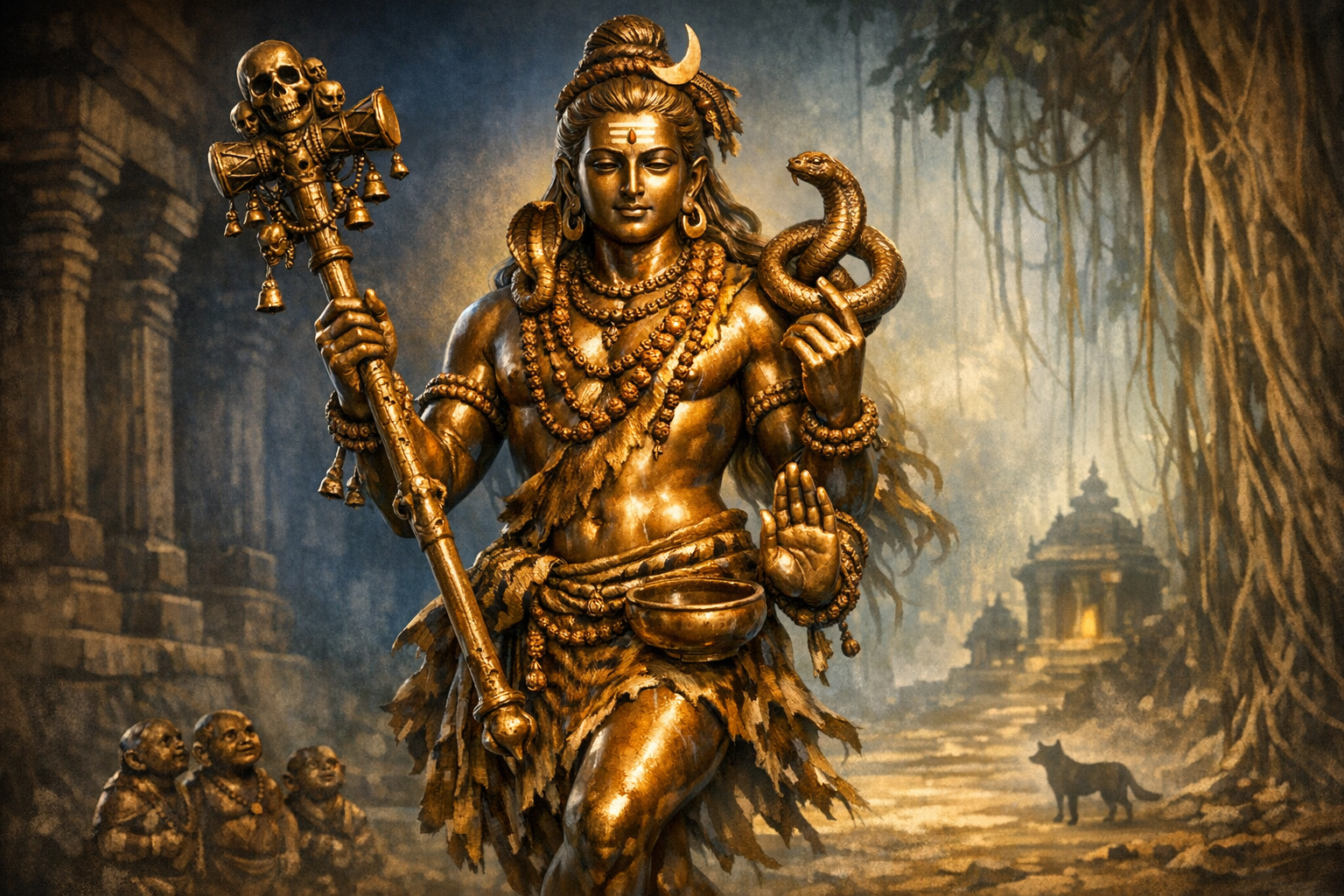
Kankala Murti, literally “the bearer of the bone-staff,” presents a riveting, philosophically charged facet of Shiva within Hindu iconography. Celebrated in the Shaiva Agamas and echoed in Puranic literature, this form synthesizes ascetic renunciation, transgressive wandering, and radical compassion into a single visual theology. At first glance, it closely resembles Bhikshatanathe itinerant mendicant form of Shivayet a closer, textually grounded reading reveals distinctive markers and a profound theological thrust toward transcendence of death (mrityu) and ego (ahamkara).
Positioned among Shiva’s many manifestations, Kankala Murti occupies a rare intersection of ugra (fierce) and shanta (peaceful) rasas. It retains the sensual ambiguity and liminal power of the forest-wanderer motif while sharpening its soteriological edge through the conspicuous presence of the kankala-danda, a staff adorned with skeletal elements. The image, long favored in South Indian temple sculpture and Chola-period bronzes, stands as a visual treatise on the hollowness of social pretensions and the immediacy of liberation (moksha) when the fear of death is seen through and surpassed.
Lexically, kankala refers to bones or a skeleton, while murti denotes a manifest form suitable for contemplation, worship, and teaching. The compound thus designates Shiva as the ascetic wanderer who bears a skeletal staffan iconographic signature that differentiates this form from Bhikshatana’s more familiar khatvanga (skull-topped staff). In both the Shaiva Agamas and sculptural handbooks (śilpaśāstra), the kankala-danda is not an incidental attribute; it is the interpretive key to the entire figure.
Agamic recensions such as the Kamikagama, Suprabhedagama, and Karanagama, alongside Puranic strata like the Skanda Purana and the Linga Purana, preserve multiple narrative threads that give rise to this form. The textual ecology is diverse, and temple traditions often blend strands, so local sthala-puranas may foreground details that differ in emphasis or sequence. Across these tellings, the outcome remains consistent: Shiva embraces an uncompromising itinerancy to instruct beings that the bonds of pride, status, and even ritual purity dissolve before the truth of impermanence.
In several accounts, Kankala Murti evolves in proximity to the Bhikshatana cycle connected to the Darukavana episode, where ascetic pride among forest rishis is upended by Shiva’s transgressive grace. There, Shiva’s wanderingbegging with a kapala (skull-bowl)exposes the fragility of moral vanity. Kankala Murti intensifies the same pedagogic arc: the bone-staff becomes a moving emblem of memento mori, a portable cremation ground that follows the wanderer into villages and ceremonial spaces alike.
Other narrative variants, reflected in certain Agamic and Puranic layers and echoed in temple lore, explain the skeletal staff through an episode of conflict that leaves a bodyor its symbolic equivalentaffixed to Shiva’s danda. Whether interpreted as the residue of transgression, the personification of ritual error (dosha), or the husk of egoic identity, the result is the same: through long penance and public mendicancy, Shiva demonstrates that the ultimate purifier is direct insight, not status, possession, or fear.
Art-historically, Kankala Murti is typically rendered as a youthful, ascetic Shiva in dynamic stride (tribhanga or a gentle alidha), often digambara (nude) or clothed in vyaghra-charma (tiger skin) or gaja-charma (elephant hide). The jata-makuta (matted hair crown) rises in a whorl; serpents substitute for jewels; the tripundra of ash marks the brow; and the third eye remains implicit or explicit, signaling omniscience and destructive compassion. The overall bearinglean, graceful, and slightly forwardconveys movement through the social world without adhesion to it.
The defining attribute is the kankala-danda: a staff often depicted with an affixed skeleton or articulated bone elements. In many sculptural programs, a transverse element suspends rattling paraphernaliabells, skulls, or a tiny damaruunderscoring the doctrine that sound, time, and embodiment are bound to dissolve. This articulate staff may be held in one of the left hands when the image is four-armed, while the corresponding right hands carry a damaru, a serpent, or show abhaya/varada mudras. In two-armed variants, the kapala-patra (skull-bowl) is common, intensifying the icon’s ascetic register.
Attendant figures vary by region and period. Ganas and bhutas often cluster around the feet; womensometimes identified as forest wives or civic onlookersappear captivated yet unsettled; a stray dog may hint at Bhairava’s presence; and children occasionally enact scenes of curiosity or trepidation. The backdrop, even when minimal, implies a liminal zone where cremation ground and city square overlap, mirroring the way Kankala Murti dissolves strict boundaries between ritual purity and common life.
Comparison with Bhikshatana sharpens Kankala Murti’s profile. Both forms share the wandering ascetic’s nudity or light attire, the kapala, and the itinerant posture. Yet Bhikshatana’s staff typically culminates in a skull (khatvanga), whereas Kankala Murti’s staff carries a more elaborate skeletal sign, pushing the discourse from ascetic subversion to a direct confrontation with death itself. Where Bhikshatana persuades softly, Kankala Murti insists unequivocally: the body’s end is certain, so compassion and non-attachment must begin now.
Philosophically, the image is a walking Upanishad. The skeletal staff operates as an uncompromising visual of anitya (impermanence), a reminder that social capital, ritual correctness, and self-image fail before the law of change. By carrying death as an emblem, Shiva appears as Mrityunjayathe conqueror of deathnot by fleeing it but by bearing witness to it, intimately and publicly. Devotees encountering this murti often report an immediate quieting of mind, a turn toward courage, and a softened heart toward all living beings who share the same fate.
Within the broader dharmic ecumene, Kankala Murti resonates with shared śramaṇa values found across Hinduism, Buddhism, Jainism, and Sikhism: non-attachment, ethical cultivation, and service grounded in humility. The wandering ascetic motif parallels the Buddhist bhikshu’s alms round and the Jain muni’s vow-intensive itinerancy; its didactic force likewise aligns with Sikh teachings that center ethical action, equality, and remembrance of the Divine. Read devotionally or philosophically, the murti advances a unifying lesson common to these traditions: when fear loosens, compassion expands.
Ritually, Kankala Murti appears in processional bronzes and niche sculptures, especially in South India. Chola-period ateliers refined the type with extraordinary anatomical subtlety and kinetic poise, making it a powerful presence in utsava circuits. While textual references surface in the Skanda Purana and allied literature, agamic manuals guided sthapatis in prescribing lakshanas, proportions, and attributes to ensure both theological accuracy and ritual efficacy. The result is an image that is as theologically dense as it is visually striking.
Temples linked to major Shaiva centerssuch as those in the Kaveri deltapreserve cognate forms and narratives in stone and bronze. In these settings, the murti functions pedagogically: devotees receive darshan of a form that traverses cremation ground and market lane without contradiction. Priestly recitations of the Sri Rudram and invocations to Mrityunjaya often accompany contemplations of this icon, knitting practice to doctrine: fear is not banished by denial but by lucid seeing.
Iconographic details admit regional variation. Some images emphasize santamserene countenance, graceful stride, gentle abhaya; others accent ugra traitspiercing gaze, more explicit skeletal detailing, or a stronger Bhairava resonance via attendant dog, sword, or noose. Both currents remain faithful to the central lakshana: the bone-staff as an uncompromising teacher. Whether encountered in bronze during a festival procession or glimpsed in a dim niche off a temple prakara, the form maintains its didactic power.
From an art-historical perspective, Kankala Murti enriches the study of Hindu Iconography by clarifying how attributes function as theological syntax. The staff, bowl, stride, and gaze compose a grammar of liberation recognizable across mediastone, bronze, and painted manuscripts. Such clarity supports interdisciplinary work across Indology, Sanskrit textuality, and archaeological documentation, while also aiding temple-goers and students in identifying, interpreting, and honoring the image correctly.
Thematically, Kankala Murti also provides a bridge for inter-sectarian appreciation within Hinduism. Vaishnava-Shaiva narrative crossovers embedded in Puranic traditions underscore complementarity rather than rivalry, and many temples honor both Vishnu and Shiva through shared festivals and reciprocal myths. In this spirit, Kankala Murti is not a challenge to other devotions but an invitation to deepen them by anchoring bhakti in the fearless knowledge that liberates.
For contemporary practitioners and researchers, the form offers two practical insights. First, contemplative engagement with mortalityremembered daily or weeklytends to yield increased ethical clarity, gratitude, and service orientation. Second, devotion to a fierce-yet-compassionate murti strengthens resilience, enabling individuals and communities to respond to suffering with steadiness rather than panic. In this way, Kankala Murti continues to teach beyond temple walls, animating an ethic of courage that harmonizes with the wider dharmic ethos.
In sum, Kankala Murti embodies Shiva as the supreme wanderer beyond death: a living commentary on impermanence, a challenge to spiritual complacency, and a call to fearless compassion. By situating the form within the Shaiva Agamas, the Puranas, and the lived practices of templesparticularly the South Indian corpus enriched by the Chola Dynastythis iconography becomes intelligible, relatable, and transformative. For seekers, scholars, and devotees across Hinduism, Buddhism, Jainism, and Sikhism, the lesson converges: only what is freely givenattention, compassion, and truthtruly remains.
Inspired by this post on Hindu Blog.
