
-
Can God Be Seen? Discipline, Darshan, and the Hard-Won Freedom of True Liberation
Can God be seen? Dharmic traditions answer yesbut only when the instrument of knowing is refined by ethics, contemplation, study, service, and grace. Drawing on the Bhagavad Gita, the Upanishads, Yoga Sutras, and parallel insights from Buddhism, Jainism, and Sikhism, this essay explains why darshan is not a spectacle but a disciplined way of seeing.…
-
Why Chamunda’s Severed, Smiling Head Signifies Bliss: Decoding Ego-Death and Moksha
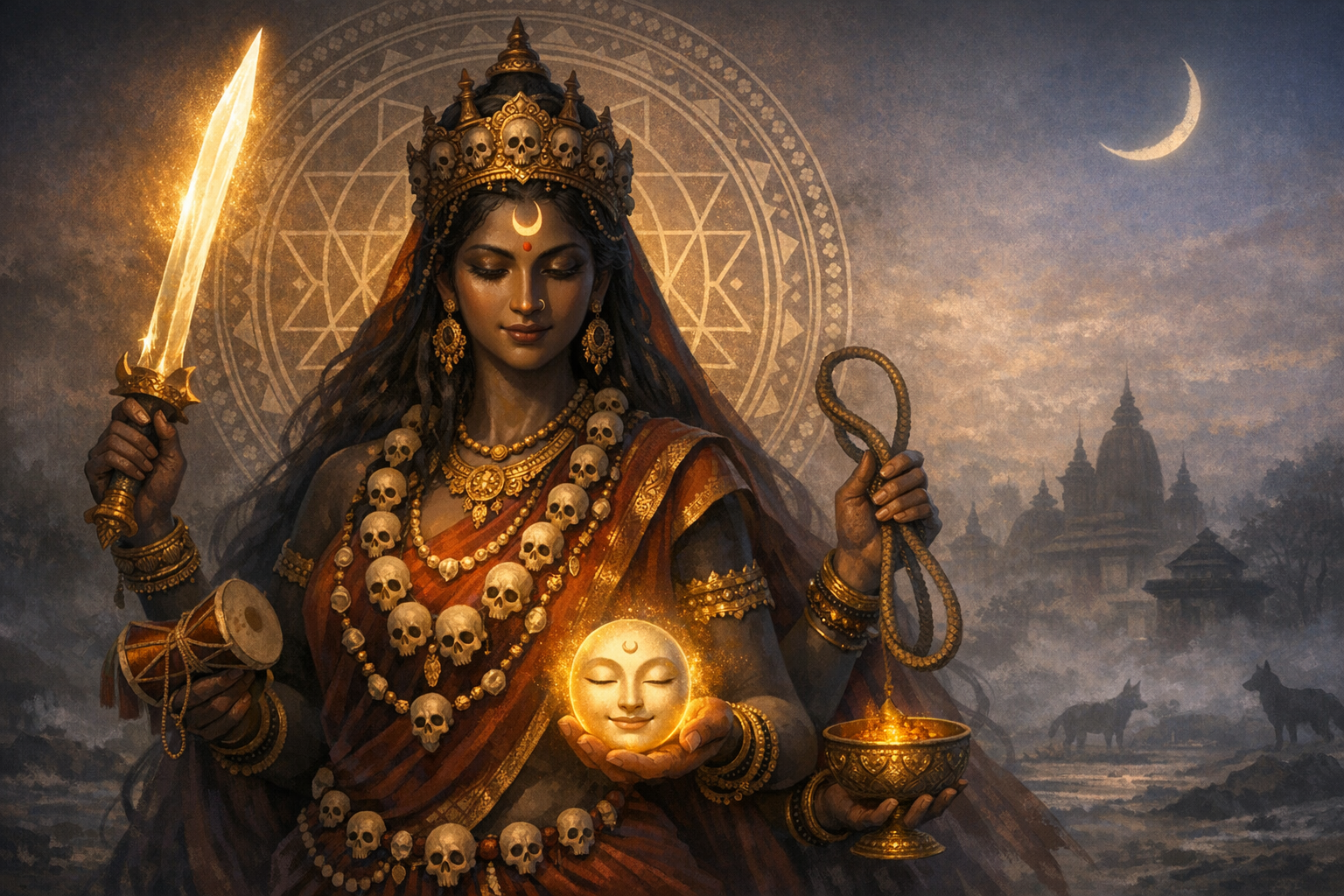
Chamunda’s severed head is not an emblem of violence but a precise symbol of liberation: the serene face represents ego-death and the bliss of moksha. By situating the image within Shakta tantra, cremation-ground sadhana, and the mundamala/kapala vocabulary, the analysis shows how fear is transmuted into insight. Panchamundi Asana symbolism and comparisons with Kali and…
-
Karma and Karmaphala in the Ramayana and Mahabharata: Dharma, Consequence, and Liberation

This essay reads the Ramayana and Mahabharata as precise ethical maps of karma (action) and karmaphala (consequence), showing how intention, duty, and context shape outcomes. It explains sañchita, prārabdha, and āgāmi karma, and situates them within dharma and the puruṣārthas. Through case studiesDaśaratha’s unintended harm, Rāvaṇa’s hubris, the dice hall’s complicity, Karna’s complexity, and Bhīṣma’s…
-
The World as a Roadside Inn: A Dharmic Guide to Impermanence, Detachment, and Freedom

This essay explores the classic dharmic metaphor of the world as a roadside inn to clarify impermanence, detachment, and ethical action. A teaching story of a mendicant and a king introduces the theme, which is then examined through the Bhagavad Gita, Upanishads, Patanjali’s Yoga Sutra, and Jain, Buddhist, and Sikh perspectives. Readers learn how anitya…
-
Break Free from Fragmentation: Seeking the Whole in Vedanta and Dharmic Paths for Inner Peace

This article unpacks the insight that suffering arises from fragmentation and shows how Vedanta and the broader dharmic traditions offer a precise remedy by seeking the whole. It explains avidya through the Upanishads and the Bhagavad Gita, connects Yoga’s kleshas and eightfold discipline to integration, and brings in Buddhist, Jain, and Sikh perspectives that converge…
-
Moksha Without Martyrdom: Why Hinduism Teaches Liberation Through Knowledge, Not Pain

The notion that God desires human suffering for spiritual realization conflicts with Hindu philosophy. Across the Upanishads, the Bhagavad Gita, and Vedanta, moksha arises through knowledge, devotion, selfless action, and meditationnot by glorifying pain. The Gita even censures self-mortification, framing tapas as disciplined refinement rather than injury. Hindu ethics centers ahimsa, while jnana, bhakti, karma…
-
Unmasking Myths: How Truly Enlightened Beings Live, Eat, and Speak Among Us

This essay dismantles the popular myth that enlightened beings must look or act extraordinary, showing instead how Dharmic traditions depict realization as profound normalcy. Drawing on Hindu philosophy, Buddhism, Jainism, and Sikhism, it clarifies how liberation expresses itself in everyday eating, speaking, working, and serving. It synthesizes concepts such as mokṣa, nirvāṇa, kaivalya, kevala-jñāna, and…
-
Beyond Name and Fame: A Dharmic Blueprint to Transcend Materialism and Find Lasting Fulfillment

Modern culture often mistakes accumulation, name, and fame for life’s highest achievement, yet this chase rarely resolves the inner void it aims to fill. A Hindu lensaligned with Buddhist, Jain, and Sikh insightsframes the compulsion as avidya, a misidentification of self with roles and possessions. Anchored in the purusharthas, the analysis shows how artha and…
-
Ravana’s Abduction of Sita Revisited: Dharma, Curses, and a Deliberate Path to Moksha
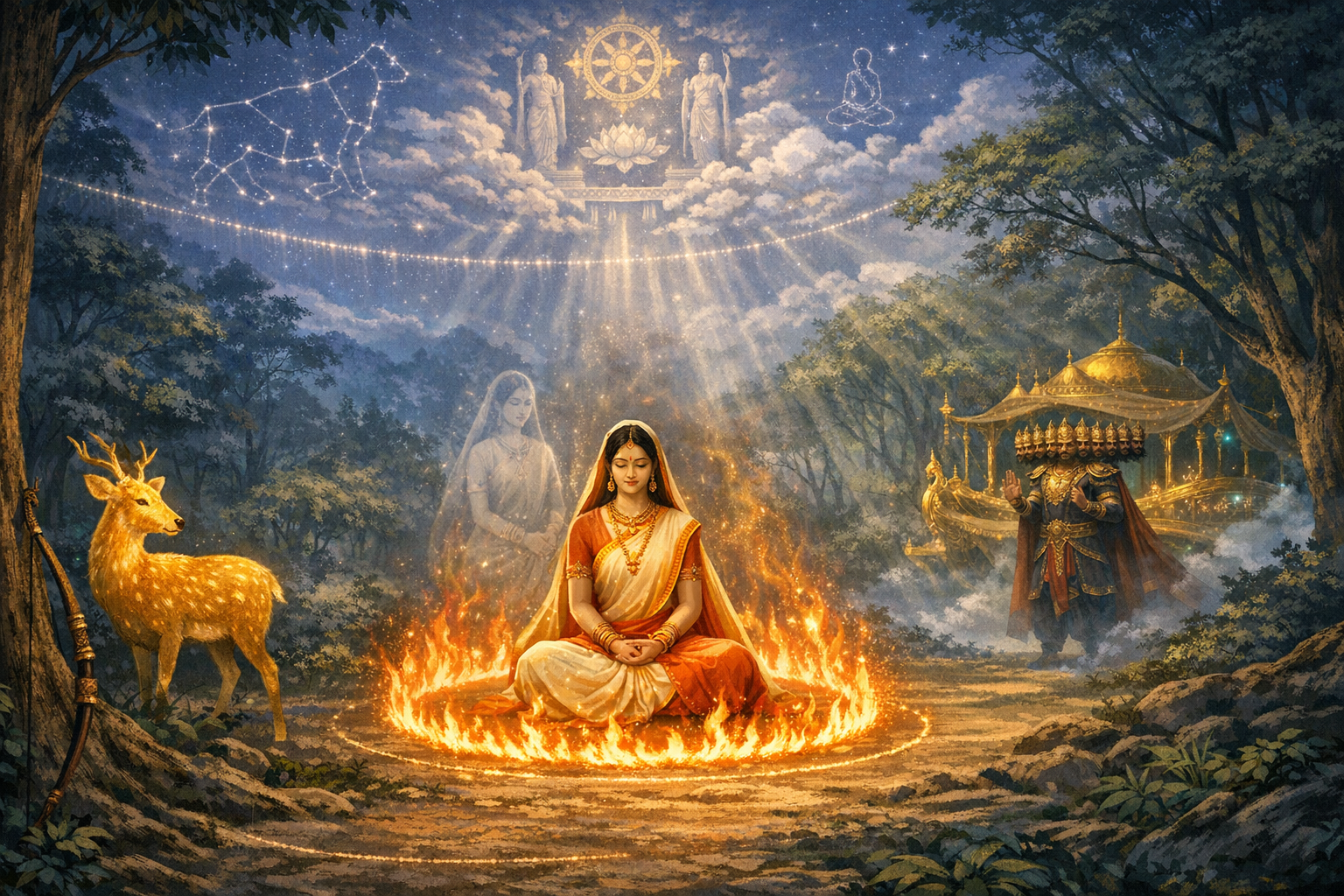
Did Ravana kidnap Sita to be slain by Sri Rama and attain moksha? A careful, text-sensitive study shows that while Valmiki’s Ramayana emphasizes Ravana’s pride and desire, later Puranic and bhakti traditions interpret his fall within a cosmic design of grace. The Jaya–Vijaya doctrine, vaira-bhakti (absorption through enmity), karmic curses, and the Maya Sita motif…
-
Cultivating Contentment: Dharmic Pathways to Enduring Happiness and Inner Peace

This essay examines why contentment generates enduring happiness through a unified lens from Hinduism, Buddhism, Jainism, and Sikhism. It distinguishes short-lived pleasure (sukha) from abiding wellbeing (ananda) and situates santosha within Yoga philosophy and the Bhagavad Gita’s portrait of steady wisdom. It integrates Vedanta’s Pancha Kosha model, Buddhist mindfulness and equanimity, Jain ahimsa and aparigraha…
-
Beyond Ahamkara: How Dharmic Wisdom Unmasks Ego and Illuminates Liberation

The aphorism “As long as there is the ego, everything else exists” concisely names the mechanism of duality in Hindu philosophy and resonates across Buddhism, Jainism, and Sikhism. This long-form analysis maps ahamkara in Sankhya, asmita in the Yoga Sutra, and adhyasa in Advaita Vedanta, linking them with the Bhagavad Gita’s diagnosis of doership. It…
-
Katha Rudra Upanishad: A Timeless, Transformative Guide to Sannyasa and Brahma-Jnana

The Katha Rudra Upanishad, affiliated with the Krishna Yajurveda, presents 47 mantras that redefine sannyasa as inner renunciation oriented to Brahma-jnana. It privileges ethical foundations like ahiṁsā and aparigraha, uniting conduct and contemplation as prerequisites for non-dual insight. By emphasizing Om, mahāvākya meditation, silence, and self-inquiry, the text converts knowledge from concept to lived clarity.…
-
Sacred Sound at Life’s Threshold: The Transformative Power of Om for Conscious Departure

This essay explores why chanting Om at the end of life is revered in Hinduism and how it supports a conscious, peaceful departure. Drawing on the Bhagavad Gita and the Upanishads, it explains Om as a symbol of total consciousness and a practical aid for liberation (moksha). It highlights how regular mantra-japa, meditation, and pranayama…
-
Nadi Samudra Nyaya: A Powerful River–Ocean Metaphor of Jiva, Brahman, and Liberation

Nadi Samudra Nyaya, the “Maxim of the River and the Ocean,” clarifies how Advaita Vedanta explains the relation between the individual self (jiva) and the ultimate reality (Brahman). The metaphor shows how apparent separateness dissolves at the point of realization, aligning with Upanishadic insights such as “Tat Tvam Asi.” Readers gain a clear, experience-near understanding…
-
Shiva Maha Purana at Prayag: Sage Suta’s Discourse on Moksha, Dharma, and Timeless Wisdom

At Prayag, amid a sacred yagya, sages invited Sage Suta to elucidate the significance of the Shiva Maha Purana, affirming the belief that attentive listening can guide seekers toward moksha. The episode demonstrates how Puranic storytelling unites devotion, knowledge, and ethical living within Hindu scriptures. It models satsangacollective listening that transforms learning into practice through…
-
Seven Stages of Life in the Ramayana: A Dharma-Guided Journey from Childhood to Moksha
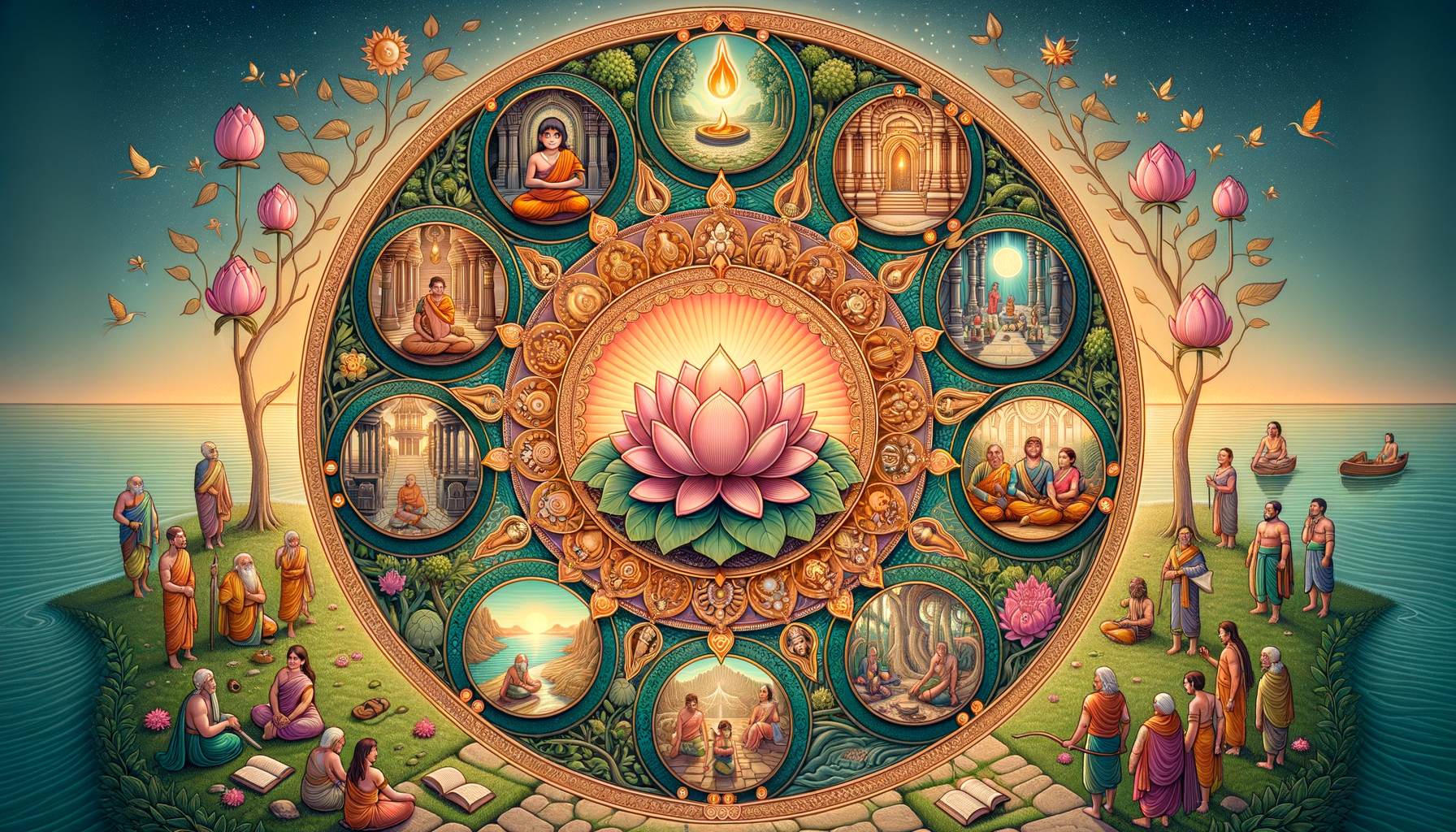
The Ramayana offers a symbolic map of seven life stagesfrom childhood to mokshashowing how dharma shapes character, relationships, leadership, and final liberation. Read as a guide, not only as history, it highlights how virtues formed in childhood mature through disciplined study, ethical family life, purposeful renunciation, just action, compassionate governance, and ultimately selfless letting go.…
-
Karmashaya Demystified: Uncovering the Hidden Storehouse of Karma in Patanjali’s Yoga

KarmashayaPatanjali’s term for the subtle storehouse of karmaexplains how actions leave impressions (samskaras) that condition future experience. Grounded in the Yoga Sutras (2.12), it links klesha-driven actions to both present and unforeseen outcomes, clarifying the mechanics of reactive patterns. Read together with the threefold classification of karma (sanchita, prarabdha, agami), karmashaya functions as a dynamic…
-
Paramapurushartha Explained: The Supreme Human Goal in Hindu Thought for Inner Freedom

Paramapurushartha signifies the supreme human goal in Hindu philosophy, situating moksha as the culmination of life’s aims while harmonizing dharma, artha, and kama. It offers a practical framework for meaning, guiding ethical prosperity and refined enjoyment toward inner freedom. Drawing on the Upanishads, Bhagavad Gita, and Yoga, it aligns with parallel ideals across Dharmic traditionsnirvana…
-
Fearlessness and Detachment in Hinduism: Powerful Practices for Inner Freedom and Growth

Fearlessness (abhaya) and detachment (vairagya) are central to Hindu philosophy, shaping a confident, ethical, and compassionate way of life. Fearlessness stabilizes decision-making under uncertainty, while detachment clarifies judgment by releasing attachment to outcomes. Practical disciplinesYoga, meditation, pranayama, japa, svadhyaya, and sevahelp integrate these virtues into daily interactions at home, work, and online. The approach strengthens…
-
Sacred Yet Transient: How Hindu Philosophy Illuminates the Soul’s Journey and the Body’s Role

Hindu philosophy presents the body as a sacred yet impermanent vessel for the eternal Atman, a view memorably expressed in Bhagavad Gita 2:22. Understanding this distinction encourages reverence for embodied life while cultivating non-attachment. The model of sthula, sukshma, and Karana Sharira explains experience across physical, mental, and karmic layers, clarifying why ethical action matters.…