
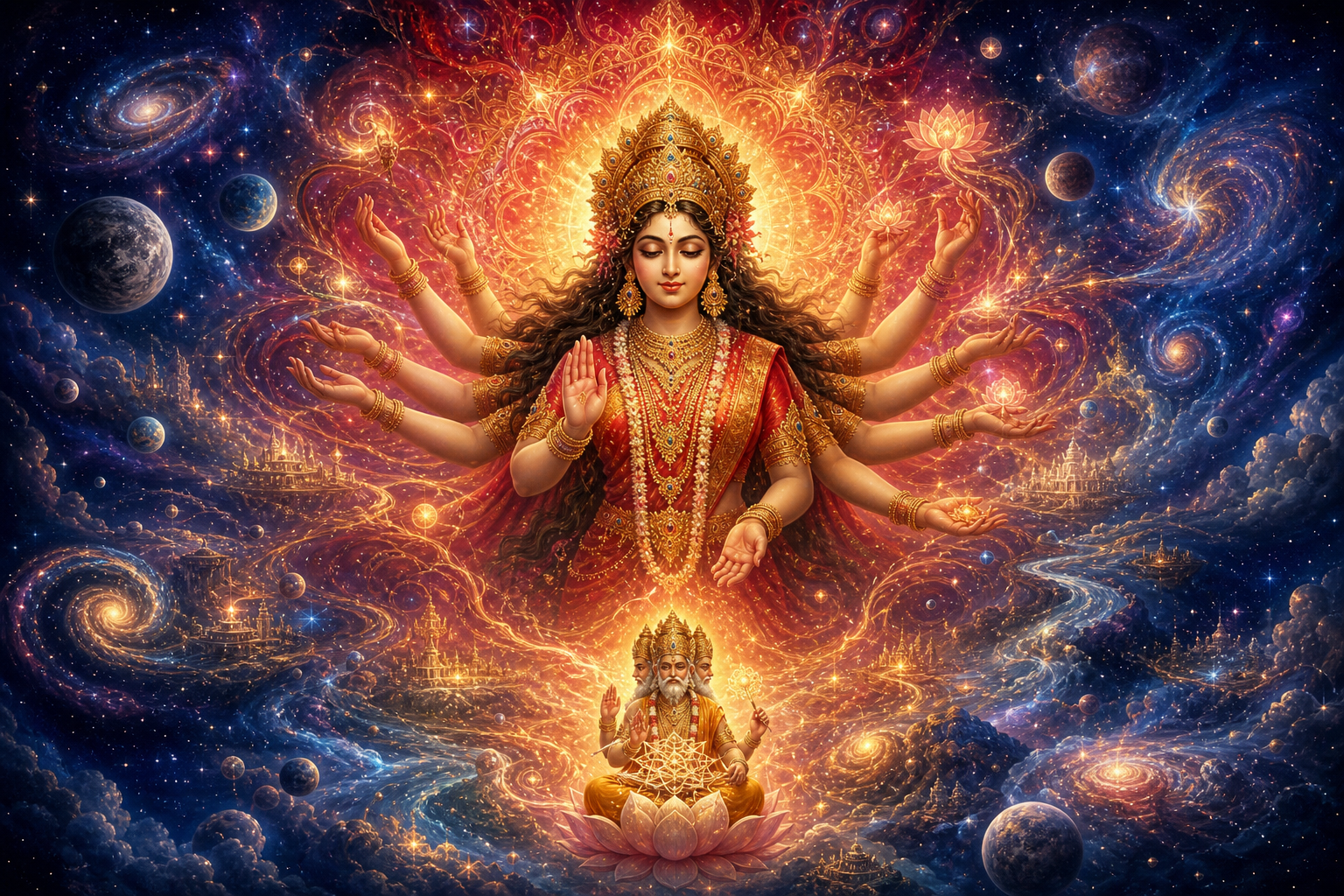
You may have heard that Brahma creates the worlds and that Devi is the source of creation. If both claims sound absolute, the natural question is: which one comes first?
The confusion clears when you distinguish the maker of manifest forms from the power that makes manifestation possible. Brahma performs a cosmic function. Devi, understood as Mahashakti, is the inexhaustible power through which that function – and every other divine function – can operate.
Begin with the distinction between Brahma, Brahman and Devi
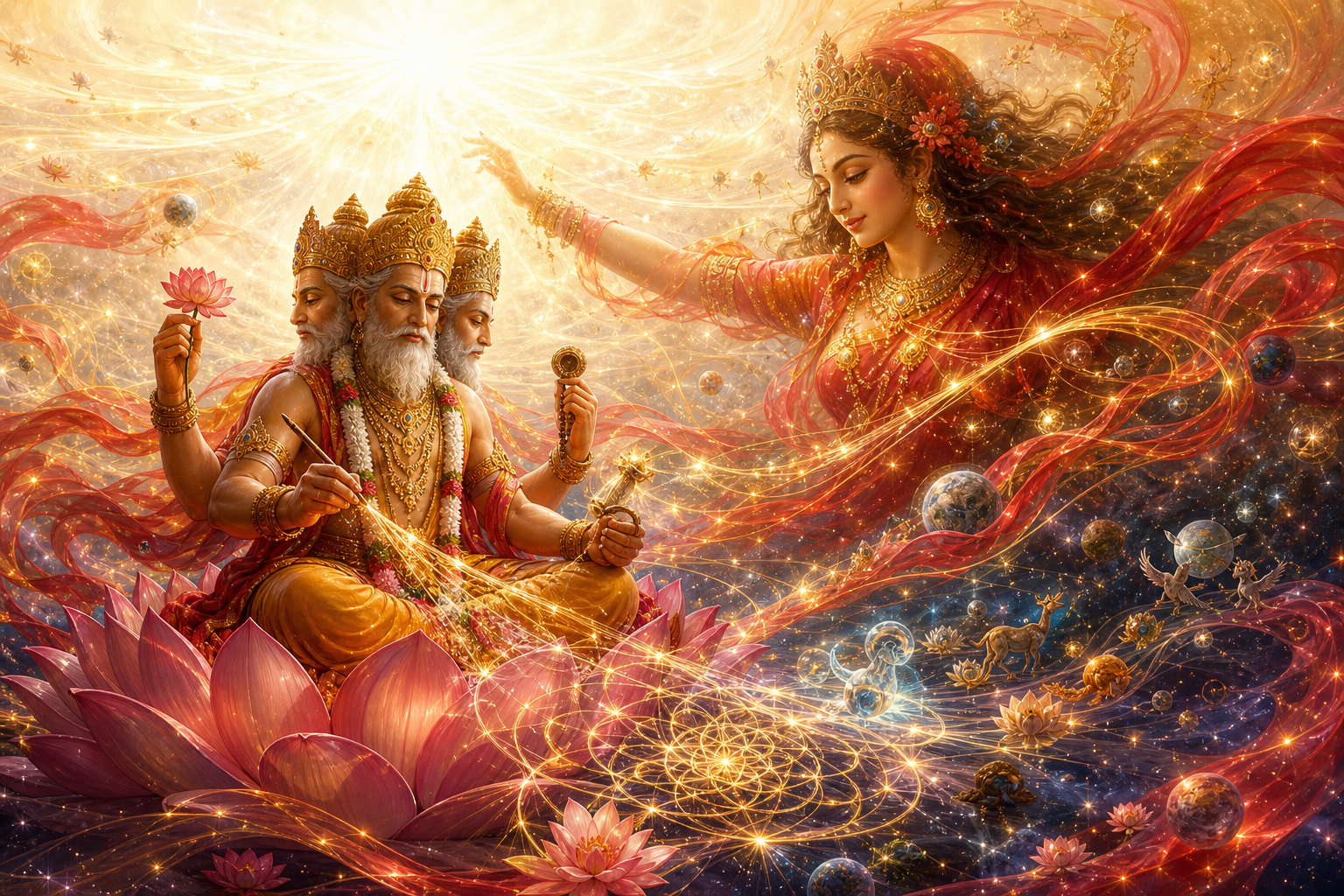
Brahma and Brahman are not interchangeable spellings. Missing this distinction turns a profound question into a needless contradiction.
| Term | What it identifies | Common misreading |
|---|---|---|
| Brahma | The deity associated with arranging and generating the manifest worlds | The absolute beginning of everything that exists |
| Brahman | The boundless reality discussed in Vedantic philosophy | A longer name for Brahma |
| Devi or Mahashakti | The Divine Mother understood as creative, sustaining and transformative power; in Shakta understanding, the Supreme Reality herself | One more limited deity competing with the others |
Calling Brahma the creator therefore does not require you to treat him as the unconditioned source. He is better understood as the cosmic architect: he brings differentiated worlds into order. The capacity to know, intend and create already depends upon Shakti.
Nor should you imagine Devi merely as a female being who happened to exist a little earlier than a male being. That would place both inside the same timeline and leave the original question unanswered. When Devi is named as the cosmic source, she is not another object waiting to be created. She names the reality from which time, causation, intelligence and form become possible.
Different Hindu traditions arrange divine names and forms differently. A narrative centered on Narayana will not necessarily use the same hierarchy as one centered on Shiva or Devi. The careful conclusion is not that every school secretly teaches an identical theology. It is that the word creator can identify a role within the cosmos without identifying the ultimate ground of the cosmos.
Read creation narratives as maps of dependence
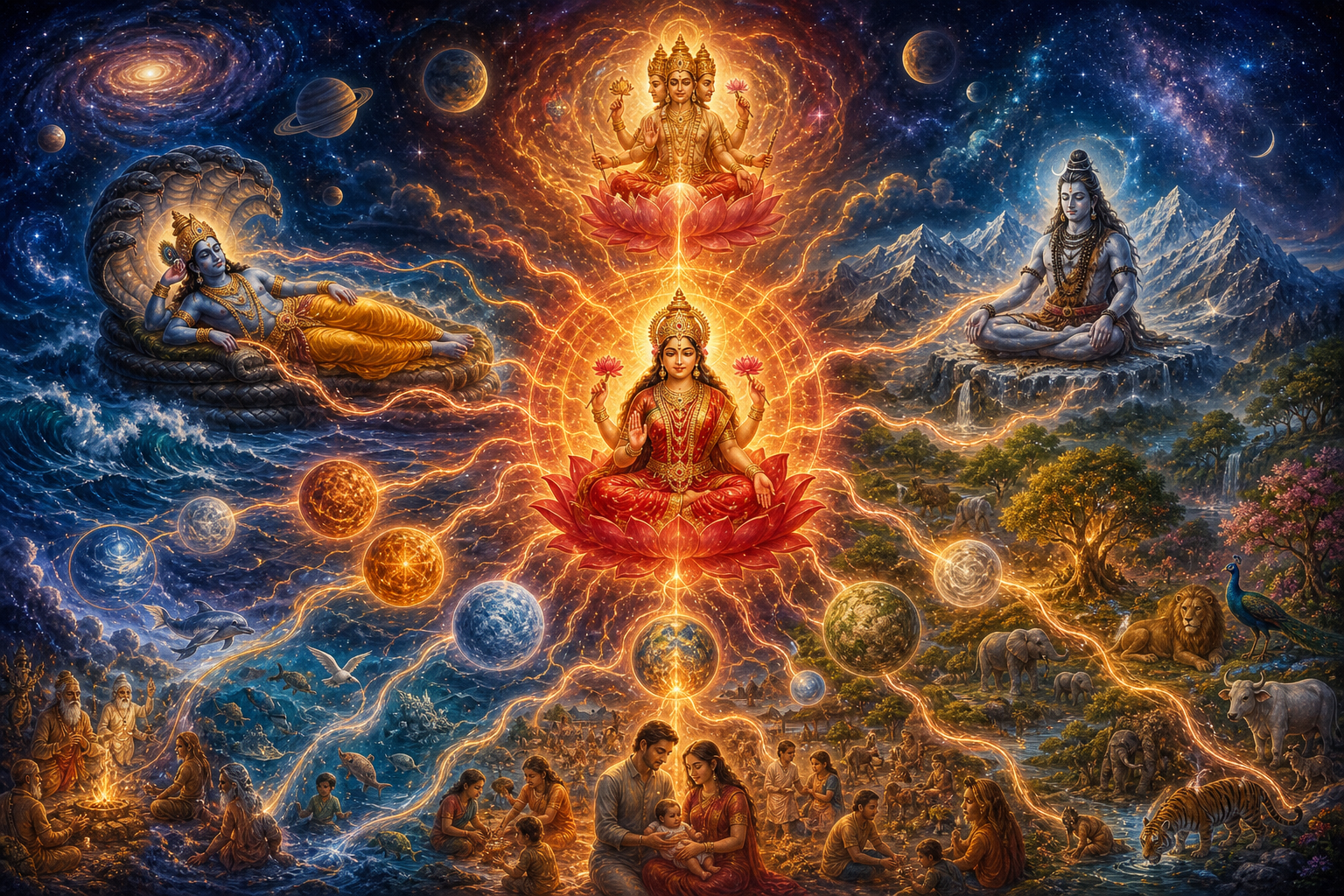
In the familiar lotus account, Narayana rests upon the cosmic waters, a lotus emerges from his navel, and Brahma appears upon it to undertake creation. The scene places Brahma inside a larger procession of manifestation, rather than at its absolute beginning. Shakti is not merely another figure added at the end of the sequence. She is the potency within the entire sequence.
You can read the imagery in four layers:
- The cosmic waters evoke reality before the familiar world of separate names and forms.
- Narayana represents the sustaining divine ground within the narrative.
- The lotus marks the emergence of ordered manifestation from that ground.
- Brahma represents the intelligence by which a differentiated cosmos is fashioned.
Shakti answers a different question from the one answered by Brahma. Brahma explains who carries out the creative office. Shakti explains how any office, faculty or form has power to act at all.
This is also why competing creation accounts should not be handled as if they were rival eyewitness reports about an event in ordinary historical time. Their sequences disclose dependence, function and sacred relationship. When two accounts place different forms at the center, ask three questions before declaring a contradiction:
- Which divine function is being emphasized – creation, preservation, transformation or the ground encompassing all three?
- Is a name being used for a personal deity, a cosmic principle, or the Supreme Reality?
- Is the sequence describing clock time, or showing that one level of manifestation depends upon another?
The Sri Yantra serves a related contemplative purpose. Its geometry is not a mechanical diagram of a physical explosion. It helps the worshipper contemplate the passage between undivided source and ordered multiplicity. If you keep a Sri Yantra, let it recall that movement instead of treating it as decoration or as an instrument for controlling outcomes.
Srimad-Bhagavatam 3.20.3 likewise places Brahma’s creative activity within a wider metaphysical procession. Its usefulness here is precise: creation through Brahma does not require creation to originate absolutely in Brahma.
Three philosophies illuminate Shakti without becoming identical
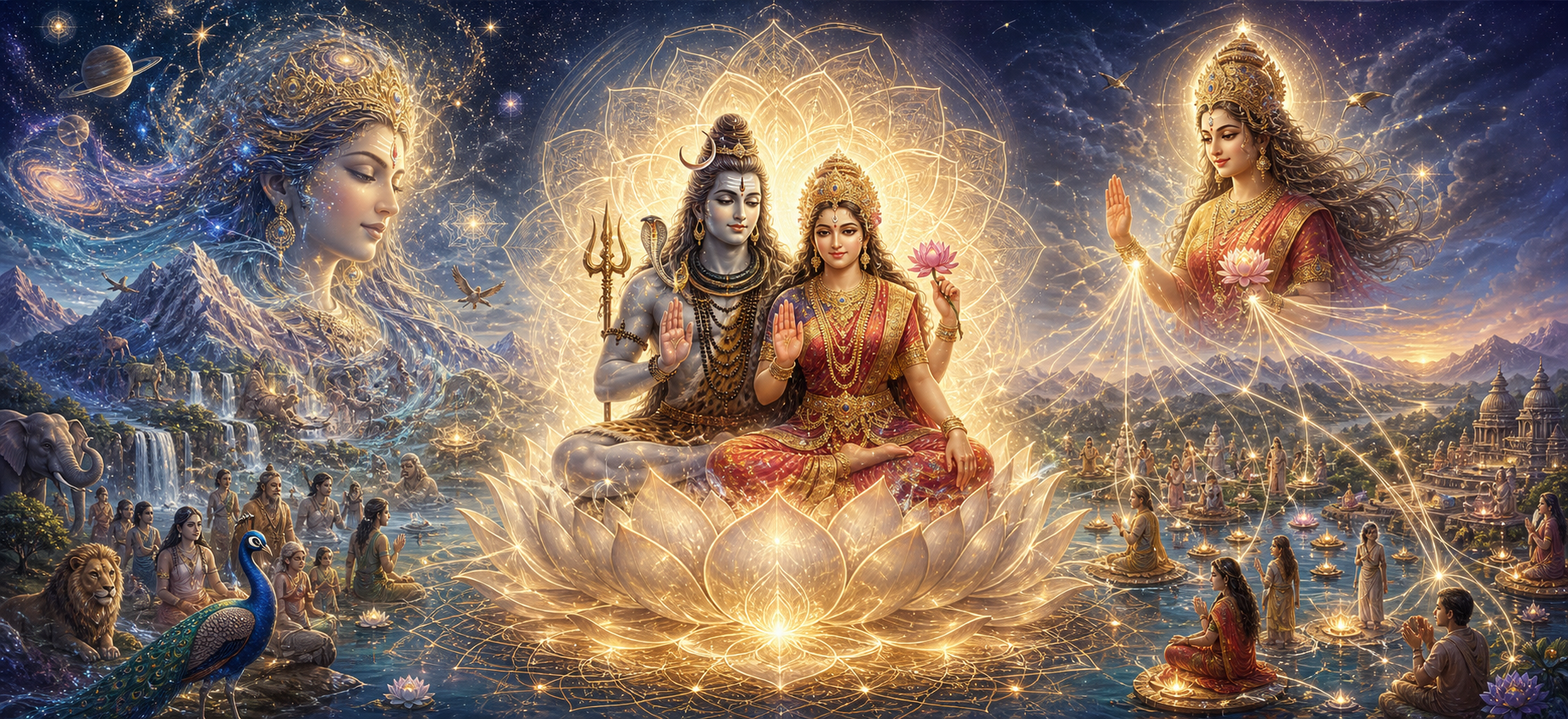
Hindu philosophy offers several vocabularies for the transition from unmanifest reality to the world you experience. They address a shared problem, but they should not be flattened into one formula.
Purusha and Prakriti in Samkhya
Samkhya explains manifestation through the relationship between Purusha, conscious presence, and Prakriti, the principle that unfolds as experienced nature. A Shakta reader can recognize Devi’s generative dimension in Prakriti. That recognition is an interpretive bridge, not proof that every Samkhya formulation is simply Shakta theology under another name.
Brahman and Maya in Vedanta
Vedantic language speaks of Brahman and Maya when accounting for the projection of names and forms. Reading Maya only as the English word illusion can obscure the point. Here it also names the mysterious power by which undivided reality appears as a structured world of plurality. Shakta interpretation can recognize that power as Devi, while particular Vedantic schools may explain its status differently.
Shiva and Shakti in Tantra
Tantric language makes inseparability central. Shiva and Shakti are not two self-sufficient realities that occasionally cooperate. The divine ground and its power of manifestation cannot be divided in practice. A motionless abstraction without power could not produce a cosmos; power without an intelligible ground would have no coherent identity.
When you encounter the name Devi, therefore, identify the level on which it is operating. It may name a beloved form approached in worship. It may name the energy active in all beings. It may name the Supreme Reality itself. A hymn or ritual can move among these levels without pausing to announce the transition. Much theological confusion comes from taking a statement made at one level and arguing against it at another.
Recognize Dharmic resonances without erasing differences
The image of generative wisdom appears beyond Shakta Hinduism, but comparison needs discipline. Mahayana Buddhism reveres Prajnaparamita as the Mother of the Buddhas because liberating wisdom is the womb of awakening. That does not turn Prajnaparamita into a Hindu creator goddess.
Jain philosophy is non-theistic and does not require a supreme creator. Its eternal tattvas offer a very different account of reality’s order. Sikh teaching proclaims Ik Onkar, the one all-pervading creative reality, and understands existence through Hukam. Neither tradition should be relabeled as Shakta simply because a point of resonance can be found.
Use the phrase shared resonance, not identical doctrine. The traditions can meet around an intuition that reality is ordered, that ego is not the final authority, and that wisdom transforms life. They still preserve distinct teachings about God, self, liberation and causation. That distinction lets you build civilizational understanding without borrowing another community’s vocabulary against its own meaning.
Let the cosmic teaching change your daily use of power

The name Mother makes the metaphysics relational. It presents the cosmos not as a machine abandoned by its maker, but as an existence continually dependent upon creative, protective and sustaining power. The maternal language also prevents Shakti from becoming a cold synonym for force.
Yet Shakti should not be confused with whatever makes you feel strong. Capacity alone does not make an action dharmic. Intelligence can heal or deceive; authority can protect or humiliate; wealth can sustain a household or feed greed. To recognize Devi in power is to accept responsibility for how power is directed.
Navaratri, Durga Puja and ordinary home worship turn that insight into a practice of courage, protection and renewal. You do not need to reconstruct the whole of cosmology each time you light a lamp. You do need a clear intention. A simple sequence can keep devotion and philosophy connected:
- Choose your level of approach. You may address Devi personally as Mother, contemplate Mahashakti as the power within existence, or move from the personal form toward the cosmic meaning. Know which movement you are making.
- Make one simple offering. Place an image or Sri Yantra before you, light a lamp where it can be tended safely, and offer something with attention. The act trains you to receive existence as a gift rather than as personal property.
- Use the mantra as a change of perception. Recite the refrain from the Devi Mahatmya, then look beyond the shrine. Its claim concerns all beings, not only a consecrated image.
- Trace the three movements of Shakti. Notice what you are being called to create, what you are responsible for sustaining, and what must be transformed or released.
- Complete one corresponding action. Begin a delayed duty, keep a neglected promise, protect someone within your responsibility, repair avoidable harm, or stop feeding a destructive pattern. Choose one act that can actually be completed.
Ya devi sarvabhuteshu shakti-rupena samsthita.
Devi Mahatmya
The refrain honors Devi as the power abiding in all beings. Its practical test is demanding. If worship makes you more attentive to sacred capacity in others, the mantra is entering your conduct. If it becomes a badge of superiority or an excuse to dominate, you have retained the symbol while missing its direction.
This also keeps the feminine divine from being honored only in abstraction. Reverence for Devi is ethically hollow when joined to contempt for women, disregard for care, or casual exploitation of vulnerable life. Human beings are not flawless merely because Shakti operates through them. The point is that power should be met with discernment and responsibility, not reduced to an object for use.
Key takeaways
- Brahma is the creator associated with ordering manifest worlds; Brahman is the boundless reality of Vedantic inquiry. Do not confuse the two terms.
- Devi as Mahashakti is not merely an earlier participant in a cosmic timeline. She names the power by which time, intelligence, form and action become possible.
- Creation narratives are most useful when you ask what depends upon what, not only which divine figure appears first.
- Samkhya, Vedanta and Tantra illuminate manifestation through different conceptual frameworks. Comparison can clarify them, but equivalence will distort them.
- The claim that Shakti abides in all beings should produce a concrete change in how you create, sustain, transform and exercise power.
The next time you stand before Devi, do not stop at asking which deity came first. Ask what makes every worthy thought, breath and act possible. Then honor the Mother by directing the power available to you toward one clear act of dharma.
References
- DharmaRenaissance Blog – Who Created Brahma? Unveiling Devi, the Supreme Mother and Cosmic Source of All
- Devi Mahatmya – Ya Devi Sarvabhuteshu refrain
- Srimad-Bhagavatam 3.20.3
