Tag: Bhakti Tradition

  • Narayaneeyam: A Soul-Stirring, Scholarly Guide to the Bhagavata Purana in 100 Dasakas

    Narayaneeyam: A Soul-Stirring, Scholarly Guide to the Bhagavata Purana in 100 Dasakas

    Nārāyaṇīyam (Narayaneeyam) condenses the Srimad Bhagavatham into 100 daśakas and just over a thousand ślokas, uniting poetry, philosophy, and devotion. Composed in 16th‑century Kerala by Melpathur Nārāyaṇa Bhaṭṭathiri at Guruvayur, it offers a structured path from cosmology and avatāras to Krishna’s intimate līlās and a culminating meditative vision. This guide clarifies its history, architecture, meters,…

  • Shiva Purana Timeless Tales: Daksha Yajna, Markandeya’s Grace, Neelakantha’s Compassion

    Shiva Purana Timeless Tales: Daksha Yajna, Markandeya’s Grace, Neelakantha’s Compassion

    This in-depth exploration of the Shiva Purana presents three profound narratives—Daksha Yajna and Sati, Markandeya’s deliverance through Mrityunjaya grace, and Shiva as Neelakantha during the Samudra Manthana—set within their textual, historical, and philosophical contexts. It clarifies how Puranic storytelling operates as both scripture and contemplative guide, uniting ritual, devotion, and ethics. Readers gain a nuanced…

  • Transformative Gauranga Mahaprabhu Lila Kirtana (Part 2), Melbourne — 12 April 2026

    Transformative Gauranga Mahaprabhu Lila Kirtana (Part 2), Melbourne — 12 April 2026

    Held on 12 April 2026 in Melbourne, Gauranga Mahaprabhu Lila Kirtana (Part 2) offered a structured immersion into Gaura-lila through congregational kirtana guided by His Grace Bhurijana Dasa, a senior disciple of Srila Prabhupada. The evening combined theology, narrative, and music to align aesthetic feeling with philosophical insight, grounded in sources such as Srimad Bhagavata…

  • Transformative Special Seminar Day 1 with HG Praghosa Das: Bhakti, Unity, and Practice | 15 May 2026

    Transformative Special Seminar Day 1 with HG Praghosa Das: Bhakti, Unity, and Practice | 15 May 2026

    Special Seminar Day 1 with HG Praghosa Das at ISKCON London Radha-Krishna Temple presented a disciplined, practice-centered exploration of bhakti-yoga for contemporary urban life. The discussion integrated classical Gaudiya Vaishnava theology with evidence-informed community leadership, child protection, and transparent governance. Attendees encountered a technical overview of the nine limbs of bhakti and the progressive stages…

  • Bliss, Boredom, and Breakthroughs: An Evidence-Based Guide to Japa Practice

    Bliss, Boredom, and Breakthroughs: An Evidence-Based Guide to Japa Practice

    Japa often swings between luminous connection and dutiful repetition. This guide explains why that fluctuation is normal and how to stabilize practice using classical modes (vācika, upāṁśu, mānasa), breath entrainment, and ergonomic cues. It reframes “bad days” into actionable categories—physiological, environmental, cognitive-emotional, and social—so adjustments become precise rather than punitive. Practical protocols cover time-of-day strategy,…

  • Eternal Longing, Infinite Union: Decoding Radha–Krishna’s Divine Love and Sacred Separation

    Eternal Longing, Infinite Union: Decoding Radha–Krishna’s Divine Love and Sacred Separation

    This long-form exploration decodes why Radha–Krishna’s love is revered not as a tragic failure of union but as a sacred pedagogy of longing. Drawing on Srimad Bhagavatham, Gīta Govinda, and Gaudiya Vaishnava theology, it explains how vipralambha (separation) heightens devotion and refines ethical action. The article clarifies key concepts—rasa, sambhoga, vipralambha, and mahābhāva—while situating them…

  • From Sadhana to Etiquette: Angas of Bhakti for Daily Practice and Interfaith Dharmic Harmony

    From Sadhana to Etiquette: Angas of Bhakti for Daily Practice and Interfaith Dharmic Harmony

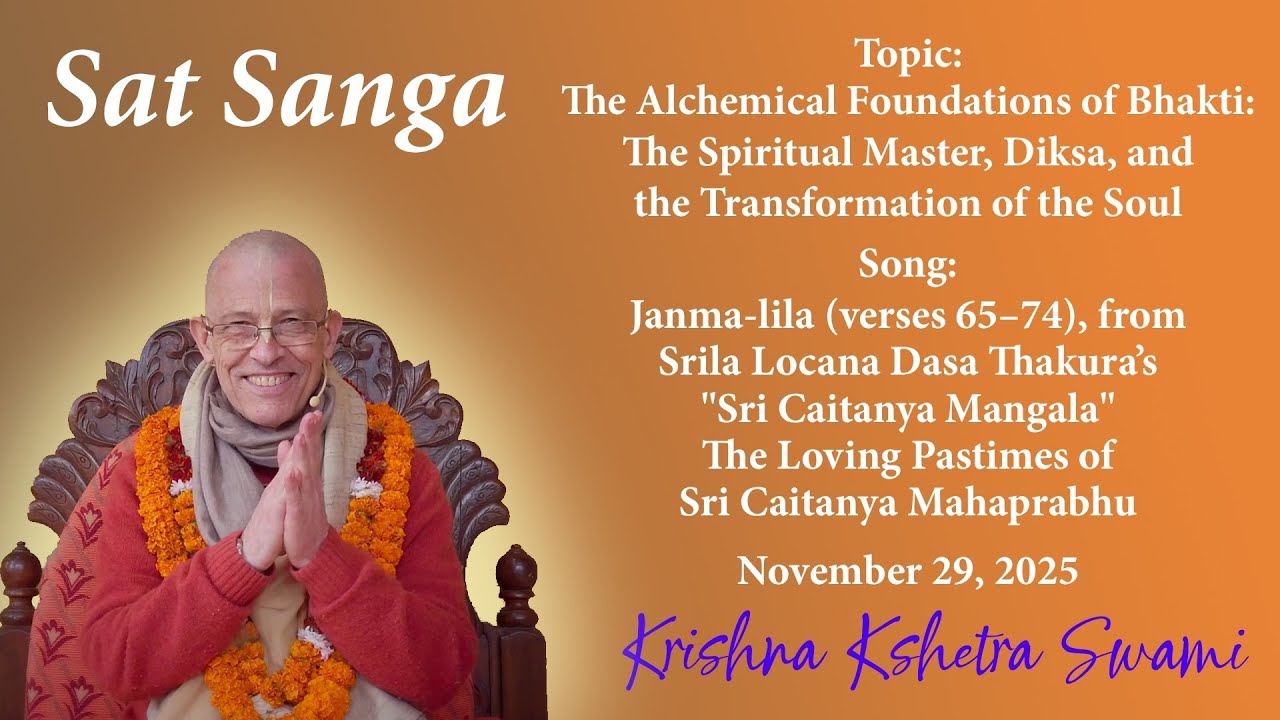
    This in-depth reflection on a Sat Sanga with HH Krishna Kshetra Swami (09.05.2026) unpacks the Angas of Bhakti—how sadhana (disciplined daily practice) and Vaishnava etiquette (sadachara) jointly mature devotional life. Readers gain a clear map of foundational and potent practices from the Gaudiya tradition, learn practical routines for japa, kirtana, and study, and see how…

  • Hare Kṛṣṇa as a Heartfelt Cry: Surrender, Bhakti, and Dharmic Unity in Practice

    Hare Kṛṣṇa as a Heartfelt Cry: Surrender, Bhakti, and Dharmic Unity in Practice

    The mantra Hare Kṛṣṇa, Hare Kṛṣṇa can be read as a concise theology of surrender: “O the energy of the Lord, O the Lord, please accept me.” Situated within the bhakti tradition, this cry for acceptance aligns with Lord Caitanya’s emphasis on humility and constant kīrtana. The piece explores how śaraṇāgati in the Bhagavad Gītā,…

  • Srila Prabhupada’s 1976 Vrindavan Marathon: Seva, Scholarship, and Global Sankirtana

    Srila Prabhupada’s 1976 Vrindavan Marathon: Seva, Scholarship, and Global Sankirtana

    In 1976 at Vrindavan, Srila Prabhupada’s day began at mangal arotik and ended past midnight with a Mathura pandal program before more than twenty thousand attendees. Eyewitness details—such as the right-hand lesson during a morning walk—reveal how subtle etiquette conveyed dharmic principles. His apology for speaking in Hindi at the pandal highlighted humility and inclusive…

  • Bond of Love with HG Akuti dd: Profound insights on Bhakti, Seva, and Dharmic Unity

    Bond of Love with HG Akuti dd: Profound insights on Bhakti, Seva, and Dharmic Unity

    This in-depth preview examines the Bond of Love Interview Series featuring HG Akuti dd, streamed by Vaishnavi Ministry on July 11, 2025, and situates it within the global evolution of ISKCON’s Bhakti Tradition. The analysis shows how love-centered devotion (prema-bhakti), seva, and the Guru-Shishya Tradition converge to strengthen community resilience in digital settings. Cross-dharmic parallels—maitrī…

  • Surrender that Liberates: How Dāsa‑Bhāva Shapes Bhakti, Seva, and Dharmic Unity

    Surrender that Liberates: How Dāsa‑Bhāva Shapes Bhakti, Seva, and Dharmic Unity

    The Bhakti concept of “dasa” (dāsa)—a chosen identity of loving service and surrender—anchors Hindu spirituality in a disciplined ethic of humility, seva, and śaraṇāgati. Grounded in scriptural sources like the Bhagavad Gita and Srimad Bhagavatham, dāsya-bhāva appears across Vaishnava, Śaiva, and Śākta traditions and is elaborated by Ramanujacharya, Madhvacharya, and Chaitanya Mahaprabhu. It flourishes in…

  • Why Ramanujacharya Asked ‘Have You Loved?’—Bhakti, Emotional Maturity, and Divine Grace

    Why Ramanujacharya Asked ‘Have You Loved?’—Bhakti, Emotional Maturity, and Divine Grace

    A classic teaching story about Sri Ramanujacharya turns on a simple question: “Have you ever loved anybody?” Rather than prescribing abstract doctrine, he points to love (prema) as the formative ground of bhakti. In Vishishtadvaita Vedanta, devotion matures through lived relationship, culminating in prapatti (surrender) supported by divine grace. The distinction between kama (desire) and…

  • Srimad Bhagavatam 3.25.43: Kapila’s Transformative Bhakti‑Sankhya, Sādhu‑Saṅga, and Dharmic Unity

    Srimad Bhagavatam 3.25.43: Kapila’s Transformative Bhakti‑Sankhya, Sādhu‑Saṅga, and Dharmic Unity

    Śrīmad-Bhāgavatam 3.25.43 crowns Kapila’s theistic bhakti‑sāṅkhya, showing how analysis attains completion only when joined to devotion. This academic yet accessible exploration, based on a Mayapur TV – English discourse by H.H. Bhakti Arjava Priti Vardhan Swami Maharaj, explains why sādhu‑saṅga, śravaṇa, and sevā reliably reconfigure consciousness. It clarifies how Bhāgavatam treats bhakti as a rigorous…

  • HH SB Keshava Swami at ISKCON Dallas: Timeless Bhakti-Yoga Wisdom and Dharmic Unity

    HH SB Keshava Swami at ISKCON Dallas: Timeless Bhakti-Yoga Wisdom and Dharmic Unity

    This analysis examines HH SB Keshava Swami’s ISKCON Dallas lecture as a model of rigorous, text-rooted bhakti-yoga tailored for a global audience. It clarifies Gaudiya Vaishnava frameworks such as sambandha–abhideya–prayojana, the nine limbs of devotion, and the acintya-bhedabheda philosophy. Readers gain practical methods to integrate mantra meditation, kirtan, seva, and shastra study into daily life.…

  • Purpose of the Vedas: Why Vaishnavas Champion Bhakti over Jnana, Karma, and Yoga

    Purpose of the Vedas: Why Vaishnavas Champion Bhakti over Jnana, Karma, and Yoga

    This in-depth exploration clarifies the purpose of the Vedas, tracing their layered structure from ritual to contemplative wisdom and showing how Vedānta articulates their culmination. It explains why Vaishnava traditions foreground Bhakti: not as sentiment, but as an integrative discipline endorsed by the Bhagavad Gita and Śrīmad-Bhāgavatam. It maps Bhakti’s relationship to Jñāna, Karma, and…

  • From Impermanence to Eternal Service: A Clear Path through Dharma, Devotion, and Liberation

    From Impermanence to Eternal Service: A Clear Path through Dharma, Devotion, and Liberation

    The essay reframes the modern pursuit of longevity through a dharmic lens, showing how Hinduism, Buddhism, Jainism, and Sikhism converge on training attention, purifying intention, and embodying seva. Instead of biological duration, it emphasizes the continuity of rightly directed consciousness and compassionate action. Technical concepts are clarified—atman, saṁsāra, karma, ahaituky apratihata, moksha—while practical disciplines (śravaṇa,…

  • Chanting with Feeling: How Remembrance of Hari Dissolves Fear and Calms the Mind

    Chanting with Feeling: How Remembrance of Hari Dissolves Fear and Calms the Mind

    This article explains how chanting with genuine feeling dissolves fear by uniting scriptural insight and modern psychophysiology. It outlines why Hari—“the one who takes away”—removes anxiety rooted in uncertainty through heartfelt remembrance (smaraṇa) and steady mantra meditation. Readers learn practical, evidence-aligned methods for pacing breath, engaging emotion (bhāva), and consolidating calm after practice. Everyday scenarios…

  • CC Madhya 4.112–123: Madhavendra Puri, Kshirachora Gopinatha, and the Power of Devotional Humility

    CC Madhya 4.112–123: Madhavendra Puri, Kshirachora Gopinatha, and the Power of Devotional Humility

    This analysis distills the core teachings of CC Madhya 4.112–123 as presented at ISKCON New Govardhana Temple on Sat 09 May 2026 by HG Aniruddha das. It explains how the Kshirachora Gopinatha narrative reveals the Lord’s intimate reciprocity with Madhavendra Puri while modeling uncompromising humility. The piece clarifies key Gaudiya Vaishnava doctrines—archa-vigraha, prasada-tattva, and the…

  • Srimad Bhagavatam 1.13.50: Vidura’s call to detachment, duty, and bhakti | ISKCON Ljubljana

    Srimad Bhagavatam 1.13.50: Vidura’s call to detachment, duty, and bhakti | ISKCON Ljubljana

    This analysis situates Srimad Bhagavatam 1.13.50 within Canto 1’s narrative of Vidura guiding Dhṛtarāṣṭra toward timely renunciation, clarifying how duty, detachment, and devotion align in practice. It explains why the verse is read as a constructive call to reorient life around ātma-tattva and bhakti, not as escapism, and shows how vanaprastha embodies humane, responsible transition.…

  • SB 3.28.29 Unveiled: Transformative dhyana on the Lord’s lotus face with HH Devamrita Swami

    SB 3.28.29 Unveiled: Transformative dhyana on the Lord’s lotus face with HH Devamrita Swami

    This in-depth exploration of Srimad Bhagavatam 3.28.29, as presented by HH Devamrita Swami at ISKCON New Govardhana, situates Kapila Muni’s dhyana instruction within the broader arc of bhakti-yoga and theistic Sāṅkhya. The verse’s focus on the Lord’s lotus-like face and benevolent smile is shown to be a practical, stabilizing attention practice that mellows the heart…