
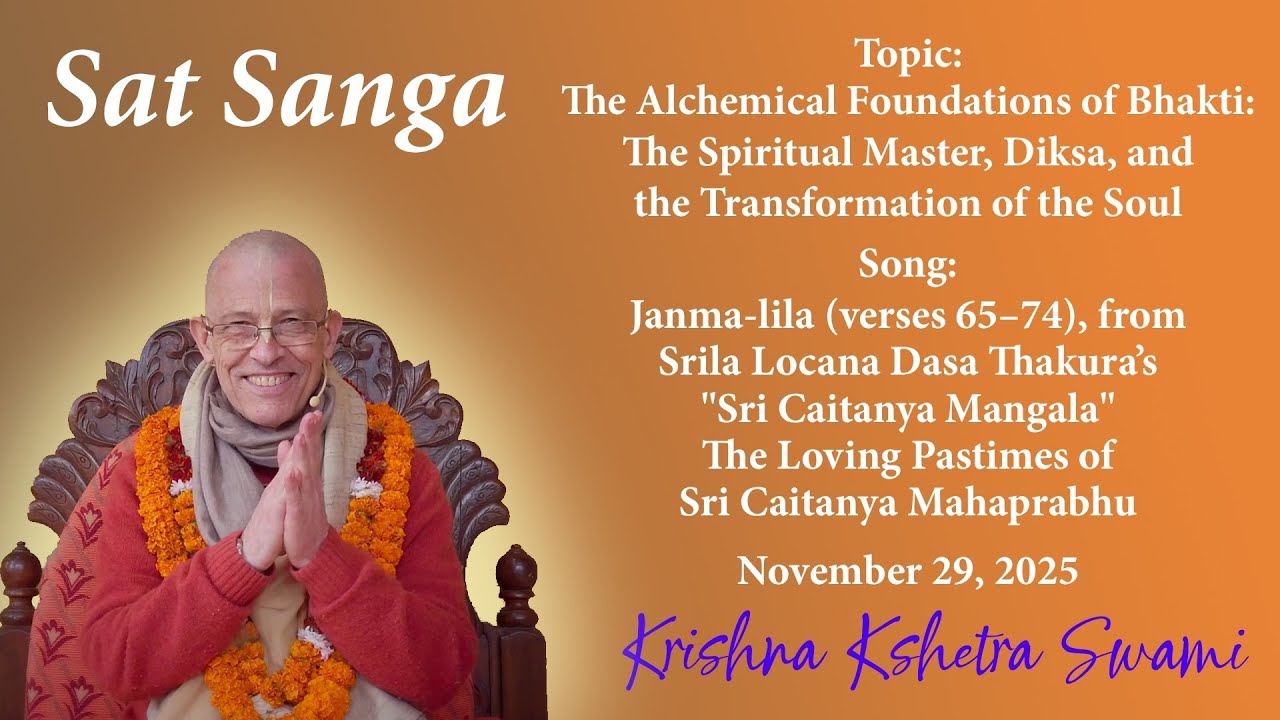

On November 29, 2025, at Go-druma Bhavan, Mayapur, India, HH Krishna Kshetra Swami presented “The Alchemical Foundations of Bhakti: The Spiritual Master, Diksa, and the Transformation of the Soul” during a Sat Sanga gathering. Framed as a study in devotional transformation, the session illuminated how guidance from the spiritual master (guru), the rite of diksa, and sustained practice of devotion work together to refine consciousness and character within the Bhakti Tradition.
The term “alchemical” served as a precise metaphor for inner refinement. Just as classical alchemy aims to transmute base metal into gold, Bhakti seeks to transmute ordinary intention into steadfast bhavaa devotional disposition centered on humility, compassion, and service. This transformation unfolds through disciplined practice, ethical alignment, and the catalytic influence of the guru, forming a coherent pathway for spiritual growth within Hinduism’s living traditions.
A focal point of the presentation was the role of the spiritual master, whose instruction anchors the Guru–Shishya Tradition. The commitment of diksathe initiation that marks deliberate entry into spiritual lifewas discussed as a vow-based reorientation of identity and purpose. Under a guru’s guidance, devotion aligns with scriptural wisdom and lived practice, enabling genuine transformation rather than mere sentiment. In this way, the Role of Guru becomes a pedagogical and ethical framework for cultivating stable devotion.
To deepen this inquiry, the session highlighted the song “Janma-lila (verses 65–74)” from Srila Locana Dasa Thakura’s Sri Caitanya Mangala The Loving Pastimes of Sri Caitanya Mahaprabhu. These verses evoke the tenderness and moral clarity of Sri Caitanya Mahaprabhu’s lila, offering a devotional aesthetic (rasa) that complements disciplined practice. Hearing and reflecting on such poetry functions as embodied theologyscriptural study that moves the heart and strengthens intention, a hallmark of Gaudiya devotion anchored in sacred texts and community discourse.
The session also underscored the formative power of sat sangaassociation with sincere practitioners. In such settings, seekers encounter shared discipline, accessible guidance, and constructive accountability. Listeners often recognize, through comparison with their own experiences, how steady companionship in spiritual practice fosters resilience, clarity, and ethical consistency. The result is a grounded devotional life where learning, chanting, and service mutually reinforce one another.
Importantly, the principles discussed resonate across the broader dharmic family. While Bhakti is rooted in Hinduism, parallels are observable in Sikh reverence for the Satguru and disciplined seva, in Buddhist refuge, precepts, and teacher-guided cultivation of karuṇā, and in Jain diksha, vows, and Acharya-guided ethical rigor. These analogues affirm a unifying insight: teacher-guided practice, vows of commitment, and ongoing community association can elevate intention into lived virtue. Emphasizing these shared contours advances interfaith harmony among Hinduism, Buddhism, Jainism, and Sikhism without erasing their distinctives.
Practical application followed naturally from these themes: participate in sat sanga; engage scripture through study and song; honor diksa or formal commitments with integrity; and translate devotion into compassionate action. Whether through kirtan, meditation, mindful speech, or service, such practices consolidate insight into daily life. The cumulative effect is the “alchemical” shift the talk describedan intentional re-casting of the heart toward devotion, wisdom, and responsibility.
By situating the Role of Guru, the discipline of diksa, and the aesthetics of sacred song within a coherent spiritual pedagogy, the Mayapur Sat Sanga offered a clear, scholarly, and accessible map for inner change. It demonstrated how the Gaudiya lineage, through texts like Sri Caitanya Mangala and the lived presence of sat sanga, continues to provide Spiritual Insight for contemporary practitioners seeking ethical clarity, emotional maturity, and enduring devotion.
Inspired by this post on Dandavats.
