
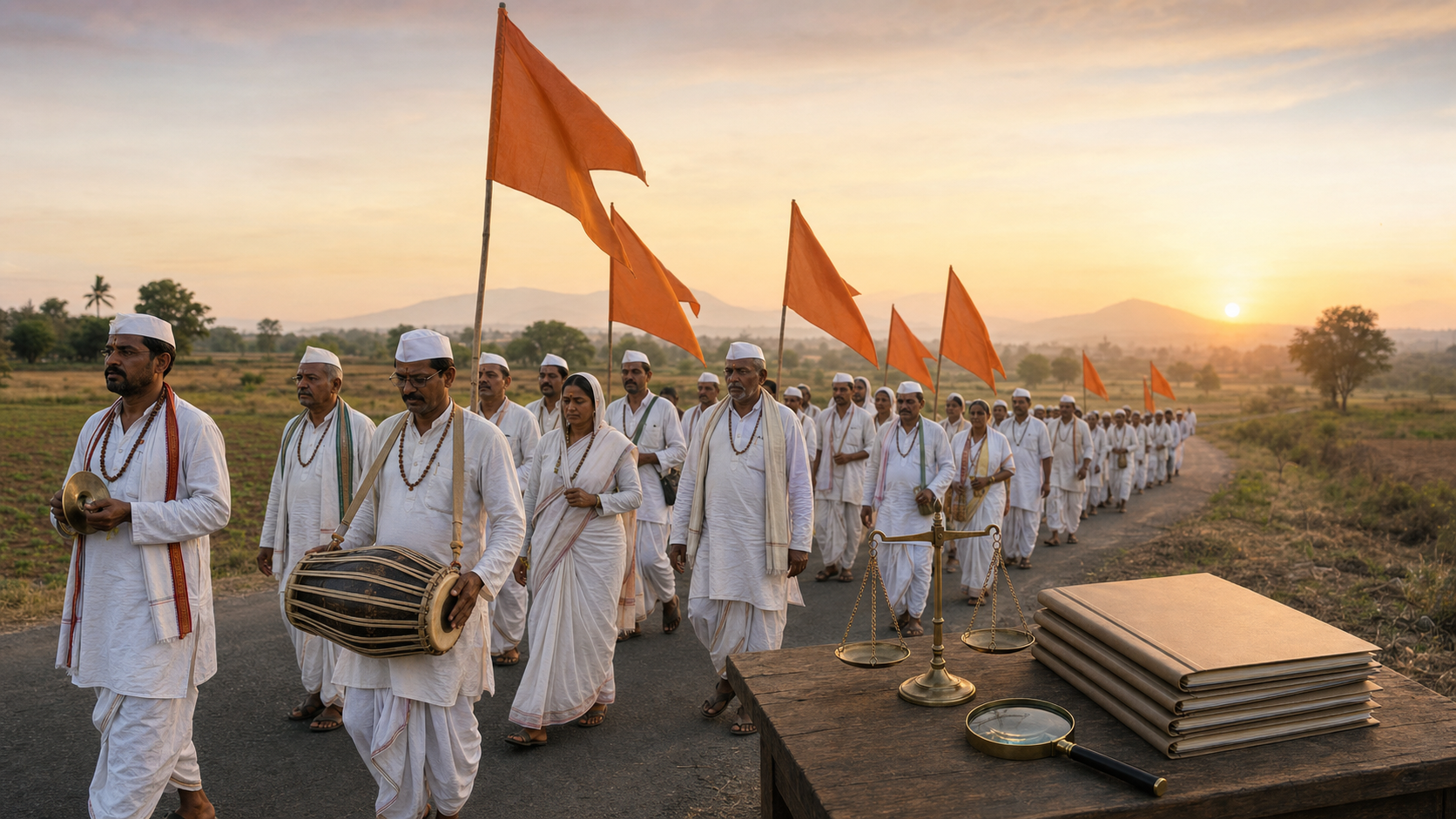
If you saw the phrase Warkari radicalisation and wondered whether it identifies a genuine security problem or merely turns visible Hindu devotion into an object of suspicion, start with three questions: What changed, who authorised it, and what evidence connects that change to violence? A grave label should not be accepted simply because it carries political force.
The controversy began after Sharad Pawar alleged that the Warkari movement was witnessing radicalisation. Hindutva leaders and Warkari organisations rejected that characterisation. Neither an allegation nor an indignant rebuttal settles the factual question. On the public material available when the claim was contested, a movement-wide charge lacked a broad body of independently verified evidence. That is not immunity from scrutiny. It is the proper provisional judgement when the evidence has not cleared the threshold demanded by the accusation.
Make the word radicalisation pass a security test

Radicalisation is often used in political speech as a synonym for becoming more assertive, conservative, religious or partisan. In security analysis, it has a narrower and more serious meaning: a process through which beliefs can come to legitimate violence, sometimes followed by recruitment, facilitation or preparation for violent action. Models associated with Fathali Moghaddam and Randy Borum treat this as a process rather than as a personality label.
That distinction matters. Strong Hindu identity is not evidence of violent intent. Neither are conservative piety, criticism of a political party, an uncompromising doctrinal opinion or participation in a large religious procession. Some expressions may be abrasive or objectionable without constituting a security threat. Conversely, an apparently respectable organisation can warrant investigation if verifiable evidence connects its authorised activity to violence. The evidence, not the cultural stereotype, has to decide.
Before applying radicalisation to an entire sampradaya, look for convergence across four dimensions:
- Ideological change: repeated, attributable endorsement of violence, rather than a general rise in religious confidence or political speech.
- Recruitment: an identifiable pathway by which people are selected, persuaded or organised for violent purposes.
- Operational facilitation: logistical support, planning, resources or coordination connected to contemplated violence.
- Behaviour over time: corroborated incidents forming a pattern, rather than one remark, one dispute or one unauthorised act.
These elements need not unfold in one fixed order, but a movement-wide allegation should show more than rhetoric. It should identify actors, authority, conduct, continuity and a plausible link to violence. If the available information establishes only that one person used inflammatory language, then the defensible conclusion concerns that person. It does not automatically concern the Warkari Sampradaya.
This is why saying that there was no publicly substantiated corpus showing a systematic link between Warkari institutions and organised violence is not the same as declaring that no Warkari-associated individual could ever commit an offence. One statement concerns the evidentiary status of a whole movement. The other would make an impossible claim about every individual near it.
Use Warkari practice as a baseline, not a romantic alibi
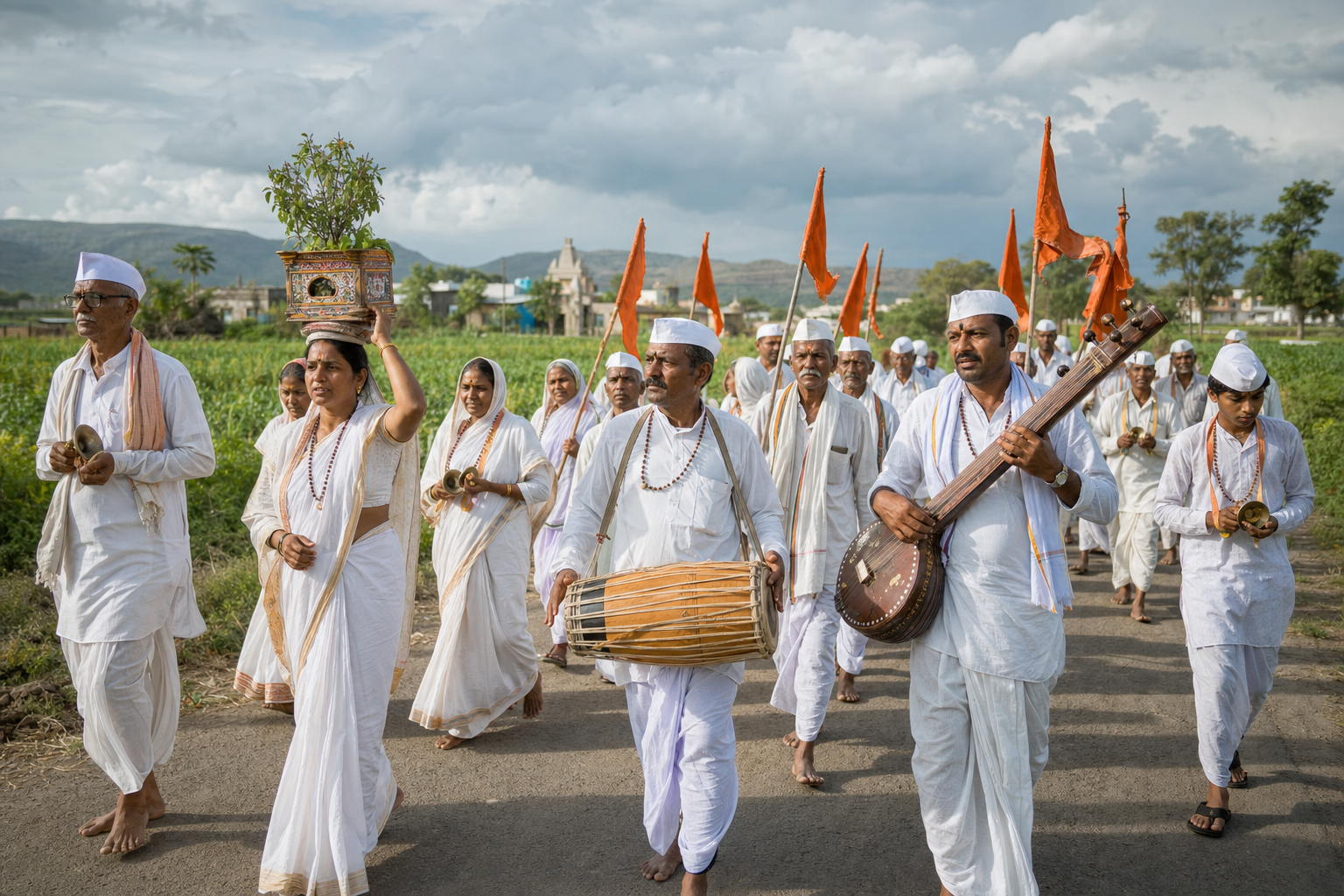
The Warkari Sampradaya is a centuries-old Bhakti tradition centred on Vitthal of Pandharpur and shaped by saints including Sant Dnyaneshwar, Sant Tukaram, Sant Eknath and Sant Namdev. Its recognisable disciplines include the Pandharpur Vari, dindi processions, palkhis, abhang, kirtan and seva. Humility, restraint, collective devotion and participation across social divisions belong to its normative centre.
That history is relevant because a claim of institutional radicalisation is a claim of meaningful change. If the movement has departed from its inherited ethic, the accuser should be able to show where the departure occurred. Did recognised leaders adopt violent language as policy? Did authorised teaching begin to justify attacks? Were devotional gatherings systematically converted into recruitment or logistical channels? Did responsible institutions approve, conceal or repeatedly excuse violent conduct?
Those questions do not assume that change is impossible. They make the alleged change observable. They also prevent a common error: treating the mere public confidence of Hindu devotees as proof that a devotional movement has become dangerous.
The lived structure of Warkari practice gives the movement substantial internal guardrails. Pilgrims proceed in organised groups, sing remembered teachings together, serve one another and remain accountable to a shared devotional discipline. The priority of bhakti over confrontation encourages moral self-regulation. Yet no large community should use its noble teachings as an automatic acquittal for a specific wrong. The right response is to compare alleged conduct with both the tradition’s norms and verifiable institutional behaviour.
This balanced approach protects the Warkari tradition more effectively than either denial or indiscriminate suspicion. If misconduct occurred, precision isolates it and permits correction. If it did not reflect recognised Warkari authority, precision prevents an individual act from being converted into a civilisational indictment.
Keep the person, institution and tradition separate

Maharashtra’s competitive political environment makes this separation especially important. Shiv Sena, Shiv Sena (UBT), coalition interests and identity-driven media narratives can all turn devotional credibility into political capital. Figures associated with both Shiv Sena alignments, including Ambadas Danve and Sanjay Shirsat, contested the radicalisation framing. That breadth is politically notable, but it is not a substitute for examining the underlying claim.
Use this attribution ladder whenever you encounter a new allegation:
| Evidence presented | What it may establish | What it does not establish by itself |
|---|---|---|
| An inflammatory statement by a pilgrim or culturally affiliated person | That individual’s stated position | An official Warkari doctrine, plan or institutional direction |
| An offence allegedly committed by someone who attends Warkari events | A specific matter for investigation and due process | That the offence was ordered, enabled or endorsed by the movement |
| An authenticated resolution or recurring directive from a recognised Warkari body | A possible institutional position within the scope of that body’s authority | Automatic proof that the whole sampradaya adopted or acted upon it |
| A corroborated pattern of violent advocacy, recruitment and logistical support | A serious security concern requiring precise investigation | Permission to stigmatise uninvolved devotees or unrelated institutions |
When a speech clip, headline or social-media claim reaches you, run it through a short verification protocol before sharing it:
- Name the actor. Replace phrases such as Warkaris did this with the name of the person or body whose conduct is actually documented.
- Establish authority. Determine whether the person was speaking privately, holding an organisational role or acting under an authenticated mandate.
- Ask what radicalisation means in the claim. If it refers only to stronger Hindu identification or sharper political disagreement, the security label is being stretched beyond its proper use.
- Inspect the evidence type. Separate a quotation, an allegation, an arrest, a proven offence, an official resolution and a repeated organisational pattern. They are not interchangeable.
- Look for independent corroboration. Party statements and community rebuttals tell you the positions in the dispute; primary evidence and neutral verification tell you what can responsibly be concluded.
- Check the time horizon. A systemic transformation should produce a traceable pattern across time. A single episode cannot carry that conclusion without further evidence.
This method also helps you recognise manipulative language. Passive constructions such as concerns have emerged conceal who is concerned and what they observed. Collective nouns such as the Warkaris can silently transfer one person’s conduct to millions of devotees. Security terminology can create an impression of verified danger even when no recruitment route, violent doctrine or operational conduct has been identified.
Key takeaways
- The Warkari movement-wide radicalisation charge was not supported by a broad, independently verified public record when it was contested.
- Religious confidence, conservative belief and partisan speech are not substitutes for evidence of violent intent or facilitation.
- Warkari teachings of bhakti, humility, seva and restraint are a relevant baseline, but specific wrongdoing should still receive lawful scrutiny.
- Always distinguish an individual’s conduct, a recognised body’s authorised position and the normative tradition of the sampradaya.
- A serious movement-level claim should identify ideological change, recruitment, operational capability and a behavioural pattern over time.
- The best defence of a devotional community is precise attribution: investigate what can be proved and refuse to stigmatise everyone else.
Defend Warkari dignity while remaining evidence-ready
If you are a devotee or community organiser
Do not answer an overbroad allegation with an overbroad denial. Ask recognised Warkari bodies to state their commitments clearly, identify who may speak for them and provide a transparent way to report misconduct. For major gatherings, voluntary arrangements covering crowd management, grievance redressal and liaison with local administration can protect pilgrims without surrendering spiritual autonomy.
When a specific accusation appears, preserve the distinction between defending the sampradaya and defending every accused person. You can insist upon evidence, due process and accurate attribution while accepting investigation of a named offence. That posture is both stronger and more credible than treating all scrutiny as hostility.
Positive public practice matters as well. Joint seva, rural health initiatives, community kitchens and river clean-ups make a shared ethic visible. Education on the history of the Warkari Sampradaya can help younger devotees recognise the difference between devotion-led social reform, legitimate political participation and conduct that violates the movement’s own standards.
If you report, govern or comment on the controversy
Attribute every claim at the narrowest level the evidence supports. Consult recognised Warkari representatives, peer-recognised scholarship on Bhakti traditions and independent observers, but do not treat any one constituency as its own final verifier. Track patterns over time. Publish corrections with the same specificity as allegations. When an offence is supported by evidence, name the act and responsible actor instead of using a devotional identity as shorthand.
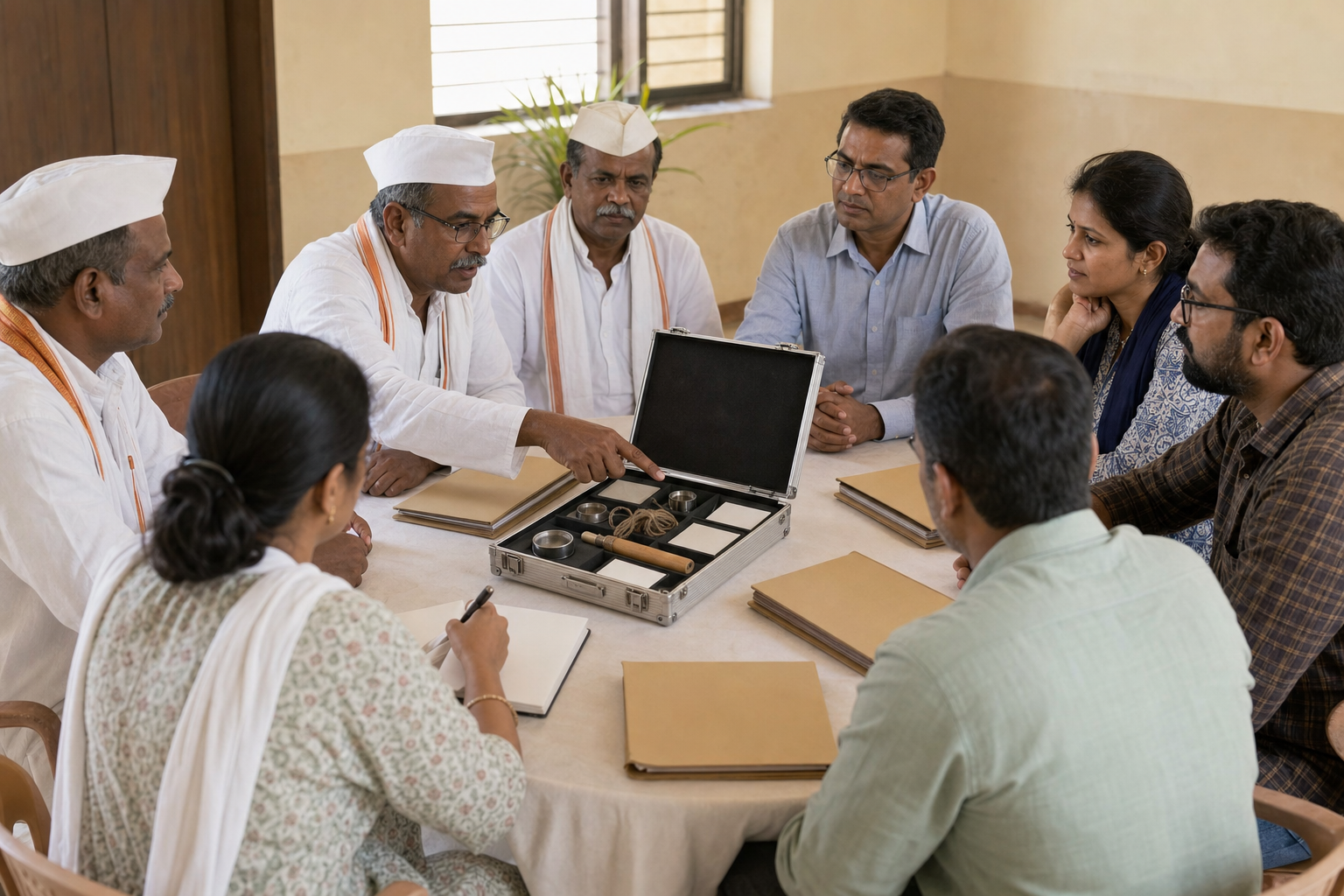
A consultative arrangement among Warkari representatives, local administration and neutral observers can address practical risks around large gatherings without placing theology under political supervision. The aim should be safe pilgrimage, prompt handling of grievances and a reliable channel for factual clarification.
The wider Dharmic family offers a constructive frame. Warkari abhang and Sikh shabad kirtan are not identical traditions, just as Buddhist metta and Jain ahimsa arise from distinct teachings. Yet musical remembrance, compassion, non-violence, restraint and seva create genuine ethical meeting points. Building on those points answers polarisation through disciplined practice rather than through slogans about unity.
Before you forward the next claim, force it through three nouns: person, institution and tradition. Ask which one the evidence actually names. If it establishes only the first, do not indict the third. If stronger evidence emerges, examine it without fear or favour. That is how you protect public safety, Warkari dignity and Dharmic unity at the same time.