
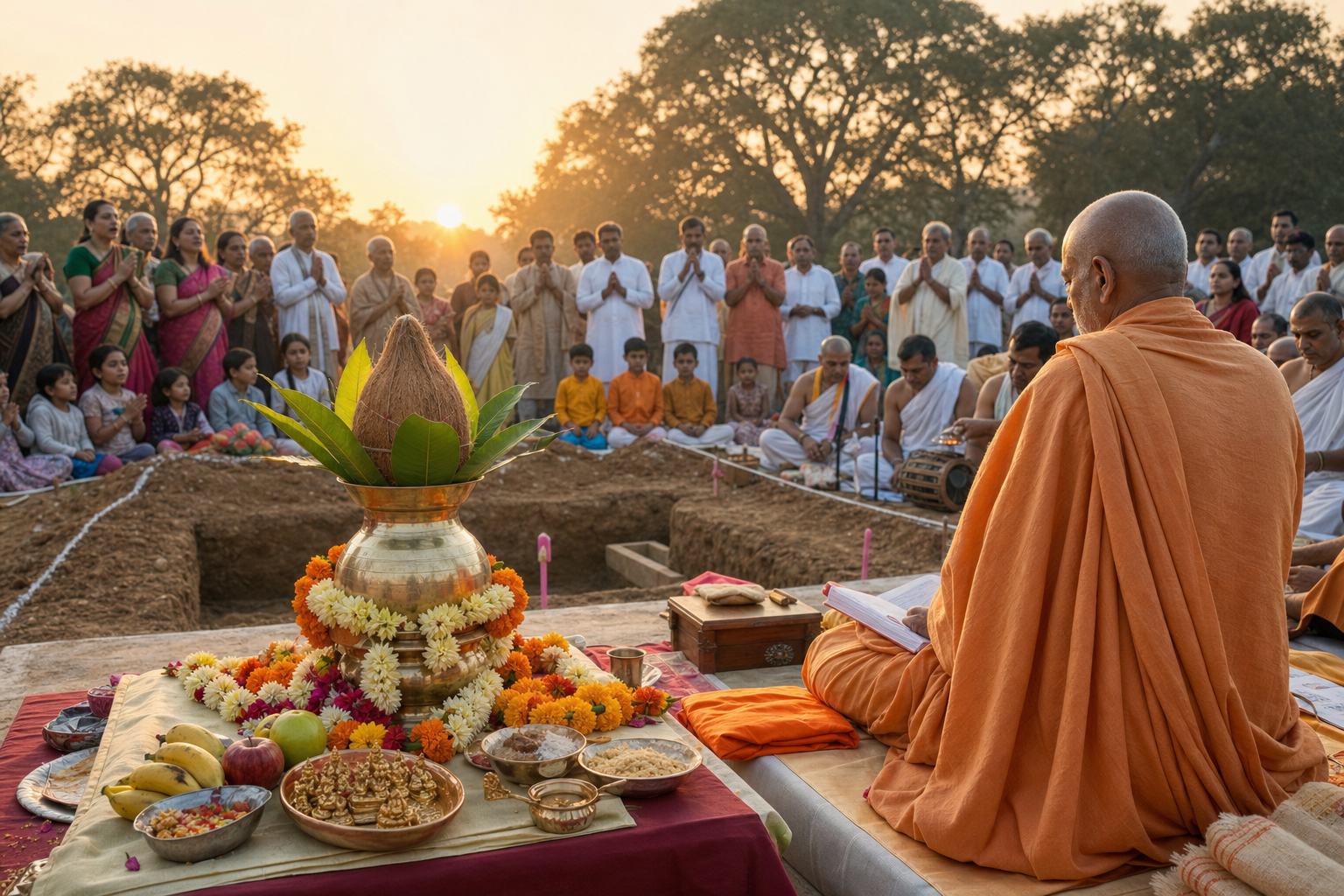
If you saw the Radha Golokananda cornerstone ceremony and wondered whether it was simply a blessing before construction, the better answer is more demanding. The rite placed the future temple under a public spiritual commitment: this building is to be raised in dharma, maintained through service, and used for more than its walls.
You can understand that commitment by watching what the ceremony joined together. Maharaj, the kalash, deity plates, offerings, mantras, kirtan, and the congregation’s calls of “Haribol” were not disconnected features. Each located the construction project within Vaishnava theology, inherited ritual discipline, and the life of a worshipping community.
What happened at the foundation
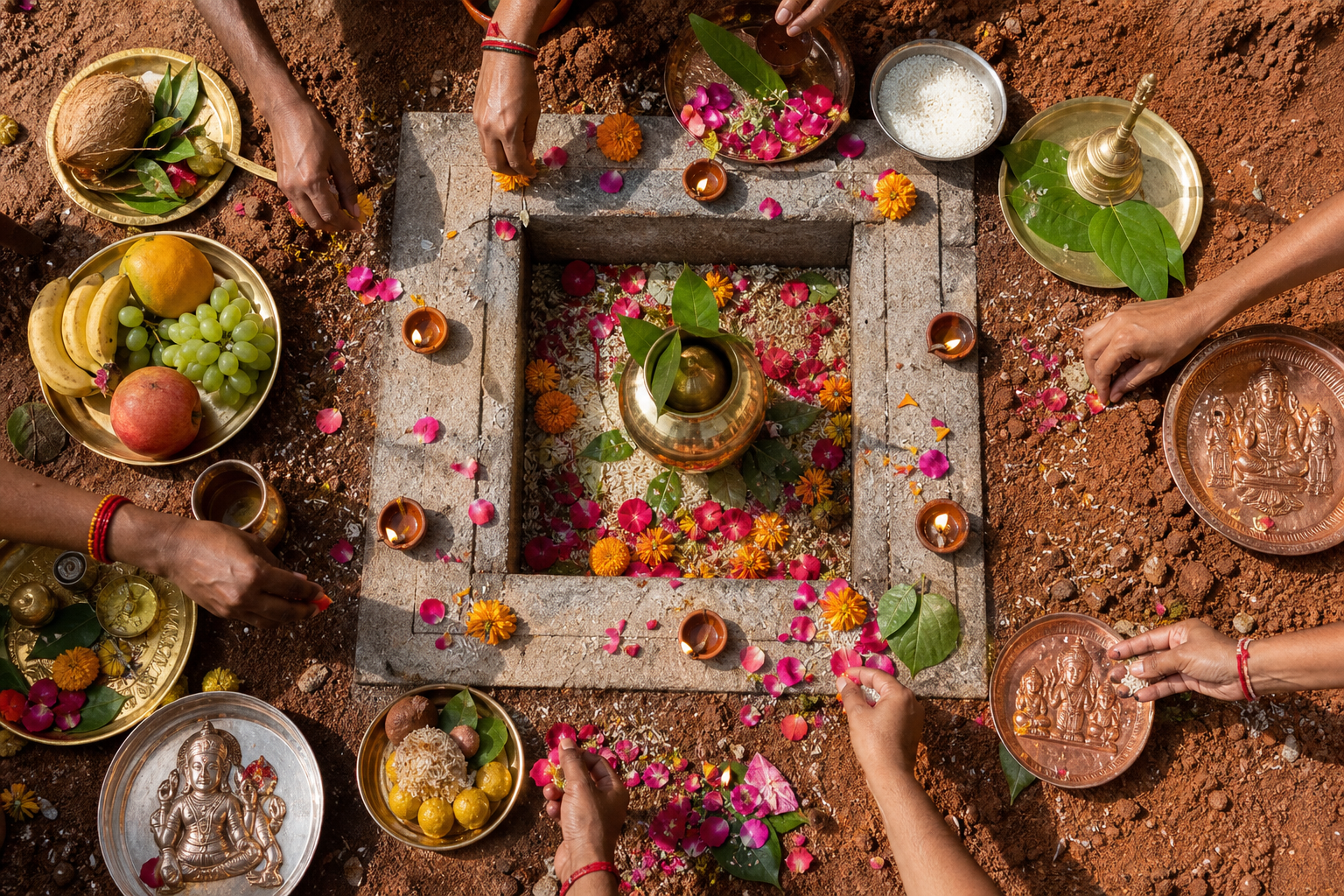
The cornerstone laying marked the beginning of a new temple dedicated to Sri Sri Radha Golokananda. Sacred vessels and plates were arranged carefully. Offerings were presented in an ordered manner. Invocations and mantras directed attention toward purity, auspiciousness, dharma, and service. Maharaj was guided through the ritual actions while the assembled devotees responded with “Haribol” and kirtan.
That combination matters. A construction milestone can be measured through engineering progress alone. A temple foundation asks another set of questions: What will this place serve? Which discipline will guide it? How will the community remain accountable to the sacred purpose invoked at its beginning?
The ceremony did not mean that the temple was complete, nor should it be confused with the eventual opening of a finished sacred space. It established the intention beneath the work still to come. The physical structure must now catch up with the spiritual promise made at its foundation.
- The kalash signalled auspiciousness and the sacred orientation of the occasion. Notice that it was placed and handled deliberately, not treated as decoration.
- The deity plates and offerings made devotion tangible. Materials became acts of service through their careful presentation.
- The invocations and mantras framed construction as work governed by dharma rather than merely by convenience.
- The kirtan and “Haribol” responses gave the congregation an active voice. The rite was performed with the community, not merely in front of it.
Ananta Shesha gives the foundation its theological depth

References to Ananta Shesha supplied the ceremony’s clearest image of support. In Vaishnava understanding, Ananta Shesha is associated with sustaining Lord Vishnu. At a foundation laying, that association brings together stability, continuity, and dependence upon divine support.
This symbolism shouldn’t be reduced to the vague idea of “good luck.” A temple is expected to endure because its community repeatedly sustains worship, teaching, hospitality, and service. The invocation of divine support therefore places a responsibility upon human supporters as well. Stability must become visible in sound construction, reliable stewardship, regular seva, and fidelity to the temple’s purpose.
If you are explaining the ceremony to a child or to someone unfamiliar with Vaishnava practice, start there: the foundation is not only the lowest part of the building. It represents what carries the temple across time. Ananta Shesha makes that otherwise invisible idea understandable.
The symbolism also corrects a common misreading of sacred architecture. Ornament is what visitors see first, but support comes before ornament. In the same way, a congregation’s quiet commitments often determine whether a temple thrives long after the excitement of construction has passed.
Why Maharaj was guided through the offerings
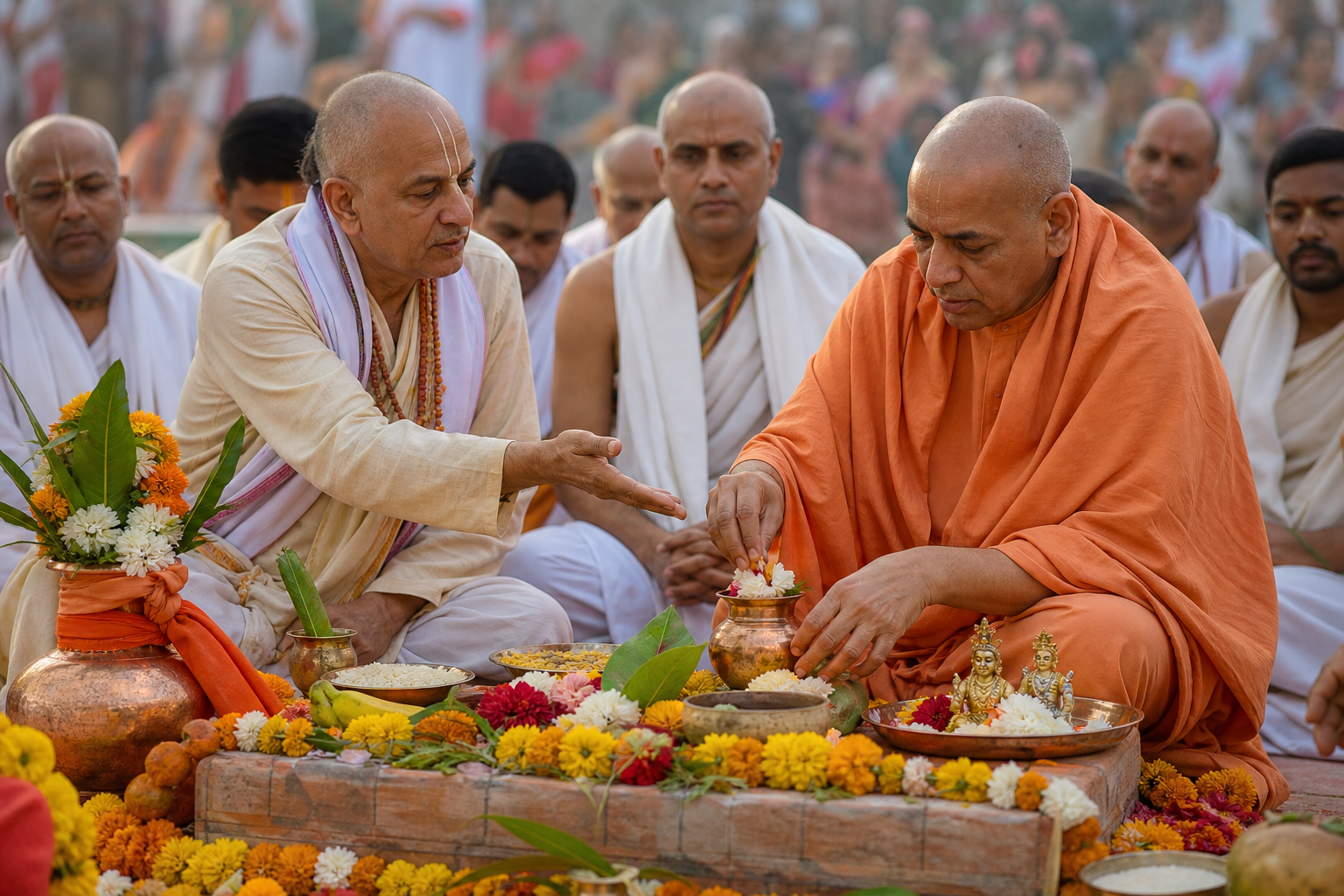
The sight of Maharaj being gently guided through the ritual actions reveals something important about authority in Vedic tradition. Reverence for a senior devotee does not eliminate procedure. The procedure itself protects the integrity of the rite by keeping actions aligned with lineage, mentorship, and shastra.
Guidance should therefore be read as care, not as hesitation. Sacred work is not strengthened by improvisation for its own sake. The measured handling of vessels and offerings showed that responsibility is shared: the senior participant, those directing the sequence, and the congregation attending to it all had distinct roles.
This is useful when you attend a ceremony whose details you don’t understand. You don’t need to imitate every movement or invent a private interpretation. Watch who prepares the materials, who gives ritual direction, when the congregation responds, and which actions are reserved for designated participants. Those distinctions will tell you more about the tradition than a hurried search for symbolic meanings detached from the actual rite.
Questions are still welcome when asked at the right time. After the ceremony, ask a knowledgeable organiser what a particular offering meant, why an invocation was used, or how the construction phase will proceed. During the rite, attentive silence and the congregational responses provide a more fitting form of participation.
A temple is built twice: in stone and in community
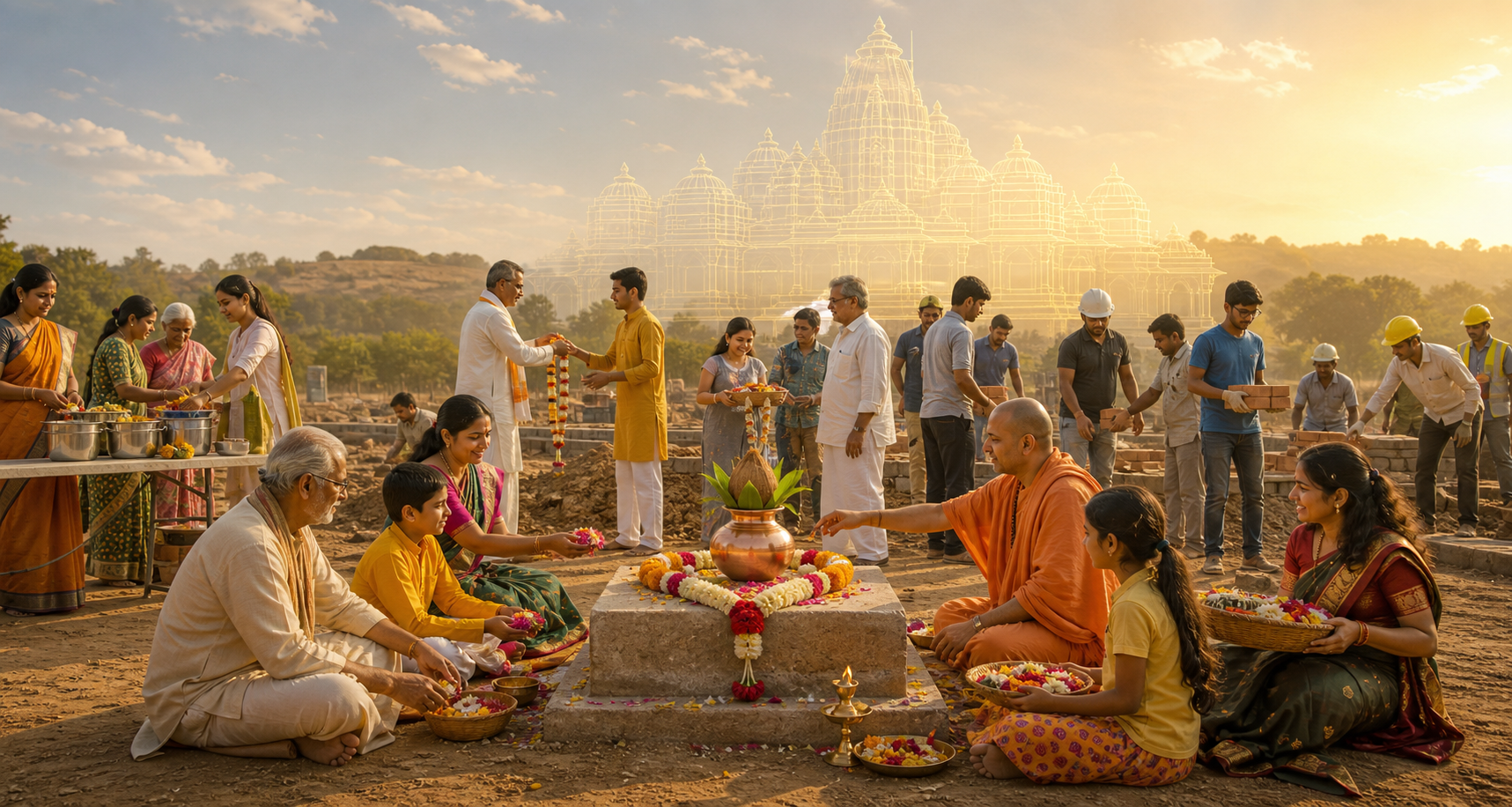
The calls of “Haribol,” the rhythm of kirtan, and the congregation’s shared attention turned the foundation laying into a collective act. That participation matters because a temple can be structurally complete and still remain institutionally fragile. Its lasting strength comes from people who worship there, teach the next generation, receive visitors, maintain the premises, and organise service.
Memories of earlier gatherings also connect a new structure with an existing devotional history. Elders carry knowledge of how the community formed. Younger participants inherit that memory by seeing, hearing, and eventually helping. Intergenerational continuity isn’t created by sentiment alone; it grows when people are given meaningful roles.
If you want your support to outlast the ceremony, turn it into a defined commitment:
- Learn one element of the rite accurately. Begin with the kalash, the offerings, the congregational response, or the symbolism of Ananta Shesha. Pass on what you can explain without exaggeration.
- Choose a form of seva that can continue. Construction assistance is valuable, but so are future commitments to worship, education, hospitality, maintenance, and outreach.
- Ask which phase needs help. A general wish to contribute becomes useful only when matched to an actual need identified by those responsible for the project.
- Request clear stewardship information. If you are contributing money or materials, ask what phase they support, how progress will be communicated, and how the completed temple’s continuing needs are being considered.
- Bring another generation into the work. Invite a younger relative to learn a response, help with an appropriate task, or hear why the temple is being built. Give them participation, not just observation.
This practical follow-through is part of the ceremony’s meaning. Worship, learning, and outreach require rooms and resources, but they also require dependable people. Sacred intention and careful administration belong together when a community hopes to preserve its heritage.
The same broad respect for sacred space can be recognised across dharmic traditions. Buddhist consecration rites, Jain pratishtha ceremonies, and Sikh Ardas connected with foundation laying each express reverence, humility, and ethical responsibility in their own forms. The resemblance is real, but the rites are not interchangeable. Dharmic unity is better served by understanding each tradition’s vocabulary and theology than by erasing their differences.
Key takeaways for attendees and supporters
- The cornerstone ceremony established a sacred intention for the new temple; it did not mark the completion of the project.
- The kalash, deity plates, offerings, mantras, kirtan, and “Haribol” responses joined ritual discipline with congregational devotion.
- Ananta Shesha represented divine support, stability, and continuity, while also pointing toward the community’s duty to sustain the temple.
- Maharaj’s guided participation demonstrated respect for lineage and the importance of following an ordered ritual process.
- Your most useful response is a continuing one: learn accurately, choose concrete seva, ask responsible questions, and include the next generation.
As construction advances, measure success by more than the appearance of the building. Look for the commitments made at the cornerstone to become visible in worship, sound stewardship, education, welcome, and service. Then choose one part of that work that you can help carry.
References
