
-
SB 2.1.21 Explained: A Powerful Path from Remembrance to Devotional Shelter

Śrīmad-Bhāgavatam 2.1.21 explains how disciplined remembrance leads the yogī toward bhakti, devotional connection, and shelter in the all-auspicious Lord. The verse appears in the Second Canto’s teaching on cosmic contemplation and the universal form, showing how meditation can mature into loving devotion. Its key terms reveal a practical psychology of attention: what the mind repeatedly…
-
Srimad Bhagavatam 3.26.53-55: Powerful Insights on Creation and Consciousness

Śrīmad-Bhāgavatam 3.26.53-55 offers a profound account of the virāṭ-puruṣa and the ordered emergence of speech, breath, smell, sight, hearing, and their presiding deities. These verses present Vedic cosmology as a sacred systems model in which the body, senses, elements, and divine governance are deeply connected. The discussion highlights how speech is linked with fire, sight…
-
Powerful Lessons from SB 5.24.03: Rāhu, Sudarśana, and Divine Protection
This reflection on the Srimad Bhagavatam class SB 5.24.03 explores the deeper meaning of Rāhu, the eclipse, and the protective power of the Sudarśana cakra. It presents the verse as more than a cosmological description, showing how the Bhagavata Purana uses sacred imagery to teach divine protection, purified vision, and resilience. The discussion highlights Lord…
-
Powerful Lesson from ŚB 4.19.23: Exposing False Spirituality with Dharma

ŚB 4.19.23 offers a powerful reflection on the difference between authentic dharma and religious appearance without inner substance. Set within the episode of King Pṛthu and Indra, the verse examines how envy and insecurity can distort sacred symbols. Its central warning concerns pākhaṇḍa, or pseudo-spirituality, where outward signs are separated from humility, discipline, and truth.…
-
Powerful Lessons from Śrīmad-Bhāgavatam 3.26.53-55 on the Cosmic Body

Śrīmad-Bhāgavatam 3.26.53-55 presents a profound account of the virāṭ-puruṣa entering the golden cosmic egg and organizing creation into meaningful departments. These verses explain how speech, breath, smell, sight, hearing, and their presiding deities emerge within the universal form. The teaching offers a technical Vedic framework for understanding the senses as sacred instruments rather than isolated…
-
Powerful Lessons from Srimad-Bhagavatam 3.24.5 on Faith, Guru, and Devotion

This article expands the brief Alachua Temple Live notice into a detailed study of HH Bir Krishna Mhj’s June 24, 2026 class on Śrīmad-Bhāgavatam 3.24.5. It explains the verse’s emphasis on śraddhā, guru-tattva, Devahūti’s spiritual seriousness, and the indwelling presence of the Supreme Lord. The discussion places the verse within Canto 3, Chapter 24, “The…
-
Nirjala Ekadashi’s Powerful Lesson: Bhima, Bhagavatam, and Devotional Discipline
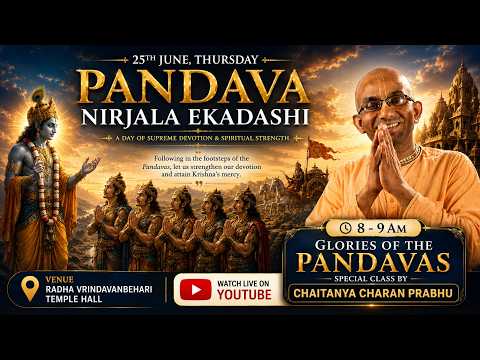
Pandava Nirjala Ekadashi is one of the most demanding and meaningful observances in the Vaishnava calendar. Associated with Bhima of the Pandavas, it teaches that sincere spiritual discipline must be guided by honesty, humility, and scriptural wisdom. The featured Srimad Bhagavatam class by HG Chaitanya Charan Prabhu highlights how fasting becomes transformative when joined with…
-
Powerful Bhāgavatam Insight: How the Supersoul Guides Mind, Senses, and Māyā

This post reflects on HH Bhakti Gaurav Narayan Swami Maharaj’s featured discourse on Śrīmad-Bhāgavatam 11.3.4, dated 21-06-2026. It explains how the verse describes the Supersoul entering embodied beings and activating the mind and senses. The discussion highlights key concepts such as pañca-dhātu, the ten senses, the mind, māyā, Paramātmā, and the three guṇas. It presents…
-
Powerful Srimad Bhagavatam 1.6.24 Wisdom: Why Devotion Never Fades

This article explores the deeper meaning of Srimad Bhagavatam 1.6.24 as discussed in the featured video by His Holiness Janananda Goswami Maharaja on Tuesday, 23 June 2026. The verse teaches that intelligence fixed in devotion to Bhagavan is never lost and that divine remembrance continues by grace. It examines the context of Narada’s instruction to…
-
Srimad Bhagavatam 11.11.1: Powerful Freedom Beyond Bondage and Liberation

This long-form reflection on Srimad Bhagavatam 11.11.1 examines Lord Krishna’s teaching to Uddhava on bondage, liberation, māyā, and the guṇas. It explains how the soul’s true identity remains spiritual even while embodied experience is shaped by material nature. The discussion places the verse within the Uddhava Gita and the Eleventh Canto’s wider teachings on devotional…
-
Bhadra Purnima Bhagavatam Marathon: Mayapur’s Powerful Call to Sacred Wisdom

The Bhagvatam Bhadra Purnima Marathon inauguration at Sri Dham Mayapur highlights the sacred importance of gifting, studying, and preserving the Śrīmad-Bhāgavatam. Rooted in Śrīmad-Bhāgavatam 12.13.13, the observance treats scripture as a living source of wisdom worthy of honor and transmission. This article explains the theological meaning of Bhadra Purnima, the role of Mayapur in Gaudiya…
-
Srimad Bhagavatam 10.29.18-22: The Gopis’ Sacred Call to Transformative Bhakti

Srimad Bhagavatam 10.29.18-22 presents one of the most profound moments in the Rasa-lila narrative, where the gopis respond to Sri Krishna’s flute with complete devotional absorption. These verses explore the tension between worldly duty and divine love without dismissing the importance of dharma. Krishna’s challenging words to the gopis reveal the depth, purity, and seriousness…
-
Srimad Bhagavatam 3.26.47-49: Powerful Sankhya Wisdom on Senses and Earth

Srimad Bhagavatam 3.26.47-49 offers a precise Sāṅkhya analysis of the senses, their objects, and the five gross elements. The passage explains hearing through sound, touch through air, sight through form, taste through water, and smell through earth. It also teaches that the effect carries the qualities of its cause, which is why earth is described…
-
Gita Nagari Bhagavatam Class: A Powerful Daily Practice for Bhakti and Puja

Gita Nagari’s daily Srimad Bhagavatam class offers a meaningful model of scriptural learning joined with devotion, greetings, and puja. The practice brings the Bhagavata Purana into everyday life through hearing, reflection, ritual worship, and community participation. This article explains the theological, cultural, and practical significance of studying Srimad Bhagavatam in a daily setting. It highlights…
-
Kubja of Mathura: Krishna’s Powerful Lesson on Grace, Dignity, and Inner Beauty

Kubja of Mathura is a deeply moving figure in Krishna bhakti literature, remembered for her encounter with Sri Krishna in the streets of Mathura. Though often associated in popular titles with the Mahabharata tradition, her story is primarily narrated in the Bhagavata Purana, Brahma Vaivarta Purana, and devotional retellings such as the Sur Sagar. As…
-
Bhagavatam 4.21.37–52: Maharaja Prithu’s Transformative Dharma of Leadership, Bhakti, and Unity

Srimad-Bhagavatam 4.21.37–52 closes Maharaja Prithu’s instructions with a rare integration of rajadharma (ethical governance) and bhakti-yoga (devotional practice). The verses argue that just leadership, social cooperation, and personal sadhana are mutually reinforcing and teleologically ordered toward pleasing the Supreme. Framed through the Paramātman perspective, the text grounds nonviolence, truthfulness, and compassion in the recognition of…
-
Conquering Pride with Humility: SB 11.3.13 and HH Guru Prasad Swami’s ISKCON Guidance

Pride undermines devotion, learning, and relationships; SB 11.3.13 situates humility as a practical method for transformation within the Nimi–Navayogendra teachings. Drawing on HH Guru Prasad Swami Maharaj’s ISKCON guidance, this analysis shows how precise sādhana, collaborative seva, and accountable satsaṅga systematically disarm ego. It distinguishes healthy self-respect from egoic inflation and offers clear behavioral metrics…
-
ŚB 4.19.14–22 decoded: Pṛthu’s Aśvamedha, Indra’s Envy, and the Ethics of Dharma

Śrīmad-Bhāgavatam (ŚB) 4.19.14–22 examines how power and piety interact when public ritual becomes a theater for rivalry. Set during King Pṛthu’s aśvamedha-yajñas, these verses depict Indra weaponizing ascetic symbols to mask sabotage, thereby illustrating the danger of kūṭa-dharmacounterfeit religiosity. The passage distinguishes authentic renunciation from its costume, urging institutions to anchor trust in conduct, not…
-
SB 11.3.5 Unveiled: Navayogendras on Bhakti, Deity Worship, and Fearless Devotional Life

This in-depth exploration situates SB 11.3.5 within the Nimi–Navayogendra dialogue of the Bhagavata Purana and explains how the verse anchors a practical turn toward embodied devotion. It clarifies the integration of association with the saintly, disciplined hearing, Deity worship (arcana), and compassionate service as core commitments of bhakti. Readers gain a precise sense of how…
-
SB 10.7.21 Morning Class: Unveiling Krishna’s Vatsalya Rasa, Trnavarta, and Yogamaya

This morning class situates SB 10.7.21 within the Gokula pastimes of Śrī Kṛṣṇa, clarifying how Trnavarta’s ‘whirlwind’ is overcome by the yogamāyā-governed ‘weight’ (gurutva) of divine presence. Drawing on Gaudiya Vaiṣṇava commentaries, it shows how vātsalya-rasa eclipses overt majesty, allowing love to be the primary mode of realization. The analysis integrates philological, theological, and psychological…