
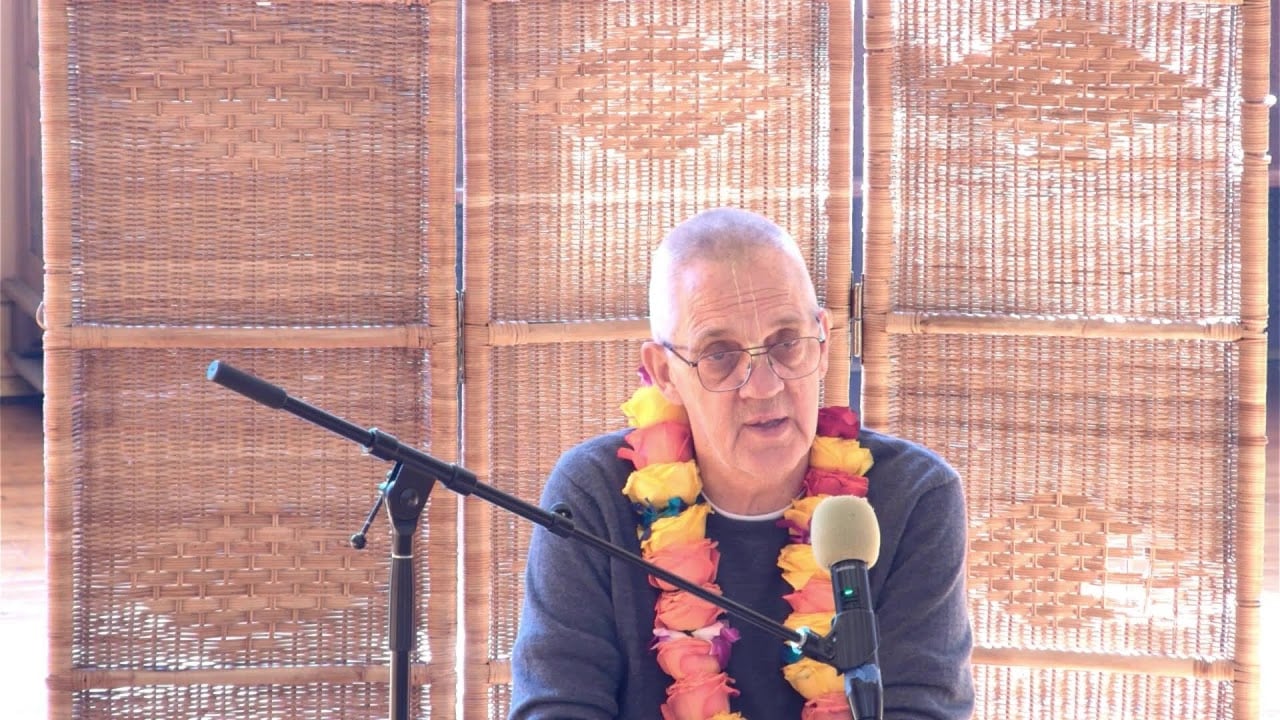
Srimad Bhagavatam 11.11.1, discussed by HG Nrsimhakavaca prabhu for ISKCON Chicago Official on June 23, 2026, opens a subtle and demanding section of the Eleventh Canto. The verse belongs to the celebrated dialogue between Lord Krishna and Uddhava, often called the Uddhava Gita, where Krishna gives final instructions on spiritual knowledge, devotion, detachment, and the inner life of the soul.
The source video is available here: Srimad Bhagavatam 11.11.1 I HG Nrsimhakavaca prabhu I 06/23/2026. The lecture continues the long-standing Vaishnava practice of reading scripture not merely as ancient literature, but as a living guide for self-understanding, ethical discipline, and devotional transformation.
The verse begins with Lord Krishna’s answer to Uddhava’s inquiry about the conditioned and liberated states of the living being. In Sanskrit, the verse reads: श्रीभगवानुवाच बद्धो मुक्त इति व्याख्या गुणतो मे न वस्तुत: । गुणस्य मायामूलत्वान्न मे मोक्षो न बन्धनम् ॥ १ ॥
In transliteration, the verse is rendered as: śrī-bhagavān uvāca baddho mukta iti vyākhyā guṇato me na vastutaḥ guṇasya māyā-mūlatvān na me mokṣo na bandhanam. The essential meaning is that bondage and liberation are designations arising from the influence of the guṇas, the modes of material nature. From the ultimate spiritual standpoint, the soul is not truly bound by matter, and the Supreme Lord, being the master of māyā, is never subject to either bondage or liberation.
This teaching requires careful attention because it does not deny the experience of suffering, confusion, duty, or spiritual struggle. Rather, it places those experiences within a higher metaphysical framework. The conditioned state is experientially real for the embodied jīva, yet it is not the soul’s eternal identity. The language of bondage and liberation is meaningful in practical spiritual life, but it does not describe the soul’s deepest ontological nature.
The Bhagavata Purana consistently presents the living being as spiritual, conscious, and capable of loving relation with Bhagavan. In this verse, Krishna distinguishes between temporary designations and essential reality. The jīva may identify with body, mind, social role, emotion, ideology, achievement, trauma, or failure, yet none of these is the final self. Such identifications are produced through contact with prakṛti, especially through the three guṇas: sattva, rajas, and tamas.
Sattva clarifies, rajas agitates, and tamas obscures. These three modes shape perception, mood, desire, action, and memory. A person may feel peaceful and wise in one season of life, restless and ambitious in another, and confused or inert in another. The Bhagavatam’s analysis is technically precise: these shifting states belong to the field of material nature, not to the eternal identity of the soul.
This insight is psychologically powerful. Much human distress comes from confusing passing conditions with permanent identity. A mind under pressure may conclude, “this is who I am,” when scripture would say, more carefully, “this is a condition moving through the mind.” The distinction does not trivialize pain. It gives pain a context and prevents it from becoming a false theology of the self.
Srimad Bhagavatam 11.11.1 therefore gives a disciplined language of freedom. Liberation is not merely a change of location, social status, or intellectual opinion. It is the restoration of clear identity through knowledge, devotion, and the grace of Krishna. In bhakti theology, freedom is not emptiness or isolation; it is loving service grounded in the soul’s natural relation with the Supreme.
The phrase “na me mokṣo na bandhanam” is especially significant. Krishna is not a being struggling within māyā. He is not first bound and then liberated. He is the supreme controller of māyā and the source of the spiritual potencies of eternity, knowledge, and bliss. This preserves a central Vaishnava distinction between the Supreme Lord and the individual soul, while also affirming that the soul’s true nature is spiritual and not material.
The verse also protects devotional life from two extremes. One extreme is crude materialism, which assumes the body and mind are the whole person. The other is careless abstraction, which dismisses the lived struggle of the embodied soul as irrelevant. The Bhagavatam avoids both. It teaches that bondage is not ultimate, yet spiritual practice remains necessary because false identification produces real consequences within experience.
For practitioners in the ISKCON and broader Vaishnava tradition, the practical conclusion is clear: the mind must be trained, the senses purified, and the heart reoriented toward Krishna. Chanting, hearing, study, worship, service, ethical conduct, and association with sādhus are not external ornaments. They are the disciplines by which mistaken identification is gradually loosened and spiritual perception becomes steady.
In a wider Dharmic context, this teaching harmonizes with the shared concern of Hinduism, Buddhism, Jainism, and Sikhism for overcoming ignorance, ego-centered living, and bondage to lower impulses. The philosophical vocabularies differ, and those differences deserve respect, yet the practical concern is often similar: human life becomes noble when consciousness is disciplined, compassion is cultivated, and the self is not reduced to appetite, fear, or social performance.
The Bhagavatam’s contribution is its specifically bhakti-centered resolution. It does not end with self-analysis alone. It points toward loving surrender to Bhagavan, especially Sri Krishna, as the complete fulfillment of knowledge. The soul is not merely to escape illusion; it is to awaken its positive nature in devotion. This is why the Eleventh Canto repeatedly joins jñāna, vairāgya, and bhakti into a single integrated path.
Modern readers may find the verse unusually relevant. Contemporary life encourages constant identification with labels: profession, politics, consumption, personal history, public image, and psychological wounds. Srimad Bhagavatam 11.11.1 asks a more penetrating question: what remains when all temporary designations are seen as movements of nature rather than the essence of the self?
This question is not escapist. A person who understands the temporary nature of material designations can act with greater steadiness in family, work, community, and society. Detachment does not mean indifference. In the Bhagavata vision, detachment means serving without being consumed by egoistic ownership. It means honoring duty while remembering that the self is deeper than success and failure.
The lecture setting at ISKCON Chicago also matters. The Bhagavatam is traditionally heard in community, not only studied privately. Hearing scripture in saṅga allows philosophical insight to become shared practice. A verse on bondage and liberation becomes more than a doctrine when discussed among people attempting to live with humility, discipline, compassion, and devotion.
HG Nrsimhakavaca prabhu’s topic therefore invites reflection on how spiritual identity is remembered in ordinary life. The measure of understanding is not the ability to repeat metaphysical terms, but the ability to respond differently when the guṇas move through the mind. Anger, pride, fear, lethargy, and craving may arise, but they need not be enthroned as the self.
In this sense, Srimad Bhagavatam 11.11.1 offers both metaphysics and medicine. Its metaphysics explains that the soul is never essentially material. Its medicine teaches that false identification can be healed through spiritual practice. The practitioner is invited to live from the soul’s relation with Krishna rather than from the instability of the guṇas.
The verse also sharpens the meaning of liberation. Mokṣa is not simply relief from discomfort. If liberation is understood only as escape from pain, it remains centered on the self’s demand for comfort. The Bhagavatam deepens the concept: liberation is the recovery of one’s true spiritual function. The liberated life is marked by clarity, humility, devotion, and freedom from false ego.
Such a vision is emotionally resonant because every serious practitioner knows the gap between spiritual aspiration and lived conditioning. Scripture does not deny that gap. It explains it without despair. The guṇas may condition behavior, but they do not define the eternal soul. Māyā may confuse perception, but it does not possess ultimate authority over Bhagavan or over the soul’s capacity to turn toward Him.
The academic value of this verse lies in its compact philosophical structure. It addresses ontology, psychology, theology, and soteriology in a single statement. Ontologically, the soul is distinct from matter. Psychologically, bondage is experienced through identification with the modes. Theologically, Krishna stands beyond māyā. Soteriologically, liberation is meaningful as release from false identification and restoration of spiritual consciousness.
For devotional readers, the enduring lesson is simple but profound: the self should not be interpreted through the fluctuations of material nature. Spiritual life begins when the living being stops mistaking temporary conditions for ultimate truth. It matures when that knowledge becomes loving service to Sri Krishna.
Srimad Bhagavatam 11.11.1 is therefore not only a philosophical verse for specialists. It is a practical mirror for anyone seeking steadiness in a restless world. It teaches that the language of bondage and liberation must be understood carefully, that Krishna is eternally beyond both, and that the soul’s deepest freedom is realized through awakened devotion, disciplined consciousness, and remembrance of its eternal spiritual identity.
Inspired by this post on Dandavats.
