-
Kokamukhi Devi: Unmasking the Jackal-Faced Shakti of Time, Death, and Sacred Renewal

Kokamukhi Devi, the jackal-faced manifestation of Adi Shakti, illuminates how fierce iconography can teach compassion, courage, and clarity. This analysis situates her cremation-ground symbolism within Shakta Tantra while drawing bridges to Buddhist charnel-ground meditations, Jain vairāgya, and Sikh remembrance of hukam. Readers gain a grounded understanding of how time and impermanence catalyze ethical living, not…
-
Saraswati Puja Stotras for Basant Panchami & Navratri: Powerful Mantras, Meaning, and Practice

Saraswati Puja on Basant Panchami and during Navratri Durga Puja honors knowledge, arts, and disciplined learning. This guide outlines when and how to chant Saraswati Puja stotras, including Om Aim Saraswatyai Namah, Saraswati Namastubhyam, and Ya Kundendu Tusharahara Dhavala. It explains simple home worship steps, from setting a clean altar to choosing practical repetition counts.…
-
Abuj Muhurat 2026 Decoded: Harness Swayam Siddhi Muhurat for Auspicious Beginnings

Abuj Muhurat (Swayam Siddhi Muhurat) provides a self-validated, highly auspicious window for beginning major life events without the usual need to check Tithi, Vaar, Nakshatra, Yog, Shukra Astha, or Guru Astha. In 2026, it remains a practical, tradition-aligned choice for weddings, Griha Pravesh, business inaugurations, and more. The approach fosters family consensus and reduces planning…
-
Shyamala Navaratri 2026: Dates, Pooja Guide, and the 9 Nights of Knowledge & Harmony

Shyamala Navaratri 2026 will be observed from 19 January to 27 January, corresponding to Shukla Paksha Pratipada through Shukla Paksha Navami in Magha. Also known as Magha Navaratri, this Gupta Navaratri honors the Shyamala aspect of the Divine Mother, emphasizing wisdom, eloquence, and the arts. The guide outlines a clear, home-friendly pooja flow—sankalpa, dhyana, Panchopachara…
-
When Joy Meets Grief Abroad: A Compassionate Guide to Navigating Sadness on Vacation

Travel sometimes magnifies emotions rather than erasing them. This narrative illustrates how C-PTSD triggers, jet lag, and unmet expectations can follow travelers—and how mindful, compassionate practices can help. Readers gain ten evidence-informed strategies to regulate the nervous system, practice radical acceptance, and build emotional resilience while away from home. Sensory grounding, present-moment awareness, somatic release,…
-
Bhishma’s Redemption on Ratha Saptami: A Mahabharata Meditation on Dharma and Legacy

Bhishma’s redemption on Ratha Saptami illuminates how the Mahabharata unites duty, remorse, and renewal under the guiding light of Surya. By situating his vigil and teachings within Uttarayana, the narrative aligns ethical reorientation with cosmic order. Readers gain clear, practical pathways to observe Ratha Saptami and Bhishma Ashtami—through Surya arghya, study of Shanti Parva and…
-
When Words Fall Silent: Hinduism’s Transformational Path to Inner Stillness and Wisdom

True silence in Hinduism is not mere muteness but an effortless stillness of mind that reveals wisdom. Upanishadic insights describe a reality beyond speech and thought, while Yoga philosophy offers a practical path through pranayama, pratyahara, dharana, and dhyana. Sound becomes a gateway to silence as japa and kirtan refine attention from words to awareness.…
-
Pratyavaya Explained: The Profound Karmic Cost of Neglected Duties in Hindu Dharma

Pratyavaya in Hindu philosophy refers to the spiritual demerit that accrues when duties are neglected or performed carelessly. Rooted in Dharmasastra and illumined by Karma Yoga in the Bhagavad Gita, it describes a precise moral causality rather than arbitrary punishment. In everyday life, it appears as inner dissonance when ethical or spiritual disciplines are skipped,…
-
4 Timeless Disciplines to Sustain Bhakti: Humility, Offense-Awareness, Strong Sanga, Clear Path
Long-term perseverance in the Bhakti Tradition flourishes when four stabilizing disciplines are cultivated: humility, freedom from offenses (aparadha), elevating sanga, and a clear path of sādhana. Humility softens ego and increases receptivity to guidance, making chanting and meditation more attentive. Guarding against offenses protects sacred relationships and aligns with universal dharmic values like right speech…
-
Vrndavana’s Timeless Radiance: An Awe-Inspiring Exploration of Krishna’s Spiritual Abode

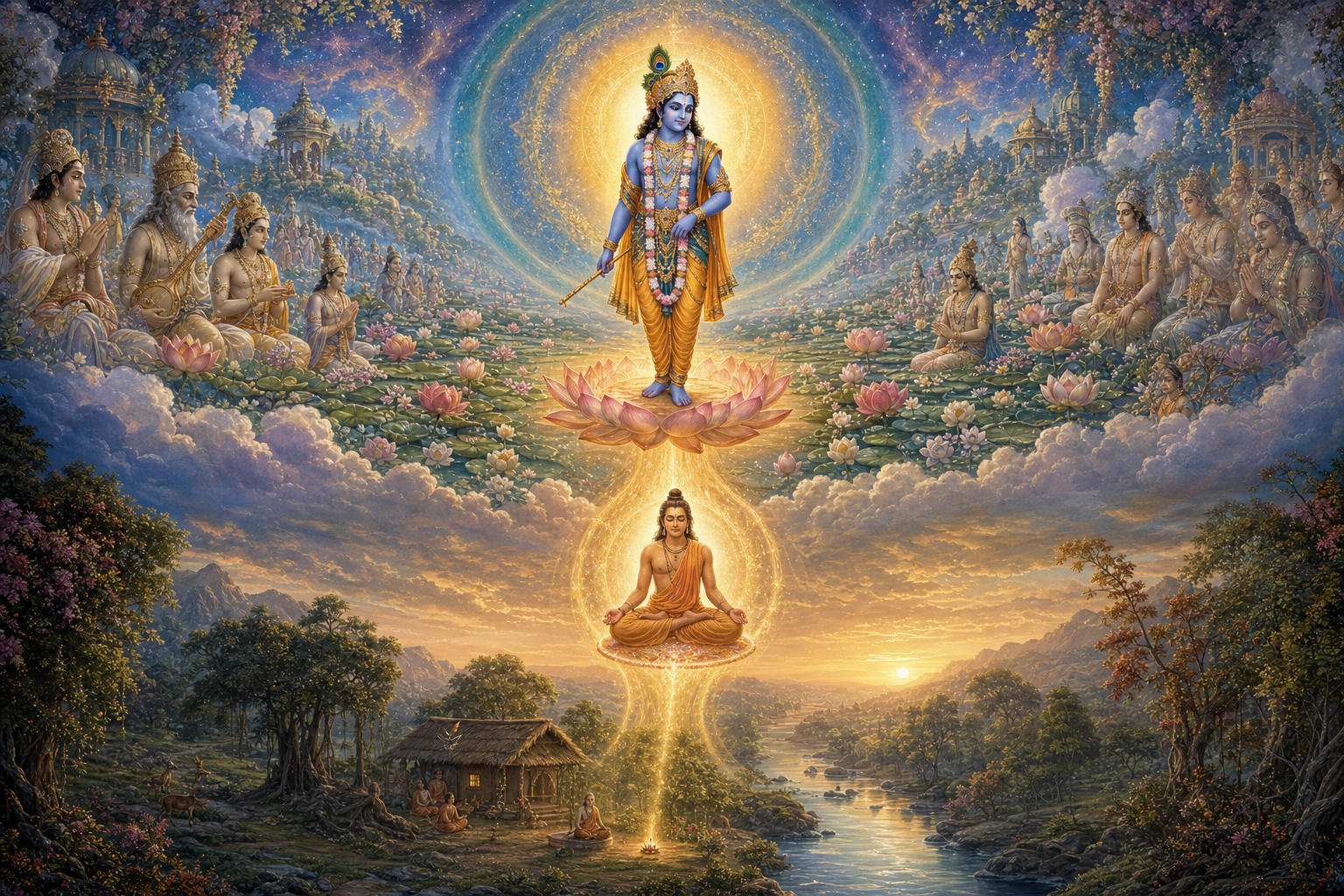
Vrndavana is portrayed as a transcendental, self-luminous realm where devotion to Krsna unfolds beyond the limits of time. The gopis, goddesses of fortune, embody pure love, while kalpa-vrksa trees, touchstone earth, and nectar waters express effortless spiritual abundance. Speech becomes song, walking becomes dance, and the flute symbolizes the musicality of devotion. Surabhi cows signify…
-
Expectations, Ego, and Liberation: Dharmic Wisdom for Healing Relationships and Joy

Dharmic traditions agree that unmet expectations and ego-driven desires fuel relational suffering. Hinduism’s Karma Yoga reframes action through detachment from outcomes, while Buddhism’s mindfulness softens craving and reactivity. Jain principles of ahimsa and aparigraha reduce harm and possessiveness, and Sikh seva dissolves ego into compassionate service. Together, these teachings cultivate empathy, patience, and a lived…
-
When Anger Blinds Truth: Dharmic Wisdom and Practical Tools to Restore Clarity

Anger, according to the Bhagavad Gita (2.63), initiates a precise cognitive and ethical decline—delusion, memory confusion, loss of discernment—ending in poor choices. Dharmic traditions converge on this insight: Hinduism, Buddhism, Jainism, and Sikhism each identify anger as a primary obstacle to wisdom and compassion. This analysis offers practical tools—breath awareness, mindfulness, loving-kindness, patience, and seva—to…
-
Doshams Decoded: Navagraha, Pitru, and Sarpa—Causes, Signs, Remedies for Karmic Harmony

Doshams are viewed as indicators of karmic imbalance rather than fixed fate, pointing toward ethical refinement and compassionate remedies. This guide clarifies the three major types—Navagraha Dosham, Pitru Dosham, and Sarpa Dosham—and outlines how they relate to planetary harmony, ancestral obligations, and ecological reverence. It highlights practical responses such as Navagraha Shanti, Pitru Tarpana, Naga…
-
Child Born on No-Moon (Amavasya) Day: Cultural Meanings, Life Paths, and Hopeful Remedies

Birth on Amavasya (Amavasai) is traditionally associated with contemplation, renewal, and inner strength rather than inauspiciousness. Positioned as the fifteenth tithi in Krishna Paksha (Vad Paksha – Bahula Paksha – dark fortnight), it symbolizes closure and a fresh start in the Hindu calendar. A complete horoscope, not the tithi alone, informs any assessment of career,…
-
Sri Parasara Bhattar: Grace-Filled Lineage and Bhakti Legacy in Vaishnavism

Sri Parasara Bhattar is honored in Vaishnavism as a luminary of the bhakti tradition, remembered for devotion, humility, and clarity of thought. Born through the grace of Sri Ranganatha and named with affection by Sri Ramanuja, his life exemplifies the strength of lineage and the guru-disciple tradition in Hindu spiritual practice. The account of his…
-
Ganesh Jayanti Vrat Katha: Timeless Maghi Ganesh Chauth Wisdom for Blessings and Unity

Ganesh Jayanti (Maghi Ganesh Chauth) falls on Shukla Paksha Chaturthi in Magh Month as per the Hindu calendar and centers on devotion to Ganesha for wisdom, clarity, and auspicious beginnings. The associated vrat katha of a righteous King and his wise queen Ratnavali underscores ethical governance, compassion, and steadfast faith. Families observe the day with…
-
Seven Daily Practices to Cultivate Wismad for Calm, Clarity, and Dharmic Unity

This guide presents seven daily practices to cultivate Wismad—an awe-filled awareness recognized across Hinduism, Buddhism, Jainism, and Sikhism. It begins with simple breathwork to calm the nervous system and prepare the mind for ethical action. Short, contemplative study fosters humility and integrative understanding through Anekantavada. Compassion-in-action turns mindfulness into service, while mindful speech and listening…
-
ज्योतिष, रोग और उपाय: ग्रहों के प्रभाव से सामान्य बीमारियों की व्यावहारिक समझ और समाधान

This piece frames health through a traditional Jyotisha perspective while remaining practical and inclusive. It focuses on common ailments—stress, low energy, inflammation, and metabolic imbalance—rather than exhaustive disease lists. Readers gain an integrative view that complements Ayurveda, Yoga, and modern medicine for safer, balanced choices. Remedies emphasize breathwork, meditation, sattvic routines, mantra, seva, and ethical…
-
योग साधना द्वारा जीवन विकास: Transform Daily Life with Practical Yoga, Calm, and Clarity

Yoga is often misunderstood as an ascetic pursuit, yet it serves as a practical method for everyday life development. Rooted in shared dharmic values, it unites Hindu, Buddhist, Jain, and Sikh perspectives through ethics, breath awareness, and meditation. A simple, consistent routine—brief asana, breathing techniques, and reflective practice—builds emotional resilience and steady focus. Ethical principles…
-
Destiny vs. Free Will: How Karma and Choices Shape Our Future Across Dharmic Traditions

Is the future predetermined, or do choices genuinely shape outcomes? Drawing on Hinduism, Buddhism, Jainism, and Sikhism, this piece clarifies how karma names conditions from the past while puruṣārtha preserves present agency. The Bhagavad Gita’s Karma Yoga, Buddhism’s emphasis on intention, Jainism’s ethical discipline, and Sikhism’s balance of Hukam and effort converge on responsible freedom.…