
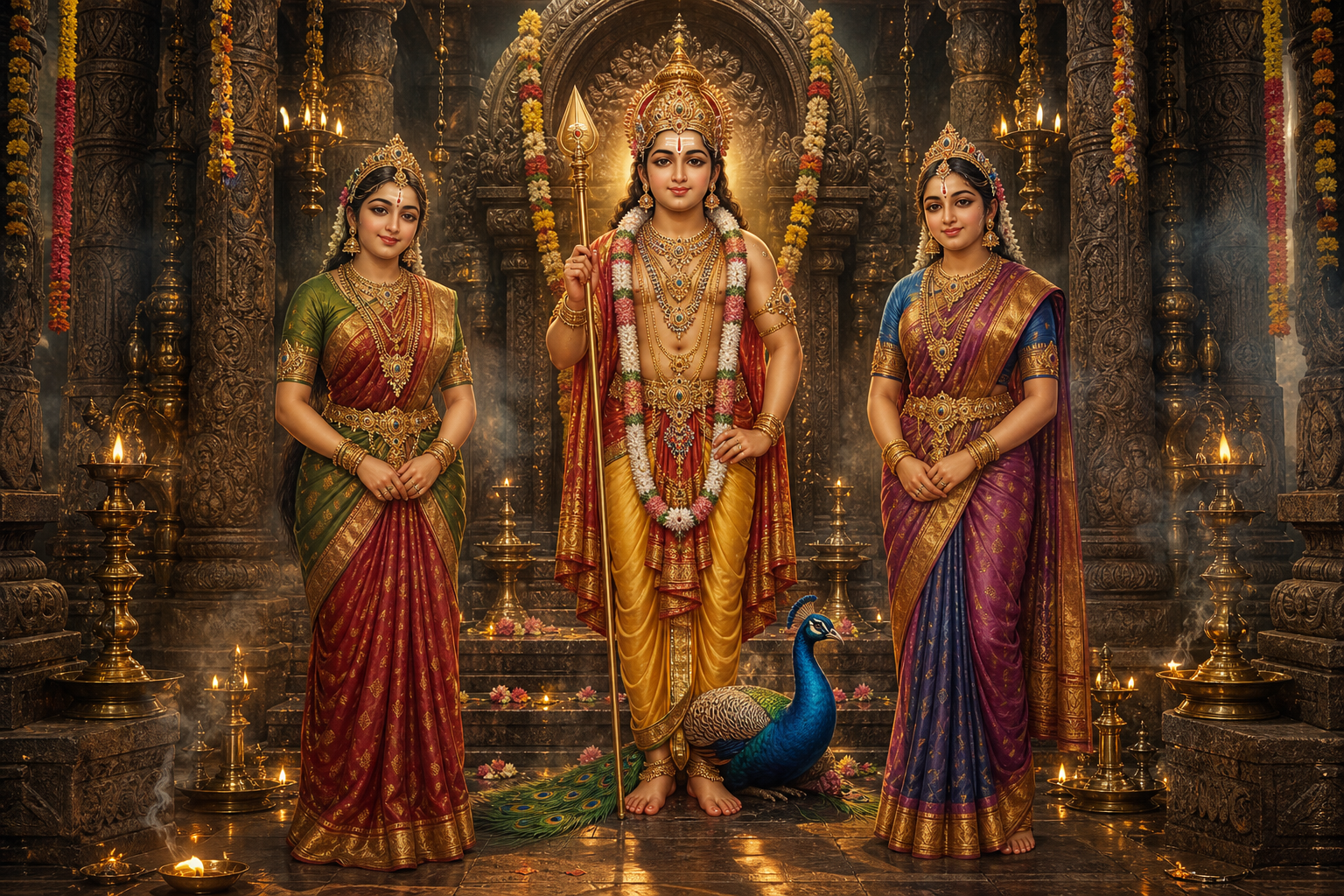
If you have stood before Subramanya with Valli and Devasena beside him, or encountered him in a very different temple setting, you may have wondered which form is correct. That question can quietly get in the way of darshan.
You do not need to force every Subramanya tradition into one formula before you can pray. Begin by recognizing the form before you, learn what its relationships emphasize, and let the temple’s own customs determine how you participate. The result is a more attentive worship: less concerned with resolving every variation and more capable of receiving what that particular form teaches.
Begin with the form the temple actually presents
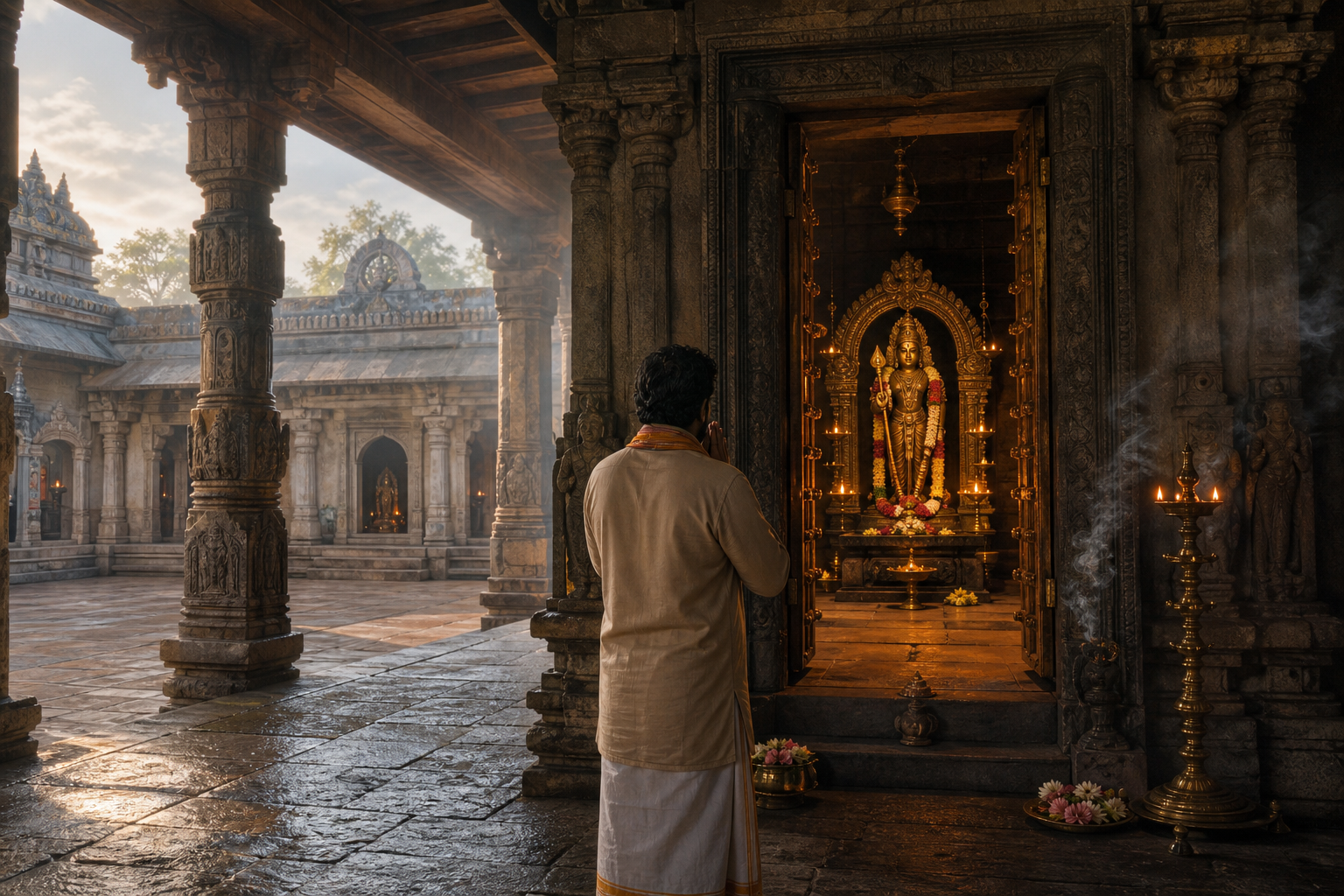
Subramanya is also known as Skanda, Kartikeya, and Murugan. These names identify the same divine figure, but a temple’s chosen name often signals its regional vocabulary, inherited stories, festivals, and devotional emphasis. Treat the local name as an invitation to listen before assuming you already know the whole tradition.
The same principle applies to iconography. A dual-consort form places Valli and Devasena at the center of the devotee’s attention. At Ghati Subramanya, by contrast, the shrine’s defining features include a swayambhu, or self-originated, Subramanya vigraha and the presence of Lakshmi Narasimha in the same sacred complex. One arrangement does not invalidate the other. Each reveals a distinct dimension of a living tradition.
When you enter an unfamiliar Subramanya temple, use this simple sequence:
- Read the temple’s own name for the deity rather than replacing it immediately with the name most familiar to you.
- Notice the central vigraha, the adjacent divine figures, and the direction in which worshippers are guided.
- Ask a priest, attendant, or knowledgeable devotee which form is being worshipped and which local narrative or festival is especially important.
- Follow the temple’s ritual order even if your home or family practice uses a different sequence.
- Only then apply a symbolic interpretation. Observation should come before explanation.
This protects you from a common mistake: treating a familiar name as though it erases local memory. Dharmic unity does not require every shrine to look or speak alike. Its continuity is often carried through precisely such regional forms.
Valli and Devasena express two sides of a complete life
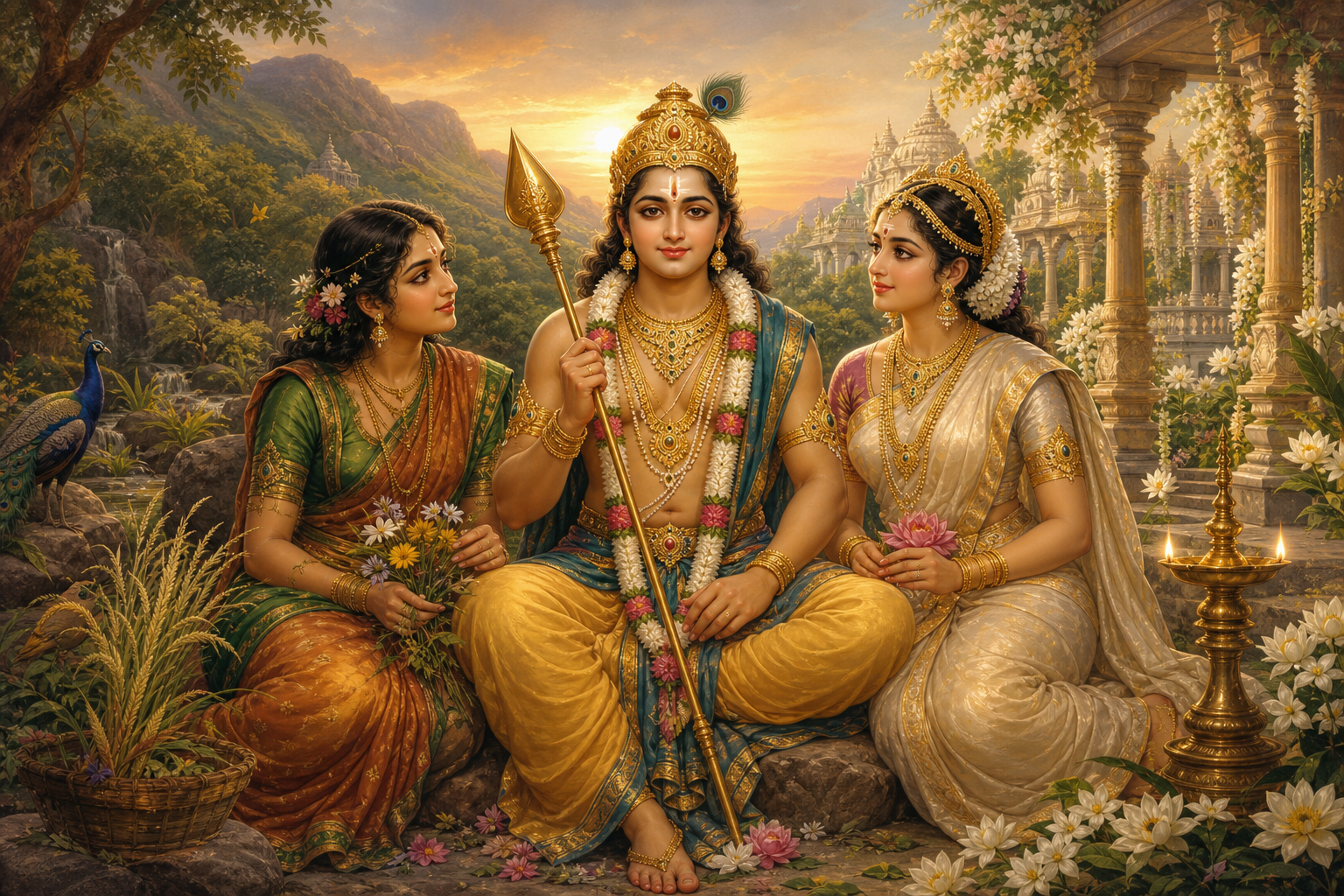
The two marriages belong to different narrative worlds. Devasena is the daughter of Indra, and her marriage to Subramanya is commonly placed in a celestial, classical, and Puranic frame. She is associated with auspicious order and a union recognized within that divine order.
Valli enters through the southern landscape. She is remembered as a tribal princess whose love is steadfast and sincere, while guardianship and social convention complicate the path to union. Her story therefore has a different emotional movement: personal longing must pass through uncertainty, recognition, and freely given affirmation.
In a widely used symbolic reading, Valli and Devasena together embody complementary powers of willing and acting. This is best understood as a disciplined pairing, not as a contest between two brides:
- Intention without action can remain private longing, however sincere it may be.
- Action without a truthful intention can become mechanical, restless, or self-serving.
- Spiritual maturity asks you to align what you genuinely seek with what you are prepared to do responsibly.
- Subramanya stands at the center as courage guided by discernment and directed toward righteous action.
This interpretation gives you a practical way to pray before the dual-consort form. Instead of approaching only with a request for an outcome, examine the relationship between your desire and your conduct. Is your intention honest? Does your next action serve it without violating another person’s dignity? Are you calling hesitation prudence, or calling impatience courage? What duty must accompany the grace you seek?
The symbolic reading should not erase the devotional one. Valli and Devasena are not merely concepts placed beside Subramanya for philosophical convenience. Devotees approach them as divine persons within a sacred family. Symbolism can illuminate that relationship, but it should not reduce living deities to an abstract diagram.
Ganapathi’s intervention must be read through consent
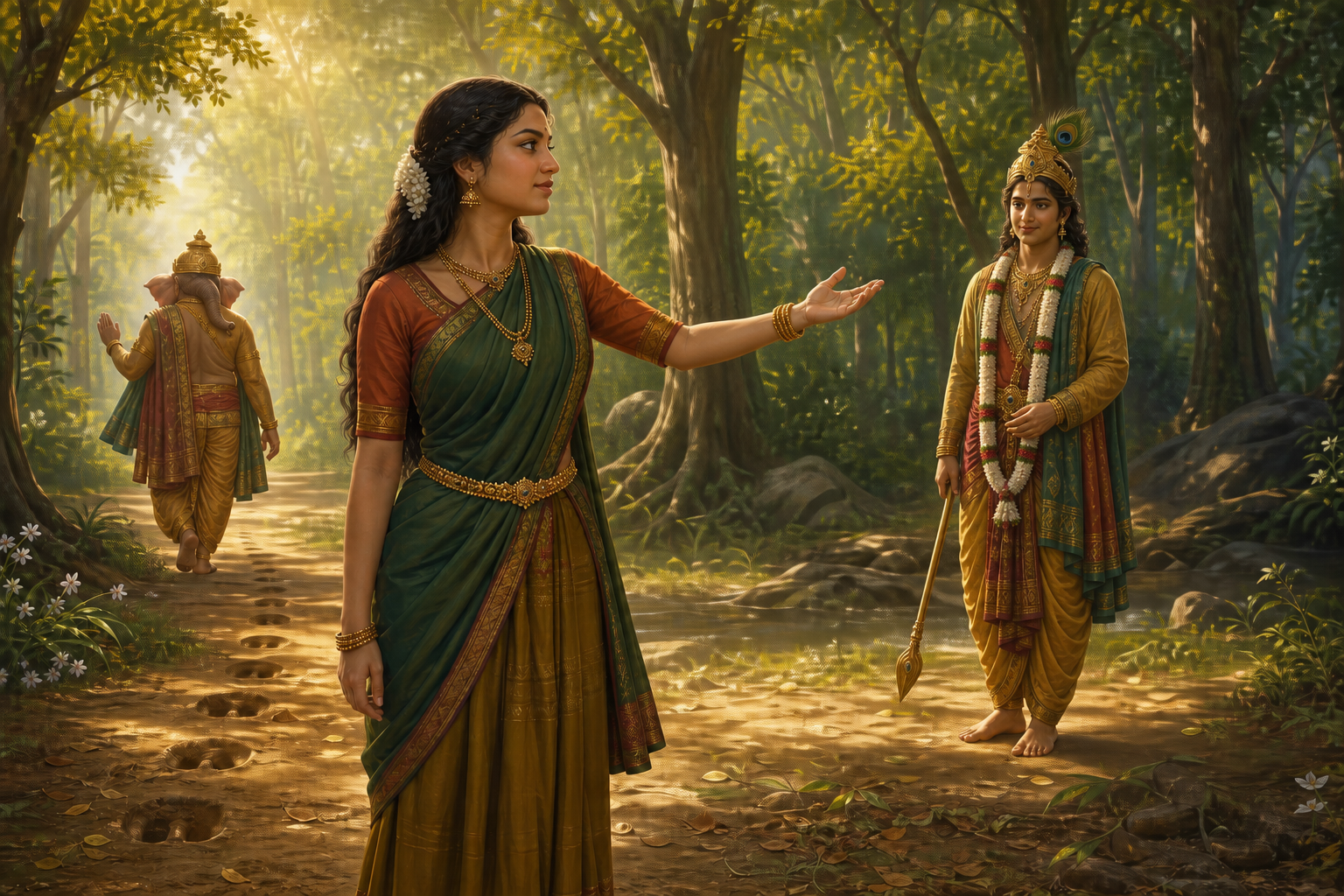
Ganapathi is structurally essential to Valli Kalyanam. In widely told versions, he takes the form of a wild elephant while Subramanya appears as an ascetic or hunter. The disturbance breaks the pattern that has kept Valli and Subramanya apart. The divine identity is eventually disclosed, uncertainty gives way to recognition, and Valli joyfully affirms the union.
The order of those moments matters. If the episode is reduced to a clever trick by which a woman is won, its dharmic center disappears. Its devotional meaning rests on an obstacle being transformed into understanding and on fear not being treated as the final basis of the relationship.
A careful reading therefore notices four movements:
- An existing obstruction prevents love from reaching a truthful resolution.
- Ganapathi unsettles the fixed situation so that it can no longer continue unchanged.
- Subramanya’s real identity and intention become known.
- Valli’s own recognition and willing assent complete the union.
This is also the boundary between sacred interpretation and harmful imitation. A divine folk narrative is not permission to frighten, deceive, corner, or pressure someone in an ordinary relationship. Human conduct must honor disclosure, trust, and consent. Ganapathi’s wisdom is seen in the movement from confusion to clarity, not in making fear itself a tool of possession.
If you attend a Valli Kalyanam festival or dramatic reenactment, watch for more than the elephant episode. Notice how the performance handles concealment, revelation, Valli’s response, and the restoration of harmony. Those details tell you whether the telling preserves the ethical depth of the union or merely stages its most entertaining incident.
Turn the theology into a grounded worship practice
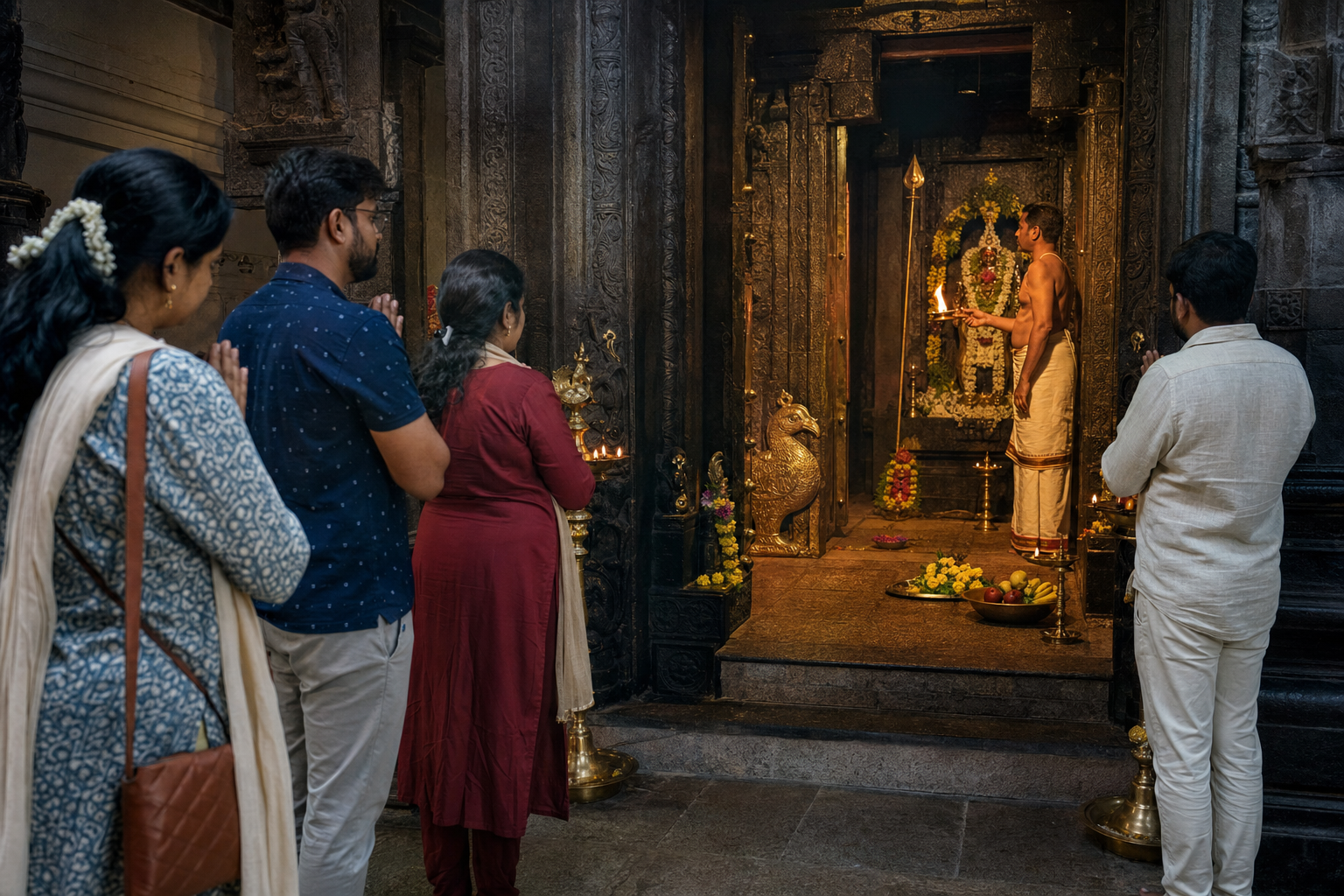
You do not need to invent a universal Subramanya ritual in order to make these traditions spiritually useful. Formal worship belongs within the instructions of the temple, family, or lineage from which you receive it. A reflective practice can remain simple and still be disciplined.
- Name the real concern you are bringing. Avoid a vague request for success when the actual need is courage, discernment, reconciliation, or the strength to carry out a duty.
- Recognize the form before you. If Valli and Devasena are present, include the relationship between sincere intention and responsible action in your prayer.
- Remember Ganapathi’s role when an obstacle has made you rigid or confused. Ask not merely for its disappearance, but for the understanding needed to meet it without abandoning dharma.
- Look to Subramanya for courage joined to discernment. Courage alone can become aggression; discernment that never acts can become avoidance.
- Leave with a concrete commitment. Make the necessary conversation, fulfil the neglected responsibility, correct the dishonest intention, or wait when another person’s consent has not been freely given.
This approach keeps prayer from becoming a bargain in which the deity is asked to deliver an outcome while the devotee remains unchanged. The sacred union becomes a mirror: desire must become truthful, action must become disciplined, and obstacles must become occasions for clearer understanding.
When you worship at home
Use the name and image received through your family or chosen tradition. If you do not know a formal puja, do not present an improvised sequence as though it were universally authoritative. Offer respectful remembrance, speak your prayer plainly, and seek guidance from a temple or qualified teacher if you want to learn a lineage-specific liturgy.
A useful home contemplation is to place your concern under three questions: What do I truly seek? What dharmic action does it require from me? Which obstacle is asking for wisdom rather than force? The questions do not replace worship. They help carry its meaning into conduct after worship is complete.
When you visit Ghati Subramanya
Ghati Subramanya is near Doddaballapur, approximately 60 kilometres from Bengaluru, making it suitable for a day pilgrimage or an unhurried weekend visit. Confirm current opening hours and local requirements before leaving, because practical arrangements can change.
An early visit can offer a quieter setting for darshan. Wear modest clothing, keep conversation subdued around the sanctum, and allow time for both Subramanya and Lakshmi Narasimha rather than treating the second sacred presence as an item to check off. Subramanya’s courage and righteous action sit here beside Narasimha’s protective power, justice, and steadfast faith. Their coexistence is itself a lesson in the ability of distinct devotional streams to share sacred space without losing their integrity.
The swayambhu character of Subramanya is central to the shrine’s sanctity. Approach it as a claim made and preserved by the worshipping community, not merely as an unusual feature for sightseeing. A pilgrimage becomes more than religious tourism when your pace, speech, and attention acknowledge that you have entered somebody’s continuing sacred world.
Key takeaways for your next darshan
- If you see Subramanya with Valli and Devasena, examine whether your sincere intention and responsible action are moving together.
- If you hear Valli Kalyanam retold, preserve the movement from obstruction to disclosure, clarity, and willing assent.
- If a temple presents a different form, learn its local sacred grammar before deciding that something is missing.
- If you want formal worship instructions, receive them from the relevant temple, family, or lineage rather than declaring one improvised method universal.
- If you ask for an obstacle to be removed, also ask what the obstacle is revealing about your fear, duty, timing, or discernment.
- If you make a pilgrimage, give the shrine enough time and attention to function as a place of worship rather than only a destination.
On your next visit, resist the urge to solve every regional variation at the temple door. Learn the divine names used there, observe the relationships placed before you, and carry one clear dharmic action home. That is where Subramanya’s sacred unions become more than stories: they join devotion to the way you choose, act, and honor others.
References
- DharmaRenaissance Blog – Ganapathi’s Pivotal Role in Valli’s Marriage: Love, Wisdom, and Skanda’s Sacred Union
- DharmaRenaissance Blog – Ghati Subramanya Temple, Karnataka: Awe-Inspiring Swayambhu Subramanya and Lakshmi Narasimha
