
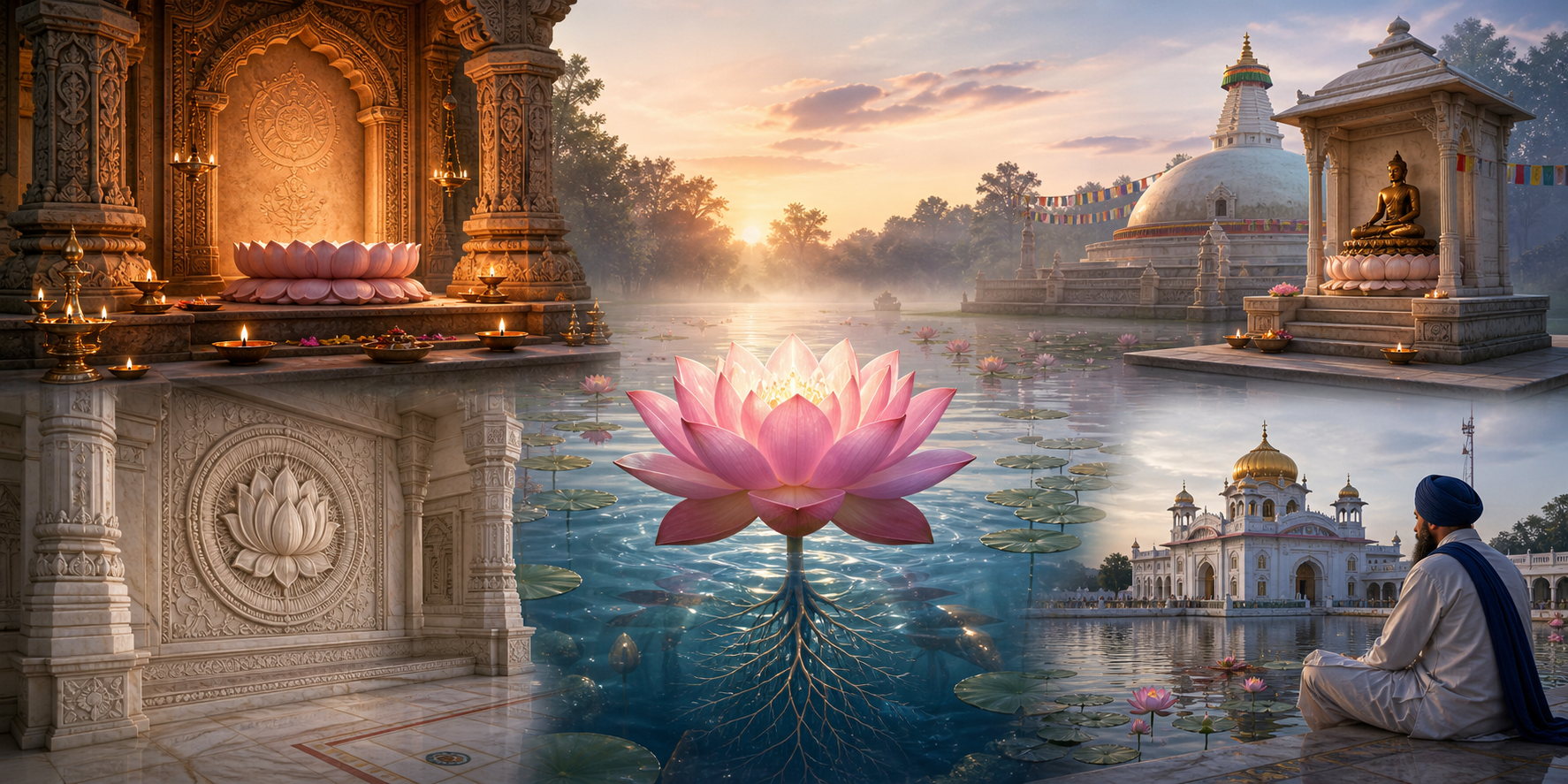
You may see a lotus beneath Ma Lakshmi, in Buddhist imagery, on a Jain pedestal, and in Sikh teaching, then wonder whether it means the same thing each time. The useful answer is that Padma carries a shared Dharmic language of purity, resilience, and spiritual awakening, but it does different work in each tradition.
That distinction matters. Once you separate the lotus’s shared visual pattern from its tradition-specific function, you can read sacred art more accurately, approach worship more carefully, and discuss Dharmic unity without pretending that Hinduism, Buddhism, Sikhism, and Jainism are interchangeable.
One shared image, not one doctrinal formula
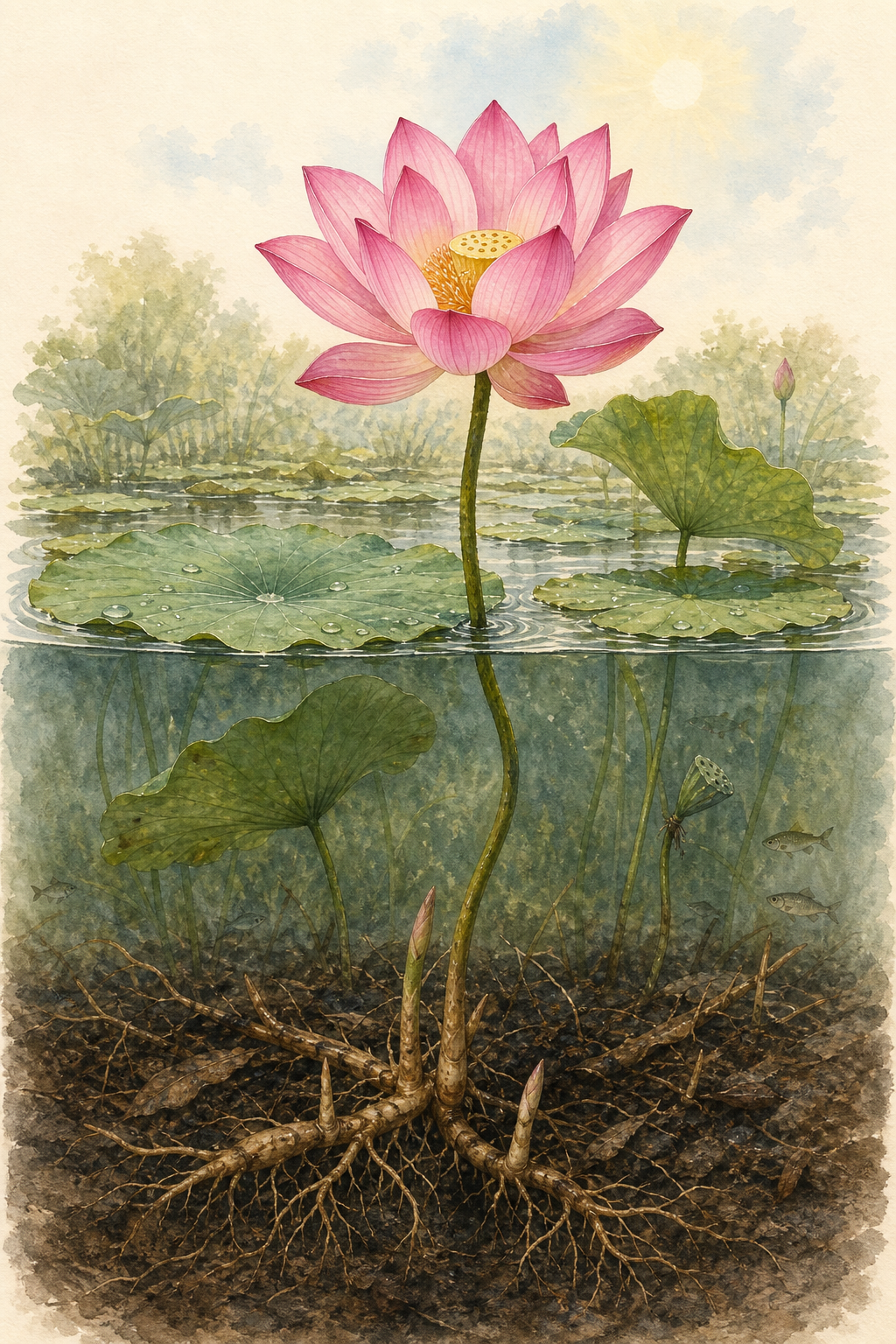
The lotus draws much of its symbolic force from a visible sequence. It is rooted in mud, rises through water, and opens without displaying the murk from which it grew. Dharmic traditions use that sequence to show that difficult conditions do not have to determine the quality of consciousness or conduct that emerges from them.
Do not reduce the mud to a crude declaration that worldly life is evil. The image is more demanding than escape. The flower remains connected to the conditions in which it grows. Its purity is therefore not mere distance from difficulty; it is the capacity to pass through difficulty without allowing confusion, attachment, or disorder to rule one’s response.
You can read the image through three connected movements:
- Condition: Mud and water represent the complicated field in which life is actually lived. Spiritual growth does not wait for perfect circumstances.
- Orientation: The stem moves toward light. A practitioner must give attention a direction rather than letting every surrounding pressure determine it.
- Fruition: The open flower points toward qualities such as wisdom, grace, compassion, clarity, detachment, and equanimity. The inward change becomes visible in conduct.
This gives you a better way to interpret Padma. Ask what conditions surround the flower, what spiritual movement it represents, and what kind of human flourishing it reveals. Then examine how the particular tradition answers those questions.
How the four traditions ask you to read the lotus
A symbol can serve as a divine seat, ritual offering, identifying emblem, contemplative image, or ethical metaphor. Its function is often more informative than its physical appearance.
| Tradition | What the lotus does | What you should notice |
|---|---|---|
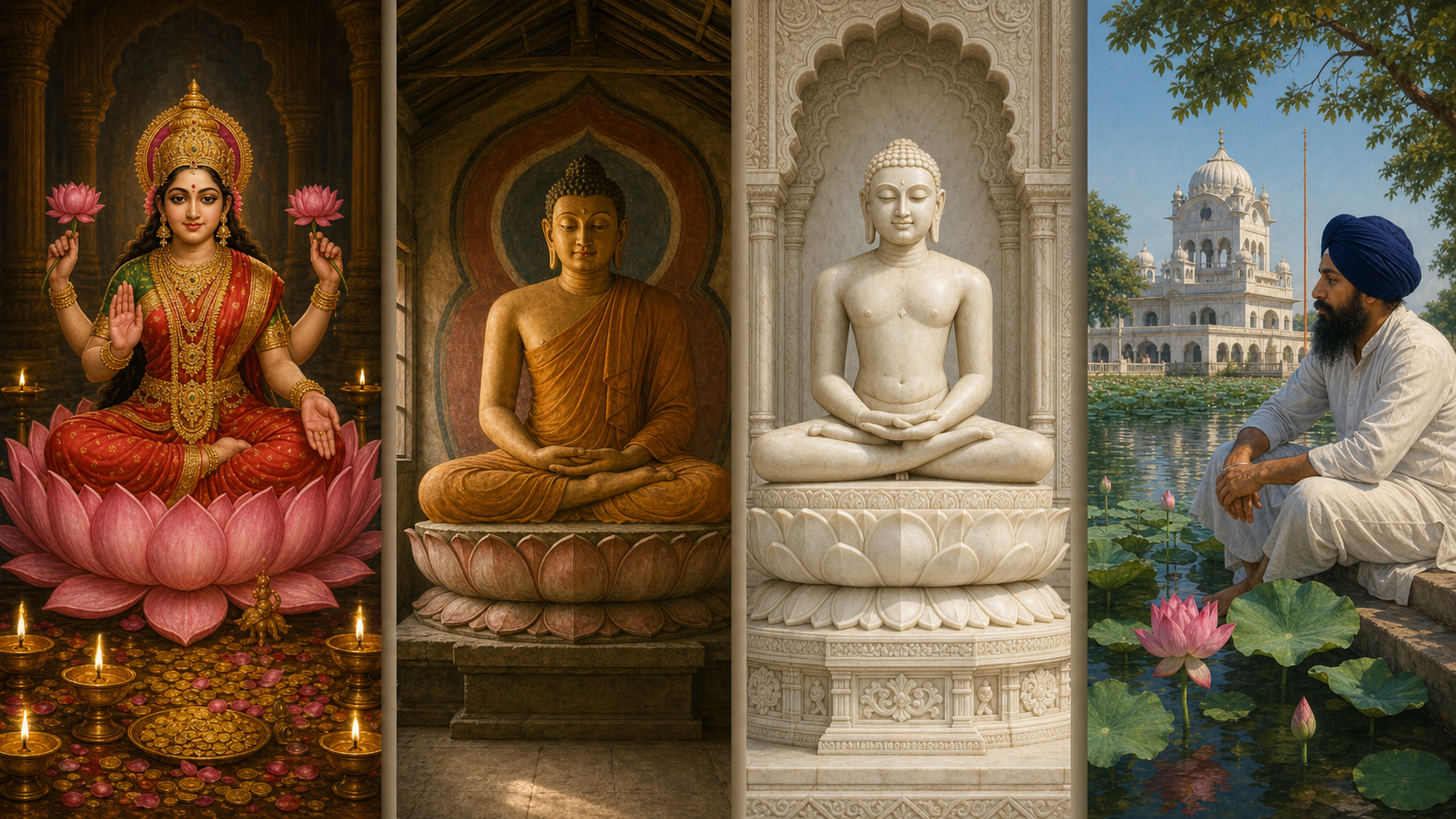
| Hinduism | The lotus is closely associated with Ma Lakshmi and Lord Vishnu. It appears as Ma Lakshmi’s divine seat and as an offering in worship. | Read Padma through śrī: prosperity joined to purity, grace, auspiciousness, and spiritual abundance. The flower is not merely decorative around the deity. |
| Buddhism | The lotus expresses wisdom flowering from the mud of human experience. | Notice the movement from confusion toward awakening. Its ethical fruit includes compassionate action, not private insight alone. |
| Sikhism | The lotus supplies an image for living in the world with inward detachment, like a blossom remaining untainted by the water around it. | Focus on participation without captivity. The lesson is not withdrawal from duties, relationships, or society, but freedom from the attachments that distort them. |
| Jainism | The lotus appears in iconography and contemplation. It is the emblem of the Tirthankara Padmaprabha, while lotus pedestals convey purity and equanimity. | An emblem can identify a particular Tirthankara as well as communicate a virtue. Preserve both functions when reading an image. |
Use the table as a method, not as a replacement for deeper learning. First identify the setting. Then identify the lotus’s function in that setting. Only then interpret its spiritual meaning.
A lotus supporting Ma Lakshmi should not be explained only as a generic sign of awakening; its relationship to divine grace and śrī matters. Padmaprabha’s lotus is not simply a general ornament; it also identifies the Tirthankara. When the lotus appears as a teaching image in a Sikh context, begin with the discipline of engaged detachment rather than importing associations from Hindu puja. In a Buddhist setting, give full weight to awakening and compassion rather than assuming that the flower primarily signifies material prosperity.
This approach protects both kinship and difference. The traditions share a symbolic grammar because they repeatedly connect spiritual clarity with life amid imperfect conditions. They remain distinct because each places that grammar within its own teachings, sacred figures, practices, and goals.
Key takeaways
- The lotus unites Dharmic traditions through a common pattern: purity and spiritual growth can emerge from difficult conditions.
- A shared symbol does not make four traditions doctrinally identical. Context determines whether Padma acts as a divine seat, ritual offering, emblem, pedestal, contemplative image, or moral metaphor.
- In Hindu practice, notice śrī, grace, purity, and auspiciousness; in Buddhism, awakening and compassion; in Sikh teaching, engaged detachment; and in Jainism, purity, equanimity, and Padmaprabha’s identity.
- The most faithful response is ethical rather than merely aesthetic. Let the lotus direct one actual choice toward clarity, compassion, steadiness, or righteous conduct.
Turn the symbol into practice without flattening it
Use Padma for a brief personal reflection
The following reflection is not a rite prescribed by every Dharmic tradition. It is a simple way to use the lotus’s shared symbolism as a test of conduct.
- Name the mud. Identify one present condition that unsettles you: resentment, distraction, pressure, fear of another person’s judgment, or attachment to an outcome. Describe the condition without making it your identity.
- Name the water. Identify the role or relationship in which you must remain involved. Ask what participation requires and what attachment is adding unnecessarily.
- Choose one petal. Select one quality that the situation needs: clarity, compassion, equanimity, gratitude, detachment, or righteous conduct.
- Give the quality a visible form. Clarity might mean speaking without exaggeration. Compassion might mean pausing before a harsh reply. Detachment might mean completing a duty without demanding praise. Equanimity might mean responding steadily when an outcome changes.
- Review the action. At the end of the day, ask whether the chosen quality became conduct. If it remained only an attractive idea, make the next action smaller and more concrete.
This preserves the central discipline of the symbol. The flower does not deny the mud, and practice does not depend on denying your circumstances. The question is what you allow those circumstances to produce through you.
Approach the lotus in worship as an offering, not a transaction
During Lakshmi Puja at Diwali and on other auspicious occasions, families may place fresh lotuses before Ma Lakshmi and Lord Vishnu as an expression of well-being, harmony, gratitude, and auspiciousness. The word “may” matters: a practice found in many homes should not automatically be declared mandatory for every family, region, or sampradaya.
If you are preparing a puja, follow the custom of your family, temple, or lineage. When you are uncertain about a suitable offering, ask the pujari or a knowledgeable elder who understands that practice. Do not invent a universal rule from an image encountered online.
Keep the offering connected to its ethical meaning. A flower placed before Ma Lakshmi should accompany a sincere examination of how prosperity is sought, received, and used. Otherwise, Padma can become a transaction for good fortune rather than a reminder that outer abundance and inner purity belong together.
Make interfaith conversation more precise
The lotus is especially useful when introducing children, students, or diaspora communities to the Dharmic family. Place examples from the four traditions beside one another and ask a functional question: “What is the lotus doing here?” Is it supporting a deity, identifying a Tirthankara, describing enlightenment, or teaching a way to live amid worldly responsibilities?
That question produces a better conversation than saying, “The lotus means purity in every religion,” and stopping there. The broad statement is not wholly wrong, but it hides the paths by which each tradition turns purity into a distinctive religious teaching.
When planning an interfaith event, let practitioners explain the lotus from within their own tradition. Frame the common ground around disciplined transformation, ethical living, and inner clarity. Avoid using the symbol to claim that doctrinal differences are unimportant. A bridge works because it joins real banks; it does not erase them.
The next time you encounter Padma, pause before calling it a generic sign of spirituality. Notice whose lotus it is, what role it plays, and what quality of conduct it asks from you. Then put that quality into one decision before the sacred symbol fades back into decoration.
References
