

When life tightens around you, the question is rarely whether you still believe. The harder question is whether you can still remember: remember the Divine Name before fear takes over, remember your dharma before reacting, and remember service when pain makes the world contract around your own needs.
If you hope to meet the final transition with Krishna, Rama, or your chosen Ishta in your heart, don’t make the last breath carry the whole burden. Train the return now. A durable bhakti practice is not one in which attention never wanders; it is one in which you know how to come back during grief, failure, illness, uncertainty, and even success.
Train the return, not an ideal devotional mood
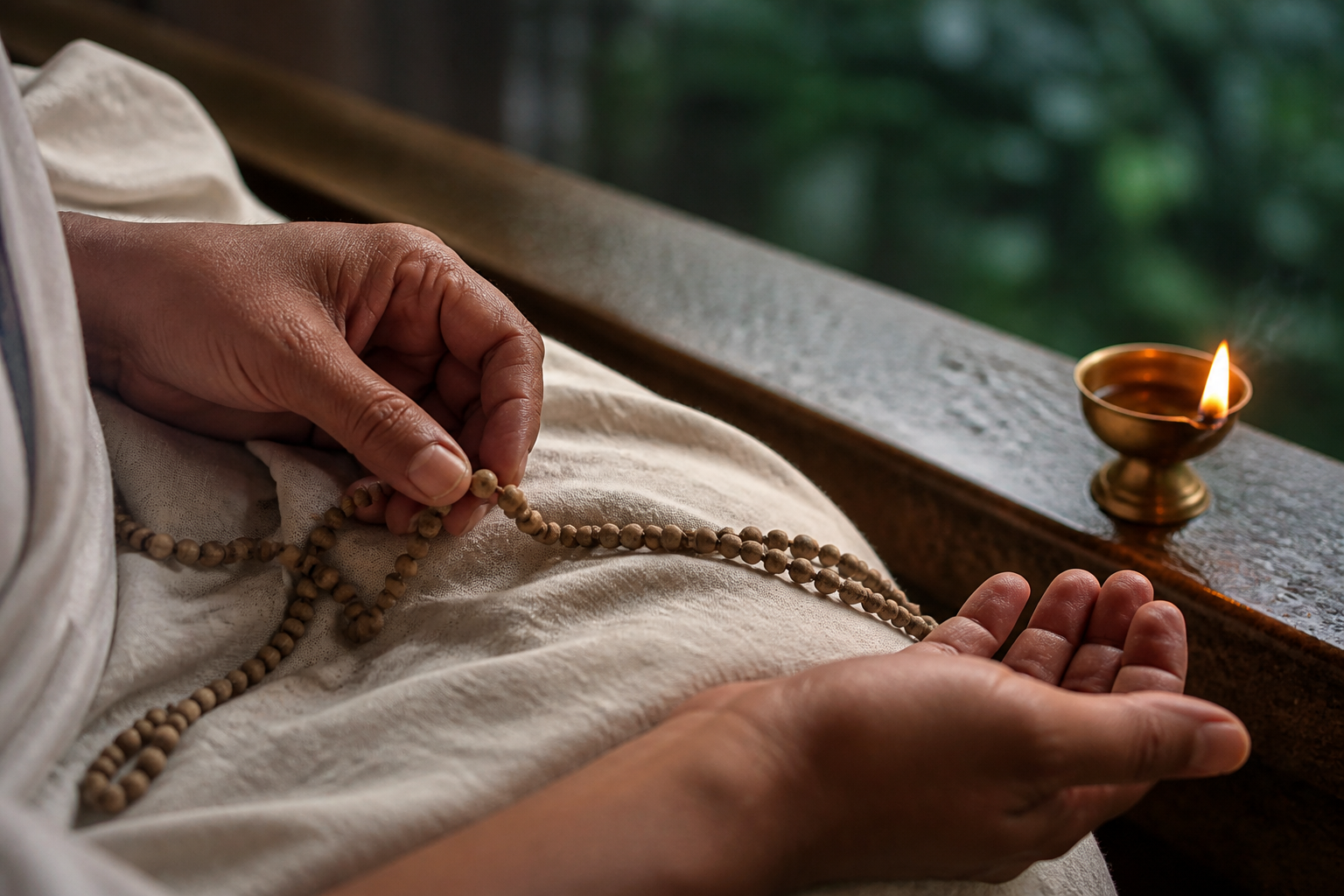
Within the Bhagavad Gita’s bhakti framework, the mind’s orientation at death bears on its destination. That teaching is sometimes heard as a warning about one decisive moment. Its practical force is broader: the final movement of attention is cultivated through all the smaller movements that precede it.
A turbulent mind cannot be bullied into sacred remembrance at the end of life. Attention becomes dependable when remembrance has been joined to affection. You return more readily to the Divine Name when it has become a place of shelter, gratitude, confession, and love rather than another obligation used to measure your spiritual worth.
Begin by choosing a stable devotional center. This may be the name of Krishna or Rama, a mantra received within your tradition, remembrance of your Ishta, or another established form of worship given by your guru and sampradaya. Avoid changing the center every time your mood changes. Variety can enrich practice, but a crisis calls most easily upon what has become familiar.
Attach that center to ordinary transitions in your day:
- On waking: remember the Divine Name before taking in messages, news, or other demands.
- At a regular pause: do your established japa, meditation, kirtan, or contemplative reading with as much attention as you honestly have.
- During work: designate one necessary task as seva. Perform it carefully, without requiring recognition.
- Before sleep: notice where the mind became lost, offer the day, and return to the Name without staging an inner trial against yourself.
The sequence matters more than an intense mood. Repetition gives attention a known route home. When you miss a cue, use the next cue instead of waiting for a cleaner day, a calmer mind, or a dramatic burst of resolve.
A useful test is simple: after irritation, fear, praise, or disappointment, what does your mind reach for first? Don’t condemn the first reflex. Notice it. Then practice the second reflex deliberately. Abhyasa begins in that gap.
Keep a floor on hard days and a guardrail on good ones
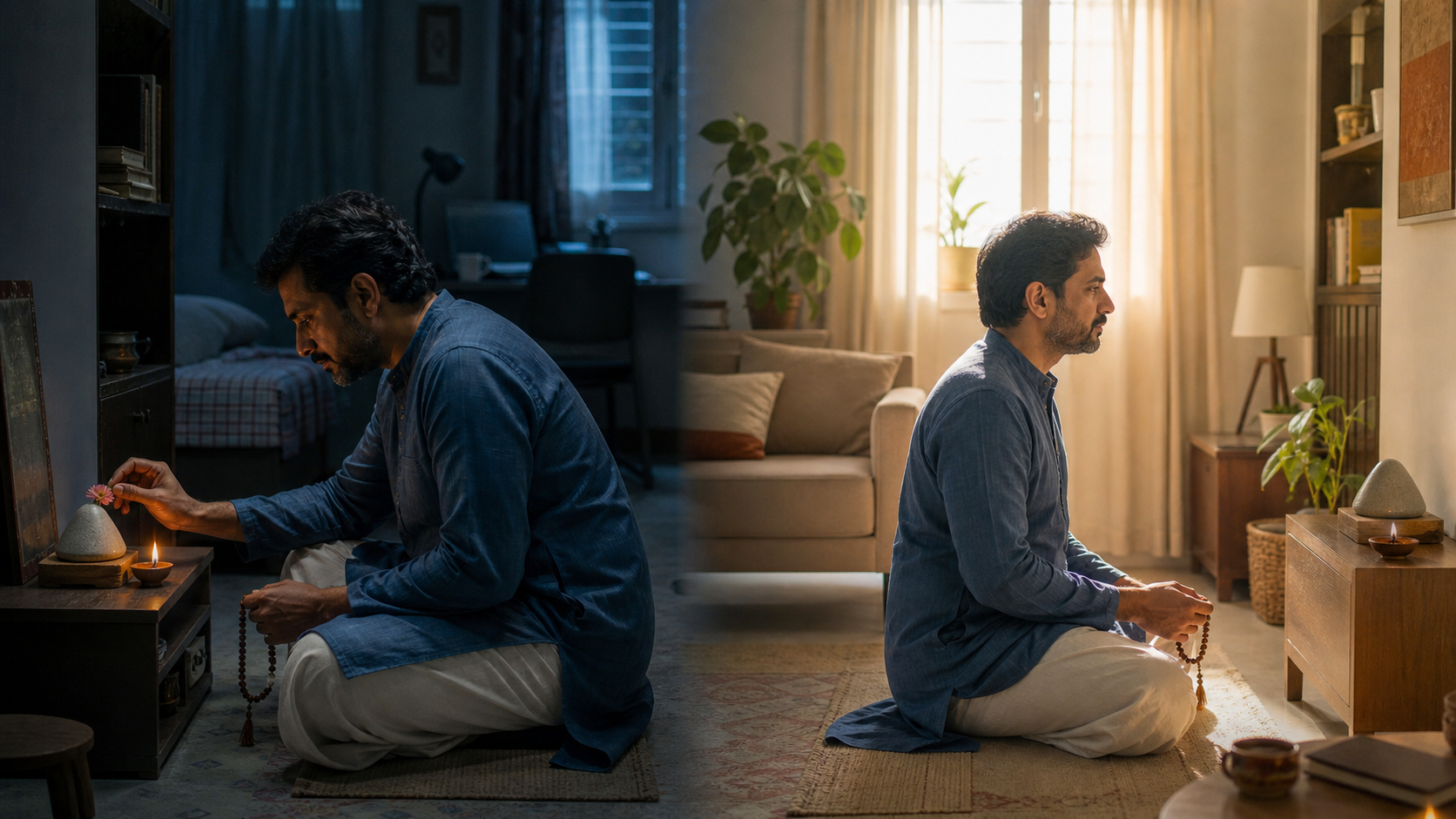
Adversity is not the only threat to steadiness. Both reversals and achievement can pull attention away from devotion. Pain can make practice feel impossible; success can make it feel unnecessary. A sustainable discipline therefore needs a floor for low-capacity days and a guardrail for expansive ones.
Your hard-day floor
Your floor is the smallest honest expression of your practice that preserves its direction. It is not a replacement for fuller sadhana, and it should not become a comfortable disguise for avoidance. Its purpose is to keep hardship from turning one disrupted day into abandonment.
- Name: pronounce or hear your chosen Divine Name attentively. If a full established practice is possible, keep it. If it is not, preserve the living connection rather than doing nothing.
- Instruction: open a trusted sacred text and stay with one teaching that tells you how to act now. Reading more is not automatically better if nothing enters your conduct.
- Service: complete one concrete act that reduces another being’s burden. A message, a meal, patient listening, or an unglamorous household duty can become seva when offered without self-display.
- Return: resume your normal discipline at the next realistic opportunity. Do not add a punishment to compensate for having struggled.
Distinguish limitation from disengagement. Limitation says, I cannot do the usual form today, so I will preserve its essence. Disengagement says, because I cannot do everything, nothing counts. The first adapts while remaining faithful; the second turns disappointment into permission to drift.
If your reduced practice continues after the immediate trial has eased, examine what now weakens it. It may be an unfavorable routine, isolating yourself from satsanga, or repeatedly choosing stimulation over remembrance. Change one supporting condition rather than relying on shame to manufacture devotion.
Your good-day guardrail
Success deserves its own discipline. Praise, promotion, influence, comfort, or a spiritual experience can quietly move the self back to the center. Use three guardrails:
- Keep the devotional anchors that were present before the success. Do not let a crowded schedule of opportunity consume the practice that gave the schedule its orientation.
- Turn gratitude into acknowledgement of dependence: on the Divine, on teachers, on family and community, and on circumstances you did not create alone.
- Convert some part of increased capacity into seva. Let success widen responsibility rather than merely widen appetite.
Hardship can reveal your need for shelter. Success can conceal it. Bhakti matures when neither condition is allowed to decide whether remembrance continues.
Make remembrance portable before a crisis arrives
A practice confined to a shrine, meditation seat, or ideal morning may remain inaccessible at the very moment you need it. Japa, kirtan, sacred reading, ethical living, seva, and brief remembrance within ordinary activity make devotion portable. They teach the mind that the Divine is not available only under ceremonial conditions.
Use common disturbances as training cues:
- When fear appears: invoke the Name before building a complete story about what might happen. Remembrance does not require you to deny the problem; it changes the place from which you meet it.
- When grief appears: bring grief into prayer rather than waiting to become composed. Bhakti is not emotional numbness. Love of the Divine and sorrow over loss can occupy the same heart.
- Before a consequential choice: pause and ask which option is favorable to dharma and sadhana, not merely which one brings the fastest relief.
- When someone frustrates you: delay the first harsh response, remember the sacred orientation you claim, and choose the next action from that orientation.
- When good news arrives: offer gratitude before turning the moment into self-congratulation.
You may also pair the Name gently with natural breathing during routine activity. Keep the breath unforced; there is no devotional benefit in straining, holding it, or turning a simple aid to attention into a physical contest. If breathing is difficult or medically affected, follow clinical guidance and use another form of remembrance.
Satsanga helps make this portability durable. A community can carry kirtan when your own voice feels weak, restore perspective when private thinking becomes circular, and give seva a real recipient. Choose association that strengthens humility, truthful self-examination, and compassionate conduct. Mere religious sociability is not the same as association that supports sadhana.
Measure progress by the direction of your returns. Notice whether remembrance comes sooner after disturbance, whether anger governs you for less of the encounter, whether decisions become more dharmic, and whether suffering leaves you more available for service rather than more enclosed. Intense spiritual feeling may come and go; these changes show whether practice is entering life.
Prepare for the final transition without making it a performance
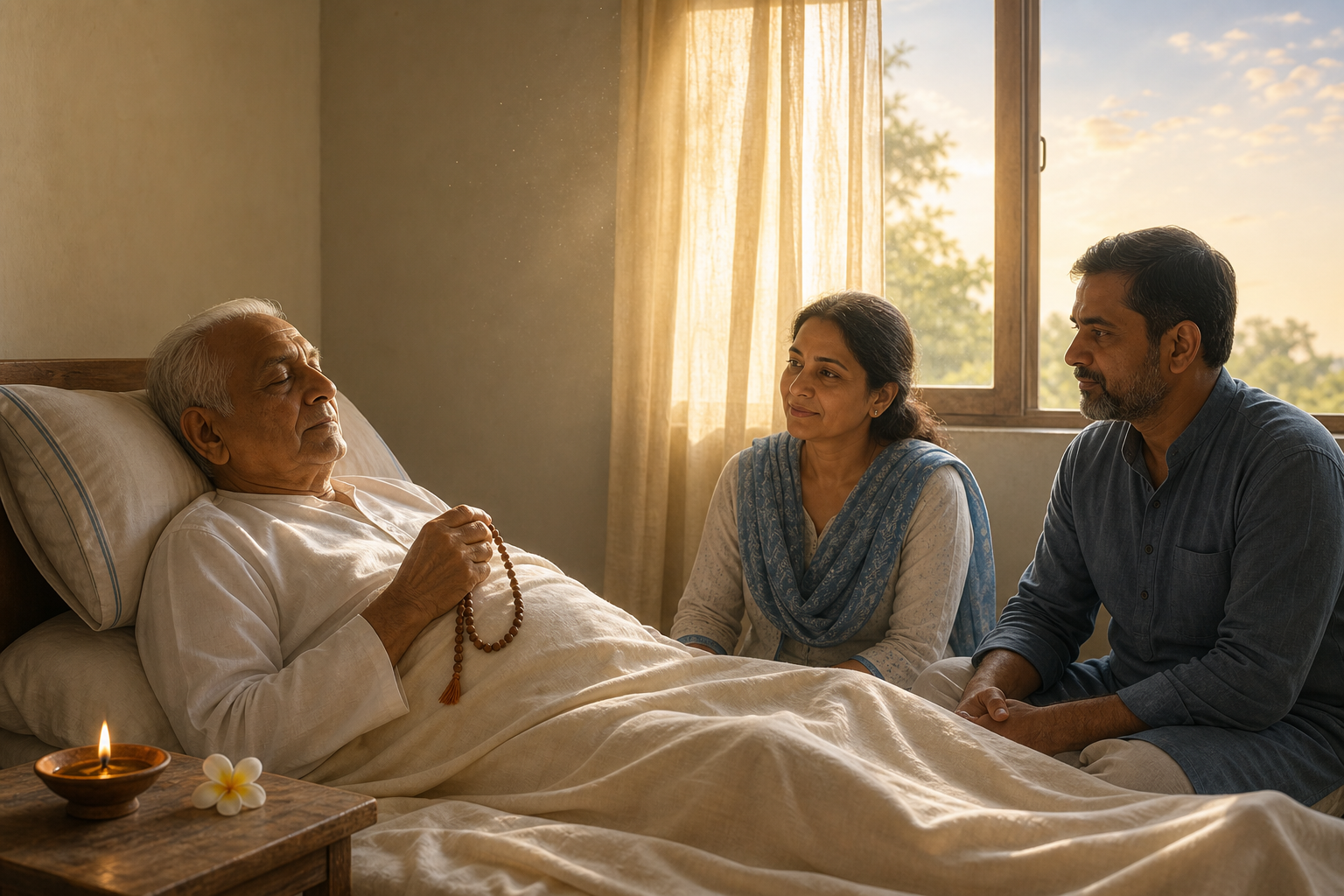
The hope of remembering the Divine at death should deepen daily practice, not produce terror about performing a perfect final scene. The final transition is not a theatrical examination in which observers grade the dying person’s last audible word. A person may be unable to speak or respond. Visible silence does not prove an empty heart, just as a spoken formula does not by itself reveal a lifetime’s inner orientation.
Preparation can still be concrete. Write down a short spiritual care preference and give it to the people most likely to be present. Include:
- the Divine Name, mantra, recitation, or sacred reading familiar to you;
- whether you would welcome soft japa, kirtan, prayer, silence, or a combination;
- the guru, family member, devotee, granthi, monk, or other trusted person you would want contacted within your own tradition;
- which familiar image, mala, scripture, or devotional object you would want nearby, where circumstances permit;
- a clear instruction that spiritual support should cooperate with necessary medical, hospice, or palliative care rather than obstruct it.
This plan is useful because families under stress may love you deeply while remembering different details about your wishes. A brief written preference reduces improvisation. Review it with someone you trust while conversation is still easy.
If you are accompanying another person, let their established path govern the room:
- Ask what form of remembrance they want, or follow preferences they expressed earlier.
- Use a familiar Name, melody, prayer, or text. The bedside is not the place to introduce an impressive new technique.
- Keep the atmosphere steady. Several people chanting louder, correcting one another, or demanding a response can turn support into pressure.
- Do not treat fear, pain, confusion, tears, or silence as evidence of spiritual failure. Seek appropriate clinical help for distress while continuing welcome spiritual support.
- Offer seva to the family and caregivers as well as prayer to the person who is dying. Quiet practical help can protect the devotional atmosphere better than commentary about how death ought to unfold.
Bhakti can accompany medical and psychological care; it is not a substitute for either. Treatable pain, breathing difficulty, severe agitation, or a mental-health crisis warrants qualified professional attention. Asking for that help does not weaken surrender.
Support the person’s actual dharmic path
Dharmic traditions share important disciplines of recollection and ethical steadiness, but they should not be flattened into interchangeable theology. Hindu bhakti may center loving remembrance of Krishna, Rama, or another Ishta. Sikh practice joins simran with seva and orientation toward Akal Purakh and the Guru. Buddhist mindfulness and maitri-karuna cultivate lucid, compassionate presence. Jain anupreksha, ahimsa, and self-discipline train reflection and freedom from harmful attachment. Their doctrines and final aims remain distinct even where their practical disciplines resemble one another.
When supporting someone from another path, ask rather than assume. What do they call the Highest or the ultimate refuge? Which words are sacred to them? Who is authorized or trusted to guide the observance? What should not be introduced? Respecting those answers is itself an act of dharma.
You also do not need to speculate about another person’s destination. Bhakti asks you to cultivate remembrance, service, and surrender; it does not appoint you to audit the unseen meaning of someone else’s final moments. At the bedside, let compassion be stronger than theological curiosity.
Key takeaways
- Prepare for final remembrance by practicing ordinary returns to the Divine Name now.
- Keep a minimum devotional floor during hardship, then resume fuller sadhana without punishment or dramatic vows.
- Guard success with unchanged practice, gratitude, humility, and increased seva.
- Use everyday fear, grief, conflict, decisions, and good news as cues for portable remembrance.
- Write down your spiritual care preferences and share them with a trusted person before a crisis.
- At the final transition, support the person’s own tradition, avoid forcing a performance, and cooperate with appropriate professional care.
Choose one Divine Name, one dependable daily cue, and one form of seva you can preserve when life becomes difficult. Then tell one trusted person what kind of spiritual support you would want at the end of life. The final transition cannot be rehearsed as an event, but the movement of the heart toward shelter can be practiced every day.
References
- Dandavats – Before the Final Breath: Mastering Mind and Bhakti for a Peaceful, Dharmic Transition
- Dandavats – Steadfast Devotion Through Life’s Trials: Cultivating Faith and Resilience in Bhakti
