
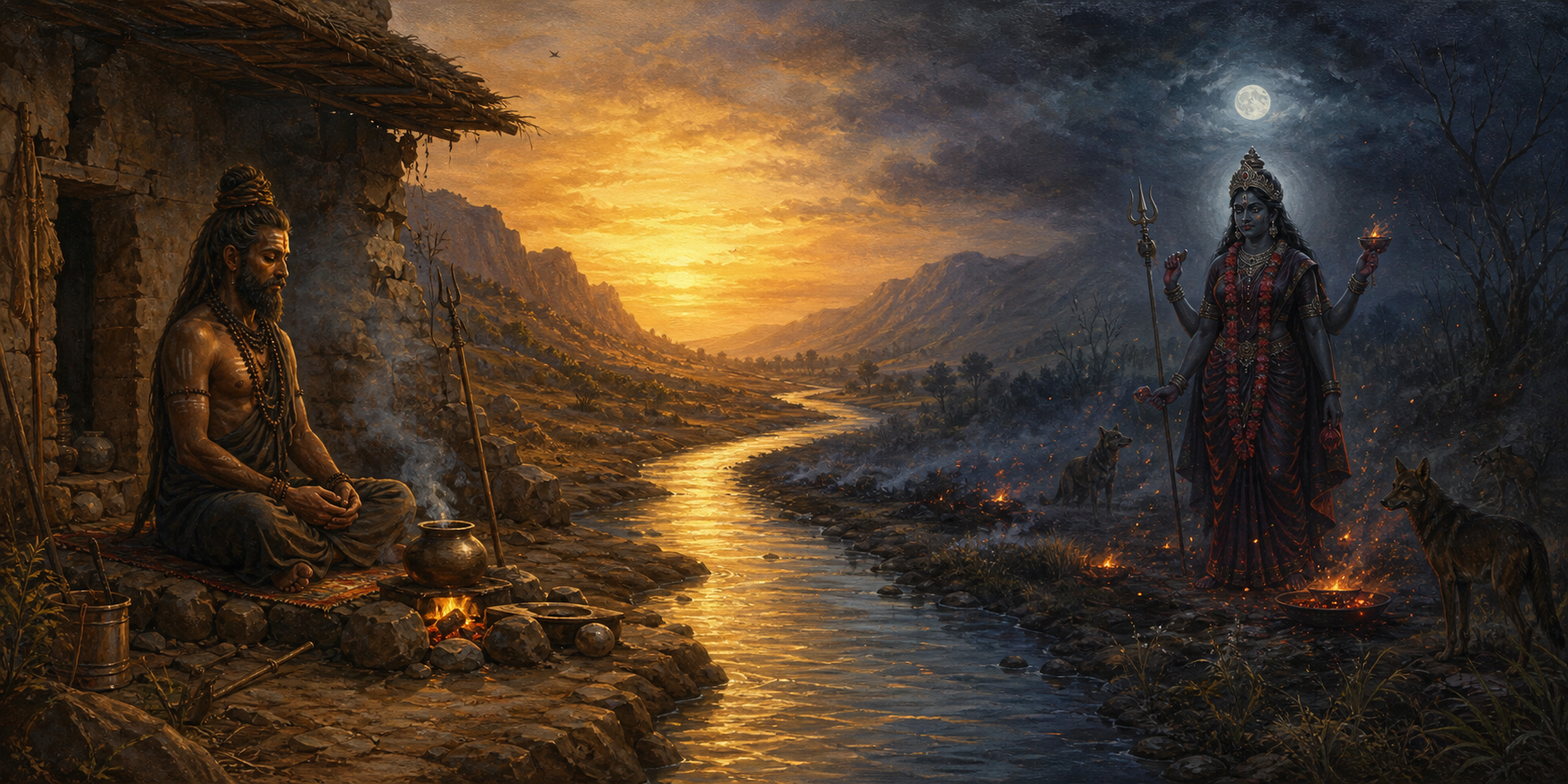
If Gorakhnath’s emergence from cow dung or Dakshinakali’s presence among cremation-ground jackals makes you uneasy, don’t rush to defend the imagery or dismiss it as primitive. The unease is part of the encounter. It shows you where an ordinary judgement about purity has collided with a spiritual language of transformation.
These images neither glorify neglect nor declare every condition morally equivalent. They ask a more demanding question: can disciplined awareness transform what you fear, reject, or consider beneath you? Learning to answer that question lets you read Nath and Shakta symbolism without reducing it to literalism, social prejudice, or fascination with the macabre.
First separate physical cleanliness from spiritual purity

A great deal of confusion disappears once you stop making one meaning of purity do every job. Physical cleanliness concerns bodies, surfaces, food, health, and ordinary care. Spiritual purity concerns intention, attachment, conduct, awareness, and the direction in which a person is being formed. One kind of judgement cannot automatically settle the other.
This distinction is practical. Do not use spiritual symbolism to deny hygiene, and do not use physical disgust to rank souls. A material may need careful handling without becoming proof of someone’s spiritual inferiority. A ritual boundary may organize a particular practice without becoming a permanent verdict on human worth.
The Gorakhnath legend makes that distinction impossible to ignore. The great yogi appears from a heap of cow dung, a setting that would look degrading if purity meant nothing more than distance from humble matter. Yet cow dung has also served in Indic domestic life as fuel, cleansing material, protective plaster, and an auspicious substance. Those uses do not make every form of contact hygienically interchangeable. They do show why the symbol cannot be translated simply as filth.
Dakshinakali’s cremation ground creates a related but sharper interruption. Death, decay, scavenging, and wilderness are placed within the Goddess’s field rather than hidden beyond the sacred boundary. The point is not that decay is pleasant. The point is that impermanence does not become unreal because you avert your eyes.
Use this distinction whenever purity language appears in spiritual discussion. Ask whether someone is describing sanitation, ritual context, ethical character, or spiritual maturity. If those registers have been silently collapsed, pause before accepting the conclusion. Much avoidable contempt begins with precisely that collapse.
The Nath movement refines the gross rather than despising it

The miraculous appearance of Gorakhnath is best approached as a contemplative legend, not as evidence offered for historical verification. Its earthly setting carries the teaching. What seems base becomes the ground from which yogic mastery emerges. Circumstance supplies the starting material; it does not dictate the spiritual result.
Read through Nath yoga, the emergence mirrors a movement from the gross, or sthula, toward the subtle, or sukshma. The ascent from muladhara through the sushumna nadi gives that movement an inner geography. Consciousness does not escape embodiment by pretending the lower starting point never existed. It is steadied, gathered, and refined through practice.
This is why asana, pranayama, pratyahara, and dhyana matter to the symbol. Posture disciplines the embodied field. Breath practice gathers energies that otherwise move reactively. Withdrawal of the senses interrupts automatic pursuit of stimulation. Meditation lets attention become less fragmented. The sequence gives transformation a method instead of leaving it as an inspiring idea.
You can apply that grammar to an ordinary recurring impulse without pretending to perform advanced yoga:
- Name the impulse plainly, whether it is resentment, vanity, lethargy, compulsive distraction, or something else. Naming it is not the same as condemning yourself.
- Clarify your bhava, the intention with which you will meet it. Decide what quality you want to cultivate in its place.
- Take a stable posture and use only a gentle, already-safe breathing practice. Do not experiment with forceful breath retention on the strength of symbolic instruction alone.
- Practice pratyahara in a concrete way by pausing the input that feeds the reaction. Put down the device, leave the argument unanswered for the moment, or sit without seeking another distraction.
- Let dhyana become sustained attention to the pattern without either feeding or fleeing it.
- Complete the practice through conduct. Choose the humble, truthful, or compassionate action that the unrefined impulse had made difficult.
The final step is decisive. Unusual sensations, esoteric vocabulary, or an impressive self-image do not prove refinement. Greater clarity, humility, service, and compassion are more reliable fruits. If a reading of Gorakhnath makes you more contemptuous of bodies, labour, or humble circumstances, you have moved against the legend’s central direction.
Purity here is cultivated rather than inherited. Birth and status cannot substitute for tapas, just as an unpromising beginning cannot prevent sincere practice. The image therefore speaks directly to anyone tempted to believe that present conditions have already fixed the limit of spiritual life.
The Shakta movement brings the excluded under the Goddess’s gaze
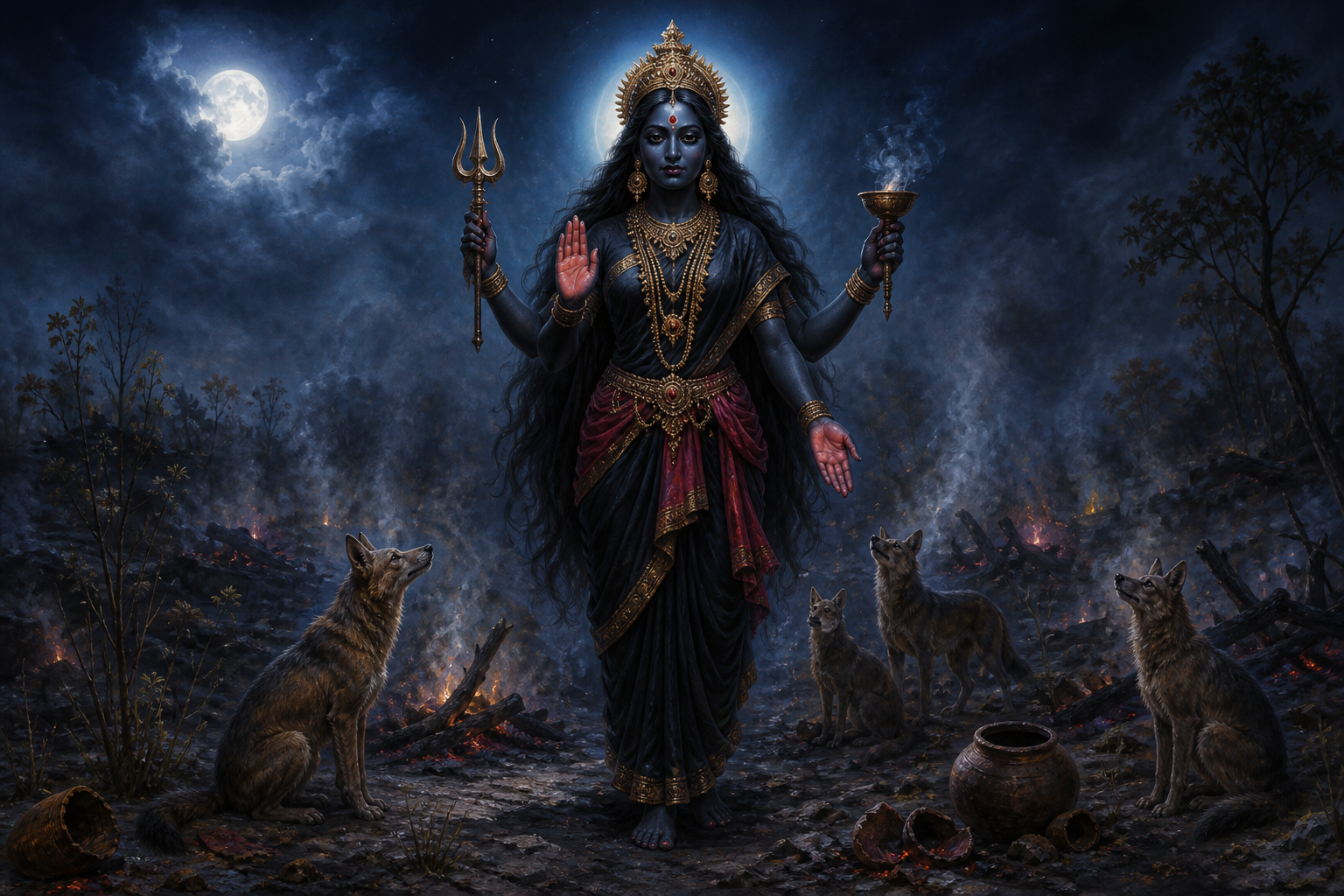
Dakshinakali begins from a different spiritual pressure. Rather than showing a yogi emerging from an earthy substrate, she stands where ordinary consciousness least wants to remain: the cremation ground. Jackals move through this threshold landscape, feeding on what has been abandoned and returning remnants to the cycle of life.
The jackal is effective precisely because it belongs at an edge: settlement and wilderness, attraction and aversion, life and death. It can represent time’s dissolution of familiar arrangements as well as the return of discarded matter to a larger process. Under Dakshinakali, that boundary creature becomes a teacher of abhaya, fearlessness.
Fearlessness does not mean the absence of caution. It means refusing to let fear dictate what consciousness is permitted to see. Mortality can be acknowledged without despair. A disowned impulse can be examined without being enacted. A marginalized being can be met without the reflex that confuses unfamiliarity with pollution.
This is transformation through inclusion, but inclusion must not be mistaken for permission. In a psychological reading, the jackals can resemble the shadow: fears, desires, memories, or aggressive energies kept at the margins of the inner life. Bringing them under the Goddess’s gaze means making them conscious and answerable to wisdom. It does not mean indulging them or allowing harmful behaviour.
When you contemplate the imagery, let each element ask something specific of you:
- The cremation ground asks what ending, loss, or impermanence you are refusing to acknowledge.
- The jackal asks what you discard automatically, and whether it is truly dangerous or merely unwanted, low-status, or uncomfortable.
- Dakshinakali asks whether you can remain present to the truth without surrendering compassion.
- Her fierce protection asks what courageous ethical action becomes possible once denial loosens its hold.
This contemplation is not an instruction to seek hazardous places, handle remains, or imitate specialized rites without guidance. The accessible work is interior and ethical: look directly at impermanence, observe aversion, and choose a response that protects life and dignity. If mantra or ritual visualization already belongs to your lineage-based practice, the iconography can deepen it. Otherwise, attentive reflection is enough to begin learning from the symbol.
Keep the Nath and Shakta movements distinct but connected
Nath and Shakta symbolism meet in their refusal to confine sanctity to polished appearances. They do not, however, make that point in the same way. Preserving the difference prevents a vague claim that everything symbolizes everything else.
| Question | Nath symbolism | Shakta symbolism |
|---|---|---|
| Starting image | A master emerges from a humble, earthy substrate | The Goddess presides over a cremation ground inhabited by jackals |
| Central obstacle | Contempt for the gross and the belief that circumstance fixes destiny | Aversion to death, change, fear, and what consciousness has excluded |
| Transformative movement | Refinement from sthula toward sukshma through disciplined yoga | Integration of the feared within the all-embracing awareness of Shakti |
| Purity takes form as | Clarity, humility, compassion, and mastery of reactive tendencies | Fearless wholeness, acceptance of impermanence, and compassionate action |
| Typical misreading | Treating the earthly origin as humiliation or spiritual disqualification | Treating fierce imagery as spectacle, nihilism, or permission to indulge harm |
The difference can be stated simply. Nath symbolism emphasizes what disciplined practice can make of the starting material. Shakta symbolism emphasizes that nothing feared or discarded falls beyond divine awareness. One refines; the other includes. In both, transformation requires you to stop confusing the initial condition with the final truth.
Parallels across the wider Dharmic family can sharpen this insight without erasing doctrinal differences. The Buddhist lotus rises unsullied from mud, while Vajrayana charnel-ground imagery confronts impermanence more directly. Jain reflection turns toward the removal of karmic accretions and the contemplation of anitya, or transience. Sikh practice joins Naam with seva and humility, while nirbhau names fearlessness as a spiritual quality.
These are not interchangeable teachings. Use the parallel to recognize a shared ethical direction: adverse conditions need not defeat awakening, and honest confrontation with transience should deepen non-harm, service, and compassion. If a supposed unity requires you to erase the methods or vocabulary of each path, it is too shallow to be useful.
Turn unsettling symbolism into a test of conduct
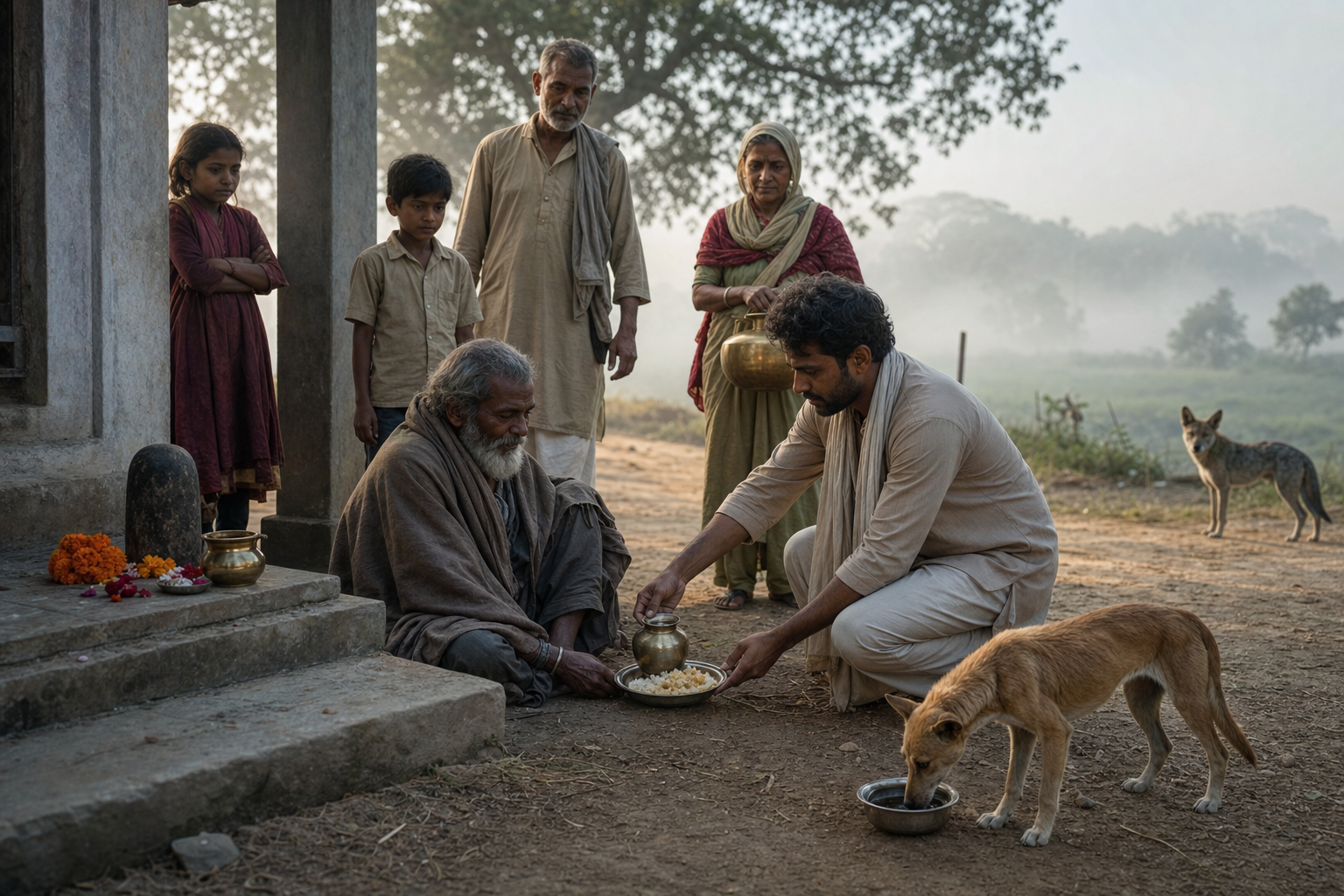
You do not need to choose between blind acceptance and embarrassed rejection when an image challenges modern expectations. Use a disciplined reading process instead:
- Describe what is actually present before interpreting it. Name the cow dung, jackal, cremation ground, yogi, or Goddess rather than replacing the image with a vague idea.
- Notice your first boundary judgement. What have you classified as pure, impure, safe, shameful, sacred, or beneath attention?
- Identify the mechanism of transformation. Is the image asking for yogic refinement, fearless inclusion, awareness of impermanence, or a combination that still preserves their differences?
- Name the virtue the image is meant to cultivate. In these symbols, useful candidates include humility, tapas, clarity, abhaya, compassion, service, and non-harm.
- Choose a practice proportionate to your actual training. A steady posture, gentle breath, attentive silence, reflection on impermanence, or an act of seva is more honest than pretending to possess an initiation or mastery you do not have.
- Judge the interpretation by its fruit. Does it reduce contempt, weaken denial, clarify responsibility, and improve how you treat living beings? If not, return to the image and question your reading.
Some interpretations can be rejected quickly. Any claim that turns humble material into proof that certain people are essentially impure contradicts the Gorakhnath motif, where sanctity emerges without permission from status. Any claim that uses Dakshinakali to romanticize cruelty, recklessness, or despair neglects the fierce compassion that holds the cremation-ground vision together.
The same test prevents a subtler mistake: admiring transgressive imagery while leaving your habits untouched. If you celebrate the Goddess’s embrace of the excluded but continue treating inconvenient people as disposable, the symbol remains decoration. If you praise Nath alchemy but refuse the discipline required to refine a recurring impulse, the legend remains entertainment.
Key takeaways
- Spiritual purity in these images is a cultivated state of intention, awareness, and conduct, not a synonym for spotless surroundings or inherited rank.
- The Gorakhnath legend presents humble matter as the starting field for yogic refinement from the gross toward the subtle.
- Dakshinakali’s cremation ground brings mortality, fear, and the discarded within divine awareness so that aversion can become fearlessness and compassion.
- Inclusion does not mean indulgence, and transformation does not mean denying physical or ethical distinctions.
- A sound interpretation should become visible in humility, non-harm, service, steadiness, and the way you treat beings at the margins of your attention.
The next time a Dharmic image unsettles you, make a brief note of what is being rejected, what power transforms it, and what ethical fruit should follow. Then carry that fruit into one concrete action: steady the breath before reacting, release a status judgement, face an ending honestly, or serve someone you usually overlook. Symbol becomes sadhana when it changes how you meet the world.
References
- DharmaRenaissance Blog – Gorakhnath’s Miraculous Emergence: A Nath Legend of Purity, Transformation, and Unity
- DharmaRenaissance Blog – Decoding Dakshinakali: The Powerful Tantric Meaning of Jackals in Cremation-Ground Iconography
