Category: Spiritual Insight

  • Shabad Beyond the Palki & Rumaalay: The Living Guru, Inner Listening, and Dharmic Unity

    Shabad Beyond the Palki & Rumaalay: The Living Guru, Inner Listening, and Dharmic Unity

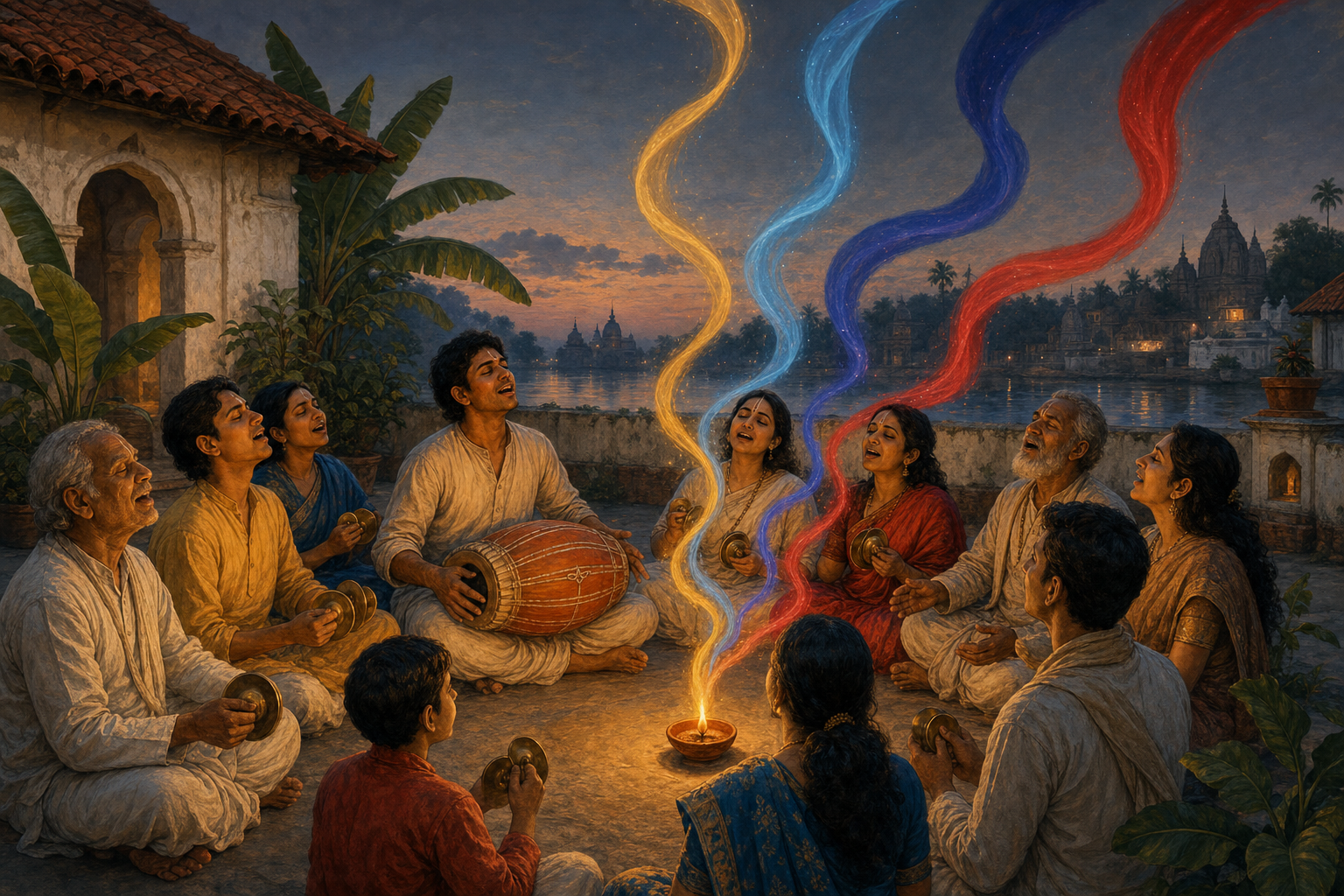
    This essay clarifies why “Shabad is the Essence of my Existence” by centering the living reality of Shabad Guru in Sikhi and explaining what truly lies “Beyond the Palki & Rumaalay.” It distinguishes reverential aesthetics from spiritual essence, showing how Palki, Rumaalay, and maryada honor the Guru while serving the primary aim of listening and…

  • How a Daily Yoga Routine Rewires the Brain, Calms the Nervous System, and Lifts Mood

    How a Daily Yoga Routine Rewires the Brain, Calms the Nervous System, and Lifts Mood

    Embedding yoga into a daily routine produces measurable benefits for mental health. Regular asana, pranayama, and dhyana raise endorphins and GABA, boost BDNF, and rebalance serotonin and dopamine. Consistent practice calms the HPA axis, lowers cortisol, improves vagal tone and HRV, and reduces inflammatory markers linked to low mood. Imaging studies show stronger prefrontal–amygdala control…

  • Panguni Uthiram’s Sacred Full Moon: Divine Marriages, Murugan Kalyanam, and Temple Traditions

    Panguni Uthiram’s Sacred Full Moon: Divine Marriages, Murugan Kalyanam, and Temple Traditions

    Panguni Uthiram, observed when Uthiram (Uttara Phalguni) Nakshatra coincides with the Pournami Full Moon in the Tamil month of Panguni, is a major festival celebrating divine marriages and the sanctity of household life. Rooted in Agamic and Puranic traditions, it highlights the kalyanam of Shiva–Parvati, Murugan–Deivayanai at Tirupparankundram, and the serthi of Sri Ranganathar with…

  • Karma in Hinduism: A Definitive, Practical Guide to Action, Consequence, and Liberation

    Karma in Hinduism: A Definitive, Practical Guide to Action, Consequence, and Liberation

    Karma in Hinduism is a precise ethical and philosophical system linking intention, action, and consequence within the larger pursuit of moksha. Drawing on the Bhagavad Gita, the Upanishads, and allied schools of Hindu philosophy, this long-form guide explains the threefold temporal model—sanchita, prarabdha, and agami—alongside the Gita’s categories of karma, akarma, and vikarma. It clarifies…

  • When Ancestors Hung by a Thread: Jaratkaru’s Vision and the Imperative of Lineage

    When Ancestors Hung by a Thread: Jaratkaru’s Vision and the Imperative of Lineage

    Sage Jaratkaru’s forest vision in the Mahabharata—ancestors hanging by a single kusa fiber—embodies the urgency of pitri-rna, the debt to one’s lineage. The narrative shows how disciplined renunciation can align with householder responsibility to sustain family, memory, and community. Through the birth of Astika and the halting of Janamejaya’s Sarpa Satra, it reveals dharma as…

  • Transformative Bhakti: Śrīmad-Bhāgavatam 3.32.22–36 Reveals a Clear Roadmap to Moksha

    Transformative Bhakti: Śrīmad-Bhāgavatam 3.32.22–36 Reveals a Clear Roadmap to Moksha

    This exploration of Śrīmad-Bhāgavatam 3.32.22–36 distills how faithful śravaṇa about Kṛṣṇa initiates and sustains bhakti-yoga as a clear pathway to moksha. It clarifies the Sāṅkhya distinction between the witnessing self and the body-mind, showing how devotion both utilizes and transcends analysis. Practical steps—daily hearing, kīrtana or japa, seva, sat-saṅga, and reflective svādhyāya—are presented alongside minimalist…

  • Success Sadhana 2026: Retrain the Mind for Lasting Happiness with Proven Dharmic Science

    Success Sadhana 2026: Retrain the Mind for Lasting Happiness with Proven Dharmic Science

    Many chase happiness outside and feel more empty over time. This article presents Success Sadhana—an integrative, dharmic, and science-informed method to retrain the mind for durable well-being. Drawing on Yoga, Buddhism, Jainism, and Sikhism, it unifies ethics, pranayama, mindfulness, and seva into a practical routine. Readers learn why hedonic chasing fails and how breath, attention,…

  • Why Lakshmi Is Worshipped with Ganesha: Timeless Wisdom for Ethical Wealth and Success

    Why Lakshmi Is Worshipped with Ganesha: Timeless Wisdom for Ethical Wealth and Success

    Why are Lakshmi and Ganesha worshipped together? This comprehensive exploration shows how the pairing harmonizes prosperity with wisdom, grounding artha in dharma. Drawing on the Sri Sukta, the Ganapati Atharvashirsha, and Puranic-smarta liturgy, it explains why Vinayaka Puja precedes Lakshmi Puja and how Panchopachara and Shodashopachara offerings encode this ethic. Iconography—from Gaja-Lakshmi to Ganesha’s mouse…

  • Mehandipur Balaji Temple’s Sacred Threshold: Why Devotees Don’t Look Back When Called

    Mehandipur Balaji Temple’s Sacred Threshold: Why Devotees Don’t Look Back When Called

    The Mehandipur Balaji Temple in Rajasthan is renowned as a living center of protection and ritual healing, where a distinctive exit norm—do not look back if someone calls—plays a crucial role in sealing vows and safeguarding attention. Framed as a threshold ethic, this guidance supports closure after darshan, reduces suggestibility in crowded spaces, and aligns…

  • Shattering the Illusion of Ego: How Pride Sabotages Liberation across Dharmic Traditions

    Shattering the Illusion of Ego: How Pride Sabotages Liberation across Dharmic Traditions

    Pride—whether named ahamkara, asmita, mana, or haumai—emerges as a shared obstacle to liberation across Hinduism, Buddhism, Jainism, and Sikhism. This essay synthesizes scriptural anchors from the Bhagavad Gita, Upanishads, and Yoga Sutra with parallel insights from Buddhist, Jain, and Sikh teachings to show how egoic inflation thrives on the illusion of separation. Readers will gain…

  • Astika Mantra from the Mahabharata: Powerful Snake-Bite Protection, Meaning, and Safe Use

    Astika Mantra from the Mahabharata: Powerful Snake-Bite Protection, Meaning, and Safe Use

    The Astika mantra, preserved in the Mahabharata’s Astika Parva, is a revered protective chant for snake-bite safety that appeals to remembrance, gratitude, and non-violence. By recalling Astika—born of Jaratkaru and Jaratkaru—who halted King Janamejaya’s sarpa-satra, the mantra respectfully addresses nāgas and requests non-injury. This guide presents the original Sanskrit, accurate transliteration, and a clear, line-by-line…

  • Craving the Crowd, Bearing Its Dust: Hindu-Dharmic Insights on Desire, Acceptance, Complaint

    Craving the Crowd, Bearing Its Dust: Hindu-Dharmic Insights on Desire, Acceptance, Complaint

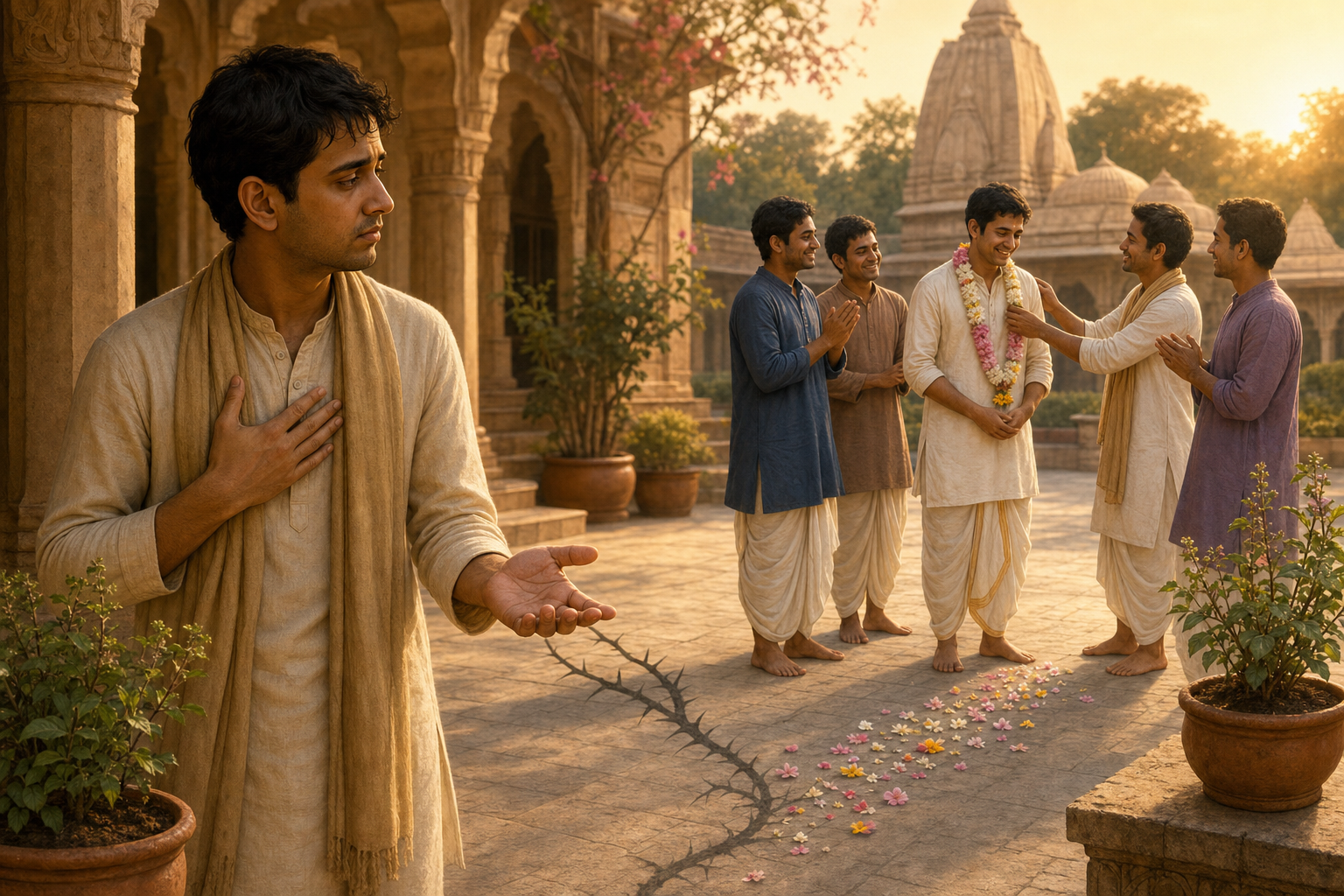
    This reflection unpacks the proverb “If you want to be part of the crowd, do not complain about its dirt” through a dharmic, multi-tradition lens. It explains why the human need for belonging carries ethical trade-offs and how Hindu, Buddhist, Jain, and Sikh teachings transform complaint into constructive participation. Drawing on the Bhagavad Gita, Patanjali’s…

  • Stop Performing, Start Choosing: Boundaries and Mindful Dating That Lead to Real Love

    Stop Performing, Start Choosing: Boundaries and Mindful Dating That Lead to Real Love

    This reflective case study follows a counselor who recognized that professional rapport-building skills, while powerful in service contexts, were undermining intimate discernment. By shifting from performance to principled boundaries, she replaced people-pleasing with values-based action, using journaling, mindfulness, and yoga to clarify non-negotiables. Direct, respectful screening questions and calendar-respecting norms transformed her process into intentional…

  • Divine Lawkeeper: How Dharma and Karma Make God the World’s Most Just Policeman

    Divine Lawkeeper: How Dharma and Karma Make God the World’s Most Just Policeman

    This essay presents a rigorous, accessible account of how Hindu philosophy understands God as the ideal lawkeeper through the integrated workings of dharma, karma, and ṛta. Readers learn how justice in Sanatana Dharma is primarily restorative and educational, privileging conscience, proportionality, and reform over retribution. The discussion bridges scripture (Bhagavad Gita, Dharmasastra, Arthasastra) with social…

  • Shweta Kali Unveiled: The White Radiance of Kali, Creation’s Source and Ash’s Return

    Shweta Kali Unveiled: The White Radiance of Kali, Creation’s Source and Ash’s Return

    Shweta Kali, the white, luminous manifestation of Kālī, embodies both creation’s dawning radiance and the serene return of all forms to ash. Rooted in Shakta Tantra and cherished in Bengal and Nepal, this form unites sattvic clarity with Kālī’s timeless power, offering a sophisticated theology of origin, transformation, and dissolution. The essay surveys iconography, mantric…

  • Affirmation, Repetition, and Social Contagion: A Dharmic Roadmap from Greed to Renewal

    Affirmation, Repetition, and Social Contagion: A Dharmic Roadmap from Greed to Renewal

    This essay reframes today’s overlapping crises—conflict, displacement, disasters, and economic strain—through the lens of affirmation, repetition, and social contagion. It explains how these mechanisms have normalized material excess and how, redirected by dharmic wisdom, they can catalyze renewal. Readers gain a clear framework linking behavioral science with the shared ethics of Hinduism, Buddhism, Jainism, and…

  • Kalidasa’s Kumārasambhava: Epic Elegance of Śiva–Pārvatī and Skanda’s Sacred Birth

    Kalidasa’s Kumārasambhava: Epic Elegance of Śiva–Pārvatī and Skanda’s Sacred Birth

    Kumārasambhava by Kālidāsa is a classical Sanskrit mahākāvya that fuses exquisite poetics with profound spiritual philosophy. Through the sacred union of Śiva and Pārvatī and the birth of Skanda (Kārtikeya), the poem dramatizes how tapas, love, and dharma restore cosmic balance. Readers gain a structured overview of the cantos, an introduction to key aesthetic concepts…

  • Bhramari Devi’s Storm of Bees: The Goddess Who Shattered the Demon Aruna’s Boon

    Bhramari Devi’s Storm of Bees: The Goddess Who Shattered the Demon Aruna’s Boon

    Bhramari Devi—hailed as the Bee Goddess—embodies a dharmic strategy where collective intelligence overcomes seemingly invincible tyranny. Drawing on Shakta traditions and Purana-based retellings, the tale of Aruna (often Arunasura) shows how the Goddess honors the letter of a boon while revealing its limits through a six‑legged, many‑voiced response. The myth’s iconography and ritual practices—fragrant flowers,…

  • Lotus in Hand vs. Lotus Throne: Revealing Sacred Power and Meaning in Hindu Sculptures

    Lotus in Hand vs. Lotus Throne: Revealing Sacred Power and Meaning in Hindu Sculptures

    The lotus in Hindu iconography carries two distinct messages: as a throne it signifies transcendence and cosmic sovereignty, while in the hand it becomes an active emblem of purity, abundance, and compassion. This guide decodes how pedestal, posture, color, and the lotus-as-attribute work together to form a visual grammar in sculptures of Lakshmi, Saraswati, Brahma,…

  • Kapalini: Shakti’s Terrifying Grace and the Awe-Filled Storm that Seeds Creation Cycles

    Kapalini: Shakti’s Terrifying Grace and the Awe-Filled Storm that Seeds Creation Cycles

    Kapalini, the skull-bearing form of Goddess Shakti, stands at the threshold where dissolution gives birth to creation. Set against the awe-filled storm of pralaya, Kapalini carries the Brahma-substance—the causal seed from which new worlds emerge—offering a precise map of Hindu cosmology. The narrative clarifies the five cosmic acts, types of pralaya, and the role of…